
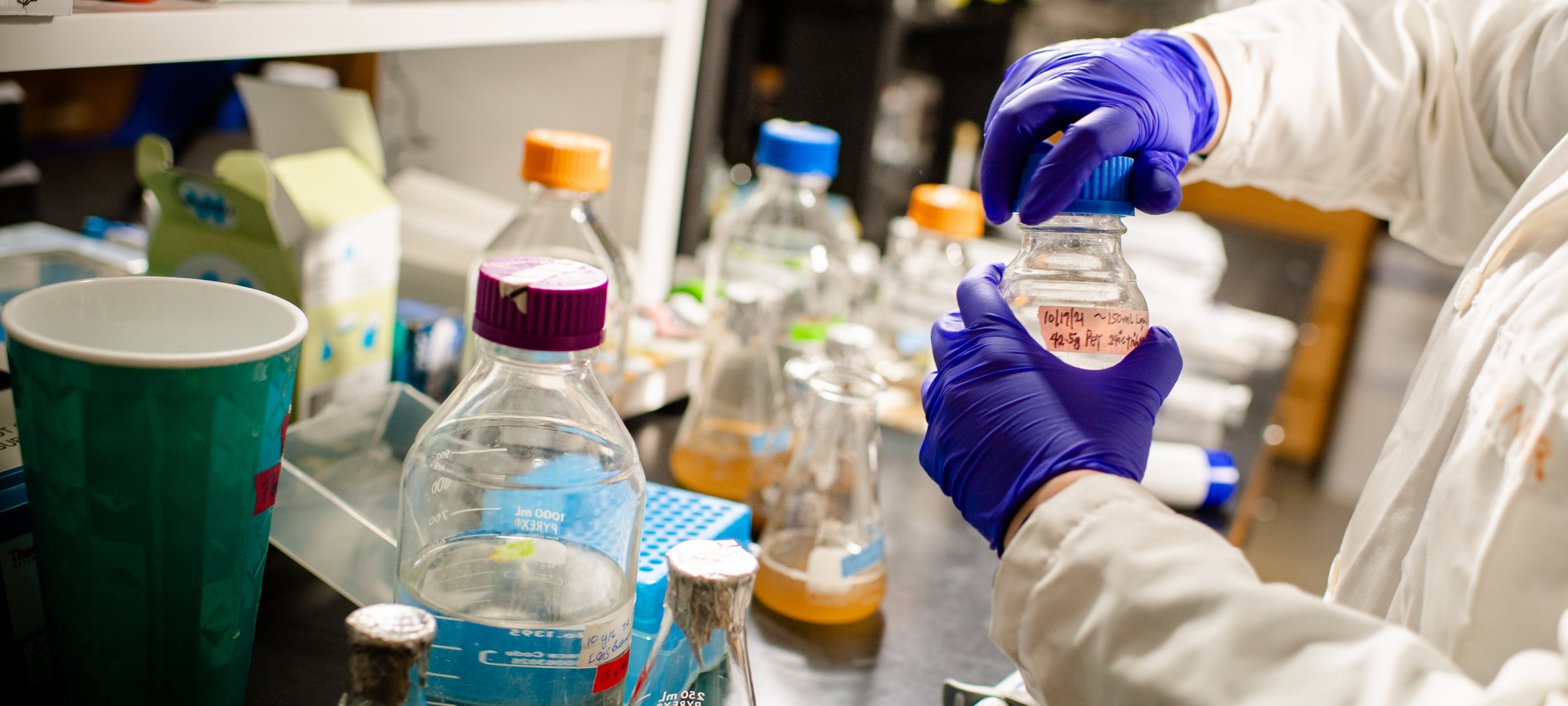
There has never been a more exciting time to become a biologist. The graduate masters and doctoral program in biological sciences at Michigan Tech frequently draws upon additional expertise in the areas of forestry, chemistry, mathematical sciences, mechanical engineering, and civil, environmental, and geospatial engineering—making for a stimulating, interdisciplinary, and intellectual atmosphere for career development. Throughout the program, students will hone their research skills, write a thesis, and complete additional coursework. PhD students will develop an original research question, execute research, write a thesis, and take both written and oral examinations to demonstrate competency in the discipline.
Focus Option
MS Focus in Medical Laboratory Management
Students may elect to focus their MS studies in medical laboratory management (MLM). The focus option consists of approximately one-half science courses and one-half business courses—integrating both theoretical and practical aspects of laboratory sciences with management theory. The program is flexible and suitable for both the experienced medical laboratory scientist and the recent graduate. It not only provides knowledge and expertise in MLM, but also challenges the student to learn more about rapid developments in immunology, microbiology, and biochemistry.
This non-thesis option within the MS degree allows for completion of the Biological Sciences MS degree within a relatively short period of time. Past candidate projects have included studies using computer analysis of cost accounting to study MLM, computer models for productivity analysis, and writing and assembling laboratory manuals. Applicants must have MLS(ASCP) certification.
Courses
Find all information regarding coursework, degree requirements, supplementary coursework options, annual student evaluations, and more in theBiological Sciences graduate handbook. All grades must be a B or better in the major subject areas and GPA of 3.0. If your GPA falls below a 3.0 then you are automatically on probation.
All graduate program options in Biological Sciences require 2 credits of graduate seminar (BL5012). In order to complete Responsible Conduct of Research (RCR) training, all graduate students must take The Scientific Profession (BL5025) as well.
Degree Options
The MS thesis option requires a minimum of 20 credits of coursework, and the report option requires a minimum 24 credits of coursework. Both options have a minimum of 12 credits of 5000 level or above and a maximum of 12 credits at the 3000-4000 level.
- The MS coursework option requires 30 credits of coursework. Students in this option must take Scientific Writing and Publishing (BL5051) as part of their coursework. A minimum of 18 credits of 5000 level or above and a maximum of 12 credits at the 3000-4000 level.
- The PhD requires 30 credits beyond the MS. If MS is ‘skipped’ then 60 credits total are required and they need to fulfill the MS requirements of 12 credits of 5000 or above and a maximum of 12 credits at the 3000-4000 level.
- For additional University minimum requirements for a course to accepted at the graduate level see Degree Requirements for the Graduate School.
Additional Opportunities
Faculty, scientists, and graduate students of various departments, areas, and research institutes maintain close working ties for interdisciplinary study and research. Some opportunities include work with:
- several campus research groups, which study environmental microbiology for bioremediation and other applications;
- the Aquatic Ecology Research Group, which includes the Fish Ecology Group and the Remote Sensing and Ecosystem Science Institute;
- the Lake Superior Ecosystems Research Center (LaSER), which studies basic ecosystem processes within the aquatic and terrestrial portions of the Lake Superior watershed;
- the Phototechnology Research Center, which focuses on biotechnology, physiology, pathology, and biochemistry of plants, using traditional approaches—as well as the latest advances in genetic engineering and molecular microanalysis;
- the Environmental Engineering Center, which studies groundwater, soil and sediment systems, air emissions, pollution control, and waste treatment; and
- the Diesel Research Group studies diesel emissions, including the effects of emission-control devices and the use of alternate fuels.
Areas of Research Excellence
Biological Sciences has a number of areas of research excellence including health, ecology and environmental sciences, and biochemistry and molecular biology.
Biological Sciences Accelerated MS
An Opportunity to Earn Both a Bachelor’s and a Master’s Degree in Five Years
This accelerated MS program prepares highly motivated students for a variety of careers in biology that require advanced training beyond the bachelor’s degree, such as in industry, teaching, independent research, or continued graduate work. You will earn both a Bachelor of Science and a Master of Science in Biological Sciences in just five years of full-time study.
This accelerated degree plan allows you to combine the master’s degree with a bachelor’s degree from Michigan Tech in biology, biochemistry and molecular biology, medical laboratory science, or computational biology.
Requirements
- Undergraduate students must apply for admission (during the first semester of their senior year) through the standard Graduate School application process and be accepted to the Biological Sciences Accelerated Master’s program prior to their bachelor's degree being awarded. However, students need to begin discussions with Biological Sciences faculty during their junior year (or at most the first semester, senior year) to ensure they are enrolled in the correct courses especially courses (6 credits from BL3000 - BL4000 level courses plus 6 credits from BL5000 - BL6000 level courses; senior rule ) that they can double-count towards accelerated masters.
- Only students who will complete both a Bachelor’s and a Master’s degree at Michigan Tech are eligible to enroll in the accelerated program.
- Students already enrolled in a graduate program may not retroactively enroll in the accelerated master’s program.
- Accelerated Admissions Requirements are detailed below.
Credits
- Students must earn 30 credits past the Bachelor of Science in Biological Sciences to complete the requirements for the Master of Science in Biological Sciences.
- Up to six credits taken as an undergraduate student can be applied toward both the BS and MS degrees, as long as they are at the 3000 - 5000 level and satisfy the requirements for both degrees.
- These six credits would typically be earned through electives and are independent of a maximum of six Senior Rule credits that may additionally count toward the MS, thus a total of 12 credits earned while an undergraduate could be applied toward the Master’s degree. Graduate School rules on course requirements for master’s degree will apply.
- A maximum of 12 credits are taken at the 3000 level or 4000 level.
- A minimum of 12 credits are taken at the 5000 level. 5000 or 6000 courses from other Michigan Tech departments and areas can be taken with approval from the advisor.
- Courses with grades less than a B (3.0) will not be counted.
- All accelerated MS students must enroll in Graduate Seminar (BL5012; once for a total of 1 credit while in the program). All students must also take BL5025. In addition to these courses, the faculty advisor will designate courses (worth at least 21 credits for MS report and at least 17 credits for MS thesis), to be taken, that are relevant to the student’s interest or research area.
GPA
- Only students with a cumulative GPA of 3.0 or above are eligible to enter the accelerated master’s program.
- Students who are accepted in the accelerated master’s program will not be allowed to continue in this program if their cumulative undergraduate GPA drops below 3.0. However, such a student will be eligible to apply through the non-accelerated master’s degree option.