
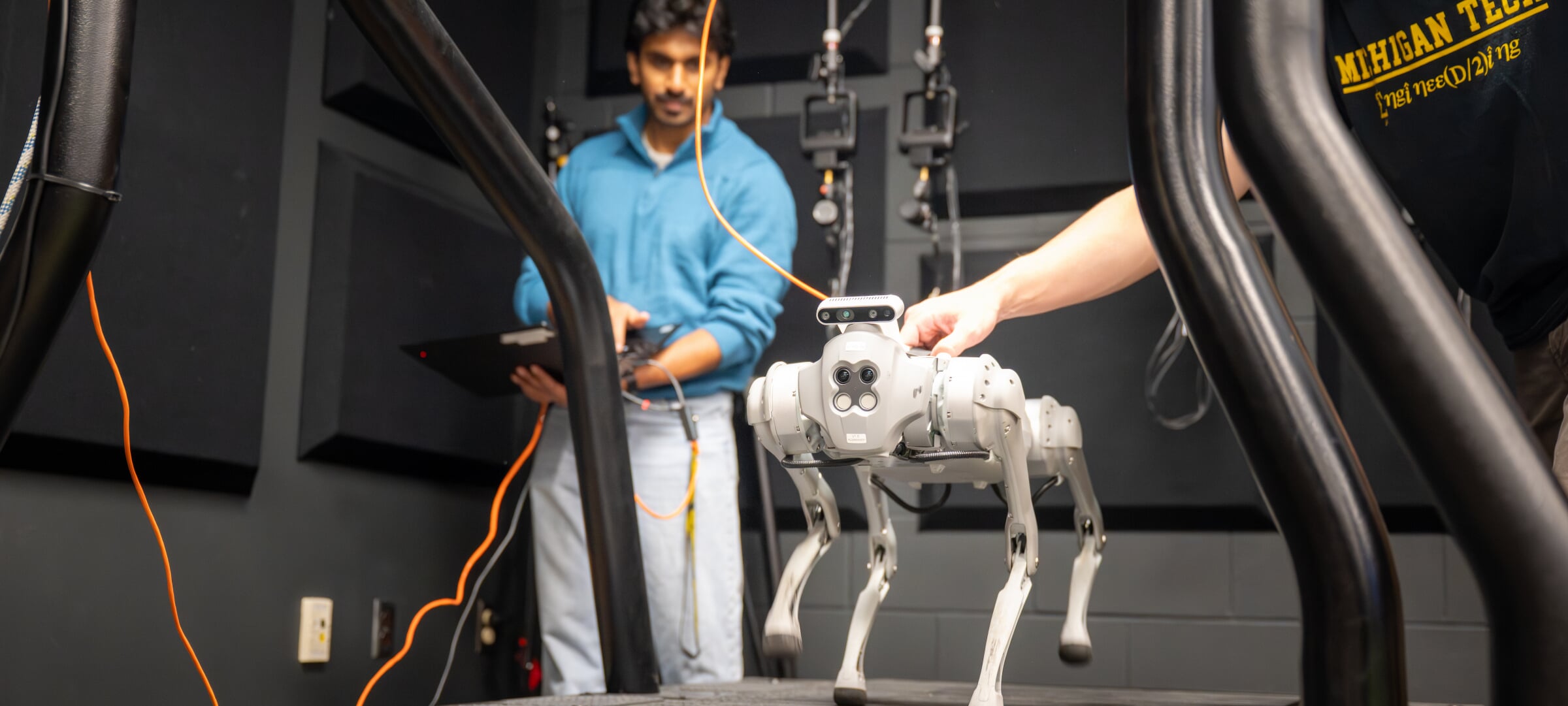
Robots are transforming how we manufacture products, transport goods, perform medical procedures, and operate in challenging environments. But making a robot sense its surroundings, make decisions, and act requires the integration of multiple technologies. Michigan Tech’s MS in Robotics Engineering brings mechanical engineering, electronics, computing, and control systems together to advance your understanding of intelligent robotic systems.
The Accelerated Master's Program is available for current Michigan Tech students.
Who Is This Program For?
The master's degree in robotics engineering is a good fit for those seeking to understand robots as integrated systems rather than isolated components. It may suit those who want to study sensing, actuation, and control in robotic systems; examine autonomy and coordinated system behavior; or connect computing, mechanical design, and electronics in robotics research.
What You'll Study
This comprehensive program offers a thorough examination of not just robotics, but also related disciplines: electrical and computer engineering, mechanical engineering, computer science, data science, and electrical and mechanical engineering technology. Investigate how sensing, control, computation, and mechanical design come together in systems that perceive their environments and act on information. Learn to design, develop, and deploy automated systems across diverse sectors, including manufacturing, healthcare, autonomous vehicles, agriculture, logistics, aerospace, and service industries.
Where You'll Apply Your Knowledge and Skills
Robotics is transforming how industries manufacture products, move goods, deliver services, and operate in challenging environments. Apply your expertise to designing autonomous systems, integrating sensors and control technologies, developing robotic motion and navigation capabilities, or testing how robots respond to their surroundings. Support innovation in manufacturing automation, autonomous vehicles, logistics, agriculture, healthcare technologies, and aerospace.
Depending on your specialization and experience, you could pursue careers as a robotics engineer, automation engineer, controls engineer, autonomous systems engineer, robotics software engineer, or research and development engineer.
-
Delivery Options
- Accelerated: MS
- On-Campus: MS
Robotics Engineering Program Details
Choose a specific degree option or delivery type to learn more about the robotics engineering program at Michigan Tech. For international students, Robotics Engineering is a designated STEM program.
On-Campus Programs
Additional Program Information
Want to learn more about robotics engineering at Michigan Tech? Visit the department for more information:
Robotics vs Mechatronics
Michigan Tech is proud to offer a master's program in mechatronics as well as in robotics engineering. The two curriculae offer different focuses on the area of mechanics and robotics:
- Robotics Engineering centers autonomous systems that may implement dynamic and adaptive learning. It dives deeper into underlying mathematics and advanced algorithms, with a focus on theoretical and Research and Development applications. Interdisciplinary overlap includes electrical, mechanical, and computer engineering.
- Mechatronics offers more attention to hands-on and applied uses for systems in industrial and manufacturing settings. Build pre-programmed tasks that systems will automatically execute. Learning focuses on practical implementation and maintenance. This program incorporates applied computing principles.
Sample Areas of Interest
Select areas of interest to help customize your Robotics Engineering MS. Sample areas include:
- Artificial Intelligence
- Autonomous Systems
- Controls
- Medical Robotics
- Robotic Vision Systems