
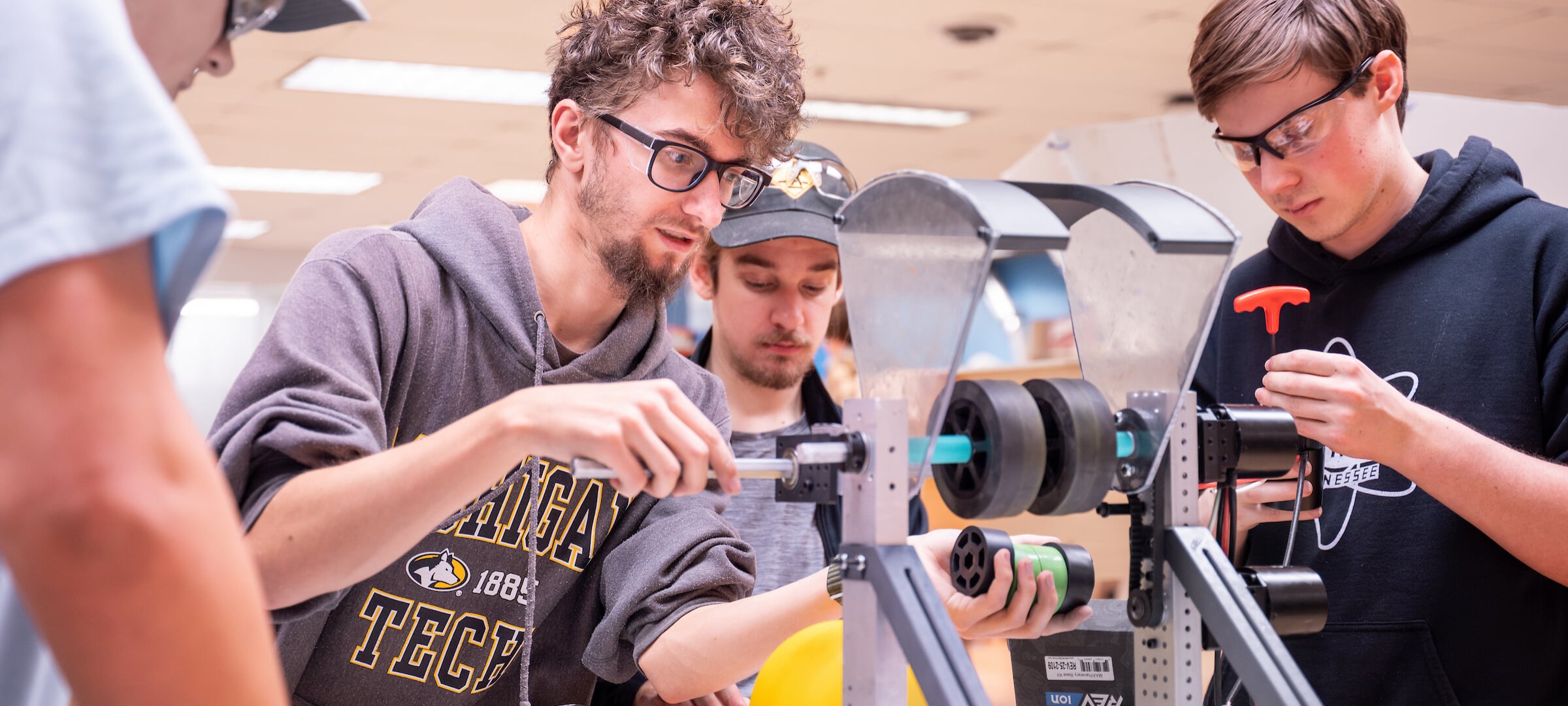

Bring your engineering and computing skills to life by stepping into the future of innovation with a minor in robotics at Michigan Tech.
This minor equips students across STEM disciplines with the ability to design, build, and program intelligent systems by integrating mechanical, electrical, and computing foundations. Whether you’re interested in automation, artificial intelligence, or advanced system design, you’ll gain hands-on experience working on interdisciplinary projects that mirror real-world robotics teams. You’ll also explore how human factors, ethics, and societal impact shape the technologies we create, preparing you to lead and collaborate in one of the fastest-growing fields in the world.
How to Enroll in a Minor
To pursue a minor, you must first be enrolled in a bachelor's degree program and submit a request to add a minor to your curriculum through the curriculum change portlet in Experience (view the My Undergraduate Degree card and select Change/Add/Drop a Major/Minor/Concentration). The minor advisor will receive notification and contact you with any questions before reviewing and approving your request. We recommend that you begin your minor studies as early as possible in your academic career. This minor will take at least four semesters to complete.
- Download the robotics minor audit for complete information.
- Please note that the minor in robotics is not open to BS in Robotics Engineering nor BS in Mechatronics majors.
Program code: IRBM; Academic year: 2026-2027
Minimum credits required: 27
1. Fundamental Courses
(18 credits, minimum)
Select at least one ccourse from each list (A-D).
- Minimum 6 credits in ME/MET
- Minimum 6 credits in EE/EET
- Minimum 6 credits in CS/DATA/SAT
A. Fundamentals of Mechanical Engineering or Mechanical Engineering Technology
- ME 2110 Statics (3) Prereqs: MA2160
- or MET 2110 Applied Statics (3) Prereqs: PH1110 or PH1140 or PH2100) and (MA1160(C) or MA1161(C) or MA1121(C))
- ME 2150 Mechanics of Materials (3) Prereqs: ME/MEEM 2110
- or MET 2150 Applied Strength of Materials (4) Prereqs: ME/MEEM 2110 or MET2110
- ME 2700 Dynamics (3) Prereqs: PH2100 and (ME/MEEM 2110 or ENG2120)
- or MET 2130 Applied Dynamics (4) Prereqs: MA2160 and (ENG2120 or ME/MEEM 2110 or MET2110)
B. Fundamentals of Electrical Engineering or Electrical Engineering Technology
- EE 2112 Electric Circuits and Lab (4) Prereqs: MA3520(C) or MA3521(C) or MA3530(C) or MA3560(C)
- or EE 3010 Circuits and Instrumentation for Cyber Physical Systems (3) Prereqs: MA1121 or MA1160 or MA1161
- or EET 1121 & 1122 Circuits I and Lab (4) Prereqs: MA1031 or MA1032 or MA1120 or MA1121 or MA1135(C) or MA1160(C) or MA1161(C)
- or EET 1411 Basic Electronics (3) Prereqs: MA1031 or MA1032 or MA1120 or MA1121(C) or MA1135(C) or MA1160(C) or MA1161(C)
- EE 2174 Digital Logic and Lab (4) Prereqs: CS1111 or CS1121 or CS1131
- or EET 2411 Digital Electronics (3) Prereqs: (EET1121 or EET1411) and (MA1031(C) or MA1032(C) or MA1120(C) or MA1121(C) or MA1135(C) or MA1160(C) or MA1161(C))
- EE 3131 Electronics (4) Prereqs: EE2112 or EE3010
- or EET 3131 Sensors and Instrumentation (3) Prereqs: EET1411 or EET2121 or PH2230 or EE2111 or EE3010
- or EET 2121 & 2122 Circuits II and Lab (4) Prereqs: (EET1121 and EET1122) and (MA1160 or MA1161)
C. Fundamentals of Computer Science or Information Technology
If chosen, you may take (CS 1131 or (CS 1121 and/or CS 1122))
- CS 1121 Introduction to Programming I (3) Prereqs: MA1031(C) or MA1032(C) or MA1120(C)
- CS 1122 Introduction to Programming II (3) Prereqs: CS1121
- CS 1131 Accelerated Introduction to Programming (5) Prereqs: MA1031(C) or MA1032(C) MA1120(C) or MA1160(C) or MA1161(C) or MA1121(C)
- CS 1142 Programming at the Hardware Software Interface (3) Prereqs: CS1122 or CS1131
- DATA 1200 Data Science with Python (3) Prereqs: MA1030(C) or MA1031(C) or MA1032(C) or MA1160(C) or MA1161(C)
- SAT 1610 Computer and Operating Systems Architecture (3) Prereqs: None
- SAT 2711 Linux Fundamentals (3) Prereqs: CS1121 or CS1131 or CS1142 or MIS2100
D. Advanced Practice
- EE 3261 Control Systems (3) Prereqs: EE3160
- or EET 4311 Control Systems (3) Prereqs: MET2130 and EET2150
- or ME 4775 Analysis & Design of Feedback Control Systems (4) Prereqs: ME/MEEM 3750 or EE3160
- SAT 3310 Scripting for Administration, Automation, and Security (3) Prereqs: CS1111 or CS1121 or CS1131 or CS1142 or MIS2100
2. Technical Integration Courses in Robotics
(6 credits, minimum)
- CS 3461 Introduction to Robotics (3) Prereqs: CS3421 or EE3172
- CS 4761 Human-Robot Interaction (3)
- EE 2180 Introduction to Robotics and Lab (3) Prereqs: (EE3010(C) or EE2112(C)) and (MA2320(C) or MA2321(C) or MA2330(C))
- EE 3280 Robot Operating Systems (3) Prereqs: EE2180 and SAT2711
- EET 3144 Introduction to Industrial Robotics (3) Prereqs: None
- EET 4144 Real-Time Robotic Systems (4) Prereqs: EET1411 or EET2121 or PH2230 or EE2111 or EE3010
- EET 4707 Autonomous Systems (3) Prereqs: (EET4311 or EET5311 or MET4801 or MET5801) and (CS1111 or CS1121 or
CS1131 or SAT4310 or SAT4650)
- or ME 4707 Autonomous Systems (3) Prereqs: ME/MEEM3750 or ME/MEEM4775(C) or EE3160
- ME 4705 Robotics and Mechatronics (4) Prereqs: ME/MEEM3750 or EE3160
- MET 4355 Industrial Digital Twin Systems (3) Prereqs: None
- MET 4800 Dynamics and Kinematics of Robotics Platforms (3) Prereqs: MET2130 or MET3130
- Senior Design or Enterprise (3 credits maximum. Instructor must certify significant robotics or mechatronics content.)
3. Human Systems Integration
(3 credits)
- HF 2000 Introduction to Engineering Psychology (3) Prereqs: None
- HF 2300 Introduction to Human-Centered Design (3) Prereqs: None
- HF 3850 Human Factors (3) Prereqs: (PSY2000 or HF2000) and UN1015
- HU 3701 Philosophy of Technology (3) Prereqs: UN1015
- HU 3704 Ethics of Artificial Intelligence (3) Prereqs: None
- HU 3710 Engineering Ethics (3) Prereqs: UN1015
- HU 3845 Human-Machine Communication (3) Prereqs: UN1015
- HU 3850 Automated Culture: Critical Approaches to AI (3) Prereqs: UN1015
- SS 3801 Science, Technology, & Society (3) Prereqs: None