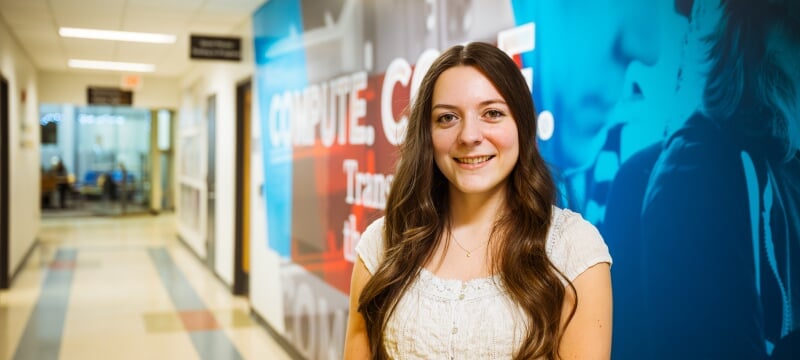
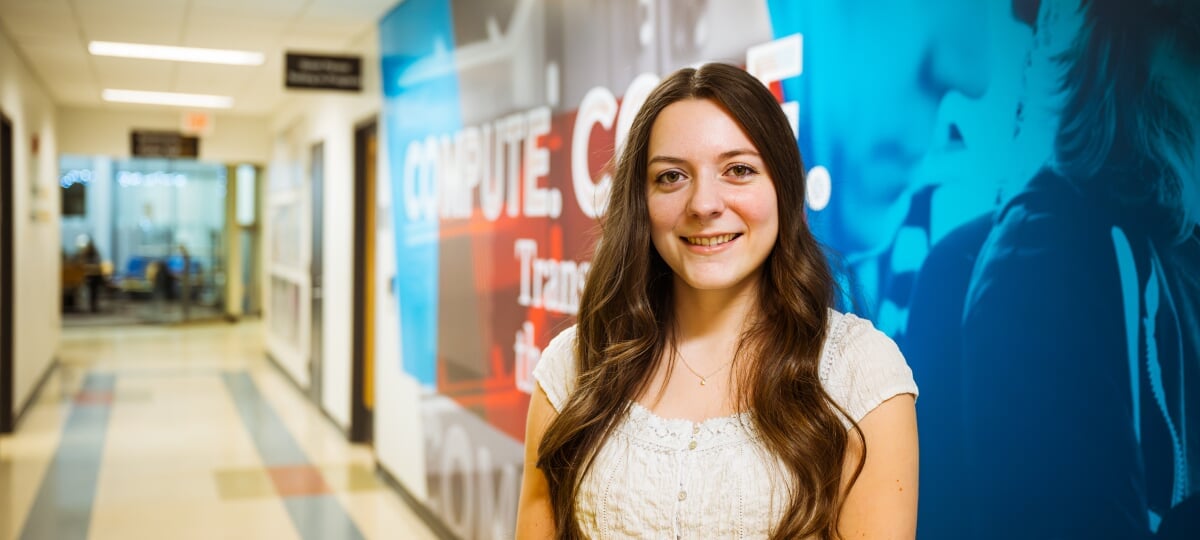
Computer science student Ashley Baird is the kind of person who thrives on completing what she starts. Baird's drive to see things through resulted in a successful machine learning project for the U.S. Department of Defense and an internship at Nissan working on the team that developed an industry-first personalized sound app.
When she crosses the stage at Michigan Technological University's 2026 Spring Commencement, the satisfaction of hitting that major milestone will be the culmination of several achievements checked off her personal Husky bucket list.
Baird, a computer science major in Michigan Tech's College of Computing, always knew she wanted to go into the field. Computer science runs in the family. Her dad owns a software company. Baird's older brother also earned his degree in computer science.
"I've always been around this career," Baird said. "I'd go to my dad's work from the time I was in elementary school and visit. And I was always into video games, which I'm not sure how they correlate, but I feel like a lot of people who like gaming go into computer science."
Baird, who grew up in Commerce Township, about 30 miles west of Detroit, also took advanced placement computer science courses in high school. "All of those factors aligned," she said.
While her career field felt predestined, Baird found Michigan Tech on her own. "It's actually kind of a funny story," she said. "It was Spirit Week at my high school and everyone was supposed to wear something showing the college they were going to. I didn't know what college I was going to go to yet. But there was a group of really smart people all wearing Michigan Tech hats. That's what really put Tech on my radar. And then I came up here and toured. It was mid-April. And there was a blizzard going on!"
Baird knows there's no guarantee that this April's weather will be any kinder than it was during her first visit. But she has her fingers crossed that MTU's Undergraduate Spring Commencement, which takes place Saturday, April 25, will contain a few elements of actual spring.
"My whole family's coming up for graduation, and some of them have never been here before. I'm hoping to show them waterfalls, not frozen water," she said.
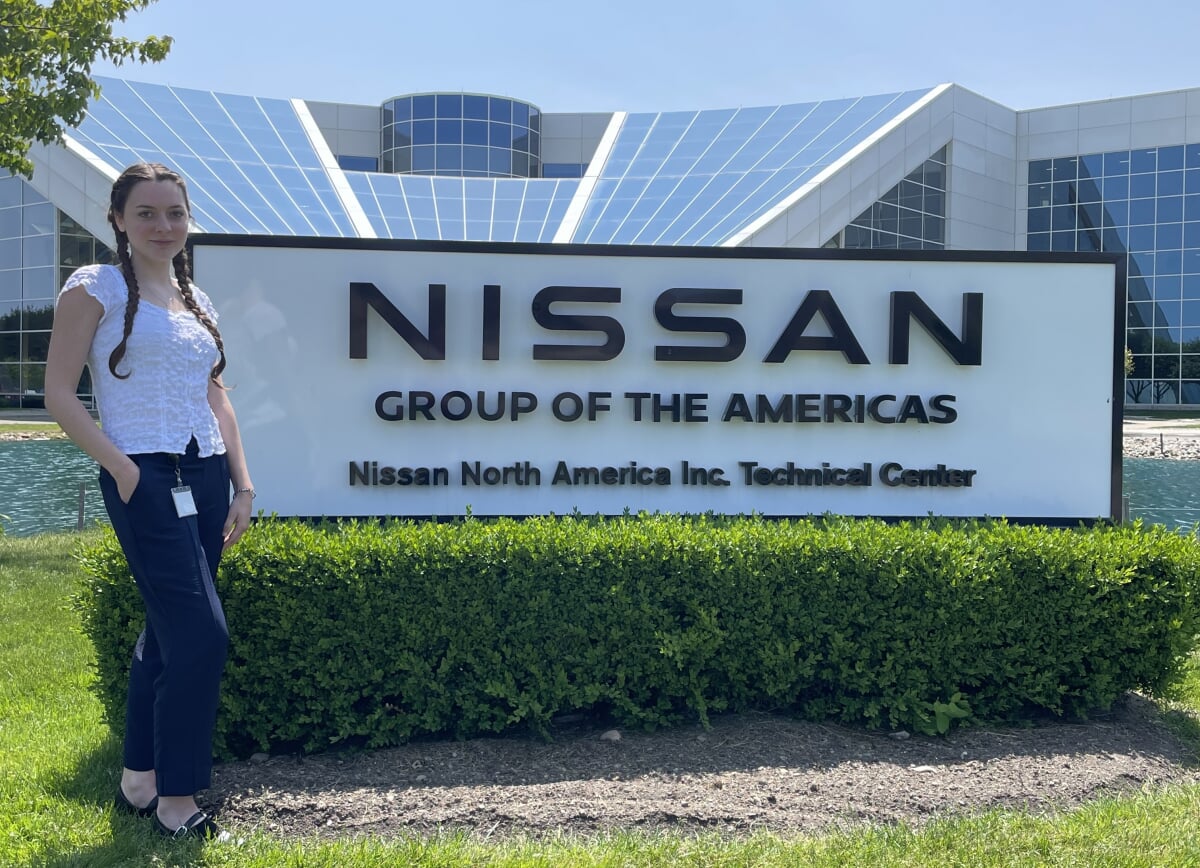
Learning to navigate the Keweenaw's challenging winter weather is one of several skills that Baird will take with her post-graduation. But one of her biggest learning adventures actually happened last summer, when she landed an internship at Nissan North America.
Part of the Nissan Team Creating a New Audio Experience
Nissan is one of hundreds of companies that attend Michigan Tech's biannual Career Fair, but Baird found her opportunity to connect with the company through a listing on the social media platform LinkedIn. She'd already completed two internships as a software engineer at DocTract in Novi, Michigan. Full disclaimer: That's her dad's company. That made the environment familiar. But it didn't mean the job was easy. To the contrary, said Baird.
"I was so busy there! My dad knows me so well that he gave me opportunities to do things that interns typically wouldn't go near tech-wise," Baird said. "So it was a really amazing experience, two summers in a row."
Baird wanted to switch it up for her third internship and experience the working environment in a large corporation. She successfully made it through multiple interview rounds. Later, her supervisor would tell her that her experience as a College of Computing Learning Center coach made a big impression.
Baird started coaching her peers at the learning center before she felt 100% ready to take it on.
"By my second year at Tech when I started being a coach, I could do programming, but I wasn't really confident in myself. Everyone says that if you're able to teach someone something, that means you really know it," she said. "Working with students, teaching them to find the bugs in their code, it really helped me be more confident in myself and my ability to help people. My boss at Nissan told me during our final review at the end of my internship that one of the reasons he really wanted to hire me was because I had tutored. Tutors show that they're self-starters capable of adapting to new things, know their stuff and are willing to put it out there."
At Nissan, Baird was placed on a team with one other intern who, as it turned out, was unable to accept the position.
"I ended up being the only intern on the team. Which actually worked out in my favor because I got a lot of focus from my teammates. I was included in a lot of things that they were doing there. It was really awesome. I loved my team. I loved how they included me," said Baird. "It was all thanks to my boss. He gave me more than the opportunity. He gave me so much credit, even to the higher-up people in the company. He was an amazing boss."
True to form, when she was given her choice of four types of projects, Baird passed up the three that were midway in development. She wanted in on the ground floor of PSP, the team's acronym for personalized sound profiles.
"I just really wanted to make my project something that I started myself," Baird said. "It was the only one that no one had touched yet because for one thing, it was a little intimidating. As a programmer you can code websites, you can code simple things, but this was controlling the sound in a car. You know, it's still programming, but it's a whole different area that you typically never touch."
The goal was to develop a way for Nissan and Infiniti vehicle owners to tailor their sound systems to their individual hearing abilities through a personalized sound app. The intent was to create a richer audio experience for everyone, including stereophiles and people who have experienced hearing loss.
Baird's duties included writing code for the initial hearing test that owners take in their car to get a baseline. She also worked on the functionality of the 10-band equalizer and the profile-saving system.
"I just dove into it," she said. "Oh gosh, it was a lot of work, figuring out how to control it."
Baird explained that in the automotive industry, a lot of cars use Google sound systems, which operate based on programming inside the in-vehicle infotainment (IVI) touchscreen. She had to find out how to integrate the PSP app into the sound system — and she needed to do it without original equipment manufacturer (OEM) privileges.
"Even though I was working as a Nissan intern, I didn't have special OEM privileges to the car. So it was really difficult finding a way to integrate with the sound system while also not breaking any other part of the sound system. And also to do it in a way that's permissible by Google because it's a third-party Google Play app," said Baird. "Even though it was published by Nissan, it has as many permissions as any other third-party app."
"My internship at Nissan definitely taught me that when you're approaching a project, you can't just have one plan for it. Even as you're pursuing that first plan, you have to be thinking of backup plans, because you never know if the first way is gonna work out or not."
The app became downloadable in the Google Play Store in late 2025. Baird is still wrapping her head around how the work she did with the team manifested in such a rapid, tangible, widespread way.
"It's honestly crazy! I was working on it with the mindset that it was a real project that was going to eventually get developed even if I didn't work on it. But it's just awesome to know that it's out there," she said. "Like, I made that!"
In addition to the personalized sound project, Baird also learned about company culture in a large organization, some of which she finds translatable to a smaller company, like DocTract, which has less than 20 employees and is where Baird will begin her career.
"What I really liked that we did at Nissan is a stand-up every day with my team, where we would all meet up and give progress updates," she said. "Some people might think that sounds like busy work. But it helped me progress so much during the summer. It's the accountability, but it's also that when I'm having an issue, I can talk about it to my team and they can give me suggestions of what to try out. It also helped me look forward to the next day because I'd make another achievement and I'd be like, 'Oh, I can't wait to share this story!'"
Baird said the daily stand-up is one of several practices she picked up that she's looking to adapt to her own workplace. She'll also apply lessons learned in Michigan Tech's student-driven Enterprise Program.
An Astronaut-led Enterprise Project
Like many Huskies, Baird joined Enterprise as a way to work in teams with clients across industries — including automotive, aerospace, cybersecurity, health tech, naval systems and robotics. As Enterprise team members, students help identify needs and innovate parts, products and services that answer them.
Baird chose the Humane Interface Design Enterprise (HIDE) team, which focuses on software application development and research. She first worked on two ongoing projects that felt a bit open-ended for her completist nature. But the third project ticked off all the boxes.
For that project, Baird's team got to partner with retired Navy SEAL, Navy captain, NASA astronaut and International Space Station Commander William M. Shepherd through the Systems Engineering Research Center, known as SERC — a university-affiliated research center sponsored by the U.S. Department of Defense (DoD). As the leader of SERC's Capstone Marketplace, Shepherd worked with student teams across the nation to design and build solutions for government customers.
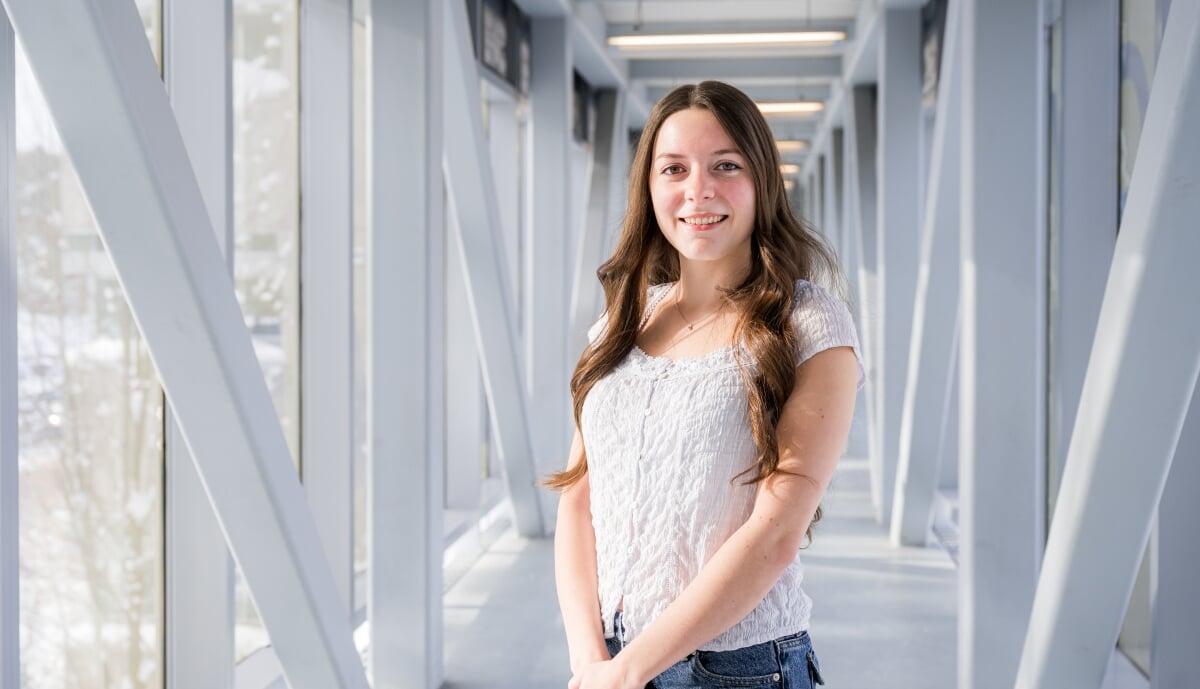
For two semesters, Baird was HIDE's team lead on the SERC-sponsored machine learning project, which centered on creating a threat-detection model able to pinpoint suspicious activity in confusing video backgrounds. The goal was to use artificial intelligence (AI) to both supplement and decrease the need for human surveillance in detecting fire, guns, knives and people, both sending and logging alerts.
"You don't really think about how much work goes into being the team lead until everyone's looking to you to tell them what to do. That's what they want you to do," said Baird. "My first approach, because this machine learning project was new to me, was, 'Let's all work together and figure this out.' But the team needed a leader."
Baird talked the situation over with her dad during Thanksgiving break. She felt at a loss, like the team wasn't making a lot of progress. Being knowledgeable in that industry space, he suggested some technology that might be helpful. Baird came back with the tech and revamped the team. She created three separate groups, assigning each of them tasks aimed at a particular aspect of creating the machine learning model.
One of the duties she most enjoyed was reporting to Shepherd, even though it was daunting.
"He actually came to campus to do some talks about his experiences as an astronaut. It was a little bit intimidating talking to him because he's got a lot of accolades behind him, but he was really nice," said Baird. The team learned about stringent DoD security protocols; Baird took on the considerable paperwork requirements herself. The team brought the project in on time.
"We met with him, and he also brought some of his co-workers," said Baird. "They were really impressed by what we made."
So was the audience at Michigan Tech's 2025 Design Expo. The project earned the event's Audience Choice Award.
Not surprisingly, turning in an on-time award-winning project felt like a good place to stop. Baird wrapped up her Enterprise involvement last semester.
Enterprise was Baird's favorite academic research experience at Michigan Tech.
"A lot of schools don't have programs like this," she said. "Being able to put it on my resume helped me with my internship — and I really enjoyed the project we made. The model was a different type of AI, and it was eye-opening to participate in creating that. Without the Enterprise Program, I probably wouldn't have had the funds or the tools to be able to work on something like that."
Baird said her second cousin is graduating high school and looking at opportunities at Tech. She encouraged him to join an Enterprise team as soon as possible.
Graduating Husky Shares More Favorite MTU Experiences
As she looks back on her academic coursework, Baird doesn't regard her studies in computer science as a hardship that she conquered. Like many students who come to Michigan Tech for the rigorous curriculum, she found joy in learning.
"I love that with the College of Computing my very first semester, I was already taking CS classes."
"There's definitely been difficult moments, but I have a lot of friends who are mechanical engineers, and to me, what they're doing looks very difficult, too," she said. "Part of it is, I'm just really passionate about programming in general. So, even if it's difficult, it doesn't feel like some random homework that I just can't wait to get done with."
Her favorite instructor was Associate Teaching Professor Gorkem Asilioglu.
"He's a little strict and his homework is sometimes hard, but I love how he structures his classes. You can tell he's really passionate about what he does and the way he teaches just clicks with my brain. When I have exams in his class, I feel really prepared for them," she said.
Regarding what she likes best about the College of Computing, Baird goes straight to its existence as an individual entity at Michigan Tech.

"I love that it's its own college," she said, noting that computer science programs elsewhere are often "lumped into" engineering colleges. "And when that happens, you're forced to take a bunch of engineering classes."
Baird also appreciated the beauty of the Keweenaw Peninsula, joining the ranks of Tech's avid northern lights chasers. She remembers driving out toward Lake Superior to see the aurora borealis one night. Seemingly denied, she was walking back from the parking lot to her residence hall when the elusive lights appeared, visible all across campus.
In addition to her photo album full of northern lights, Baird carries memories of awe-inspiring experiences with her fellow Huskies.
"I don't know why it is, but, the type of person who comes to this area and this college, they're just very friendly. They're very open-minded," she said. "I've met a lot of great people here. And I'm sure we'll still be friends after we graduate."
Michigan Technological University is an R1 public research university founded in 1885 in Houghton, and is home to nearly 7,500 students from more than 60 countries around the world. Consistently ranked among the best universities in the country for return on investment, Michigan's flagship technological university offers more than 185 undergraduate and graduate degree programs in science, technology, engineering, mathematics, computing, forestry, business, health professions, robotics, psychology, social sciences, humanities, and the arts. The rural campus is situated just miles from Lake Superior in Michigan's Upper Peninsula, offering year-round opportunities for outdoor adventure.