

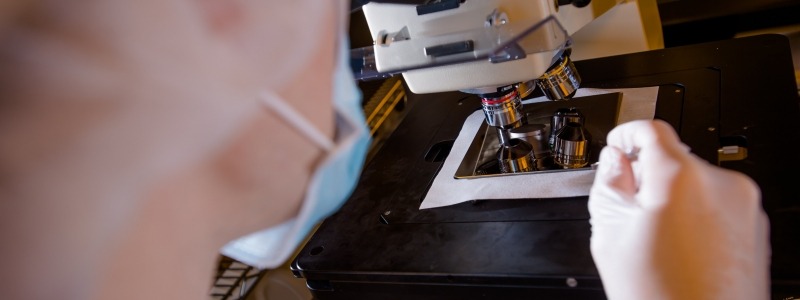
The Department of Chemistry is at the forefront of basic and applied research, with faculty driving breakthroughs in diverse areas of chemical science. In each of our dynamic research groups, faculty and students coalesce around an area of research. Advanced labs and equipment support our activities.
Research opportunities in the department are wide-ranging and available to students at both the undergraduate and graduate level of study. All faculty members accept undergraduate student researchers into their labs. Graduate students work closely with a faculty advisor and their peers in a research group. Participate in innovative, hands-on projects as you become an expert in the topic of your choice.
Learn more about our research groups and their associated faculty.
Research Areas
Catalysts accelerate chemical reactions. Departmental research in this area includes development of new metallic and organometallic catalysts and understanding their activity at a molecular level.
Faculty and Areas of Interest
Research in chemical measurement is focused on developing better, faster, more-accurate, and more-detailed analyses of chemical substances and processes. Departmental expertise includes fluorescent sensors, chromatography, and ultrahigh resolution mass spectroscopy.
Faculty and Areas of Interest
Faculty conduct experimental and theoretical research directed toward elucidating electronic and molecular structure, structure-activity relationships, and dynamic interactions at the molecular level. Departmental research may include studies focusing on the dynamic behavior and chemical reactions of molecules and atomic and molecular clusters in gas, liquid, and solid phases.
Faculty and Areas of Interest
Departmental research includes the synthesis of novel organic, inorganic, andorganometallic molecules, as well as the development of new synthetic methodologies.
Faculty and Areas of Interest
Studies focus on the teaching and learning of chemistry, including new teaching methods, assessment, and education of teachers.
Faculty and Areas of Interest
Research employs chemical approaches to investigate processes at the chemistry-biology interface.
Faculty and Areas of Interest
Research in the environmental chemical sciences promotes the understanding of natural and anthropogenic chemical processes in our environment.
Faculty and Areas of Interest
Departmental research addresses the creation or study of macromolecular, supramolecular, and nanoscopic species and other organized structures that show unique chemical and physical properties and reactivities.
Faculty and Areas of Interest
The discovery and development of theoretical and computational methods/models to address chemical challenges is the focus of this departmental research group. Areas of interest include electronic structure, quantum reaction dynamics, statistical mechanics, molecular dynamics, and simulation and modeling techniques for molecular systems and systems in condensed phases.