
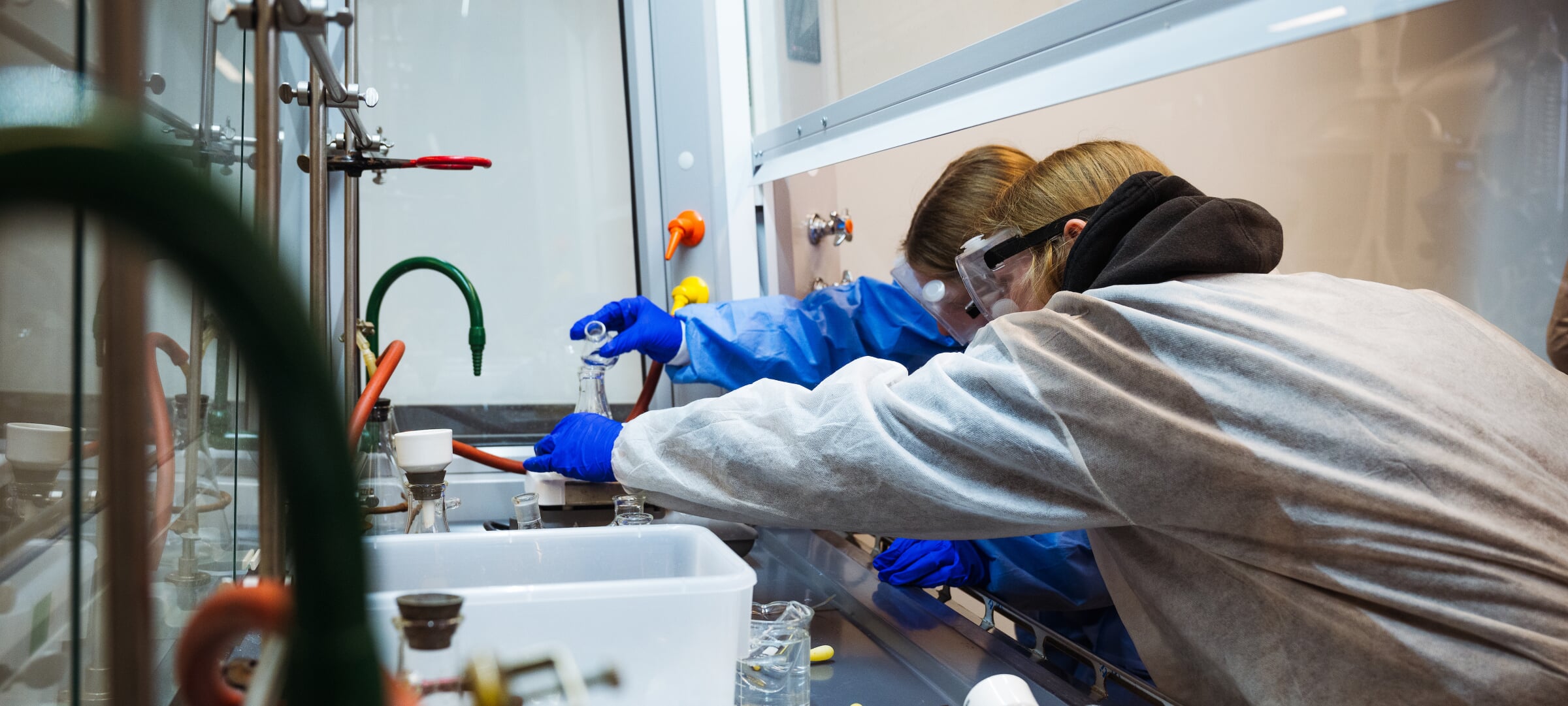
The Department of Chemistry offers research-intensive programs leading to MS and PhD degrees in Chemistry, giving talented, motivated students the chance to make discoveries in chemical science, biochemistry, and related disciplines. Students work closely with a faculty advisor in research groups of two to six people.
In this personalized environment, you become the primary expert on your topic and contribute to all aspects of the project. Students have direct, hands-on access to modern analytical instruments and often participate in interdisciplinary research. We are seeking students with a strong background in chemistry and the motivation and enthusiasm to pursue new and unsolved research questions.
Areas of Interest
- Analytical Chemistry
- Atmospheric Chemistry
- Biochemistry
- Chemical Synthesis
- Environmental Chemistry
- Inorganic Chemistry
- Materials Chemistry
- Medicinal Chemistry
- Nanotechnology
- Organic Chemistry
- Pharmaceutical Chemistry
- Physical Chemistry
- Polymer Chemistry
- Theoretical/Computational Chemistry
"There are many ways to synthesize one molecule. The same applies to life, one destination can be achieved from multiple different paths, so, choose your own path."
Biochemistry projects include the development of biomolecular nanoparticles capable of targeted drug delivery, the molecular basis of lectin-mediated immune regulation and pathogen invasion, investigation of the metabolism of inositol phosphates in plants, and understanding the relationship between protein misfolding/aggregation and disease processes.
Learn More About Research Opportunities
Degree Options
Earn a Bachelor's and a Master's in Five Years
Are you ready to accelerate your education? Get on the degree fast track with the Chemistry Accelerated Master's (BS-MS) program, and you will earn both a Bachelor of Science and a research-based Master of Science in Chemistry in five years of full-time study.
This accelerated degree plan allows you to combine the master's degree with any bachelor's degree offered by the Department of Chemistry, including the Bachelor of Science in Chemistry, Bachelor of Science in Pharmaceutical Chemistry, and Bachelor of Science in Computational Chemistry and Chemical Informatics, or the interdisciplinary Bachelor of Science in Biochemistry and Molecular Biology.
Students enrolled in the Chemistry Accelerated Master's (BS-MS) program begin graduate course work during the fourth year and finish the requirements for their master's degree within three semesters of completing their bachelor's degree. Upon graduation, you will be prepared to succeed in industry or in a chemistry doctoral program.
Chemistry Accelerated MS Requirements
Accelerated Program Overview
Third year
During the spring semester, you will begin undergraduate research, either in a class such as CH 4721 or by enrolling in CH 4990.
Summer semester following your third year
You will enroll in at least 3 credits of undergraduate research under the Senior Rule (these credits will count toward only your master's degree, not your bachelor's degree).
Fourth year
You will enroll in 6 course credits that will count toward both your bachelor's degree and your master's degree. You will choose these credits in consultation with your advisor and the Graduate Programs Committee, especially looking for graduate-level courses (5000 level or higher). You will need a minimum of 12 graduate-level course credits (not including research credits) to meet the master's degree requirements, and scheduling can be difficult.
Summer semester following your fourth year
After receiving your bachelor's degree, you will enroll in 3 master's research credits. At this time, your status will change to graduate student.
Fifth year
You will enroll in a rigorous curriculum combining course work and research credits. You will plan your schedule in consultation with your advisor and the Graduate Programs Committee, which will ensure mastery of chemistry at an advanced level in both breadth and depth.
Summer semester following your fifth year
You will write and defend your thesis.
PhD Degree Requirements Overview
This is a brief overview of the requirements for a PhD degree from the Department of Chemistry:
- A minimum of 60 credits:
- 20 Course Credits
- Qualifying Examination (Research Update)
- Original research proposal
- PhD Dissertation
- Oral Defense of PhD Research
- Proof of mastery of chemistry concepts through passing Placement Exams or Department Courses
Learn More About Chemistry PhD Requirements
"I find inspiration to work hard, and continue to push forward in research from the myriad of dedicated faculty, staff, and students found in the Department of Chemistry."
Financial Support For Graduate Studies
PhD Students
Masters Students
Students pursuing a Masters degree are not offered GTA or GRA support. However, once they arrive on campus, they may apply for jobs in the department or elsewhere at Michigan Tech. Preference for department employment is given to students who have successfully completed at least one semester of coursework.
Our graduates have a wide range of job titles including
Career Opportunities
A graduate degree in chemistry opens doors to many career opportunities.
We support the professional development of graduate students through opportunities in interdisciplinary teams and the sharing of research results within and beyond campus. Our alumni are contributing their expertise to companies large and small, from exciting start-ups to established companies such as Kimberly-Clark and Amgen to government laboratories including Brookhaven and Los Alamos.
- Professor
- Assistant Professor
- Forensic Scientist
- Process Engineer
- Environmental Consultant
- Science Research Analyst
- Senior Technical Problem Solver