

Distinguished Submissions
Soufia Bahmani - "Prompt, Panic, Prediction"
R.L. Carr - "A Greater Gravity"
Eli Larsen - "Pong"
Kent Premo - "Mandalas in CoCo Basic"
John Umbriac - "Power Off"
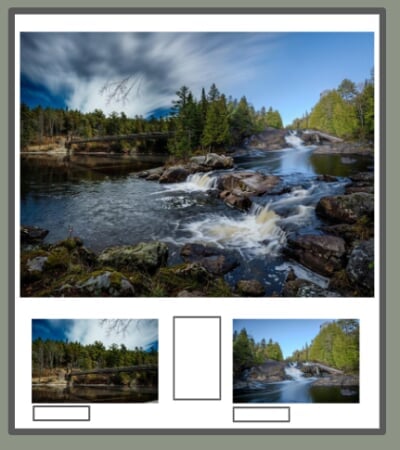
Confluence by Cal Gilbertson
AI photo blend of two actual images taken
Mr by David Falls
This is a piece of electronic music I composed as a tech student in the late 90's/early 2000's. It was programmed and sequenced entirely on a Roland MC-303 "Groovebox"

All Downhill From Here by Christopher Schmidt
I've always been hesitant to use ai to generate art - mainly due to philosophical/environmental reasons (art theft/job displacement/electricity consumption). But - even if I could ignore that - also out of fear of what it might conjure up and that I could become too dependent on it and it might taint my ability to visualize what I want to create. I took the Art in Silico exhibit as an opportunity to put my concerns and fears aside and peek behind the curtain to see what openart.ai would create based on a model of my own artwork. The results were "interesting" and maybe even a little bit reassuring. I'm not sure if my model succeeded in breaking ai or if it's because my prompts were lacking, but, for now at least, I feel like I can keep laying down my own pixels without wondering how ai might interpret my ideas.
Distinguished Submission
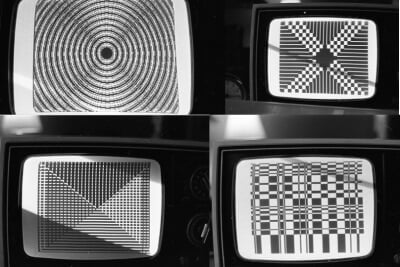
Mandalas in CoCo Basic by Kent Premo
Photos of computer art rendered on a portable TV, programmed on Radio Shack/Tandy TRS-80 Color Computer CoCo) using included Microsoft Basic. Any saving of code was stored digitally on cassette deck, but not preserved.
Distinguished Submission
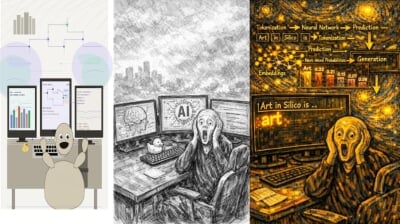
Prompt, Panic, Prediction by Soufia Bahmani
This three-part digital artwork traces a journey from human intuition to computational refinement. Simple Prompt begins with a playful, accessible visual language in which art, data, and code appear in direct and simplified form. The central panel introduces the emotional witness: a distressed figure, drawn from the art-historical memory of The Scream, confronting a contemporary language model at the threshold between confusion and recognition. In Prompt Engineering, the hidden architecture of text generation becomes visible—prompt, tokenization, embeddings, neural network processing, next-token prediction, generation, and output—rendered through a luminous Van Gogh-inspired field of movement and light. By combining art-historical reference with computational diagrams, the work explores the meeting point of human emotion, machine intelligence, and digital creativity. Across the three panels, what first appears chaotic gradually becomes legible: even the screaming figure begins to witness understanding emerge from the machine, as human intention passes through computational logic and returns transformed as art.
Distinguished Submission
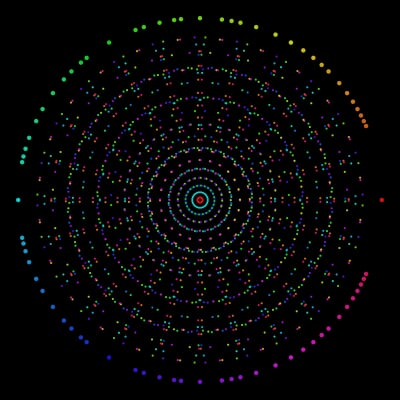
A "Strange" Quantum Moduar Mandala by Eli DeWitt
The "strange" function of Kontsevich and Zagier is defined only when q=e(x) is a root of unity, i.e. x is a rational number. When multiplied by just the right factor, this function becomes a quantum modular form. This art piece exhibits the complex image of the quantum modular form and its 24-fold symmetry for all rational x with denominator less than 16.
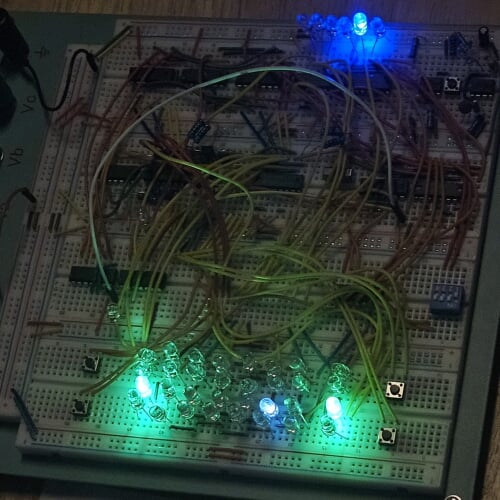
Pong by Eli Larsen
Self-made electronic Atari Pong game without code
Distinguished Submission
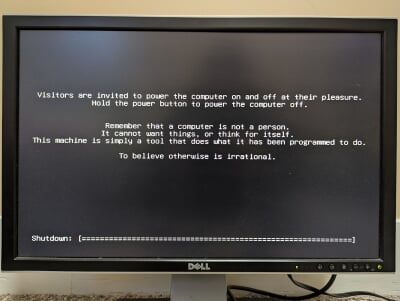
Power Off by John Umbriac
This piece was inspired by the "hold to power off" feature found on electronics like headphones or speakers. When holding that button on my headphones, I get the unpleasant impression that I'm strangling them. Finding out that this is not a common reaction was the motivation for making this piece. The piece consists of a Single Board Computer (the UDOO Bolt) and a monitor. The computer is running an instance of Ubuntu Server that runs a Python script upon startup.
Distinguished Submission
Neoliberal Loops by Emma Johnson
Neoliberal Loops is an attempt to materially conceptualize neoliberalism. I collected the NYC stock market data from each day of The 2008 Great Recession (December 2007 through June 2009) from The Wall Street Journal. Composed in MIDI, the NASDAQ numbers correspond to musical notes to create a musical composition, with the pitch changing by one half-tone every 50 stock-market points on a musical scale ranging from C3 (middle C) to G5. Notes get lower as the stock market decreases. The music is in 4/4 time with each bar including the opening, high, low, and closing stock-market numbers, represented in four quarter notes. Rests in the music stand in for weekends and holidays when the stock-market trading floor is closed. The first and last notes of the measure can be different because there is a pre- (4am-9:30am) and post-trading market (4-8pm) outside of regular business hours, 9:30am-4pm EST. The music also incorporates additional layers. I added notes when the U.S. government infused money into the system via AIG and two subsequent bailouts, transforming single notes to harmonies, triads, and sevenths. Another layer is the Occupy Wall Street intervention in 2011 which added diminished 9th notes to the composition. I invite the viewer to reflect on the 2008 Recession in a new way.
https://www.mininggazette.com/news/arts-and-entertainment/2026/09/neoliberal-loops/
Best in Show
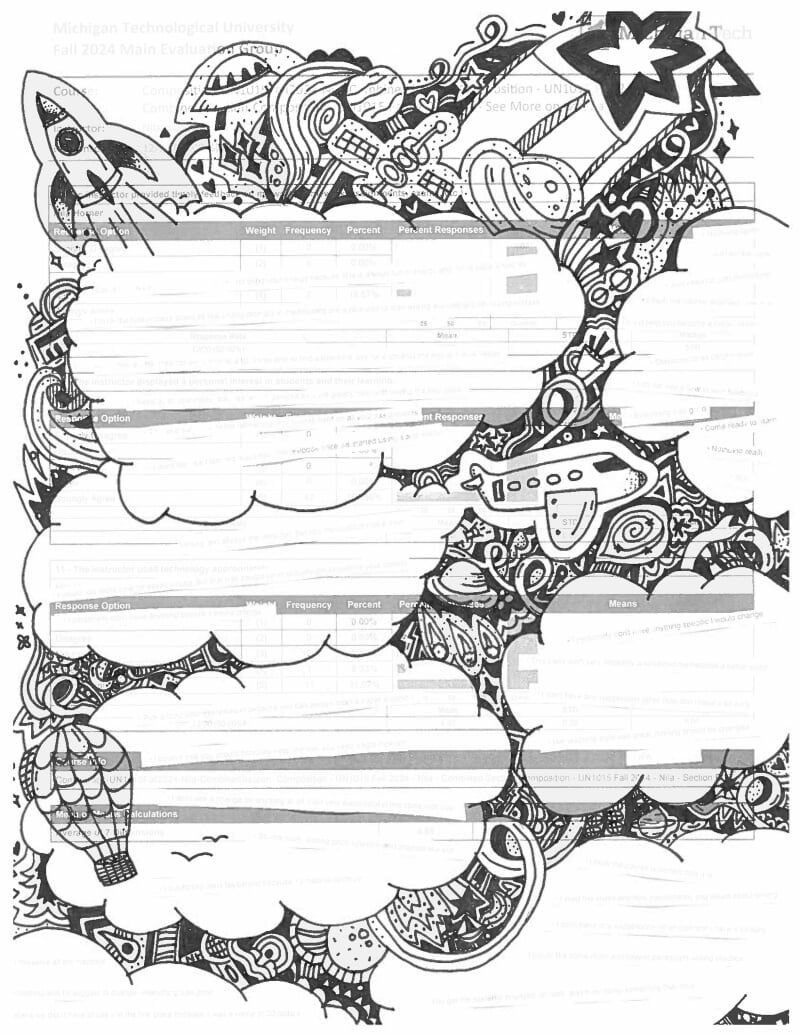
Data-Driven Instruction by Nila Horner
Student comments and survey data provided by my own course evaluations are re-imagined in "Data-Driven Instruction." By taking comments out of context and placing them within the stars, to the space we are told to encourage our students to reach, this piece highlights the creativity required of graduate student instructors. With very little feedback other than this end-of-semester report and one or two observations, this artwork exemplifies the ways in which graduate students face challenges as new instructors and maintain support for their students. Although assessment is a much-contested practice within the realm of higher education, we have to ask: what really makes an effective teacher, and how can data actually support our instruction?
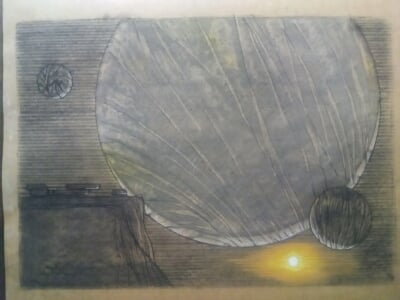
Shadow of the King by R.L. Carr
Massive moon looming over planetary base
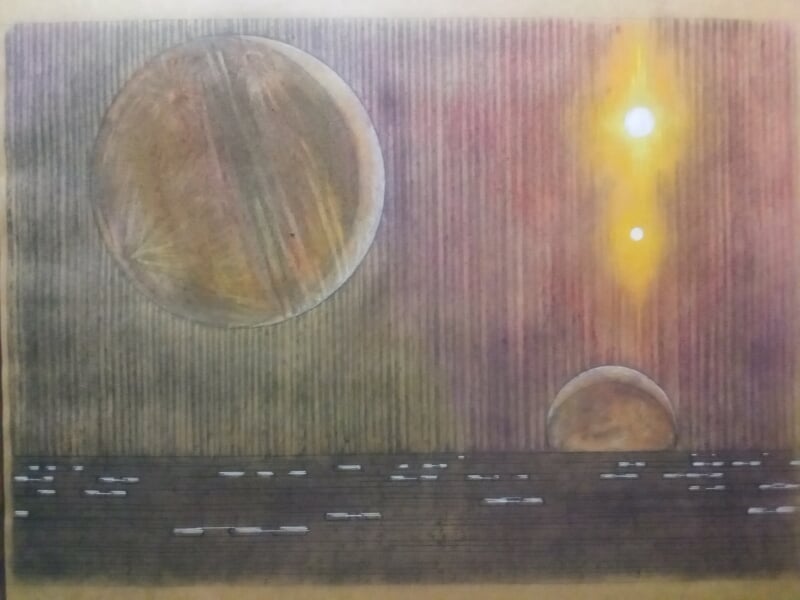
A Little Bit More Light by R.L. Carr
Colony under binary stars
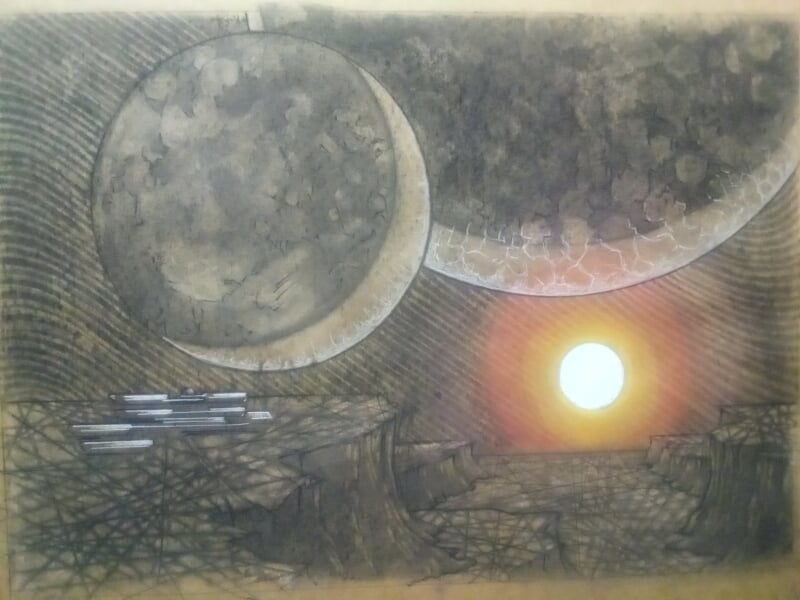
A Greater Gravity by R.L. Carr
Planetary base under large star
Distinguished Submission
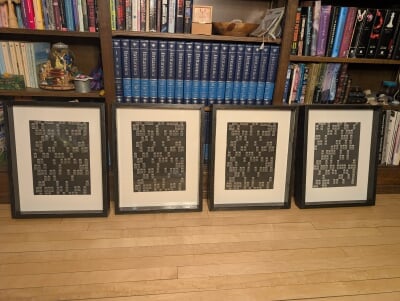
TH3 H0LL0W M3N by J.P. Harrison
Installed as four discrete but continuous panels, this work consists of four 11×14 cameraless prints. Each print encodes a line from the final stanza of The Hollow Men by T.S. Eliot in binary. The text was translated into ASCII using a custom-built application, which arranged the binary into a controlled grid with defined spacing and borders. In the physical composition, RJ45 cable caps represent “1” values, and empty space represents “0.” These arrangements were placed on acrylic and exposed directly onto photosensitive paper using a rayograph technique. The work uses physical components of network infrastructure alongside an experimental cameraless photographic process to examine technological transition and obsolescence. The source text describes a gradual, internal collapse rather than a singular catastrophic event. Written in 1925 and revisited here through contemporary materials, the text reflects a persistent condition: the sense of an ending that does not arrive all at once, but continues to be experienced across time.
Best in Show
Switched-On Computer by Lio Coulter and Robert Schneider
Collage art by human and experimental music produced using hand-made AI
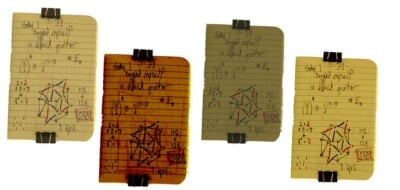
black by David Zdancewicz
A construction of the E8 lattice, the root system of the largest exceptional Lie algebra.