

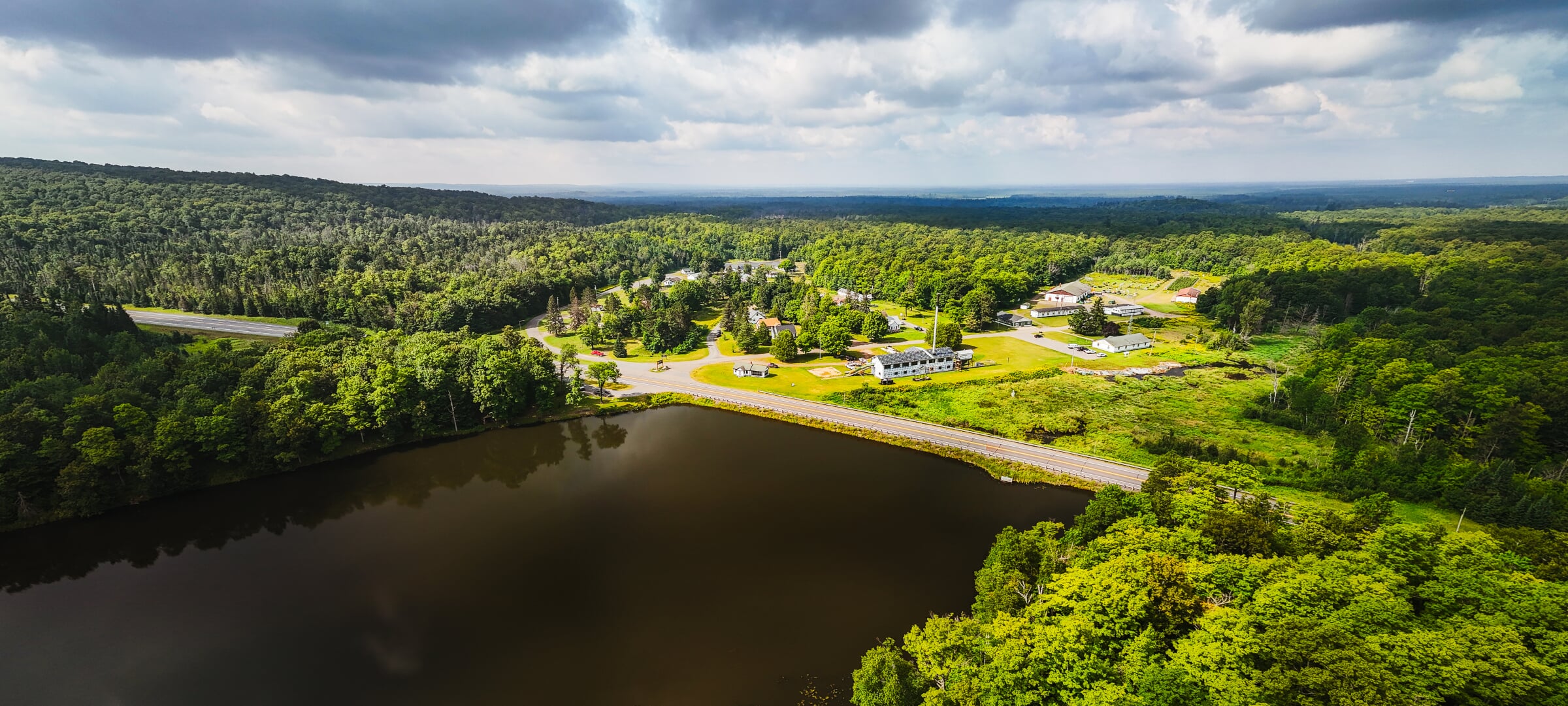
Our forests are your living lab—and playground. Undergraduate students in forestry, wildlife, ecology, and soils perform a minimum of 714 hours of outdoor coursework to fulfill degree requirements. Whether you're participating in our Forestry and Environmental Resource Management (FERM) enterprise program, or hiking, skiing, or mountain biking, you can get there fast. They’re right in our backyard.
The College's largest research forest, home to the Ford Center, includes the 1936 Ford Sawmill, a 20-acre man-made lake, Canyon Falls—one of the region's most dramatic water features—and a portion of the 4,600-mile North Country Trail—which, when completed, will be the longest National Scenic Trail in the United States. Henry Ford's white-clapboard planned community revolved around lumber production—and is one of the first highly publicized examples of selective cutting practices.
Research on sustainable forestry, silviculture, and ecological processes, conducted here since the property was donated to Michigan Tech in 1954, continues today. College traditions, from the field practicum 80-acre to the annual tapping of the maples for Sugarbush syrup-making, are joined by LIDAR remote range-sensing data collection and predictive climate modeling.
From monitoring materials exposed to extreme weather to analyzing wildlife habitat, our forest hosts year 'round management practices, studies, and demonstrations for students, researchers, and the public.
"Our students are always doing something fun. Any time people are enjoying our land, you're seeing the results of our students."
Live and Breathe What You’re Learning
The University owns 5,866 acres of forestland. There are satellite research properties throughout Michigan's Upper Peninsula. These forests are on or close to campus:
Ford Forest
Acres: 3,700
Location: 42 miles south of Michigan Tech’s main campus on US Highway 41 (see map)
Forest types: Upland northern hardwood and outwash plain jack pine forests with minor components of lowland conifer, natural red pine, and pure aspen forest
Uses: Integrated Field Practicum, field trips, SURF, research, conferences and retreats, and outreach, like Sugarbush maple-syrup making classes and tours of the Alberta sawmill and complex property created by auto magnate Henry Ford
Tech Trails
Acres: 615 with 40 miles of trails
Location: On campus, south side (Tech Trails map)
Forest types: Mixed hardwoods, conifers, and aspen
Uses: Undergraduate courses (FW2051 Field Techniques, FW2010 Vegetation of North America), walking, running, biking, snowshoeing, and skiing, including collegiate and national Nordic racing
More Research Forests Near Campus
Trail cams. Deer enclosures. Oak genetic studies. Aspen decomposition. These Michigan Tech properties are home to demonstration projects, FERM initiatives, and ongoing studies. They're open for recreation as well. Get directions, and get outside.
Nara Family Forest
- 658 acres
- Mixed hardwoods, forested wetland, and lowland conifers
Prickett Dam Tract
- 120 acres
- Hemlock, aspen, and hardwoods
Wilkinson Tract
- 240 acres, Lateral Creek frontage
- Wetlands, hardwoods, mixed conifers, and lowland conifers
Dow Property
- 300 acres, Montreal River frontage
- Lowland, mixed conifers, and hardwoods
Mass Woodlot
- 40 acres
- Mixed hardwoods, hardwood-hemlock, and mixed conifers
Rugg Property
- 35 acres
- Lowland hardwoods and mixed conifers
Smith Forty
- 40 acres, near Elm River
- Northern hardwoods
Goodman Property
- 15 acres
- Northern hardwoods and Scots pine