
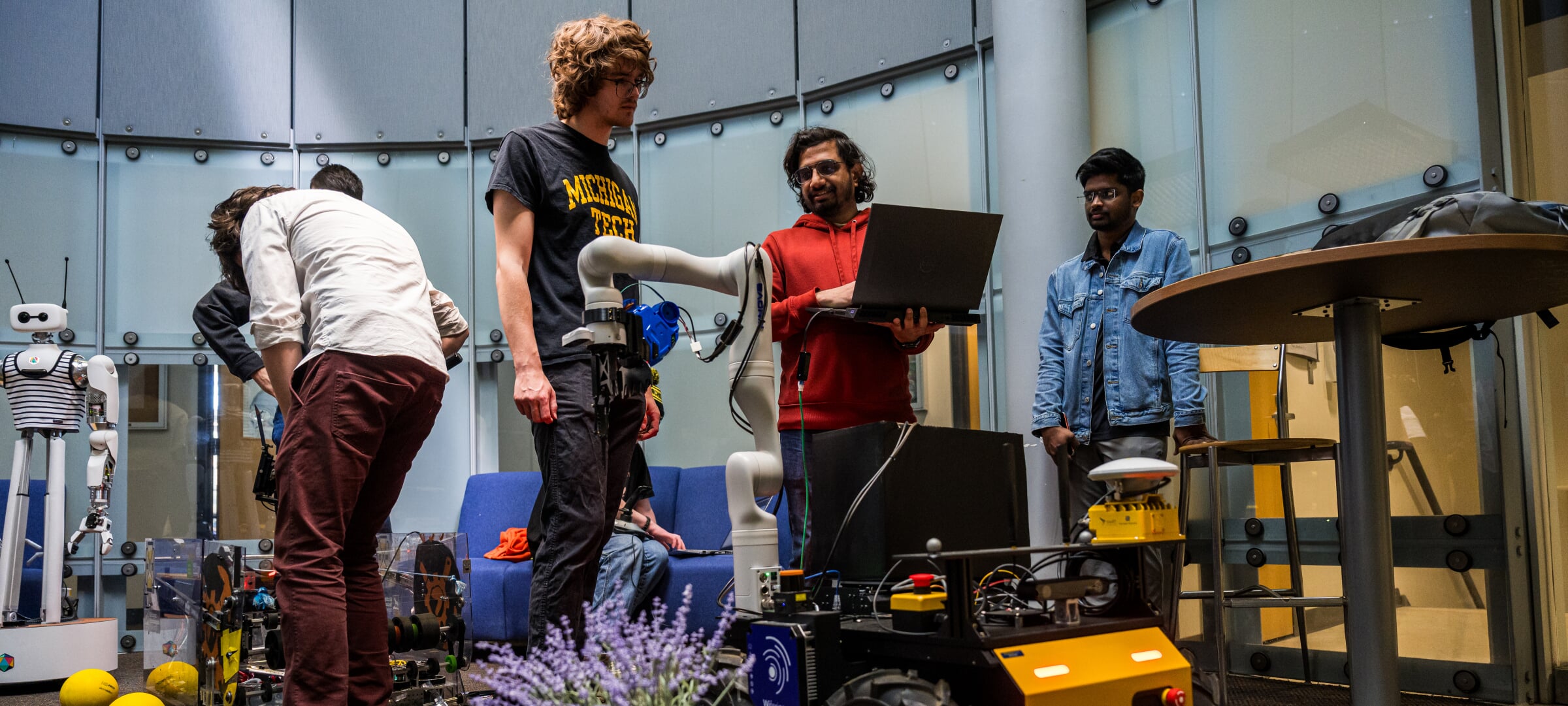
Design, develop, and deploy automated systems across many sectors. Become a master of advanced robotics systems and their real-world applications and graduate with the skills to build your future in your choice of technical industries.
At Michigan Tech, you get prepared for advanced research and technical leadership roles that allow you to gain the experience required to meet the growing demand for automation experts.
Program Overview
Students will apply fundamental principles of robotics engineering to the design, analysis, and implementation of robotic systems that address real-world engineering challenges. Preparing graduates to excel in fields like healthcare, transportation, manufacturing and logistics, and public safety.
The Michigan Tech Master of Robotics Engineering focuses on autonomous robotic systems that can operate independently, perceiving their environment, making decisions, and performing tasks without constant human control.
Degree Options
Whether your interests lie in research or coursework, we offer a master's degree option to suit your educational goals.
The curriculum structure of the proposed MS program requires 30 credits of graduate work. The Graduate Academic Advisor and the departmental faculty will help the students tailor programs to fit their interests and needs. All course plans must be approved by the graduate program director. The credit requirements for the MS program plan are summarized in the table below.
Notes For Degree
Course credits exclude research/project courses (e.g., EE 599X), other directed study or project courses, and ENT courses. A maximum of 3 credits of EE 5805 can be included in the coursework requirements. EE 5805 (1-3 credits) may be taken once with pre-approval from the Graduate Program Director (GPD) by coursework MS students. Coursework credits do not include Advanced Responsible Conduct for Research Training (RCR)
All courses must be 4000-level or above. 3000-level courses are not counted towards degree requirements. A maximum of 12 credits is allowed of 4000-level courses for coursework and report options, while a maximum of 9 credits is allowed for thesis options.
Courses outside of the Department should be approved by the advisor and Graduate Program Director. Usually, courses that are offered in Physics, Mathematics, Mechanical Engineering, Biomedical Engineering, Materials Science and Engineering, Computer Science, and Applied Computing will be approved. Students must seek approval from the Graduate Program Director before registering courses from other disciplines.
This option requires a research thesis prepared under the supervision of the advisor. The thesis describes a research investigation and its results. The scope of the research topic for the thesis should be defined in such a way that a full-time student could complete the requirements for a master’s degree in 12 months or three semesters following the completion of coursework by regularly scheduling graduate research credits.
The minimum requirements are as follows:
| Option Parts | Credits |
|---|---|
| Coursework (minimum) | 20 Credits |
| Thesis research | 6-10 Credits |
| Total (minimum) | 30 Credits |
| Distribution | Credits |
|---|---|
| 5000-6000 series (minimum) | 12 Credits |
| 3000-4000 (maximum) | 12 Credits |
Programs may have stricter requirements and may require more than the minimum number of credits listed here.
Department Requirements
| Credit Category | Credits |
|---|---|
| Core Required Courses Credits | 15 |
| Elective Credits | 2-9 |
| Co-op (5000-level) Credits | 0-3 |
| Project/research Credits | 6-10 |
| Total Required Credits | 30 |
Notes
- EE 5990 cannot be taken before completing a minimum of one semester in the program
- Project/Research credits may include credits needed to meet the Advanced RCR requirement. All MS students with report or thesis option must take Advanced RCR training. Advanced RCR must be taken within two semesters.
- Students must complete the following milestones - 30 Credits
- Complete all coursework and research credits (see above credit requirements)
- Take advanced RCR Graduate course (1 credit)
- Prepare and Submit Approved Thesis or Report
- Pass Final Oral Defense
This option requires a report describing the results of an independent study project. The scope of the research topic should be defined in such a way that a full-time student could complete the requirements for a master’s degree in 12 months or three semesters following the completion of coursework by regularly scheduling graduate research credits.
Of the minimum total of 30 credits, at least 24 must be earned in coursework other than the project:
| Option Parts | Credits |
|---|---|
| Coursework (minimum) | 24 Credits |
| Report | 2-6 Credits |
| Total (minimum) | 30 Credits |
| Distribution | Credits |
|---|---|
| 5000-6000 series (minimum) | 12 Credits |
| 3000-4000 (maximum) | 12 Credits |
Programs may have stricter requirements and may require more than the minimum number of credits listed here.
Department Requirements
| Credit Category | Credits |
|---|---|
| Core Required Courses Credits | 15 |
| Elective Credits | 6-13 |
| Co-op (5000-level) Credits | 0-3 |
| Project/research Credits | 2-6 |
| Total Required Credits | 30 |
Notes
- EE 5991 cannot be taken before completing a minimum of one semester in the program
- Project/Research credits may include credits needed to meet the Advanced RCR requirement. All MS students with report or thesis option must take Advanced RCR training. Advanced RCR must be taken within two semesters.
- Students must complete the following milestones - 30 Credits
- Complete all coursework and research credits (see above credit requirements)
- Take advanced RCR Graduate course (1 credit)
- Prepare and Submit Approved Thesis or Report
- Pass Final Oral Defense
This option requires a minimum of 30 credits be earned through coursework. A limited number of research credits may be used with the approval of the advisor, department, and Graduate Admissions. See degree requirements for more information.
A graduate program may require an oral or written examination before conferring the degree and may require more than the minimum credits listed here:
| Distribution | Credits |
|---|---|
| 5000-6000 series (minimum) | 18 Credits |
| 3000-4000 (maximum) | 12 Credits |
Department Requirements
| Credit Category | Credits |
|---|---|
| Core Required Courses Credits | 15-18 |
| Elective Credits | 12 |
| Co-op (5000-level) Credits | 0-3 |
| Project/research Credits | 0 |
| Total Required Credits | 30 |
Available Courses
Note: Courses are grouped by focus area; however, students are not required to take courses listed within a particular group. Introduction to robotics system is required and the focus area courses are optional.
Introduction to Robotics Systems (required)
Sensing and signal processing for robotics applications in manufacturing and autonomous navigation. Heavy emphasis on developing, testing, and evaluating algorithms. MATLAB programming required.
- Credits: 3.0
- Lec-Rec-Lab: (3-0-0)
- Semesters Offered: Fall
- Restrictions: Must be enrolled in one of the following Class(es): Junior, Senior
- Pre-Requisite(s): EE 2180 and (ENG 1101 or ENG 1101T)
Design of autonomous systems focusing on safety. Covers localization, sensor fusion, and motion planning. Emphasizes autonomy capability level, functional safety, and hazard analysis. Students will use autonomous vehicle data sets to develop sensing, perception, and path-planning strategies on simulated autonomous vehicles.
- Credits: 4.0
- Lec-Rec-Lab: (3-0-2)
- Semesters Offered: Spring
- Pre-Requisite(s): (EE 3261 or MEEM 3750) and EE 3280
The main concepts of autonomous systems will be introduced including motion control, navigation, and intelligent path planning and perception. This is a hands-on project based course. Students will have the opportunity to work with mobile robotics platforms. Having a foundational understanding of programming is recommended to make the most of this course.
- Credits: 3.0
- Lec-Rec-Lab: (0-2-2)
- Semesters Offered: Fall, Spring
- Restrictions: Must be enrolled in one of the following Major(s): Robotics Engineering, Mechanical Eng-Eng Mechanics, Mechanical Engineering
- Pre-Requisite(s): MEEM 3750 or ME 3750 or MEEM 4775(C) or ME 4775(C) or EE 3160
Introduction to autonomous systems and robotics with focus on automated ground vehicles. Project based course using distributed computing to solve problems related to motion planning, perception, and localization. Requires experience with Linux operating systems variants, version control systems, and C++ or Python.
- Credits: 3.0
- Lec-Rec-Lab: (2-0-3)
- Semesters Offered: Fall, Spring
- Restrictions: Permission of department required; Must be enrolled in one of the following Level(s): Graduate; Must be enrolled in one of the following College(s): College of Engineering
Advanced Control and Motion Planning
Overview of linear algebra, Modern Control: state-space based design of linear systems, observability, controllability, pole placement, observer design, stability theory of linear time-varying systems, Lyapunov stability, optimal control, Linear Quadratic regulator, Kalman filter, Introduction to robust control.
- Credits: 3.0
- Lec-Rec-Lab: (0-3-0)
- Semesters Offered: Fall
- Restrictions: Must be enrolled in one of the following Level(s): Graduate; Must be enrolled in one of the following Major(s): Electrical Engineering, Electrical & Computer Engineer
- Pre-Requisite(s): EE 3261 or MEEM 3750 or ME 3750
Overview of linear algebra, modern control; state-based design of linear systems, observability, controllability, pole placement, observer design, stability theory of linear time-varying systems, Lyapunov stability, optimal control, linear quadratic regulator, Kalman filter,
- Credits: 3.0
- Lec-Rec-Lab: (0-3-0)
- Semesters Offered: Fall
- Restrictions: Must be enrolled in one of the following Level(s): Graduate; Must be enrolled in one of the following Major(s): Mechanical Eng-Eng Mechanics, Mechanical Engineering
- Pre-Requisite(s): MEEM 3750 or ME 3750 or EE 3261
Studies nonlinear systems from perspective of analysis/control system design. Explores fundamental properties for nonlinear differential equations in addition to describing functions, phase plane analysis, stability/instability theorems. Develops and applies control system design approaches for nonlinear systems, including feedback linearization and sliding mode control.
- Credits: 3.0
- Lec-Rec-Lab: (0-3-0)
- Semesters Offered: Spring
- Restrictions: Must be enrolled in one of the following Level(s): Graduate
- Pre-Requisite(s): EE 5715 or MEEM 5715 or ME 5715
Study of methods to solve problems in electrical engineering that do not have a single analytic solution, and hence a best solution must be found iteratively. Algorithms and implementations are studied, with heavy emphasis on MATLAB coding of real problems, and evaluation of solutions.
- Credits: 3.0
- Lec-Rec-Lab: (3-0-0)
- Semesters Offered: Spring, in even years
- Restrictions: Must be enrolled in one of the following Level(s): Graduate; Must be enrolled in one of the following Major(s): Electrical & Computer Engineer, Electrical Engineering, Computer Engineering
Introduction to automotive control systems for engine, transmission, cruise and headway control, active suspension systems, hybrid electric vehicles, and autonomous driving. Advanced control methodologies include linear-quadratic optimal control, model predictive control, dynamic programming, and equivalent consumption minimization strategy.
- Credits: 3.0
- Lec-Rec-Lab: (0-3-0)
- Semesters Offered: Spring
- Restrictions: Must be enrolled in one of the following Level(s): Graduate; Must be enrolled in one of the following Major(s): Electrical & Computer Engineer, Electrical Engineering, Computer Engineering
- Pre-Requisite(s): EE 3261 or MEEM 4775 or ME 4775
Introduction to automotive control systems for engine, transmission, cruise and headway control, active suspension systems, hybrid electric vehicles, and autonomous driving. Advanced control methodologies include linear-quadratic optimal control, model predictive control, dynamic programming, and equivalent consumption minimization strategy.
- Credits: 3.0
- Lec-Rec-Lab: (0-3-0)
- Semesters Offered: Spring
- Restrictions: Must be enrolled in one of the following Level(s): Graduate; Must be enrolled in one of the following Major(s): Mechanical Eng-Eng Mechanics, Mechanical Engineering
- Pre-Requisite(s): MEEM 4775 or ME 4775
Perception and Computer Vision for Robotics
Sensing modes, signal and image processing for industrial robotic automation processes. Emphasis placed on widely used sensors, including cameras and 3-D sensors for process control and computer vision for autonomous navigation.
- Credits: 3.0
- Lec-Rec-Lab: (3-0-0)
- Semesters Offered: Spring
- Restrictions: Must be enrolled in one of the following Major(s): Electrical & Computer Engineer, Electrical Engineering, Computer Engineering; May not be enrolled in one of the following Class(es): Freshman, Sophomore, Junior
- Pre-Requisite(s): EE 5522
Fundamentals of image processing are covered including image representation, geometric transformations, binary image processing, compression, space and frequency domain processing. Computer programming in MATLAB and Python required.
- Credits: 3.0
- Lec-Rec-Lab: (3-0-0)
- Semesters Offered: Fall, Spring
- Restrictions: Must be enrolled in one of the following Level(s): Graduate; Must be enrolled in one of the following Major(s): Electrical & Computer Engineer, Electrical Engineering, Computer Engineering
Digital signal processing techniques with emphasis on applications. Includes sampling, the Z-transform, digital filters and discrete Fourier transforms. Emphasizes techniques for design and analysis of digital filters. Special topics may include the FFT, windowing techniques, quantization effects, physical limitations, image processing basics, image enhancement, image restoration and image coding.
- Credits: 4.0
- Lec-Rec-Lab: (3-0-2)
- Semesters Offered: Fall
- Pre-Requisite(s): EE 3160
Practical implementation of digital signal processing concepts as developed in EE4252. Emphasis on applications of DSP to communications, filter design, speech processing, and radar. Laboratory provides practical experience in the design and implementation of DSP solutions.
- Credits: 3.0
- Lec-Rec-Lab: (2-0-2)
- Semesters Offered: Spring
- Pre-Requisite(s): EE 4252
Explore the concept of usability and how this is assessed and applied to various products, interfaces, systems, and information with a focus on heuristic evaluation, cognitive walkthroughs, card sorting, tree testing, surveys, interviews, and ISO standards.
- Credits: 3.0
- Lec-Rec-Lab: (0-3-0)
- Semesters Offered: On Demand
Introduction to this cognitive-systems engineering method that unpacks complex work through systematic interviews with experts. Students will collect data to address engineering, business, or socio-technical challenges.
- Credits: 3.0
- Lec-Rec-Lab: (0-3-0)
- Semesters Offered: Fall
- Restrictions: May not be enrolled in one of the following Class(es): Freshman
- Pre-Requisite(s): (PSY 2000 or HF 2000) and UN 1015
Examination of basic sensory mechanisms and perceptual phenomena. Sensory mechanisms reviewed will include vision, audition, olfaction, gustation, vestibular system and touch.
- Credits: 3.0
- Lec-Rec-Lab: (0-3-0)
- Semesters Offered: Spring, in even years
- Restrictions: May not be enrolled in one of the following Class(es): Freshman, Sophomore
- Pre-Requisite(s): PSY 2000 or HF 2000
AI/Machine Learning for Robotics
This course introduces practical AI/ML tools for solving real engineering problems. Students learn end-to-end workflows and basic deployment using modern Python libraries. Core topics include supervised learning, unsupervised learning, and reinforcement learning. Application domains emphasize common engineering contexts.
- Credits: 3.0
- Lec-Rec-Lab: (3-0-0)
- Semesters Offered: Spring
- Pre-Requisite(s): EE 3180
This course introduces practical AI/ML tools for solving real engineering problems. Students learn end-to-end workflows and basic deployment using modern Python libraries. Core topics include supervised learning, unsupervised learning, and reinforcement learning. Application domains emphasize common engineering contexts.
- Credits: 3.0
- Lec-Rec-Lab: (3-0-0)
- Semesters Offered: Spring
- Restrictions: Must be enrolled in one of the following Level(s): Graduate
- Pre-Requisite(s): EE 3180
Fundamental ideas and techniques used in the construction of problem solvers that use Artificial Intelligence technology. Topics include knowledge representation and reasoning, problem solving, heuristics, search heuristics, inference mechanisms, and machine learning.
- Credits: 3.0
- Lec-Rec-Lab: (0-3-0)
- Semesters Offered: Spring
- Restrictions: Must be enrolled in one of the following Level(s): Graduate
- Pre-Requisite(s): CS 2311 and CS 2321
This course covers the four main paradigms of Computational Intelligence, viz., fuzzy systems, artificial neural networks, evolutionary computing, and swarm intelligence, and their integration to develop hybrid systems. Applications of Computational Intelligence include classification, regression, clustering, controls, robotics, etc.
- Credits: 3.0
- Lec-Rec-Lab: (3-0-0)
- Semesters Offered: On Demand
- Restrictions: Permission of instructor required; Must be enrolled in one of the following Level(s): Graduate
This course will explore the foundational techniques of machine learning. Topics are pulled from the areas of unsupervised and supervised learning. Specific methods covered include naive Bayes, decision trees, support vector machine (SVMs), ensemble, and clustering methods.
- Credits: 3.0
- Lec-Rec-Lab: (3-0-0)
- Semesters Offered: Spring
- Restrictions: Permission of instructor required; May not be enrolled in one of the following Class(es): Freshman, Sophomore, Junior
This course introduces students to machine learning algorithms and their applications in engineering. Topics include supervised and unsupervised learning algorithms. Students will apply machine learning techniques to problems in different areas including mechanical, biomedical, and materials design problems.
- Credits: 3.0
- Lec-Rec-Lab: (3-0-0)
- Semesters Offered: Spring
- Restrictions: Must be enrolled in one of the following Level(s): Graduate; Must be enrolled in one of the following College(s): College of Engineering
Human-Robot Interaction and Safety
Human-Robot interaction is a multi-disciplinary course dedicated to understanding, designing, and evaluating robotic systems for use by or with humans. Theory and research methodologies will be covered in a semester-long project with real robotic platforms. Topics include robot communication, control, supervision, teaming, and XR interfaces.
- Credits: 3.0
- Lec-Rec-Lab: (3-0-0)
- Semesters Offered: Fall
- Restrictions: May not be enrolled in one of the following Class(es): Freshman, Sophomore
Soft Robotics/ Bio-inspired Robotics
Human-Robot interaction is a multi-disciplinary course dedicated to understanding, designing, and evaluating robotic systems for use by or with humans. Theory and research methodologies will be covered in a semester-long project with real robotic platforms. Topics include robot communication, control, supervision, teaming, and XR interfaces.
- Credits: 3.0
- Lec-Rec-Lab: (3-0-0)
- Semesters Offered: Fall
- Restrictions: May not be enrolled in one of the following Class(es): Freshman, Sophomore
Secure Communications for Robots
Computer network architectures and protocols; design and implementation of datalink, network, and transport layer functions. Introduction to the Internet protocol suite (TCP, UDP, IP), domain name service and protocols, file sharing protocols, wireless networks, and network security.
- Credits: 3.0
- Lec-Rec-Lab: (3-0-0)
- Semesters Offered: Fall, Spring, Summer
- Restrictions: May not be enrolled in one of the following Class(es): Freshman, Sophomore
- Pre-Requisite(s): CS 3411
Building blocks of wireless sensor networks, sensor node design, wireless communications, network protocols, data storage and retrieval, sensor localization and clock synchronization. Example application areas: robotics, autonomous vehicles and networks, power engineering, smart-grid, environment monitoring, and disaster relief.
- Credits: 3.0
- Lec-Rec-Lab: (3-0-0)
- Semesters Offered: On Demand
- Pre-Requisite(s): (CS 4461 or EE 4272 or EE 5722) and (EE 3170 or EE 3173) and (CS 1129 or CS 2141)
Introduces the mathematical theory of communication science. Topics include baseband and digital signaling, bandpass signaling, AM and FM systems, bandpass digital systems, and case studies of communication systems.
- Credits: 3.0
- Lec-Rec-Lab: (3-0-0)
- Semesters Offered: Fall, Spring, Summer
- Pre-Requisite(s): EE 3160 and EE 3131 and EE 3180
Learn fundamental of cryptography and its application to network security. Understand network security threats, security services, and countermeasures. Acquire background knowledge on well known network security protocols. Address open research issues in network security.
- Credits: 3.0
- Lec-Rec-Lab: (3-0-0)
- Semesters Offered: Spring
- Pre-Requisite(s): EE 4272 or CS 4461 or SAT 4812
Cybersecurity for Robotics
This covers fundamentals of computer security. Topics include practical cryptography, access control, security design principles, physical protections, malicious logic, program security, intrusion detection, administration, legal and ethical issues.
- Credits: 3.0
- Lec-Rec-Lab: (0-3-0)
- Semesters Offered: Fall
- Restrictions: May not be enrolled in one of the following Level(s): Graduate
- Pre-Requisite(s): CS 3411 or CS 4411
This covers fundamentals of computer security. Topics include practical cryptography, access control, security design principles, physical protections, malicious logic, program security, intrusion detection, administration, legal and ethical issues.
- Credits: 3.0
- Lec-Rec-Lab: (0-3-0)
- Semesters Offered: Fall, Spring
- Restrictions: Must be enrolled in one of the following Level(s): Graduate
- Pre-Requisite(s): CS 3411 or CS 4411
This course exposes students to the concepts of secure software development. Students will learn how to develop high-quality software that is resistant against cyber- attacks, by minimizing the number of vulnerabilities that can be exploited by an attacker. Topics include: access control, race conditions, buffer overflows, code injection, fuzzing techniques, cryptographic software, web application and Java security.
- Credits: 3.0
- Lec-Rec-Lab: (3-0-0)
- Semesters Offered: Spring
- Pre-Requisite(s): CS 4471
This course covers various aspects of producing trusted computer information systems. Topics include network perimeter protection, host-level protection, authentication technologies, formal analysis techniques, and intrusion detection. Current systems will be examined and critiqued.
- Credits: 3.0
- Lec-Rec-Lab: (0-3-0)
- Semesters Offered: Spring
- Restrictions: Must be enrolled in one of the following Level(s): Graduate
- Pre-Requisite(s): CS 4471 or CS 5471 or SAT 4520
Embedded Systems for Automation
Covers the use of low-power microcontrollers and hardware- dependent C for embedded sensing and control systems. Emphasizes direct interfacing with analog and digital sensors and actuators of several different modalities, to implement end-to-end embedded systems for applications including robotics and wireless sensor nets.
- Credits: 4.0
- Lec-Rec-Lab: (3-0-1)
- Semesters Offered: Spring, Summer
- Restrictions: Must be enrolled in one of the following Class(es): Senior
- Pre-Requisite(s): EE 3171 or EE 3173 or EE 3174
Cross-discipline system integration of sensors, actuators, and microprocessors to achieve high-level design requirements, including robotic systems. A variety of sensor and actuation types are introduced, from both a practical and a mathematical perspective. Embedded microprocessor applications are developed using the C programming language.
- Credits: 4.0
- Lec-Rec-Lab: (0-3-3)
- Semesters Offered: Fall, Spring
- Pre-Requisite(s): MEEM 3750 or EE 3160 or ME 3750
Cross-discipline system integration of sensors, actuators, and microprocessors to achieve high-level design requirements, including robotic systems. A variety of sensor and actuation types are introduced, from both a practical and a mathematical perspective. Embedded microprocessor applications are developed using the C programming language. A final project is required including analysis, design, and experimental demonstration.
- Credits: 4.0
- Lec-Rec-Lab: (0-3-3)
- Semesters Offered: Fall, Spring
- Restrictions: Must be enrolled in one of the following Level(s): Graduate; Must be enrolled in one of the following Major(s): Mechatronics, Mechanical Eng-Eng Mechanics, Mechanical Engineering
- Pre-Requisite(s): MEEM 3750 or ME 3750
This course introduces embedded control system design using a model-based approach. Course topics include model-based embedded control system design, discrete-event control, sensors, actuators, electronic control unit, digital controller design, and communication protocols. Prior knowledge of hybrid electric vehicles is highly recommended.
- Credits: 3.0
- Lec-Rec-Lab: (0-2-2)
- Semesters Offered: Fall
- Restrictions: Must be enrolled in one of the following Level(s): Graduate; Must be enrolled in one of the following Major(s): Electrical Engineering, Electrical & Computer Engineer
- Pre-Requisite(s): MEEM 4700 or ME 4700 or MEEM 4775 or ME 4775 or EE 3261 or EE 4261
This course introduces embedded control system design using model-based approach. Course topics include model-based embedded control system design, discrete-event control, sensors, actuators, electronic control unit, digital controller design, and communications protocols. Prior knowledge of hybrid electric vehicles are highly recommended.
- Credits: 3.0
- Lec-Rec-Lab: (0-2-2)
- Semesters Offered: Fall
- Restrictions: Must be enrolled in one of the following Level(s): Graduate; Must be enrolled in one of the following Major(s): Mechanical Eng-Eng Mechanics, Mechanical Engineering
- Pre-Requisite(s): MEEM 4775 or ME 4775 or EE 4261 or EE 3261
Automotive systems for light duty vehicles are examined from the perspectives of requirements, design, technical, and economic analysis for advanced mobility needs. This course links the content for the automotive systems graduate certificate in controls, powertrain, vehicle dynamics, connected and autonomous vehicles.
- Credits: 3.0
- Lec-Rec-Lab: (0-3-0)
- Semesters Offered: Fall
- Restrictions: Must be enrolled in one of the following Level(s): Graduate; Must be enrolled in one of the following Major(s): Automotive Systems & Controls, Electrical Engineering, Computer Engineering, Electrical & Computer Engineer
Automotive systems for light duty vehicles are examined from the perspectives of requirements, design, technical, and economic analysis for advanced mobility needs. This course links the content for the automotive systems graduate certificate in controls, powertrain, vehicle dynamics, connected and autonomous vehicles.
- Credits: 3.0
- Lec-Rec-Lab: (0-3-0)
- Semesters Offered: Fall
- Restrictions: Must be enrolled in one of the following Level(s): Graduate; Must be enrolled in one of the following Major(s): Mechanical Eng-Eng Mechanics, Automotive Systems & Controls, Hybrid Elec. Drive Vehicle Eng, Mechanical Engineering
Provides a thorough understanding of how electric machines can be used to drive loads with control of speed, torque and position. Topics include basic electro-mechanics, rotating machinery, dc machines, ac machines, power electronics and load modeling. Applications include industrial systems, hybrid/electric vehicles and electric power systems.
- Credits: 3.0
- Lec-Rec-Lab: (3-0-0)
- Semesters Offered: Spring
- Pre-Requisite(s): (EE 2112 or EE 3010) and EE 3120
