
Master the new electricity. Build intelligent systems that don’t just process data—they learn, adapt, and act.
Artificial intelligence has moved beyond the realm of science fiction to become a driving force of global innovation. At Michigan Tech, we do more than use AI; we build it from scratch. Our Bachelor of Science in Artificial Intelligence is a rigorous, technical degree centered on machine learning and deep learning, designed for those who want to lead the next digital transformation.
Request Information
Form loading . . .
At other universities, you might learn to use AI as a shortcut. At Michigan Tech, you’ll learn to direct its power as a complex instrument of innovation. Like a skillful musician on a violin or an engineer using a scanning electron microscope, an AI instrumentalist trained at Michigan Tech understands that proficiency requires precise knowledge, plenty of practice, and commitment. At Tech, there's no "easy button." We equip you with the deep technical oversight to ensure the results are accurate, ethical, and sustainable.
Tomorrow needs graduates who can design and deploy responsible AI systems. Whether you are interested in self-driving cars, advanced healthcare diagnostics, or national security, this program gives you the tools to turn code into intelligence.
What Will I Study?
Your curriculum is built on a powerhouse foundation of computer science, data science, and mathematics. You’ll move from first-year subjects like introductory programming to advanced topics like neural networks and cloud computing.
You won't just be working in a lab, either. As part of your degree, you'll consider AI's human impact. Every AI student explores the social and ethical considerations of their work, ensuring that as you build the future, you do so with an eye on equity, governance, and real-world impact.
- AI Core: Dive into machine learning, deep learning, and algorithm design.
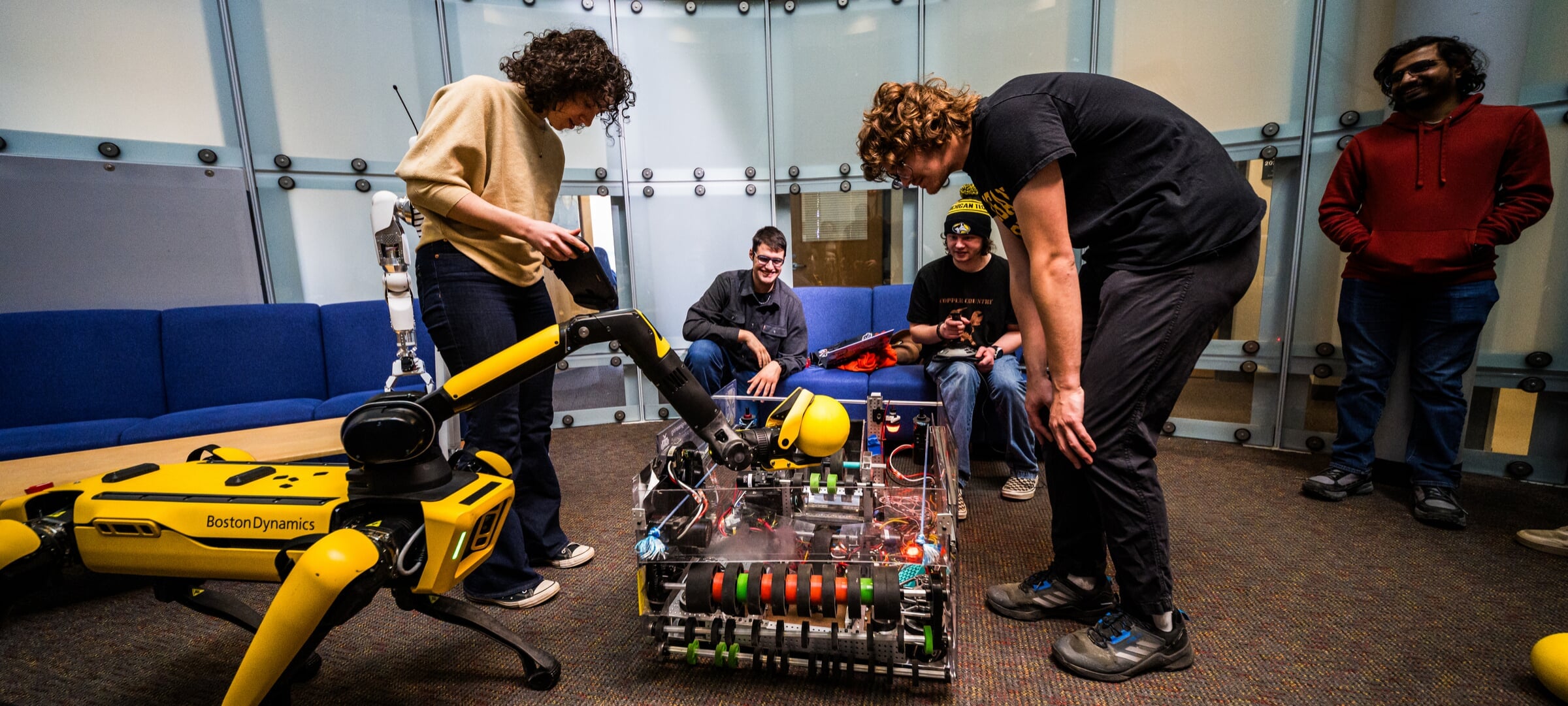
- Hands-on Tools: Gain experience with natural language processing, computer vision, and robotics.
- Capstone Project: Tackle a real-world problem using AI methods in a collaborative, project-based setting.
Focus Areas
Tailor your degree to your specific career goals with a 15-credit technical focus area. Many of these options allow you to earn an additional minor along the way.
- Theoretical: For those who want to push the mathematical boundaries of what AI can do.
- Software Engineering: Learn to build, deploy, and maintain software products driven by machine-learned models.
- Data Center: Master the hardware and systems that power hyper-scale computing.
- Cybersecurity: Focus on using AI to protect networks and identify vulnerabilities.
- Business: Use AI to drive innovation, entrepreneurship, and business intelligence.
- Human-Computer Interaction: Study how humans interact with intelligent systems, including robotics and user interface design.
Tomorrow Needs Careers in AI
Tomorrow needs a new kind of professional—the AI instrumentalist. In a world being reshaped by digital transformation, Michigan Tech isn’t just keeping pace. We’re setting the tempo. As an R1 research institution, we provide a direct pipeline to the industries that power the global economy. Ranked No. 2 in the nation for internships among public universities, Huskies go beyond the study of AI. They master their instruments in real-world settings alongside industry leaders before they ever cross the stage at graduation. This hands-on, action-based learning ensures our graduates enter the workforce with the grit and technical depth required to navigate a shifting landscape with absolute confidence.
Earning an AI degree from Michigan Tech is one of the safest financial bets a student can make in a disruptive market. A Tech degree opens doors and significantly boosts your earning potential from day one. With a median early-career salary of $82,000 and a record-high 94.6% job placement rate, we ensure our Huskies are ready to innovate, ready to solve problems, and ready for whatever tomorrow brings.
A Future-forward Career that Pays Well
Our Bachelor of Science in Artificial Intelligence graduates are qualified to work in business, industry, academia, government, research, or other economic sectors. They may also pursue graduate degrees in areas of study including data science, statistics, applied statistics, health informatics, and more.
Artificial intelligence is growing rapidly. While it does not yet provide data specifically on AI, data science overlaps somewhat with AI, and the U.S. Bureau of Labor Statistics forecases 34% growth in employment for data scientists between 2024 and 2034. The mean entry-level salary for an artificial intelligence specialist is $117,447 with a mean annual salary of $138,581 and the top 10 percent making $229,000, according to Payscale.
See additional computing salary information.
Figures from Payscale accessed May 2026.
Career Opportunities Are Endless
Step onto the leading edge of a global industrial evolution. Jump-start your career by transitioning immediately into high-impact roles such as machine learning engineer, AI systems architect, data scientist, or robotics software developer.
From day one, you'll perform sophisticated work like designing neural networks, training deep learning models, and building the autonomous systems that power healthcare diagnostics, national security, and smart manufacturing. Advance fast here, on the campus of a research-focused institution where professors care about your professional growth. Develop AI expertise through hands-on research and elite internships that provide a direct pipeline to the world’s top tech and industrial firms.
By mastering both the high-level technical theory and the critical ethical oversight required for responsible innovation, you’ll possess the "AI capital" that distinguishes a leader from a user, allowing you to move quickly into senior-level roles and shape the future of the field.
Explore Career Opportunities for AI
- Autonomous Systems Engineer: Design the "brains" behind self-driving cars, drones, and the Mars rover, using real-time sensor fusion to navigate unpredictable environments.
- Machine Learning Researcher: Push the boundaries of human knowledge by developing novel algorithms that enable computers to learn and solve complex problems without explicit programming.
- AI Ethics and Policy Analyst: Ensure the "new electricity" is used responsibly by identifying algorithmic bias and shaping the legal frameworks that govern how AI impacts society.
- Computer Vision Specialist: Train machines to "see" and interpret the world, enabling everything from high-tech medical imaging that detects disease to facial recognition systems for national security.
- Natural Language Processing (NLP) Engineer: Teach computers to understand, translate, and generate human language, powering the next generation of virtual assistants and sophisticated translation tools.
- AI Sustainability Consultant: Use predictive modeling to optimize renewable energy grids and reduce the massive carbon footprint of hyper-scale data centers.
- Robotics Coordinator: Oversee the integration of AI-powered robots in advanced manufacturing and "smart" factories, bridging the gap between digital intelligence and physical action.
- AI-Enhanced Cybersecurity Analyst: Combat the threats of the future by using machine learning to detect zero-day vulnerabilities and defend against automated cyberattacks in real time.