Purpose
To ensure the quality of online courses, Michigan Tech has established a Senate policy
which requires all online courses to be peer reviewed. Please refer to the links below
for more details on the senate policy.
Two -Tier Course Review Process
For online courses, a two-tier course review system has been established — "basic"
and "full" course reviews. Based on enrollment and the frequency of the course offering,
each online course will be assigned to one of these levels of course review by the
provost’s office. The provost’s office will contact the dean with a list of priority
reviews and when a course is selected for review, the CFE instructional design team
will be notified to initiate the course review process.
Basic Course Review
The CFE has developed an online course basic review rubric that aligns with the 7th
edition Quality Matter (QM) HIgher Education rubric, but incorporates less strict
requirements. This rubric will be used to evaluate the quality of online courses during
the basic course review process. The QM course review management system will not be
used for the basic course review.
An instructional designer from the CFE will serve as the course reviewer to review,
manage, and support the basic course review process. No faculty reviewers will be
required in the basic course review process.
Basic Course Review Process
Once the CFE receives an email from the provost’s office indicating the course should
be reviewed, a CFE instructional designer (ID) will be assigned to the course, and
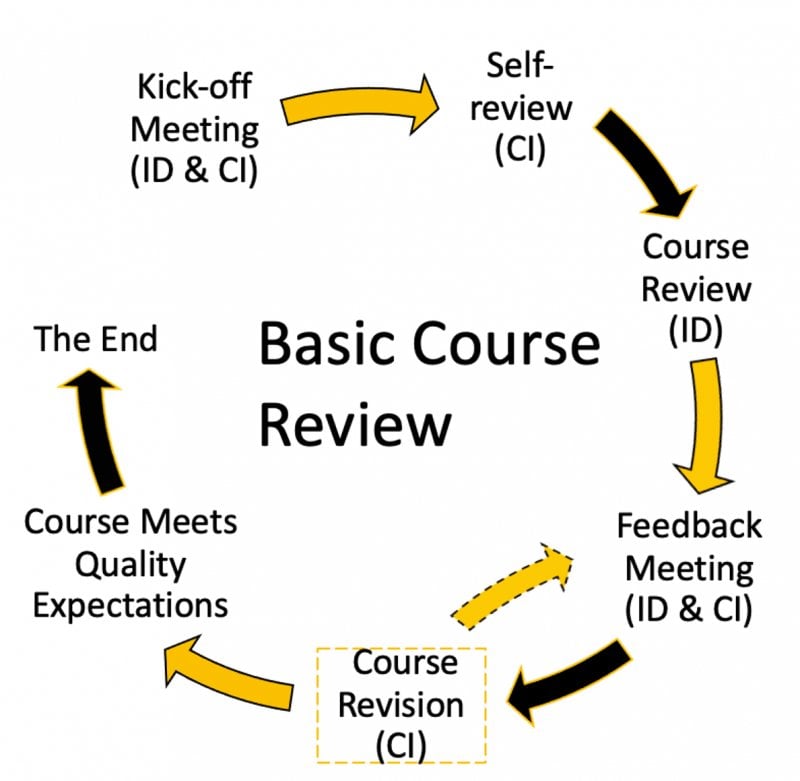
the review process will begin. The basic course review steps and flow diagram below
explain the process:
- The ID will host a kick-off meeting with the course instructor (CI) to introduce the
course review process, timeline, and responsibilities of each role.
- The CI completes a self-review of the course using the basic course review rubric
and makes any necessary revisions.
-
Once the course is ready, the ID will review the course using the basic course review
rubric.
-
Once the review is done, the ID will host a feedback meeting with the CI to discuss
the review results and provide suggestions for improvement.
- If the review results show that the course meets the quality expectations, then the
course review ends; if the review results show that the course does not meet the quality
expectations, then the CI needs to revise the course using the feedback and suggestions.
-
The ID will review the course revisions. If the revisions implemented by the CI achieve
course quality expectations, then the course review ends. If not, the CI will repeat
steps four to six until the course meets the quality expectations.
Full Course Review
The Quality Matters (QM) Higher Education Rubric (7th edition) will be used to evaluate the quality of online courses during the full course review
process. The QM course review management system will be used for the full review process.
Two reviewers will be involved in the course review process: an instructional designer
(ID) from CFE and a trained faculty reviewer (FR). The instructional designer will review, manage, and support the course review
process. A faculty reviewer who is familiar with the subject matter of the course
will also review the course and provide feedback.
Full Course Review Process
Once the CFE receives an email from the provost’s office indicating the course should
be reviewed, a CFE instructional designer (ID) will be assigned to the course, and
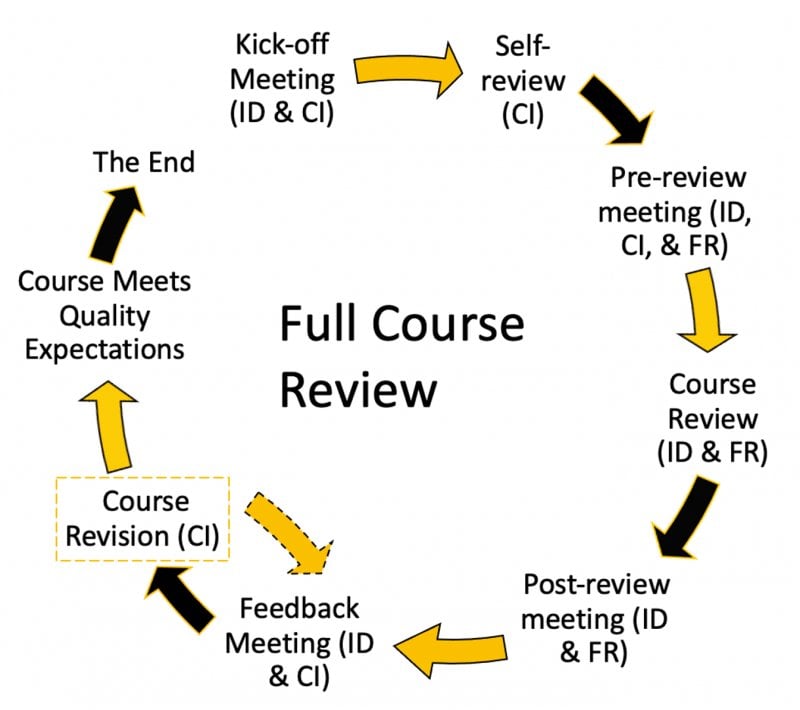
the review process will begin. The full course review steps and flow diagram below
explain the process:
-
The ID will host a kick-off meeting with the course instructor (CI) to introduce the
course review process, QM course review management system, timeline, and responsibilities
of each role.
-
The CI completes a self-review of the course using the QM higher education rubric
(7th edition) and makes any necessary revisions.
-
Once the course is ready, the ID will host a pre-review meeting with the CI and faculty
reviewer (FR) to introduce the course review process, timeline, responsibilities of
FR, reviewer worksheet, and information about “How to Write Helpful Recommendations” from QM.
- The ID and FR will review the course using the QM higher education rubric (7th edition)
and take notes of suggestions and feedback
- Once the review is complete, the ID will host a post-review meeting with the FR to
review and discuss the review results.
- The ID will host a feedback meeting with the CI to discuss the review results and
give suggestions for improvement.
- If the review results show that the course meets the quality expectations, then the
course review ends; if the review results show that the course does not meet the quality
expectations, then the CI needs to revise the course.
- The ID checks the revisions. If the revisions the CI made meet the quality expectations,
then the course review ends. If not, repeat steps six to eight until the course meets
the quality expectations.
Quality Matters Rubric
The rubric available online provides the review standards used in a Quality Matters review. A fully annotated
version of the rubric, which is used during the full course review, is available from
the CFE upon request.
Resources