
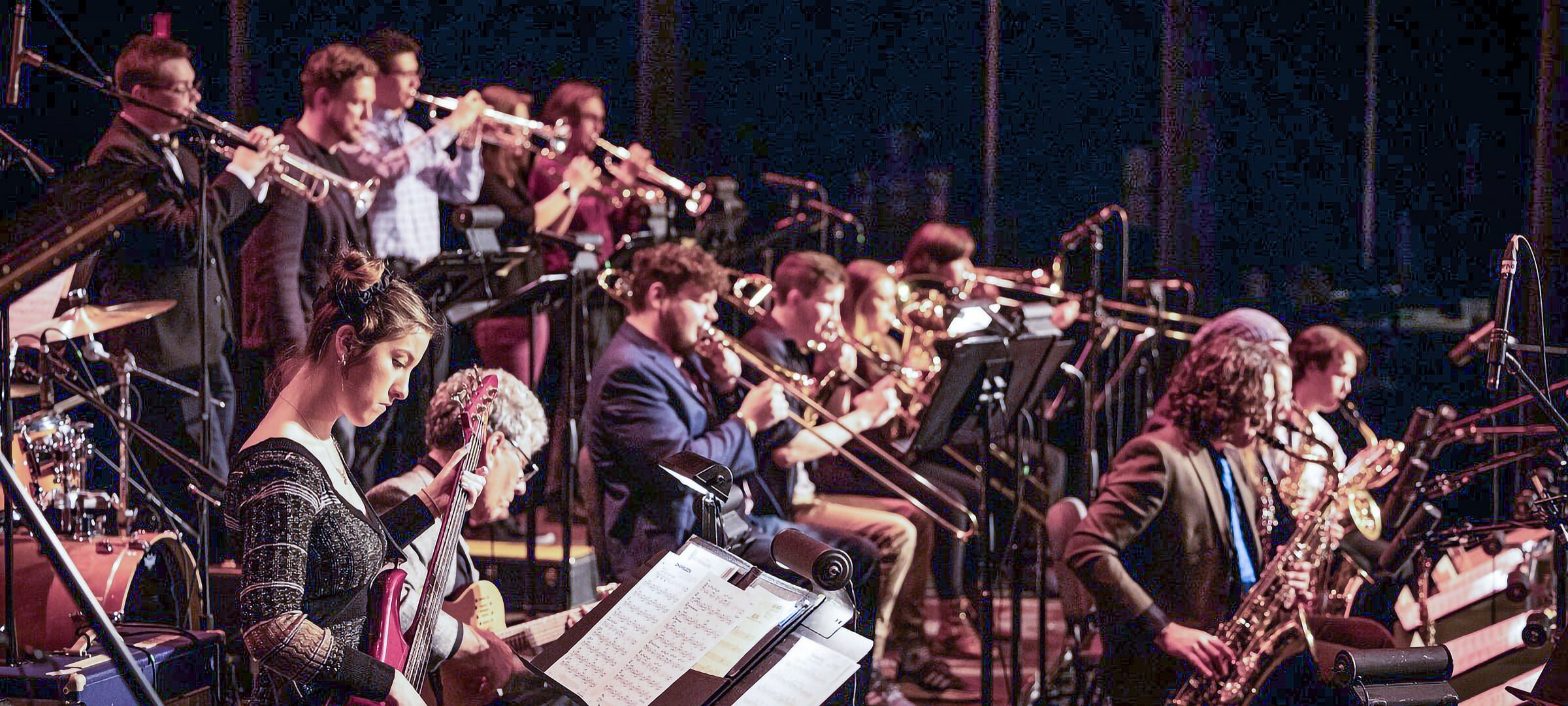
Study Jazz at MTU's Historic Jazz Program
MTU's Jazz program was started in the 1950's by Don Keranen and has been an integral part of the Visual and Performing Arts department at Michigan Tech for more than 6 decades. Run by trumpeter, composer, and entrepreneur Adam Meckler, the Jazz Studies program consists of two full size big bands, a New Orleans-style Brass Band, and four jazz small groups. Students who perform in Tech's premier Jazz Ensemble, The Jazz Lab Band, will enjoy a yearly outreach tour. Recent tours have gone to Chicago, Detroit, and Minneapolis. Students on tour have performed in historic Jazz clubs like Crooners in Minnesota, Cliff Bell's in Detroit, and DIY arts spaces like the Fulton Street Collective in Chicago.
Students who minor in Jazz Studies will play in jazz ensemble(s), and take a series of jazz courses including:
- History of Jazz
- Jazz Theory and Aural Skills
- Jazz Improvisation
- Jazz Arranging
- Final Project: Independent Study
Tech's Jazz Studies program is an in-depth and hands-on program for players who want to explore the rich heritage of Jazz. Students will learn music by ear, improvise in a variety of contexts, arrange and compose new music, learn about the history of the music, and discover broad historic and modern styles—all while making music with life-long friends in one of the oldest Jazz programs in the Midwest.
Try out for any of Michigan Tech’s accomplishedJazz Ensembles, Workshop Jazz Band, R&D Jazz Band, Jazz Lab Band, and Jazz combos. Get more involved by joining the student-led Video Game Jazz Ensemble.
Full STEAM Ahead
Combine your love of science, technology, engineering, the arts, and math (STEAM) into a career that requires creative, artistic, and technical skills. In the Department of Visual and Performing Arts, we emphasize creativity, self-motivation, and concrete goals—attributes that, combined with academic performance, add up to success. Develop critical skills to continue as a lifelong learner who adapts to ever-evolving entertainment industry technology. Our programs and faculty engage students and enrich campus by involving scholars from diverse fields in ambitious and meaningful projects, exhibitions, and performances.
- Access state-of-the-art facilities: Michigan Tech's Rozsa Center for the Performing Arts—the region's premier performing arts center—and the Walker Arts and Humanities Center are home to a traditional performance hall, flexible black box space, costume and scene shops, and a packed schedule of multimedia events. Work side-by-side with faculty on Michigan Tech productions and complete high-tech training in all aspects of the profession in well-equipped shops, labs, and performance venues—many with 24/7 access.
- Get personalized attention: With a student-faculty ratio of 8:1, you can build valuable relationships with world-class professors. Our students can access personal quality educational time with faculty and staff, and more exploratory time in the studio (with industry-specific equipment and tools).
- Build a career: Work one-on-one with your advisor to develop your career path—from student internships to post-graduation employment in the industry. Build your professional network and strengthen your presentation and interview skills at industry conferences and events. Build your portfolio as you prepare for a thrilling career in the arts and entertainment industry.
- Get involved: Join the 250 member strong Huskies Pep Band or one of 12 other ensembles. Be part of any of our 30+ music performances, 6+ art exhibitions or events, and 5 theatre shows. Or join any number of professional organizations on campus—WMTU; Audio Engineering Society; Mu Beta Psi (national music fraternity, non-music majors welcome); Sound Girls; Above The Bridge Records ; Sound and Lighting Service; and more.
Tomorrow Needs You
Supercharge your analytical skills to meet the demands of a technology-driven society at a flagship public research university powered by science, technology, engineering, and math. Graduate with the theoretical knowledge and practical experience needed to solve real-world problems and succeed in academia, research, and tomorrow's high-tech business landscape.