Students and faculty with a passion for robotics are making Michigan Tech a destination for all things robots and automation. To meet the needs of a quickly evolving industry, the University's scholars and researchers are using their multidisciplinary acumen to find solutions for real-world challenges in autonomous machinery. In the process, they're inspiring a new generation of robotics enthusiasts.
When Edwin Yazbec '21 '22 says he's made robotics his whole life, he means it. The Michigan Tech alumnus works full-time as a project engineer for Variation Reduction Solutions Inc. (VRSI), an engineering services company focused on industrial robotics based in Plymouth, Michigan. But Yazbec's passion for robotics doesn't stop at the end of the work day; in his off-hours, he volunteers with FIRST Robotics, the world's leading youth robotics community. Yazbec mentors two local high school robotics teams and volunteers at competitions.
"It's difficult to describe to someone else what it means to volunteer for a FIRST Robotics team," says Yazbec. "It's like, 'Oh yeah, I give up all my free time five days a week to help high school students build a robot that sometimes doesn't work.' People look at you like you're crazy."
But Yazbec knows just how important FIRST Robotics teams can be for students. He joined his own high school's robotics team, the Robo-Cubs, during his sophomore year at University of Detroit Jesuit High School and Academy.
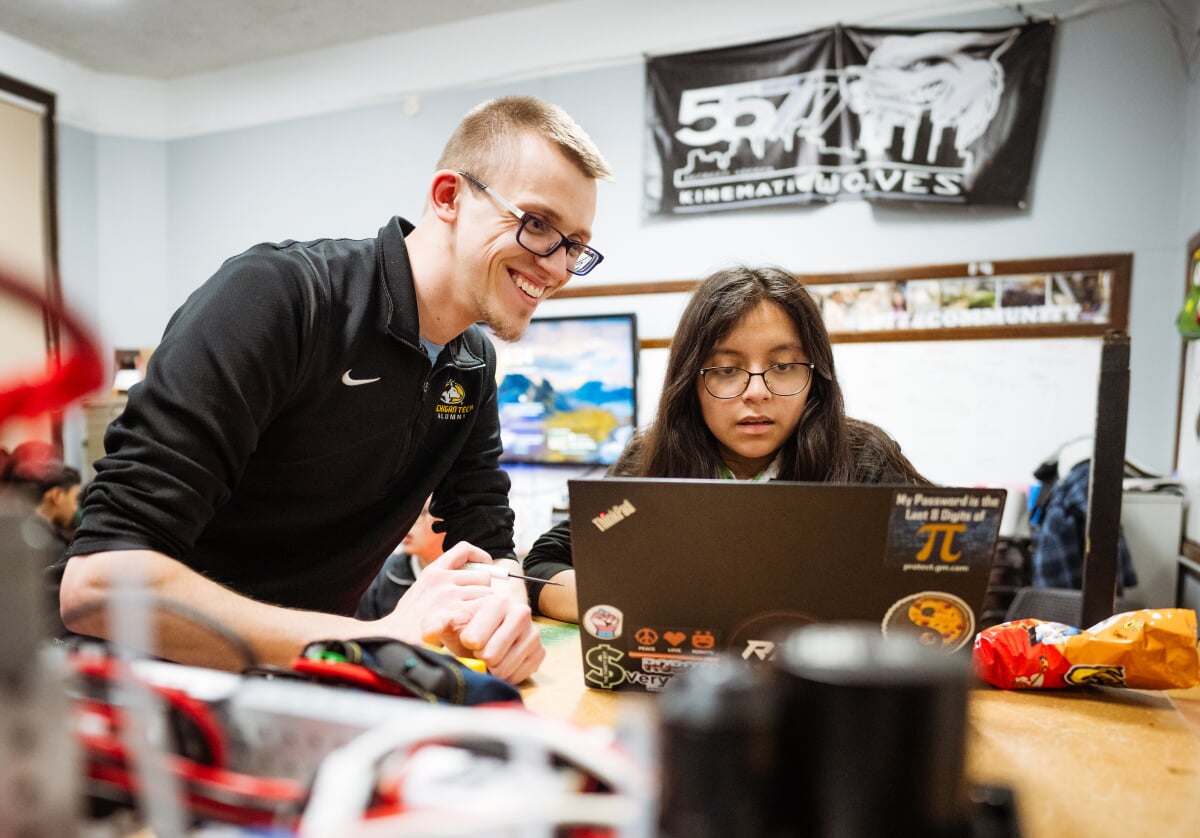
"I was excited to be building stuff," he says. "It was fun to design the thing, build the thing, and then see it work or not work. The quick feedback of design, build, and test was pretty exciting."
He credits much of his present-day success to those early years with FIRST. "Those technical skills, which formed the foundation of my knowledge of what I would need to succeed in college and in my career, were started on my FIRST Robotics team," he says.
FIRST—an acronym for For Inspiration and Recognition of Science and Technology—is a global nonprofit organization that prepares young people for the future through a suite of welcoming, team-based robotics programs for ages 5-18. The annual FIRST Robotics Competition challenges high school teams to design, program, and build industrial-sized robots to play an action-packed game. Each year's game is unique, featuring changing themes, rules, and objectives. Teams also create a team identity, raise funds to meet their goals, and perform STEM outreach activities in their communities while being guided by adult mentors like Yazbec.
After graduating from U of D Jesuit, Yazbec came to Michigan Tech in fall 2016 as a mechanical engineering student. "I knew the engineering program at Tech was solid, which was why I chose to apply," he says.
While at Tech, the College of Computing introduced its master's degree in mechatronics—a field Yazbec was already interested in.
"Mechatronics had been something I was initially looking at for undergrad, and so when I heard about Michigan Tech's master's program, I thought it would be a great opportunity," he says. "With the classes I had already taken, and doing it at an accelerated pace, it was only an extra year to get my master's, which felt like a no-brainer."
As a Husky, Yazbec held internships and co-ops with various companies in manufacturing engineering and participated in the Disney College Program at Walt Disney World. After graduating in 2022, he was a defense engineer intern with Trident Maritime Systems before joining VRSI.
Yazbec says the multidisciplinary nature of his coursework at Tech prepared him for his current role as a project engineer.
"In robotics nowadays, having a broad range of skills can be very helpful to any role you're in," says Yazbec. "I've got a Swiss Army knife of tools in my toolbox from mechanical engineering, mechatronics, and the programming I've done in the past."
Robotics is more than just a career for Yazbec. His passion and excitement for the field is what keeps him coming back as a FIRST Robotics mentor, a role he's held since he graduated high school nearly 10 years ago. He sees that same excitement in the students he mentors.
"I've worked with students who come in knowing absolutely nothing, who have never used hand tools or shop tools. You get them to do something hands-on maybe once or twice, and they say, 'That's amazing! I want to do that again,'" says Yazbec. "Seeing that enthusiasm for when things work and their drive for when things don't work is really, really exciting."
Robotics Happens Here
That same enthusiasm for robotics is alive and well on Michigan Tech's campus. In lecture halls, laboratories, makerspaces, and dormitories, Huskies are exploring everything robotics and automation have to offer.
With 15,465 square feet of laboratory space dedicated to robotics education and research, nine related undergraduate majors, and nearly 20 research groups and facilities focused on robotics research, Michigan Tech is continuously exploring the depth and breadth of the robotics field.
In the College of Engineering, students engage in the holistic integration of electrical, mechanical, and computing systems with a degree in robotics engineering—a multidisciplinary program offered by the Department of Electrical and Computer Engineering. With an emphasis on learning by doing, students gain the skills to research and develop the autonomous systems of the future.
Students looking to specialize in robotic components can do so with degrees in computer engineering, electrical engineering, mechanical engineering, or mechanical engineering technology. And, like FIRST Robotics high school teams, Huskies gain knowledge and skills hands-on, by working through the engineering design process and discovery-based learning—positioning Michigan Tech engineers at the forefront of positive change in the field of robotics.
"FIRST Robotics has been tremendously successful engaging youth in engineering and computing because it has created a community that celebrates curiosity and innovation through serious play," says Michelle Scherer, dean of the College of Engineering. "Here at Michigan Tech, we give them a bigger sandbox to play in with a cross-campus community that spans multiple departments and colleges, and lets students choose the part of robotics that they are most interested in."
Computing students at Michigan Tech develop the practical skills and theoretical knowledge they need to join the inventors, computational thinkers, and innovators of tomorrow. In the College of Computing, students blend industrial control and automation with a degree in mechatronics, exploring control and manufacturing processes in state-of-the-art facilities led by world-renowned faculty.
By working closely with expert faculty and driven peers to develop transformative technologies, students can become experts with degrees in computer science, electrical engineering technology, and information technology. Regardless of approach, there's more to explore in the field of robotics, automation, and control.
"Computing, mechanical engineering, and electrical engineering all come together to build robots," says Dennis Livesay, Dave House Dean of the College of Computing. "We have embraced this broad view at Michigan Tech and are working hard to connect the various departments, programs, and faculty that work in these spaces."
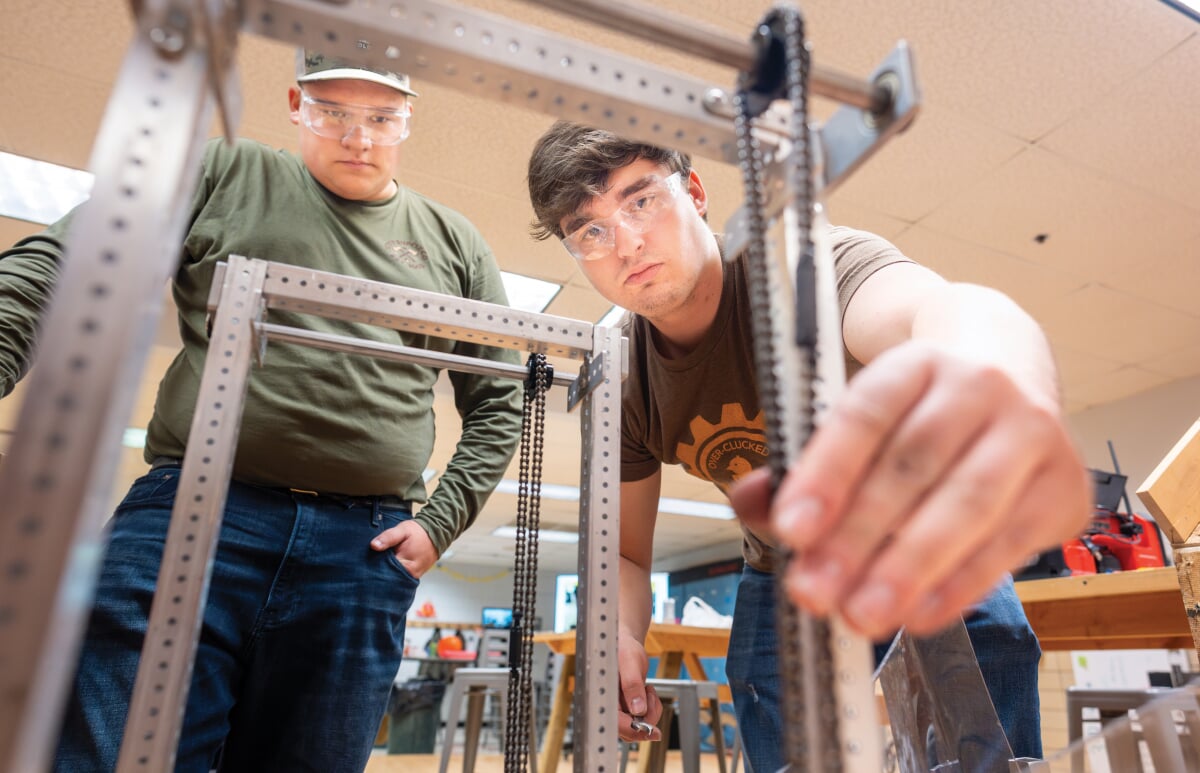
Robotics education doesn't just happen in the classroom at Tech. Students involved in the Enterprise Program's unique project-based curriculum work on self-guided, interdisciplinary teams to tackle real-world challenges for real clients in industry. Enterprise students develop lunar rovers as part of MINE, the Multidisciplinary INnovation Enterprise; compete in autonomous vehicle competitions on the Robotic Systems Enterprise team; or build custom drones with the Wireless Communication Enterprise.
For enthusiastic students like Yazbec, robotics exploration in coursework and projects is not enough. Those looking for more involvement often find Copper Country Robotics (CCR), a student organization established for alumni of FIRST programs as well as anyone interested in the field of robotics. CCR members mentor and volunteer with local high school robotic teams and competitions across Michigan's Upper Peninsula.
Tech's multidisciplinary approach to robotics education means that students have many avenues to explore the field. Where hands-on, practical education is vital to the educational framework, Michigan Tech students are working with robots and robotic systems every day.
The Copper Country's New Boom
When Yazbec came to Michigan Tech, Copper Country Robotics was only in its second year. The group was small but committed, and during his time in the student org, Yazbec helped institute technical workshops for the local high school teams near Houghton.
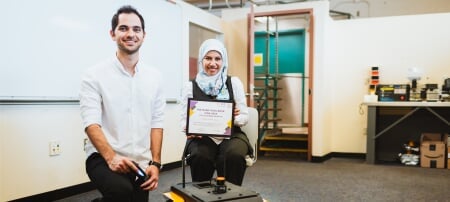
Those workshops continue today, now led by mechatronics student Athenabelle Lieu '26, CCR's current president. A FIRST alumna herself, Lieu first became aware of Michigan Tech when someone mentioned Tech's FIRST connections.
"I came to campus looking to join Copper Country Robotics," says Lieu, who hails from Berrien Springs, Michigan. "I heard about the FIRST Robotics alumni group and I wanted to continue being involved."
Just as they did during Yazbec's time, CCR members serve as volunteers and mentors for the Upper Peninsula's FIRST robotics teams—except now, the organization boasts nearly 60 members. The workshops for local high school teams have expanded to an annual boot camp where Michigan Tech students lead lessons on electronics, mechanics, and design—necessary skills for the FIRST Robotics Competition season.
And CCR is still growing at Tech. The organization has partnered with the Department of Electrical and Computer Engineering and is looking to expand their volunteering into Wisconsin. Also, for FIRST's 2025 competitive season, CCR participated in the Robot in 3 Days challenge—an event where university students have 72 hours to build a working robot prototype that meets the season's FIRST Robotics Competition specifications. Their robots serve as examples for high school teams, who have six weeks to complete their own design and prototyping phases.
The work is never done for the robotics club, but that's what Lieu likes about it; she enrolled at Tech in no small part because of Copper Country Robotics. Like Yazbec, Lieu's passions were sparked on her high school robotics team, where she was drawn to all the new skills she could learn. When her high school team found itself without a lead programmer, Lieu stepped up, even though she had no prior experience.
"I taught myself programming from past resources and documentation for four weeks straight," says Lieu. "When I finally got the robot to move its arm a little bit, I was leaping up and down. That was when I decided that robotics was something I wanted to study."
Lieu chose to study mechatronics at Michigan Tech because she wanted to be able to work across all fields of robotics—electronics, mechanics, programming, and more. Now, she is passing on her skills and passions to the next generation.
In addition to her responsibilities as CCR president, Lieu is the programming mentor for Team 857, Superior Roboworks, the first and oldest FIRST Robotics team in the UP, which is based out of Houghton High School. She works with new robotics enthusiasts like herself, and she's willing to go the extra mile for her students.
"It's exciting to see students who take initiative," says Lieu. "They come up to me and say, 'Hey, I've never done this before and I really want to try.' As long as they are interested, I will teach them what I can."
That enthusiasm for the work is something Lieu still carries with her today. "I see a lot of myself in the students I work with," says Lieu. "It feels great to pass on something to someone else."
Meet the Robots
Blizzard T. Robot
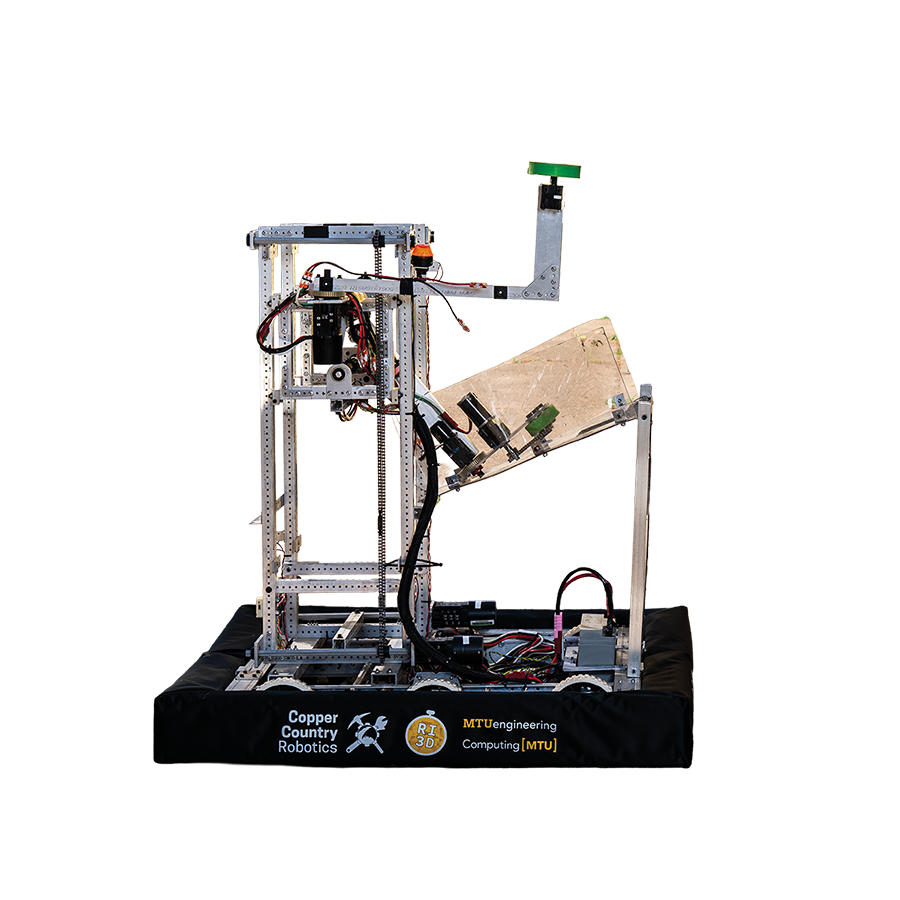
As part of FIRST Robotics' 2025 Robot in 3 Days challenge, Copper Country Robotics members constructed their working prototype, Blizzard T. Robot, in just 72 hours. They did so while documenting their process and the robot's specifications for public use. Their robot met the same requirements as the 2025 FIRST Robotics Challenge as a way to inspire and educate the high school robotics teams competing last year.
ATLAS Rover
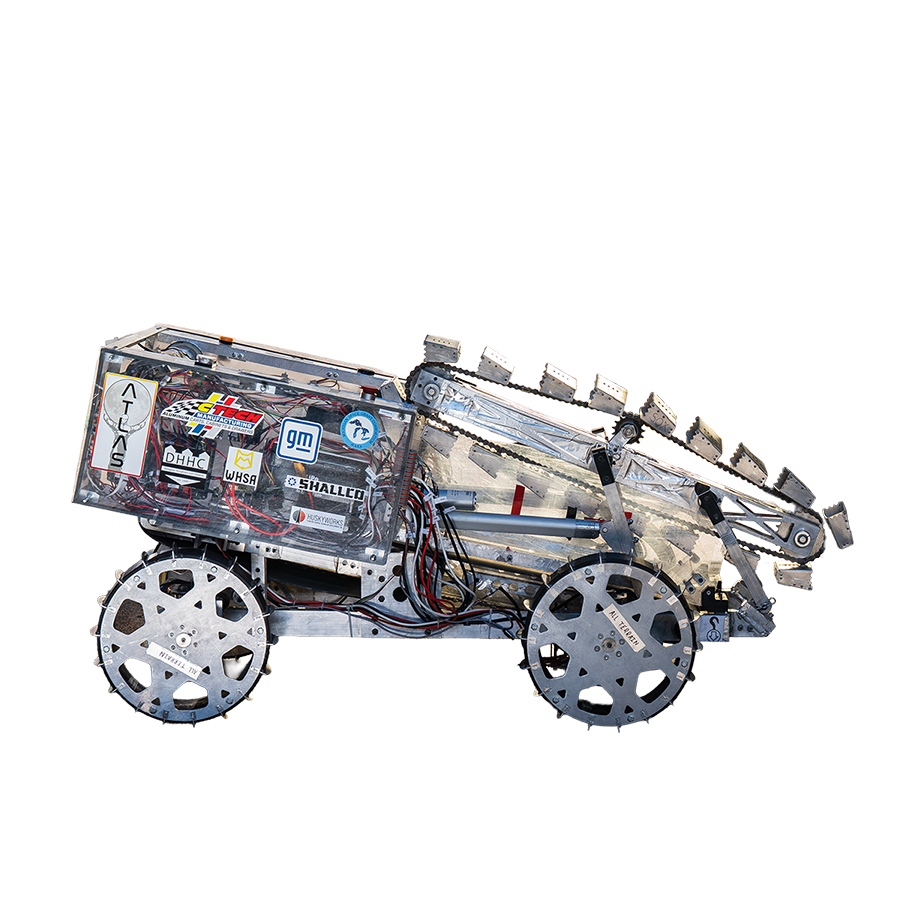
The Advanced Terrain Lunar Alteration and Shaping rover, or ATLAS, was Michigan Tech's entry in NASA's 16th annual Lunabotics Challenge, where the University's Astro-Huskies team placed fourth in the nation. The Astro-Huskies, part of Tech's Multiplanetary INnovation Enterprise (MINE), developed the ATLAS rover to remotely maneuver across a simulated lunar surface, collect material from an excavation site, and deposit the material in a nearby construction site.
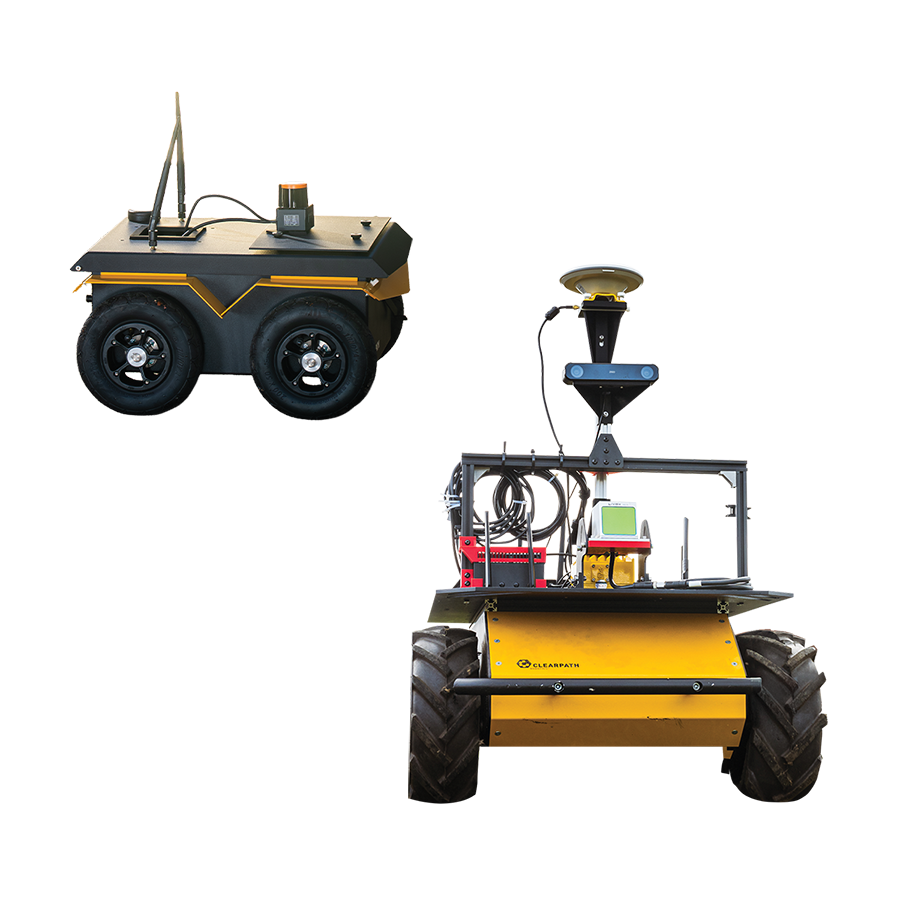
Husky and Jackal
Developed by Clearpath Robotics, the Husky and the Jackal are mobile robotic platforms designed for customizable robotics research. Assistant Professor Jung Yun Bae utilizes the Husky model in her automated agricultural research and Assistant Professor Amna Mazen won the 2025 international Benchmark Autonomous Robotic Navigation (BARN) Challenge with the Jackal.
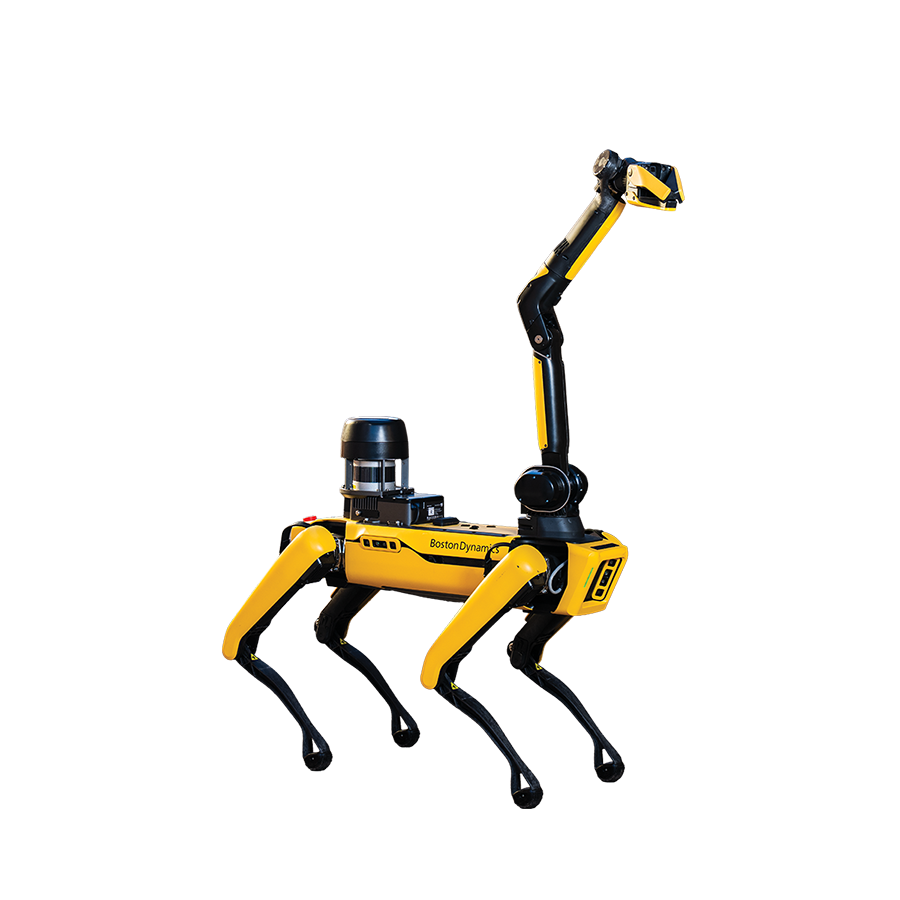
Balto
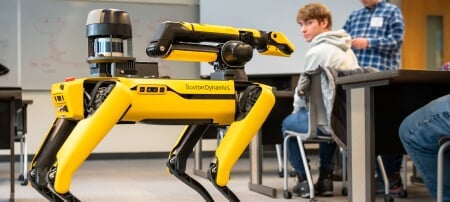
As one the newer robots on campus, Balto is a state-of-the-art Boston Dynamics quadruped robotics platform who will serve as a greeter in Michigan Tech's forthcoming new robotics lab in Rekhi Hall. Currently, Balto visits students and faculty around campus in an effort to familiarize the campus community with its robotic capabilities.
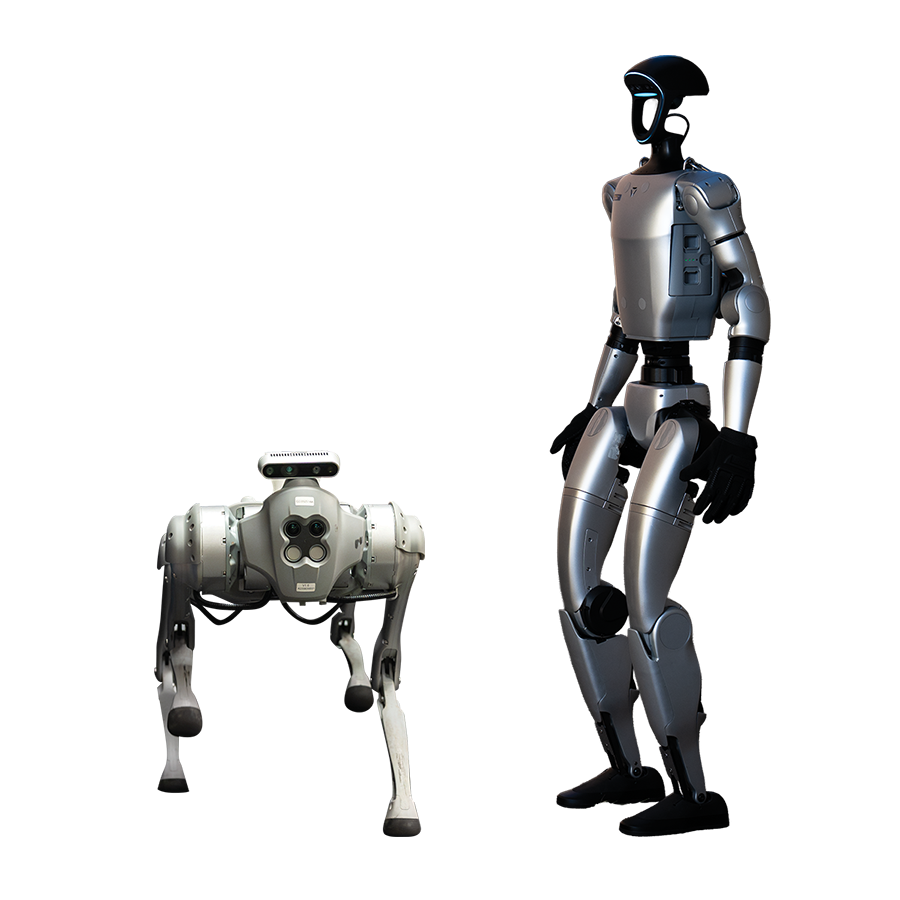
GoFish and Ecer
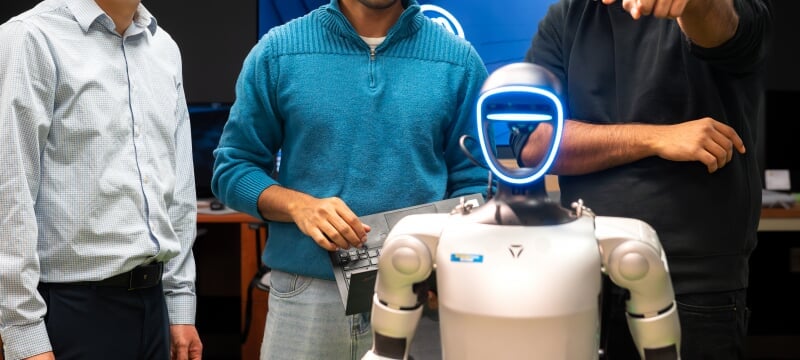
In Assistant Professor Tan Chen's lab, researchers study locomotion, movement, and control in both humanoid robots as well as bipedal (two-legged) and quadrupedal (four-legged) robots. Through their work, Chen's team hopes to advance the robots' ability to maneuver through complex physical environments, including rugged terrain on Earth and in space.
Research with Bark and Byte
Tech students aren't the only ones playing with robots. Faculty members and researchers from across the University investigate how robotics can drive innovation in the fields of manufacturing, aerospace, agriculture, kinesiology, and communication.
Assistant Professor Jung Yun Bae in the Department of Mechanical and Aerospace Engineering and Department of Applied Computing uses Clearpath Husky robots to streamline agricultural operations in her Intelligent Robotics and System Optimization Lab. With a grant from the Michigan Department of Agriculture and Rural Development, Bae and her team are assembling a low-cost, modular robotic fleet to improve the economic return of labor-intensive produce.
In the College of Computing, Assistant Professor Michael Walker walks a different kind of dog around campus. Balto, a quadruped robot designed by Boston Dynamics, will welcome visitors to Rekhi Hall's forthcoming robotics lab. Walker currently leads demonstrations around campus for students in an effort to inspire a future generation of robotics professionals and enthusiasts.
"You never know if some random robotics professor out of nowhere shoving the remote controller of a cutting-edge robotic system into your hands is the little push you needed to realize that you were really interested in something you had never considered before," says Walker.
Amna Mazen, assistant professor in applied computing as well as manufacturing and mechanical engineering technology, is fresh off her win at the international Benchmark Autonomous Robotic Navigation (BARN) Challenge, where her navigational algorithm not only blew away the competition but set a new standard for autonomous navigation. Now, she and her team in Tech's Robotics and Remote Sensing Lab plan to publish that algorithm to share with the robotics community.
Mazen is proud to be a part of the robotic ecosystem at Michigan Tech. "I like the work and I like how much I am supported here at Michigan Tech," she says. "Everyone wants you to be successful."
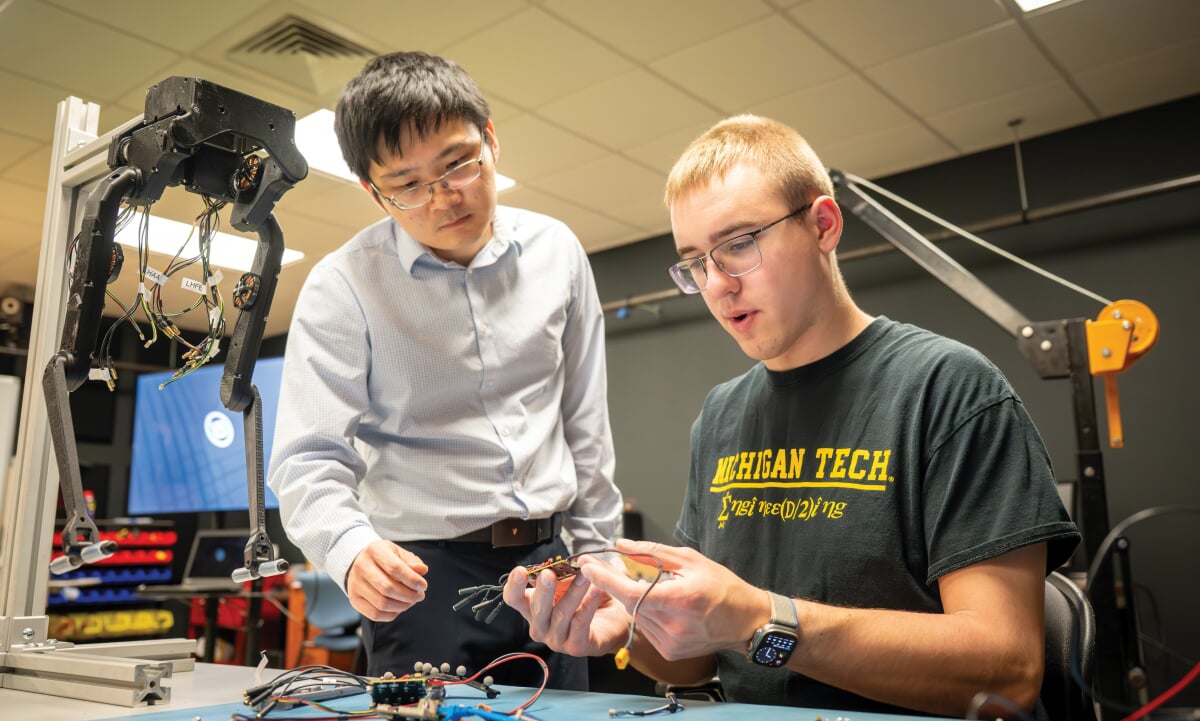
In Assistant Professor Tan Chen's Robotics Locomotion and Applied Control (RoLAC) Lab, he and his team are working to make bipedal, quadrupedal, and humanoid robots move more efficiently in a variety of environments. For their current project, funded by the National Science Foundation, Chen and lab members are investigating how walking robots can be better utilized in space environments, like the surface of the moon or Mars.
While Chen focuses on robotic locomotion, working at a STEM-focused technological university with many avenues for robotics research allows him to think holistically about the field of robotics. He's interested in a larger question: How can humans, artificial intelligence, and robots work together harmoniously in the future? In 2025, he organized a workshop for the international Conference on Automation Science and Engineering on the future of work in the age of robotics and AI.
"It's a very large field, and not entirely my focus, but I find it interesting," says Chen. "It goes beyond science, industry, and technology. We need to consider social sciences, especially to understand how these future worlds can coexist."
Robotics has already moved into the social sciences at Tech. Assistant Professor Jason Archer in the Department of Humanities leads research and teaches courses on human-machine communication. Different from human-robot interaction, which focuses on improving how humans and robots communicate, Archer's work is more interested in how interacting with machines and robots as often as we do is shaping our collective culture.
"Now more than ever, machines seem to be more autonomous and they seem to be communicating in ways that suggest they act as their own agents in communication," explains Archer. "How is communicating with machines potentially shifting how we value human-to-human communication? What are the values we want to shape going into the future?"
Archer is grateful to be able to ask these types of questions at Michigan Tech. More than half of the students enrolled in his human-machine communication course are engineers and computer scientists, and he accepted his position at Tech due in a large part to the University's technological prowess.
"I wanted to work with people who were developing these technologies to get a better understanding of the technical aspects but also their desires and motivations," says Archer. "This is a place where I can learn a lot from engineers and scientists but then I can fill the gap of critical cultural perspectives on the work being done at a university like this."
It's important to Archer that Tech students not only have the technical skills necessary to build these machines, but the social skills and cultural awareness needed to understand the impact of the work they are doing.
"Our students need to have a critical understanding of these technologies," he says.
Armed with a variety of perspectives, from the mechanical and electrical to the computational and cultural, Michigan Tech students, faculty, and staff are investigating everything the field of robotics has to offer.
Labs and Facilities
With 15,465 square feet of lab space dedicated to robotics education and research, Michigan Tech is committed to discovering real solutions to real challenges in robotics, automation, and artificial intelligence.
- Automation in Manufacturing and Industrial Systems Lab
- Collaborate Robotics and Immersion Lab
- Intelligent Robotics and System Optimization Lab (IRoSOL)
- Autonomous Systems Teaching Lab
- Robotics and Mechatronics Teaching Lab
- Intelligent Systems and Control Lab
- Planetary Surface Technology Development Lab (PSTDL)
- Benedict Lab
- Robust Autonomous Systems Lab (RASL)
- Robotics Locomotion and Applied Control (RoLAC) Lab
- Robotics and Remote Sensing Lab (RRSL)
- Neuromorphic Robot Lab
- Robotics and Controls Teaching Lab
- Plexus Innovation Lab
- Mechatronics Playground
- Hydraulic Motion and Control Lab
- Polymeric Additive Manufacturing Facility
- Manufacturing and Mechanical Engineering Technology Machine Shop
Life Among the Machines
For students like Yazbec and Lieu, robotics is more than just a course of study; it's how these FIRST alumni turned Michigan Tech Huskies found their sense of purpose.
"Robotics has taught me a lot about myself and what my skill set is," says Lieu. "I've learned how to communicate with local businesses so they will sponsor us. I've learned how to present myself and make honest connections."
Those interpersonal skills may seem secondary to some, but not to Lieu. She's become a leader on campus, inspiring both her peers at Tech and future robotics students.
"I didn't realize how much impact I could have on other people," she says.
Yazbec knows that the broad skill set he gained in his multidisciplinary robotics education is what makes him successful in his current role. Now he's helping guide others down the same path to success in the robotics industry.
"Robotics is the reason I am in the position I am now, why I've had the experiences that I've had, and that's something I want other students to have," says Yazbec. "I've had wonderful mentors in my past and I want to be able to be that positive role model for students now."
Outside of Michigan Tech, Yazbec finds that few people spend as much of their time thinking about robots as he does. He understands that, but wouldn't have it any other way.
"There are a lot of things to do in this life, and robots are just one of them," says Yazbec. "But I know what I signed up for. Robots have basically become my life."
Michigan Technological University is an R1 public research university founded in 1885 in Houghton, and is home to nearly 7,500 students from more than 60 countries around the world. Consistently ranked among the best universities in the country for return on investment, Michigan's flagship technological university offers more than 185 undergraduate and graduate degree programs in science, technology, engineering, mathematics, computing, forestry, business, health professions, robotics, psychology, social sciences, humanities, and the arts. The rural campus is situated just miles from Lake Superior in Michigan's Upper Peninsula, offering year-round opportunities for outdoor adventure.