
From campus spaces to the surrounding landscape, Michigan Tech encourages exploration and calculated risk-taking. These experiences sharpen Huskies' technical skills while building confidence, adaptability, and problem-solving instincts that extend far beyond the classroom.
East Hall: A New Home for Huskies
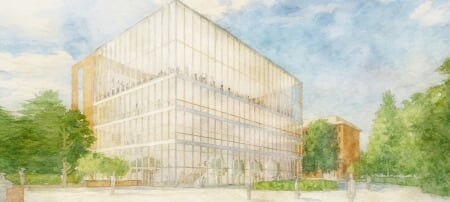
Michigan Tech's East Hall, a new residence hall designed with sustainability and student connection in mind, officially opened its doors in August 2025.

Located at the east entrance to campus, East Hall adds 126,000 square feet of residence space for as many as 512 Huskies. The new residence hall features modern, collaborative spaces that enhance student life and help address the growing demand for student housing as the University continues its strong trend of measured enrollment growth.
East Hall's added housing space makes room for more Huskies to experience the vibrant, supportive community that defines campus life. National research has often linked living in campus housing with higher retention, improved academic outcomes, and stronger campus engagement for college students.
"Serving as a gateway to campus, the new East Hall represents Michigan Tech's ongoing commitment to student success through its innovative design and emphasis on collaborative spaces," said Rick Koubek, the University's president.
The hall features suite-style rooms for both single and double occupancy. It also has a gaming lounge, a music studio, shared kitchens, study lounges, adaptable meeting rooms, and a convenience store for students.
East Hall's amenities include building-wide air conditioning and covered bike storage, as well as a semi-private bathroom in each unit. Its sustainable features include an energy-efficient HVAC system, LED lighting, and other resource-conscious elements, putting the building on track for LEED certification from the US Green Building Council. The Leadership in Energy and Environmental Design rating system measures a building's sustainability and resource efficiency, with certifications ranging from Certified to Silver, Gold, and Platinum.
Planning for the new hall began in 2023 as part of Michigan Tech's long-term campus plan, which outlines strategic priorities for enrollment growth, facility renewal, and the student experience. The first new residence hall since Hillside Place opened in 2010, East Hall represents a significant investment designed to meet current and future student housing demand.
"East Hall expands our housing capacity by 19 percent and introduces new living options for students, offering them a different experience each year they live on campus," said Matt Weekley, executive director of Residential Living. "Its design bridges the shared community of traditional residence halls with the added responsibility of suite-style living, helping students build the skills they'll need for independent living."
Tech Hosts Regional ASCE Student Symposium
Last April, Houghton became a city of civil engineers! More than 450 student competitors arrived at Michigan Tech to participate in the Eastern Great Lakes ASCE Student Symposium. Michigan Tech's student chapter of the American Society of Civil Engineers hosted the event, which saw 16 universities attend.

Holding the regional civil engineering conference at Michigan Tech was a true return to the event's roots. In 1987, MTU competed in the first-ever Student Steel Bridge Competition alongside Lawrence Technology and Wayne State Universities.
Since then, Steel Bridge has become part of a suite of civil engineering student competitions held during ASCE regional symposiums across the country. Michigan Tech's ASCE chapter has a history of standout performances in Steel Bridge, as well as the Concrete Canoe and relatively new Timber Strong contests.
Huskies worked all year to plan the symposium. In addition to weekly team meetings and practices, ASCE students coordinated team registration and waivers, communicated updated rules and guidelines, and handled publicity and logistics for the event.
"Preparing for competition each year is a monumental effort in itself, but adding symposium planning to the mix has granted me a humbling respect for all those who have volunteered their time planning past symposiums and those yet to come," said Brendan Tanner '26, senior civil engineering student and Michigan Tech's ASCE chapter president during spring 2025.
"It's an honor to be able to host the regional competition," said Connor Tokie '25, MTU Steel Bridge team captain, prior to the event. "It's a really big deal that we get to host this year. We take a lot of pride in that and we are excited to have other schools up here."
Michigan Tech won the Timber Strong, Concrete Canoe, and Wastewater Treatment competitions, and earned second place in Steel Bridge. Additionally, Huskies received the Spirit of the Competition award for their integrity, teamwork, and professionalism.
"Michigan Tech civil engineers are humble, hardworking, and dedicated to the profession," said Audra Morse, College of Engineering associate dean and former chair of the Department of Civil, Environmental, and Geospatial Engineering. "They are comfortable saying 'I don't know' and will seek out an answer. They value hands-on experiences, getting dirty, and challenging themselves to succeed. Civil engineers at Tech are intrinsically motivated and they love to win."
MTU Announces Chang K. Park Center for Student Wellness
In December, the University's Board of Trustees approved construction of the Chang K. Park Center for Student Wellness—a new facility intended to provide students with over 90,000 square feet for modern campus wellness programming and holistic care.
The facility, to be located between the Memorial Union and Administration Buildings, will advance student emotional, physical, and mental health, with dedicated space for instructional areas, a fitness center, locker rooms, group training rooms, a medical clinic, outreach and prevention offices, and accessible wellness amenities throughout.
The center is made possible by a transformational $55 million gift—the largest individual gift in University history—from alumnus and philanthropist Chang K. Park '73. The building is expected to open in fall 2028.
Design Expo, Enterprise Program Celebrate 25 Years at Michigan Tech
Michigan Tech's Design Expo rang in its 25th year in April as more than a thousand students presented their collaborative projects. Design Expo 2025 featured work completed by Huskies in all stages of their MTU education, including first-year Engineering Fundamentals students, teams from Michigan Tech's Enterprise Program, and capstone Senior Design students.
Sponsored by Enterprise—also celebrating 25 years—and the College of Engineering, Design Expo continues to be a national beacon of hands-on, experiential education. The annual event showcases years of work, study, and interaction between student team members, faculty advisors, and industry.

"This year's Design Expo was more than a showcase—it was a celebration of what happens when education meets experience," said Nagesh Hatti, Enterprise Program director. "The energy, creativity, and professionalism displayed by our students left a lasting impression on everyone in the room."
"Industry judges were deeply impressed by the complexity and innovation behind student projects, and students walked away with meaningful feedback that will shape their future careers," said Hatti. "The 25th anniversary of the Design Expo was a powerful reminder of how far we've come."
The event was also an opportunity for Michigan Tech students to celebrate a year's worth of hard work.
"It's been great to see what everyone else is working on," said Ryan Moreau '25, whose Senior Design team presented at this year's expo. "We've been so focused on our own project that we haven't had much time to hear about other projects. It's really nice to see all the different applications that Tech engineers are doing."
The Enterprise Program began its unique project-based curriculum during the 1999-2000 academic year, in conjunction with the first Design Expo. For its 25th anniversary, Enterprise recognized the dedication and exceptional contributions of eight advisors and champions at Michigan Tech who played pivotal roles in shaping the program's success.
The Enterprise Program presented its inaugural Enterprise Distinguished Service Awards to Brett Hamlin, Glen Archer, Rick Berkey, Jason Blough, Brad King, Robert Pastel, Tony Rogers, and Christopher "Kit" Cischke. Each honoree has contributed more than 15 years of service to Enterprise, dedicating their time and expertise to guide teams, ensure student success, and advance the program's discovery-based learning mission, as well as foster industry collaborations and strengthen the bridge between academia and industry.
Green Campus Enterprise member Emily Johnson '27, a junior environmental engineering student, offered a student's take on the Enterprise Program's mission: "It's really cool to get hands-on in a project rather than just attending lectures all day," she said. "It's great to see your work on campus making a difference."
The Making of a Cardboard Boat
Since 2005, Huskies have put their engineering prowess to the test by building and racing cardboard boats during Homecoming Week. Like highly classified snow statue strategies, most teams hold boat-building secrets close to the vest (er, life jacket). Lucky for us, the East Hall crew of the 2025 entry Unicorn agreed to spill the details.

A seaworthy cardboard boat is a precision vessel made of many parts and pieces. The Unicorn was a roughly rectangular vessel measuring 120 inches long and 60 inches wide, with triangular ends measuring 40 inches on a side and extending 30 inches from the center. It was made of many assorted cardboard pieces, some measuring 24 inches wide, swathed in a dozen 30-foot rolls of six-inch duct tape. While donning 30-inch-tall life jackets for extra buoyancy, paddlers propelled the vessel using 48-inch-long oars, each approximately three inches across and one inch thick at the handle, with a paddle blade that was one-quarter-inch thick.
Before a single piece of cardboard was sacrificed, the crew went full Michigan Tech, drafting, calculating, debating, and re-sketching hexagonal cross-sections, bow angles, and anything else that might keep their boat afloat.
Front and center, their whiteboard bore the now-immortal warning, "X is flat floe!!" Translation: Ignore stability and your boat will wobble like a first-year Husky in spring semester trying to conquer the hill to the SDC in Crocs and gym shorts.
Their primary building material? Cardboard hoarded from 2025 Move-In Days. More than 7,800 square inches of cardboard surface area went into the 15-foot vessel, reinforced with crossmembers fashioned from—you guessed it—cardboard scrap. The team also debuted their signature innovation: flotation-maximizing "Best-a-gons" (patent pending, obviously).
Assembly required 10 to 12 mostly 30-foot rolls of duct tape—because if duct tape can't fix it, you're not using enough.
The boat launched at a respectable 300 pounds. It exited the water north of 600. Call it buoyancy, call it tenacity—either way, it's pure Michigan Tech engineering in action.
Read more about the good ship Unicorn and its voyages.
Marcus Tomashek Latest in Long Line of Tech's Badger State Greats
Michigan Tech fans have heard this story before: A men's basketball player from Wisconsin arrives in Houghton, puts on the black and gold, and proceeds to light up the SDC Varsity Gym while lifting the Huskies to national relevance. It's a familiar script—one that now stars Marcus Tomashek.

A senior from Green Bay, Tomashek is the latest product of a well-worn pipeline connecting the Badger State to Michigan Tech basketball. Austin Armga, Ben Stelzer, Kyle Monroe, Owen White—Tech's list of recent Wisconsin-bred All-Americans reads like a roll call of program legends. Even head coach Josh Buettner, a Shawano native, was a two-time All-American during his playing career with the Huskies.
Tomashek is etching his name in Michigan Tech's record books right alongside his predecessors. As a junior, he averaged 23.2 points, 4.2 rebounds, and 2.8 assists per game, earning himself a slew of awards in the process: Player of the Year in both the D2CCA Midwest Region and the GLIAC; All-Region, All-GLIAC First Team; and All- American honors. His 720 points ranked fourth for points in a season across MTU program history. In January, midway through his senior season, he became just the fifth men's basketball player in University history to score 2,000 career points.
Off the court, Tomashek fits seamlessly into the Upper Peninsula. A soft-spoken outdoorsman, the Yooper-in-spirit blends in with the fans who fill the stands to watch him play. The forestry major spent summer 2025 working at Michigan Tech's Ford Center in Alberta, continuing to balance his academic pursuits with his rise as one of the GLIAC's most dangerous scorers.
For Michigan Tech fans, the story is familiar—and the show is as compelling as ever.
Michigan Technological University is an R1 public research university founded in 1885 in Houghton, and is home to nearly 7,500 students from more than 60 countries around the world. Consistently ranked among the best universities in the country for return on investment, Michigan's flagship technological university offers more than 185 undergraduate and graduate degree programs in science, technology, engineering, mathematics, computing, forestry, business, health professions, robotics, psychology, social sciences, humanities, and the arts. The rural campus is situated just miles from Lake Superior in Michigan's Upper Peninsula, offering year-round opportunities for outdoor adventure.