
Michigan Tech is making good on our designation as one of the nation's premier R1 research institutions with a haul of prestigious national, international, and University research awards.
MTU Robotics Lab Wins International Autonomous Navigation Challenge
Michigan Tech's Robotics and Remote Sensing Lab brought home an unprecedented win in the 2025 Benchmark Autonomous Robot Navigation (BARN) Challenge.

Led by Amna Mazen, assistant professor of applied computing and manufacturing and mechanical engineering technology, the Robotics and Remote Sensing Lab tested their algorithm against 50 unseen simulated environments in the challenge's first stage. They placed seventh—enough to earn an invitation to compete in the physical stage at the IEEE International Conference on Robotics and Automation, held last May in Atlanta, Georgia.
Michigan Tech was the only first-time competitor to make it to the physical stage at ICRA. In a complete upset, Mazen's team won by a wide margin.
"After the first two rounds, the organizers declared us the winners because even if we didn't compete in the third round, we would still have won," said Mazen. "We were so successful in the first two rounds that there weren't enough runs in round three for any of the other teams to catch up."
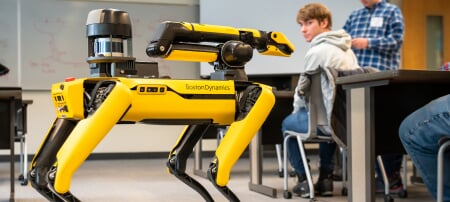
The BARN Challenge began as a way to create an annual benchmark for robotic navigation systems and help autonomous robots perform better in challenging environments. Competitors develop navigation algorithms for the Clearpath Jackal robot, which guide the robot through an environment as quickly as possible without any collisions.
The challenge creates a public dataset describing over 300 simulated environments. Using this data, robotics researchers around the world can test their own algorithms against the simulated obstacles.
Mazen created the team's winning algorithm as a PhD student in robotics at the University of Detroit Mercy. After joining Michigan Tech's faculty in 2024, she and graduate student assistants Kamyab Yazdipaz and Innocent Mateyaunga '25 "robustly updated" it for the challenge.
Mazen said her algorithm follows rules, telling the robot, "If you see this, do that. If you see that, do this."
She said the other teams based their algorithms on learning a series of environments, and if their robots had encountered obstacles similar to what they knew, they would have navigated better than Michigan Tech's. But the challenge's physical stage featured new environments in each of its three rounds, giving Mazen's algorithm the advantage.
"Since my algorithm is rule-based, it generalizes better," she said. "If the other teams encounter a brand-new environment, they will not be as successful, but my robot will."

In the physical stage's first round, Michigan Tech's robot completed all five of its runs successfully, with no collisions. None of the other eight teams completed any—and the second round did little to level the playing field.
"Many people attending ICRA came up to us to ask how our algorithm works and how we were able to be so successful," she said. "The organizers told us that this competition may have to change in the future based on our performance."
Mazen considers this the logical next step to move the field of autonomous robotic navigation forward. She said she hopes the Robotics and Remote Sensing Lab's winning performance will help challenges like BARN evolve.
"We want everyone to be able to navigate through the environments successfully. That way we can focus on the next step, which is who can do it faster," she said. "That's the next problem, to be able to navigate the environments both successfully and optimally."
Michigan Tech Research Award
2025 Michigan Tech Research Award winner John Vucetich is one of the most recognized wildlife ecologists on the planet, with a body of research that ranges across species and disciplines.

A distinguished professor in the College of Forest Resources and Environmental Science, Vucetich is perhaps best known for his research related to Michigan Tech's Isle Royale wolf-moose project—a 67-year-old study based at Tech since 1975. He joined the research team in the '90s and is now one of its co-leaders.
Vucetich's work in conservation biology, particularly in carnivore conservation, is praised for advancing the field's understanding of wildlife management and conservation practices. He is also noted for his early adaption of environmental data science techniques, which led to the discovery of new insights about the population ecology of wolves and moose on Isle Royale.
Beyond the wolf-moose project, Vucetich holds an exemplary commitment to teaching and mentoring his students.
His impactful contributions to research include examinations of carnivore ecology, conservation genetics, the US Endangered Species Act, environmental ethics, and conservation in social sciences. One award nominator described him as "the best and most influential conservation ethicist in the world."
Vucetich has been a scientific advisor to the Humane Society of the United States since 2015. He's the author of two books: 2021's Restoring the Balance: What Wolves Tell Us about Our Relationship with Nature and the textbook The Biology and Conservation of Animal Populations, which received the 2025 best authored book award from The Wildlife Society, a worldwide organization dedicated to excellence in wildlife stewardship.
The Michigan Tech Research Award recognizes outstanding scholarly achievement by a faculty member and is awarded based on the impact of the person's research—particularly sustained research or a noteworthy breakthrough. The Michigan Tech Research Award is symbolic of the University's high standard for research endeavors.
National Science Foundation Graduate Research Fellowships
Michigan Tech graduate students Anthony Ciletti, William Johnston, and Ellie Resendiz are the recipients of Graduate Research Fellowships from the National Science Foundation (NSF).
The oldest STEM-related fellowship program in the United States, the NSF Graduate Research Fellowship Program (GRFP) recognizes exceptional graduate students in science, technology, engineering, and mathematics disciplines early in their career. The fellowship supports students with three years of funding during their graduate education.
Ciletti and Johnston are PhD students studying mechanical engineering-engineering mechanics in the Department of Mechanical and Aerospace Engineering. Both are advised by Associate Professor Bhisham Sharma. Resendiz is a master's student in the College of Forest Resources and Environmental Science working alongside Assistant Professor Jared Wolfe.
Ciletti's research involves acoustic sound absorbing materials, an area where he said exciting possibilities have emerged thanks to 3D printing and other manufacturing advancements. He is working to develop experimental and computational tools needed to characterize these materials, especially those which investigate pore geometry.
Johnston's research explores the development of 3D printing techniques to create inflatable structures that use tensegrity principles to improve dimensional accuracy.
Resendiz's research aims to identify characteristics of stopover habitat that drive variation in body condition of migrating songbirds in the Great Lakes region.
Bhakta Rath Research Award
Researchers Pengfei Xue and Miraj B. Kayastha developed computational models of regional Earth systems to better understand and predict extreme weather and environmental change. Their groundbreaking work, which represents the Great Lakes in 3D and accurately captures lake-atmosphere interactions, has been honored with Michigan Tech's 2025 Bhakta Rath Research Award.

Xue is a professor in Michigan Tech's Department of Civil, Environmental, and Geospatial Engineering and associate director of the Great Lakes Research Center. He and Kayastha, his PhD student, centered their research on the Great Lakes as a crucial part of the ever-expanding puzzle of regional climate variability and prediction. Colleagues place their work at the forefront of regional climate studies and recognize Kayastha as a top-tier researcher and future leader in the field.
"Our research aims to understand how the Great Lakes and their regional climate might evolve in the future, with a particular focus on changes in water levels and devastating lake-effect snowstorms," said Kayastha.
"In essence, our research provides the scientific foundation and decision-support tools needed to navigate an uncertain future," said Xue. "It directly advances the nation's capacity for sustainable development, resource security, and resilience—critical pillars for meeting the challenges of the decades ahead."
Xue and Kayastha's models take an interconnected, holistic approach to understand and predict extreme weather events and environmental change.
"We are entering a time when climate variability, extreme weather, and environmental change will increasingly challenge the resilience of our infrastructure, natural resources, and communities—especially in freshwater and coastal regions," said Xue. "Our work in regional Earth system modeling helps us understand how these interconnected systems respond to both natural forces and human activities. These systems are not only vital ecological assets but also essential to drinking water supply, energy production, transportation networks, and the economic well-being of over 30 million people living in the Great Lakes region."
The Bhakta Rath Research Award recognizes a doctoral student and their Michigan Tech faculty adviser. The award was established by Bhakta B. Rath and his wife, Sushama Rath, to recognize those who conduct exceptional scientific and technological research in anticipation of the future needs of the nation while supporting potential advances in emerging technology.
Susanta Ghosh Receives NSF CAREER Award
In 2025, Michigan Tech researcher Susanta Ghosh's work in machine learning-based electron density prediction received one of the National Science Foundation's highest honors.

Ghosh, an assistant professor of mechanical and aerospace engineering, received a $669,490 NSF Faculty Early Career Development Program (CAREER) Award for his research project "Bayesian Symmetry-Respecting Machine Learning Framework for Predicting Electronic Structures in Materials Design."
The project focuses on gaining fundamental insights to atomic configurations and corresponding electronic structures, as well as providing cost-effective, large-scale electronic structure calculations in order to accelerate materials design and discovery.
"Accelerating materials modeling and discovery through artificial intelligence can revolutionize advanced materials research and device design impacting a wide range of fields," said Ghosh. Beyond materials science, his research is also applicable to fields such as biomedical imaging and continuum physics problems.
The CAREER Award is the National Science Foundation's most prestigious award in support of early-career faculty who have the potential to serve as academic role models in research and education. The honor also recognizes rising leaders whose work could drive research advances in their department or organization. The award will support Ghosh's research through 2030.
"Professor Ghosh's NSF CAREER Award draws on his expertise across several disciplines to converge on solutions for complex problems," said Michelle Scherer, dean of the College of Engineering. "This is exactly what these prestigious NSF awards are meant to support—innovative approaches to complex problems. It will be exciting to see what Professor Ghosh and his students discover!"
MTU Joins Research Universities for Michigan
Michigan Technological University is the newest member of Research Universities for Michigan (RU4M), an allied academic research cluster of the state's four leading research institutions that fosters talent, academic research, and economic revitalization in the state.
Michigan Tech's inclusion marks a significant expansion of RU4M's collective expertise and impact. Additionally, membership in the group further aligns the University's cutting-edge research and talent pipeline with Michigan's key industries, including advanced manufacturing, artificial intelligence, sustainability, and life and health sciences.
RU4M's other members are Michigan State University, the University of Michigan, and Wayne State University.
Collectively, Michigan's four R1 universities totaled more than $3.135 billion in research and development expenditures for fiscal year 2023. This accounts for more than 93 percent of the state's total academic R&D conducted, and 95 percent of the state's total academic R&D funded by the federal government, which supports research related to defense, health sciences, and other vital areas to drive American competitiveness.
Michigan Tech is the first institution added to RU4M since its formation in 2006 under the name University Research Corridor, or URC. Tech was invited to join in March 2025 after the University was elevated to R1 status by the Carnegie Classification of Institutions of Higher Education, formally placing Michigan Tech among the nation's most elite research institutions. Shortly after Michigan Tech joined the group, members voted unanimously to adopt the name RU4M to better reflect the group's evolving mission and growing impact across the state.
Michigan Technological University is an R1 public research university founded in 1885 in Houghton, and is home to nearly 7,500 students from more than 60 countries around the world. Consistently ranked among the best universities in the country for return on investment, Michigan's flagship technological university offers more than 185 undergraduate and graduate degree programs in science and technology, engineering, computing, forestry, business, health professions, humanities, mathematics, social sciences, and the arts. The rural campus is situated just miles from Lake Superior in Michigan's Upper Peninsula, offering year-round opportunities for outdoor adventure.