

From new faculty and leading-edge research to the forward-looking legacy of a Dean Emeritus, our Huskies benefit from a College of Business support system that builds community and scholarship.
Business Dean Emeritus Remembered
In February, the College of Business joined friends and family in celebrating the life of two-time Michigan Tech School of Business and Economics Dean Robert "Gene" Klippel. Klippel died February 20 at age 86.

Klippel was one of nine deans to serve the College, holding the position from 1994 to 2001 and again from 2012 to 2015. Dean Johnson, current dean of the College of Business, said Klippel's help was key in laying the groundwork for the SBE's 2019 transition into a full academic college.
"Gene was responsible for leading the effort that earned AACSB (Association to Advance Collegiate Schools of Business) accreditation the first time," said Johnson.
Klippel expressed his vision for technology-infused education that would set Michigan Tech business students apart in the 2013 Impact Magazine.
"Businesses never sit still, rest on their laurels. They evolve, they adapt, they react, and they innovate. Business education should be no different," he wrote. "Hard decisions, bold action. That is reality in the School of Business and Economics. That is what we invent by merging business and technology. That is the edge every business strives to grasp. That is the advantage we seek for our students as they create the future."
Read more about Klippel's life and legacy as a business educator.
New Faculty Share Their Expertise
Last fall, the Michigan Tech College of Business welcomed Giridhar Reddy Bojja, assistant professor of information systems and analytics, and Steven Holloway, assistant teaching professor of economics.
Data, Health, and Hands-on Learning
Bojja brought to Michigan Tech a unique blend of academic expertise and industry experience in information systems, analytics, and computer science. His professional background includes roles at Sanford Health, Johnson & Johnson, Sharecare, and Amazon Business Upstream Analytics.
In his research, Bojja continues to explore the intersection of healthcare and technology, focusing on information technology capabilities, health outcomes, and predictive analytics. In the classroom, he connects this work to real-world applications, ensuring that students graduate ready to tackle challenges in a data-driven economy.
Decisions, Equity, and Inspiration
Holloway's first year was shaped by his passion for economics and teaching. His research examines how people make decisions over time through the lens of behavioral economics, building models to better understand the complexity of human thought.
"I feel very privileged to impart knowledge, knowing that some lesson of mine may be the spark that shapes the path of someone's academic and professional career," said Holloway, who aims to inspire students through his inclusive teaching style and thoughtful mentorship.
Dean Johnson, dean of the College of Business, said the new faculty members have made meaningful contributions.
"Dr. Bojja and Dr. Holloway brought fresh ideas, energy, and opportunities for collaboration. Their expertise in technology, research, and teaching strengthens our team of scholars and educators who not only advance knowledge but also foster a vibrant, supportive community for our students," he said.
Helping Small Businesses Think Big
The Michigan Regional Small Business Development Center (SBDC) office hosted at Michigan Tech is making a difference across the organization's Upper Peninsula region.
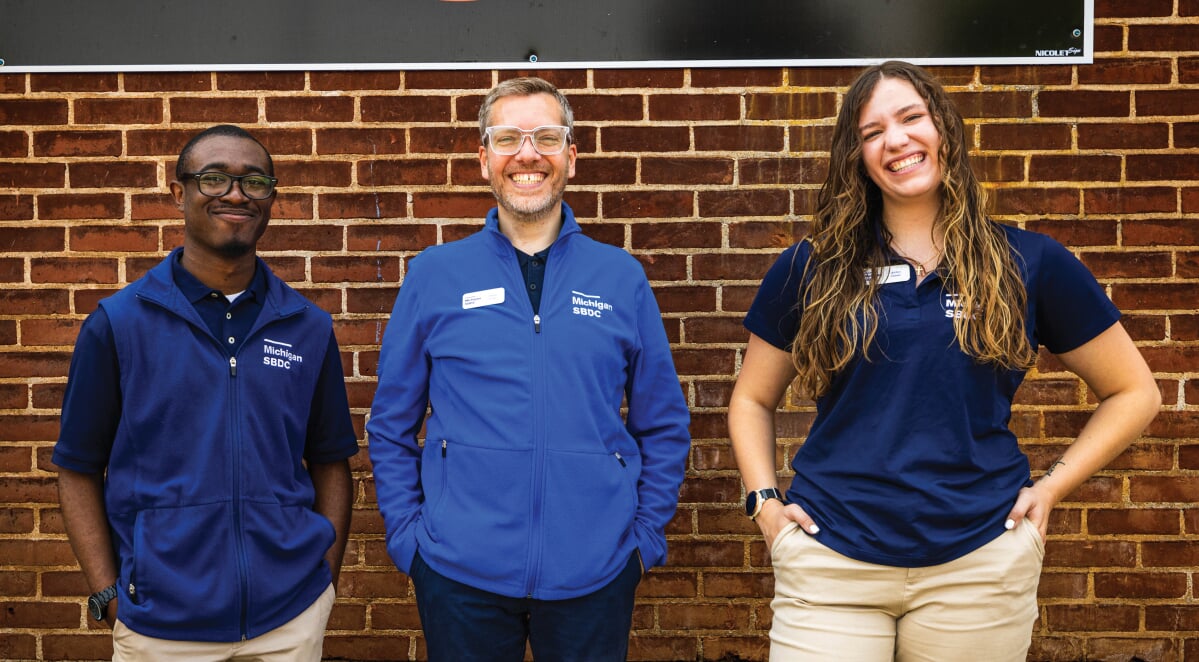
This spring, March 19 marked the ninth annual national SBDC Day, designed to raise awareness about how centers around the country contribute to job creation and measurable economic growth.
The SBDC's UP regional office is hosted at Michigan Technological University through a collaboration with the University's Office of Innovation and Commercialization and the College of Business.
"Michigan Tech is honored to serve as the host for the SBDC regional office," said Jim Baker, senior associate vice president for research, innovation. "The SBDC team does exceptional and highly impactful work in providing essential support for small businesses across the entire region."
Read more about small UP businesses getting a huge boost.
Award-winning Faculty Contribute to College Excellence
Each year, the College of Business recognizes faculty whose work exemplifies the Michigan Tech spirit of discovery, service, and student-centered learning. These awards highlight the many ways our faculty contribute to both the advancement of knowledge and the success of our students.
The College of Business Research Award was presented to Laura Connolly, associate professor of economics. Connolly's research explores critical issues in labor economics and public policy, providing insights that extend far beyond campus. Her scholarship not only informs policymakers but also inspires students to consider how economics can contribute to the development of resilient and thriving communities.
The College of Business Service Award was presented to Ann Hardin, assistant teaching professor in accounting. Hardin's dedication to the College of Business extends well beyond the classroom. Through committee leadership, student advising, and community engagement, she models what it means to invest in both the institution and its people. Her service strengthens the fabric of the College and ensures that students and colleagues alike feel supported.
The College of Business Teaching Award was presented to Laura Sieders, assistant teaching professor of accounting. Known for her dynamic teaching style and genuine care for students, Sieders creates a learning environment where complex concepts become approachable. Her commitment to student growth and success reflects the College's mission to prepare graduates who are ready to lead from day one.
Sieders was also selected for inclusion in Michigan Tech's 2024-25 Deans' Teaching Showcase. The Ed and Betty Robinson Faculty Fellow in Accounting and director for the MS in Accounting and Analytics degree program, Sieders was featured for her outstanding work in making students feel comfortable in the classroom while learning challenging material.
Sieders came to academia after 25 years in the corporate sector, where she specialized in not-for-profit accounting. She's taught at every level, from introductory to graduate-level courses. After only three semesters with Michigan Tech, three of her courses ranked in the University's top 10 percent of similarly sized sections.
Dean Johnson, dean of the College of Business, said Sieders exemplifies the combination of connection and challenge that helps students excel in their studies and careers. "She has a special sense of pride and responsibility as a COB alumna who has come full circle back into the classroom," said Johnson. "I appreciate the skill and dedication Laura brings to her work—and we can see the benefit that it has on our students."
Another Impactful Year for Business Faculty Research
Regional resource modeling. Organizational and leadership research. Insights on the Metaverse and entrepreneurship. Recent College of Business research and publications demonstrate how our faculty are taking stock of evolving challenges, advancing knowledge that matters as they contribute to Michigan Tech's robust research community.
Faculty Highlights
Jenny Apriesnig, associate professor of economics, brings a regional perspective to natural resource issues, particularly those connected to the Great Lakes. Recent projects include quantifying the economic impact of aquaculture in Michigan, analyzing livestock indemnity policies, and assessing the impact of university research spending on local economies, all while engaging students in meaningful research.
Manish Srivastava, professor of strategic management and innovation, investigates how firms innovate and compete through alliances and acquisitions. His award-winning research sheds light on how organizations develop knowledge structures, with recent studies focusing on partnerships, mergers, and the influence of geographic and relational networks on innovation.
Sonia Goltz, professor of organizational behavior and Mickus Endowed Faculty Fellow in Business Impact, examines how power, leadership, and gender equity influence organizations. Her research on mentoring, inclusive leadership, and organizational change, together with her selection as the 2021 Michigan Tech Diversity Award recipient, highlights her lasting impact on advancing equity in the workplace.
Elham Asgari, assistant professor of management and entrepreneurship, coauthored "Franchising in the Metaverse: Entrepreneurial Pathways for Virtual and Mixed Reality," which won the Tariq Farid Franchise Institute Award for Best Paper. Her research reflects how entrepreneurial trends are converging with emerging technologies, underscoring the forward-looking nature of Michigan Tech's scholarship.
Faculty Research Contributions
Jenny L. Apriesnig (with Ingrid M. Sokup) published "Economic impact of potential aquaculture production in Michigan, USA" in Aquaculture International (Vol. 33, Issue 5, May 2025, p. 320). Apriesnig and Sokup's study estimates the potential economic benefits of developing aquaculture in Michigan, highlighting how fish farming can contribute to job creation and regional growth.
Jenny L. Apriesnig (with V. Campbell, J. Thompson, D. Pendell, and G. Tonsor) published "Producer perceptions of current U.S. livestock indemnity policy" in Applied Animal Science (Vol. 40, August 2024, pp. 542–548). This article explores how US livestock producers view indemnity policies, providing insights into producer awareness, perceptions, and policy effectiveness.
Jenny L. Apriesnig (with Laura E. Connolly, Emanuel M. R. Castro Oliveira, and Kathleen E. Halvorsen) published "Regional Economic Impact of University Research Expenditures" in Studies in Higher Education (July 2024, pp. 1–26). Examining the impact of university research spending, the study highlights how academic investment strengthens local and regional economies.
Jenny L. Apriesnig (with Laura E. Connolly and Travis White) co-authored "Local Economic Impacts of Deepening the Menominee Harbor" (2024). Findings highlight how the proposed deepening of the Menominee Harbor would affect the local economy, showing the potential benefits for commerce and community development.
Giridhar Reddy Bojja (with Omar El-Gayar, Loknath Sai Ambati, James Boit, and Nevine Nawar) contributed the chapter "The Impact of the Internet of Things in Healthcare Delivery: A Systematic Literature Review" in Impact of Digital Solutions for Improved Healthcare Delivery (IGI Global, November 2024). This chapter examines how Internet of Things technologies are impacting healthcare delivery, highlighting opportunities to enhance patient care and system efficiency.
Gary A. Campbell (with Ayfer Gedikli and Mansoor A. Koondhar) co-authored the chapter "Circular Economy and Mining" in Global Pathways for Efficient Waste Management and Inclusive Economic Development (Springer, June 2025). Campbell's chapter examines how circular economy principles can be applied to the mining sector, highlighting strategies to minimize waste and foster sustainable economic development.
Gary A. Campbell (with Simona Bigerna) published "The impact of by-product production on the availability of critical metals for the transition to renewable energy" in Energy Policy (Vol. 198, February 2025). Their research examines the effects of by-product production on the availability of critical metals essential for the shift to renewable energy, underscoring challenges and insights for sustainable resource management.
Gary A. Campbell (with Jose M., Anna M. Gil-Lafuente, Finn Kydland, Lluis Amiguet, Vlado Vivoda, Yalin Lei, and David Fleming-Munoz) published "50 years of Resources Policy: A bibliometric analysis" in Resources Policy (Vol. 96, September 2024). This article presents a bibliometric analysis of 50 years of Resources Policy, tracing research trends, influential authors, and the journal's impact on the field of resource economics.
Jun Dai (with Chao Zhang, Weidong Zhu, Yong Wu, and Xulong Chen) published "Drivers and Concerns of Adopting Artificial Intelligence in Managerial Accounting" in Accounting and Finance (January 2025). The study identifies key drivers and concerns influencing the adoption of artificial intelligence in managerial accounting.
Jun Dai (with Fengke Li, Meehyun Kim, and Miklos Vasarhelyi) published "Using Artificial Intelligence in ESG Assurance" in Journal of Emerging Technologies in Accounting (Vol. 21, Issue 2, October 2024, pp. 83–99). This work examines how artificial intelligence can be applied to ESG assurance, highlighting opportunities and challenges for practice.
Jun Dai (with Yu Gu, Xinxin Wang, Stevens Katz, and Miklos Vasarhelyi) published "Government ESG Reporting in Smart Cities" in the International Journal of Accounting Information Systems (Vol. 54, September 2024). Dai and other partners explore the role of government ESG reporting in smart cities, focusing on transparency and accountability in urban contexts.
Sonia M. Goltz (with Karen Colbert, Betsy Lehman, and Adrienne R. Minerick) published "Exploratory Assessment of Advocates & Allies Workshops at a Midwestern STEM-Focused Institution" in ADVANCE Journal (May 2025). Their research assesses the effectiveness of Advocates & Allies workshops at a Midwestern STEM-focused institution in fostering an inclusive culture.
Sonia M. Goltz (with Patricia J. Sotirin) published "Reflections on Experience: A Community of Practice Mentoring Initiative for Mid-career Professionals" in ADVANCE Journal (September 2024). Goltz and Sotirin's article reflects on a community of practice mentoring initiative designed to support mid-career professionals in higher education.
Manish K. Srivastava authored the chapter "Strategic Choices between Alliances and Acquisitions: What Do We Know, and Where Do We Go from Here?" in Advances in Mergers and Acquisitions (July 2024). Srivastava's chapter reviews what is known about strategic choices between alliances and acquisitions and outlines future research directions.
Manish K. Srivastava (with Sai Yayavaram) published "Choosing Between Alliances and Acquisitions and the Implications of the Choice: A Knowledge Recombination Perspective" in Strategic Organization (May 2025). In this publication, Srivastava analyzes how firms choose between alliances and acquisitions, framing the decision through a knowledge recombination perspective.
Manish K. Srivastava published "Exploring the Impact of Relational and Geographic Search on Firm Innovation" in Journal of Business and Management Studies (Vol. 7, Issue 2, April 2025, pp. 224–231). The article investigates how relational and geographic search activities influence firm-level innovation outcomes.
Michigan Technological University is an R1 public research university founded in 1885 in Houghton, and is home to nearly 7,500 students from more than 60 countries around the world. Consistently ranked among the best universities in the country for return on investment, Michigan's flagship technological university offers more than 185 undergraduate and graduate degree programs in science and technology, engineering, computing, forestry, business, health professions, humanities, mathematics, social sciences, and the arts. The rural campus is situated just miles from Lake Superior in Michigan's Upper Peninsula, offering year-round opportunities for outdoor adventure.