
Students who come to Michigan Tech tend to be as excited about research as they are about outdoor recreation opportunities. The good news is, so are their professors. Two members of the College of Computing community explain how easy it is for Huskies to find access, camaraderie and community.

How Undergrad Research at Tech Supercharges Your Experience
Hear from a computing science student and his professor about how easy and rewarding it is to get involved in research at Tech right away.
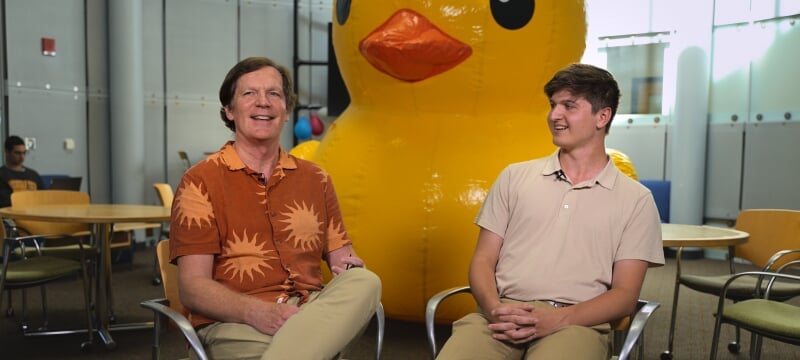
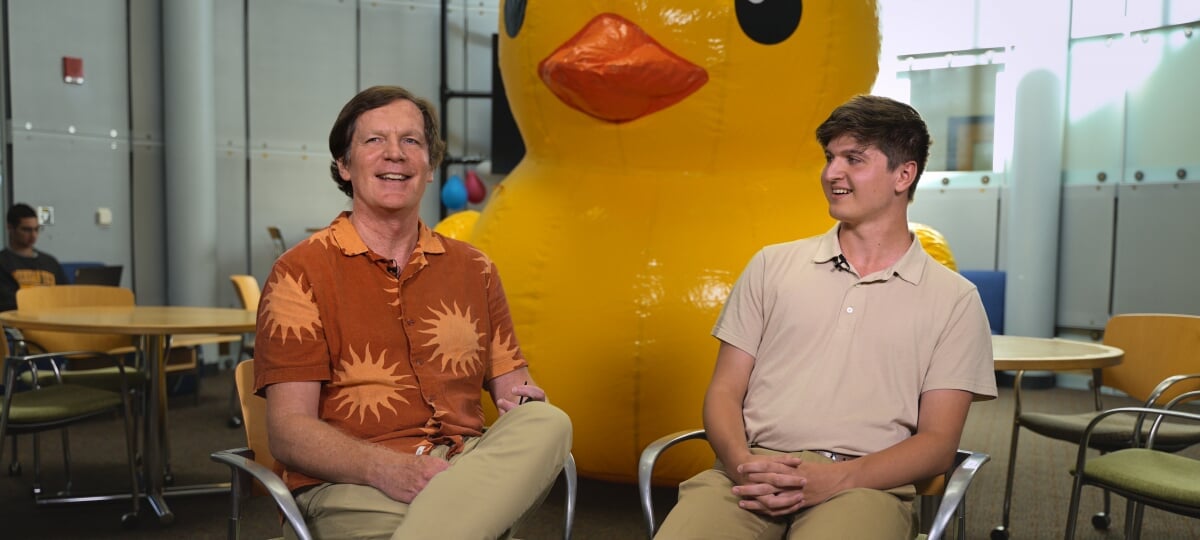
Computer Science Professor Charles Wallace and computer science major Connor Fleser '26 didn't come to Michigan Technological University at the same time. But they did come for similar reasons, which included the desire to do research and to enjoy what the University's back yard — the Keweenaw Peninsula — has to offer.
For Fleser, Michigan Tech's Mont Ripley Ski Hill, with free access for students, was "a perk. It felt cool. I've always taken trips up to the UP, but it also was just a really good school with a lot of different opportunities," he said.
"Actually, I came to Michigan Tech for a similar reason to Connor," said Wallace. "I would come up to the UP for camping trips and just to experience the wild, and then when it came time to apply for jobs, I realized that I could actually live up here. That was really exciting. So yeah, that was a draw for me, too."
They met in Wallace's Formal Models of Computation course.
"I was actually really excited because you were incredibly eager as a teacher," Fleser told Wallace. "I remember one time you did a little hop after a student asked a question that you found really exciting. So I figured out of all of my professors, I wanted to get to know you more. When you were talking about research, I wanted to come meet you, and then I started sitting in on your meetings about the formal methods of research. It was just really interesting, and it seemed like something I hadn't done before. So it was an interesting opportunity to learn more about that kind of stuff."
Wallace remembers asking students in the class if they were interested in doing research involving the material they were talking about, which related to the mathematical foundations of computer science. "And Connor raised his hand, and we went for it," said Wallace. "There was a nice project, it seemed like a nice scope for an undergraduate student to embark on, and he really took it on. So it's been really a great pleasure working with him. He's full of great ideas and always thinking about the next step and where we can take things further. So I really appreciate a lot of creativity, a lot of natural smarts and a great work ethic."
Fleser said the experience helped him refine his career path. "Working with you, you really are passionate, much like you were in that one computer science class, which is why I wanted to get involved," he told Wallace. Fleser learned about other research projects, including an initiative to help people expunge their criminal records and the Building Adult Skills in Computing (BASIC) sessions at Portage Lake District Library in Houghton that help older people who are unfamiliar with technology achieve digital literacy. "I was really excited by how much it was actually trying to help the community, because I think that's a really important thing with computing and computer science. What I want to do eventually is try to help people — that would be my ultimate goal with computer science," said Fleser.
Wallace said that students coming to Tech can feel confident that they'll have rewarding research opportunities.
"If you are interested in something, if there's something in class or outside of class that catches your eye and really sparks your interest, it's so easy to go and ask faculty about possibilities, and there are a lot of them out there," said Wallace. "There are funded research projects around campus that undergraduate students can get involved in. It's all about getting in touch with faculty members and starting the conversation."
Michigan Technological University is an R1 public research university founded in 1885 in Houghton, and is home to nearly 7,500 students from more than 60 countries around the world. Consistently ranked among the best universities in the country for return on investment, Michigan's flagship technological university offers more than 185 undergraduate and graduate degree programs in science, technology, engineering, mathematics, computing, forestry, business, health professions, robotics, psychology, social sciences, humanities, and the arts. The rural campus is situated just miles from Lake Superior in Michigan's Upper Peninsula, offering year-round opportunities for outdoor adventure.




Comments