The Colleges of Computing and Engineering at Michigan Technological University are teaming up to launch a new doctoral fellowship that attracts and nurtures top-tier researchers from both fields.
Dennis Livesay, the Dave House Dean of Michigan Tech's College of Computing, and Michelle Scherer, dean of the University's College of Engineering, announced the inaugural Dave House Computational Innovation Fellowship this week. The initiative aims to bridge the disciplines of engineering and computing through deep, sustained research collaborations by uniting faculty and students from both colleges.
Supported by Tech alumnus Dave House '65 and the House Family Foundation, the fellowship is the first of its kind at Tech, in that it's specifically designed to recruit and support high-caliber doctoral students through support and mentorships based in both computing and engineering.
"Collaboration and interdisciplinary research make Michigan Tech stronger."
"The Colleges of Engineering and Computing have made great strides in working together, and it's my hope that these fellowships will catalyze even more long-lasting partnerships," said House.
The two-year fellowship is awarded to a pair of current MTU faculty members, one in the College of Engineering and one in the College of Computing, based on a joint research project proposal that includes mentorship and support for a co-affiliated doctoral student.
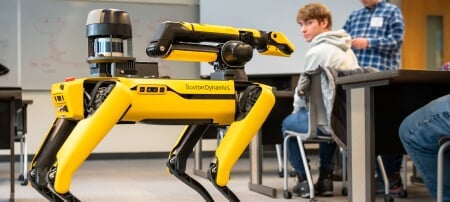
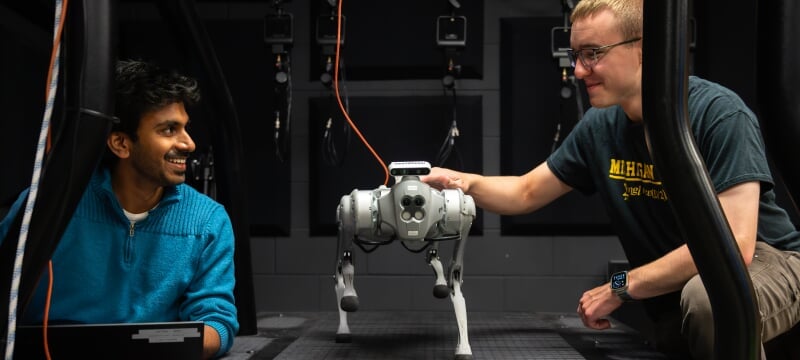
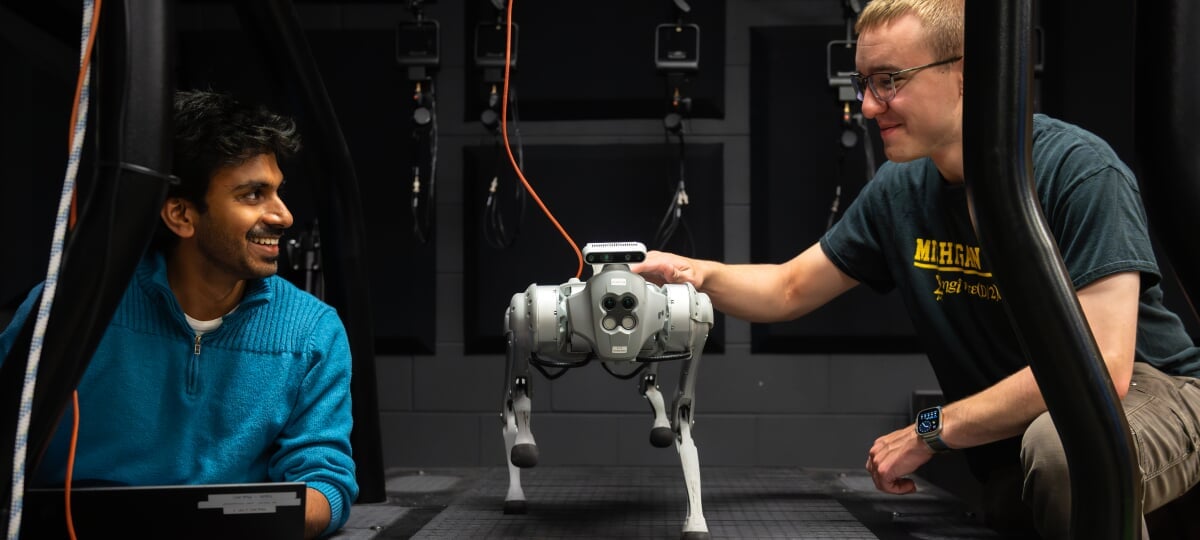
The inaugural fellowship has been awarded to Assistant Professor Tan Chen of the Department of Electrical and Computer Engineering and Assistant Professor Michael Walker of the Department of Computer Science for their research in human-robot interaction. In addition to the novel and interdisciplinary nature of their work, the award selection was also based on the research's potential for important long-term outcomes.
Proposal submission evaluations, led by Department of Electrical and Computer Engineering Chair Wayne Weaver and Department of Computer Science Chair Zhenlin Wang, also took the quality of proposed co-mentorship for the Ph.D. student into consideration.
The student, whose name has not yet been announced, will work with Chen and Walker to advance Michigan Tech's prowess in the fields of robotics and automation. They'll receive two years of support, including full tuition, a yearly stipend, standard graduate student benefits and funds for conference travel.
Chen and Walker's winning research project, titled "A Hybrid Autonomous-Human Control Framework for Safe Deployment of Humanoid Robots in Real-World Applications," integrates advanced humanoid robotic hardware, nonlinear control theory, and artificial intelligence (AI) with human-in-the-loop teleoperation, immersive interface design and implementation, and computational frameworks.
Chen joined Michigan Tech in 2022 and currently serves as director of the Robotics, Locomotion, and Applied Control Lab, where he investigates robotics, dynamical systems, geometric nonlinear control and machine learning, with a current specialization in applications to legged and humanoid robotics.
"I am grateful for this award, and for the generous support from the Dave House family, the colleges and the departments, which together provide a valuable opportunity to integrate our complementary expertise and tackle practical challenges in deploying humanoid robots in real-world environments," said Chen. "I'm excited about this collaboration and look forward to working with Michael to deliver impactful outcomes, generate meaningful results, and establish a strong foundation for future external funding."
Walker, who came to Michigan Tech in 2024, primarily focuses on human-robot interaction, with the goal to increase the frequency and effectiveness of mixed human-robot teams in real-world settings. He's the director of Tech's Human-Robot Interaction Lab.
"Robotics is such a multidisciplinary field, so a fellowship built around cross-department collaboration like this is especially exciting," Walker said. "Tan and I have both started moving more into humanoid robots in our labs, so this feels like a really natural time to join forces and explore the intersection of humanoid robots, humans, and AI. I'm excited to keep working in this research space with a collaborator whose expertise really strengthens the work and allows for the exploration of new research directions."
Deciding to collaborate on a fellowship proposal came easily to the researchers, Walker said.
"Tan is actually one of the Michigan Tech faculty I've known the longest. We first met when I was visiting campus before I joined as an assistant professor, and ever since then we've been looking for the right opportunity to work together," he said. "We come at robotics from different but very complementary angles, with Tan working more on robotics control and me focusing more on the human-centered design and deployment of these systems, so this felt like a great fit."
As fields like robotics, automation and artificial intelligence become increasingly integrated between the disciplines of engineering and computing, Deans Livesay and Scherer are eager to develop programming that meets the cross-collaborative needs of both academia and industry.
"The most consequential technological breakthroughs happen at the intersection of disciplines," said Livesay. "These fellowships meet the urgent demand to tear down silos and build the bridges our engineers and computer scientists will use to fuel the next generation of discovery. We're grateful to Dave for his vision and support and excited to get started!"
Scherer views the collaborative nature of the fellowships as a primary engine for answering the challenges of today and tomorrow.
"There is no better way to drive innovation than to bring folks from different fields together to tackle a problem from multiple angles," said Scherer. "Dave's vision for connecting faculty across colleges by supporting them to work as a team with a PhD student to think out of the box is a wonderful gift. I'm excited to see the research advances that catalyze at Michigan Tech!"
By providing dedicated, unencumbered support at the start of the supported student's doctoral journey, the cross-college fellowship is designed to enable students to focus exclusively on their research milestones and coursework. The initiative supports Michigan Tech's goals as an R1 research institution, which include continued expansion of impactful projects and growth in doctoral candidate enrollment.
Michigan Technological University is an R1 public research university founded in 1885 in Houghton, and is home to nearly 7,500 students from more than 60 countries around the world. Consistently ranked among the best universities in the country for return on investment, Michigan's flagship technological university offers more than 185 undergraduate and graduate degree programs in science, technology, engineering, mathematics, computing, forestry, business, health professions, robotics, psychology, social sciences, humanities, and the arts. The rural campus is situated just miles from Lake Superior in Michigan's Upper Peninsula, offering year-round opportunities for outdoor adventure.