

1885-1925: Department of Metallurgy and Chemistry
Michigan Mining School and Michigan College of Mines
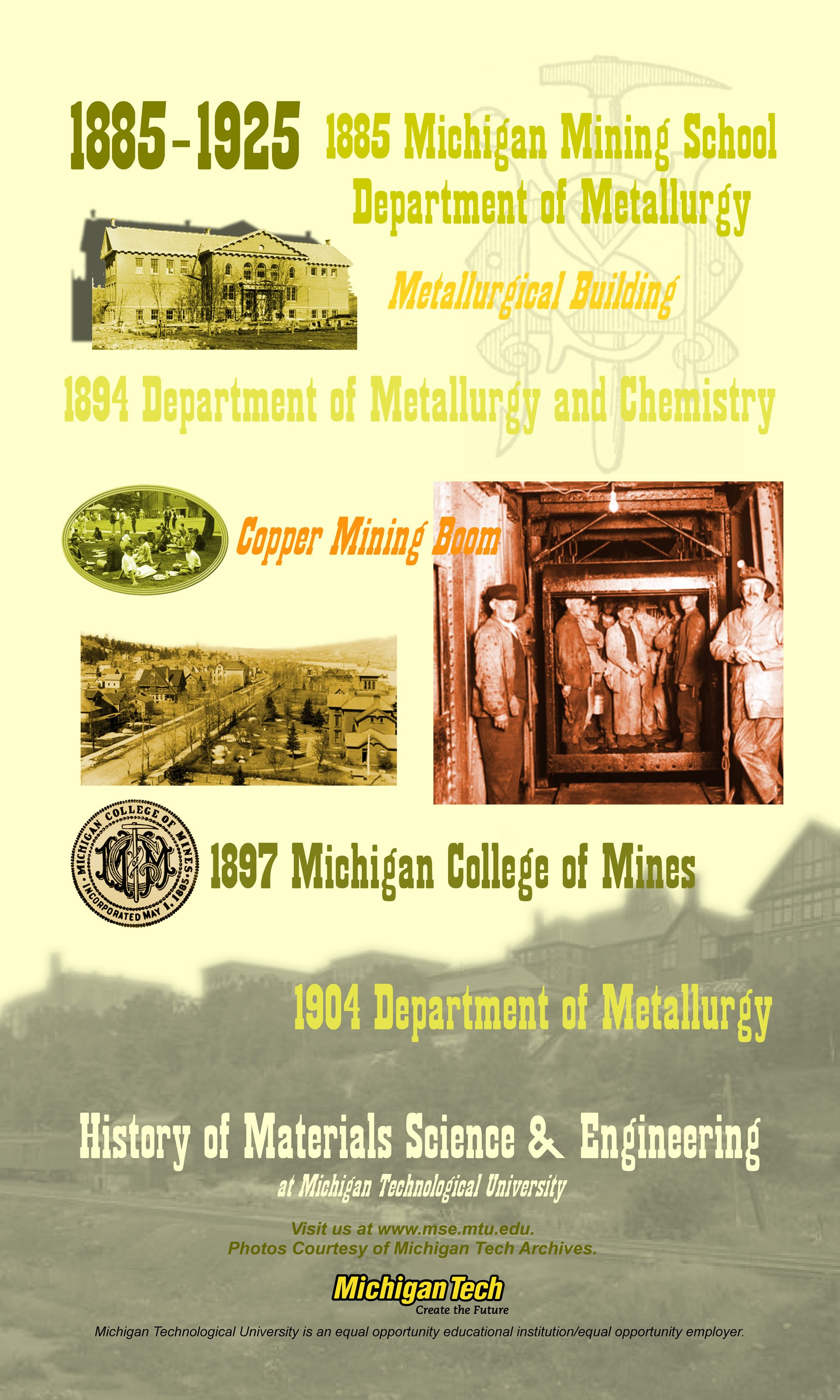
The Upper Peninsula of Michigan was home to one of the United States' great metal mining booms in the late 1800s. Starting around 1850, native copper metal was mined, and in the 1880s and 1890s the activities grew to truly massive proportions, fed by the nation's demand for electrical wiring and other copper metal products. As an example of the scale of the operations, in 1895 the Calumet and Hecla Mining Company, just one of the major producers, paid a dividend of $25 million to its shareholders. The nearby city of Calumet, Michigan, was one of the first cities in the world to install electric street lights and trolley cars.
To support the mining industry, the State of Michigan opened the Michigan Mining School in the fall of 1886, with facilities located in the upper story of the original Houghton Fire Hall. Metallurgy was an important component of the mining curriculum from the start, and a distinct department was established on the discipline; however, in 1894, the metallurgy and chemistry departments were combined.
In 1897, the school's name was changed to the Michigan College of Mines, and by 1904, the metallurgy department had once again become an independent entity and now occupied a new building, which burned in 1924 and was replaced by the original McNair Hall. For approximately forty-seven years, McNair Hall was home to the metallurgy department, until it was demolished to make way for construction of the Electrical Energy Resources Center. In 1973, the department moved into the Chemistry-Metallurgy Building, and in 1991, the department took up residence in the Minerals and Materials Building, the facility that houses the research and teaching operations today.
| Year | Event |
|---|---|
|
1660 |
Jesuit missionary explorer Father Rene Menard is first known European to reach Keweenaw Bay, wintering at site near what is now L’Anse. |
|
1836 |
In exchange for abandoning its claim on the commercially-active Toledo strip as part of a border dispute (known as the “Toledo War”) with the state of Ohio and as a condition for its approval of Michigan’s petition for statehood, the U.S. Congress proposes a compromise that will assign to Michigan most of the area now known as the Upper Peninsula. Under pressure from the Congress and President Andrew Jackson, Michigan concedes defeat in the border dispute and grudgingly approves the compromise in December at a meeting known as the “Frost-bitten Convention” of the territorial government. |
|
1837 |
Michigan becomes a state. |
|
1841 |
Douglass Houghton submits his first scientific report to the State detailing iron and copper resources in the Upper Peninsula. |
|
1845 |
Douglass Houghton drowns in Lake Superior near Eagle River, MI. |
|
1852 |
Portage Lake, the town that will eventually be renamed as Houghton, is established by Ransom Sheldon. |
|
1861 |
|
|
1865 |
US Congress authorizes excavation to create the Portage Lake shipping canal. Houghton becomes a primary shipping port for the Keweenaw mining district. |
|
1885 |
“The Michigan Mining School” is established from “Act 70” of the Michigan Legislature, sponsored by the Honorable Jay A. Hubbell, State Senator from Lake Linden. |
|
1886 |
|
|
1887 |
|
|
1888 |
|
|
1889 |
|
|
1890 |
|
|
1891 |
Fred Fraley Sharpless is given the title, “Professor of Metallurgy.” |
|
1892 |
Metallurgical assay lab added to Hubbell Hall. |
|
1893 |
|
|
1894 |
Metallurgy and Chemistry are packaged as the first stand-alone department within the College. |
|
1895 |
|
|
1896 |
|
|
1897 |
School name changed to the Michigan College of Mines. |
|
1898 |
|
|
1899 |
Fred Walter McNair is named President of Michigan College of Mines. |
|
1900 |
|
|
1901 |
Engineering (later Sperr) Hall is completed with state funding. |
|
1902 |
|
|
1903 |
|
|
1904 |
|
|
1905 |
|
|
1906 |
|
|
1907 |
|
|
1908 |
College enrollment reaches a maximum of 292 students, but is followed by several years of decline due to economic recession and widespread suspicion of mining due to over-speculation. |
|
1910 |
|
|
1911 |
|
|
1912 |
|
|
1913 |
|
|
1914 |
Professor A.J. Houle named head of Department of Metallurgy. |
|
1915 |
|
|
1916 |
|
|
1917 |
|
|
1918 |
|
|
1919 |
|
|
1920 |
|
|
1921 |
|
|
1922 |
“The Lode” College newspaper established. |
|
1923 |
Metallurgy Building burns down. |
|
1924 |
|
|
1925 |
|
1925-1965: Department of Metallurgy
Michigan College of Mining and Technology
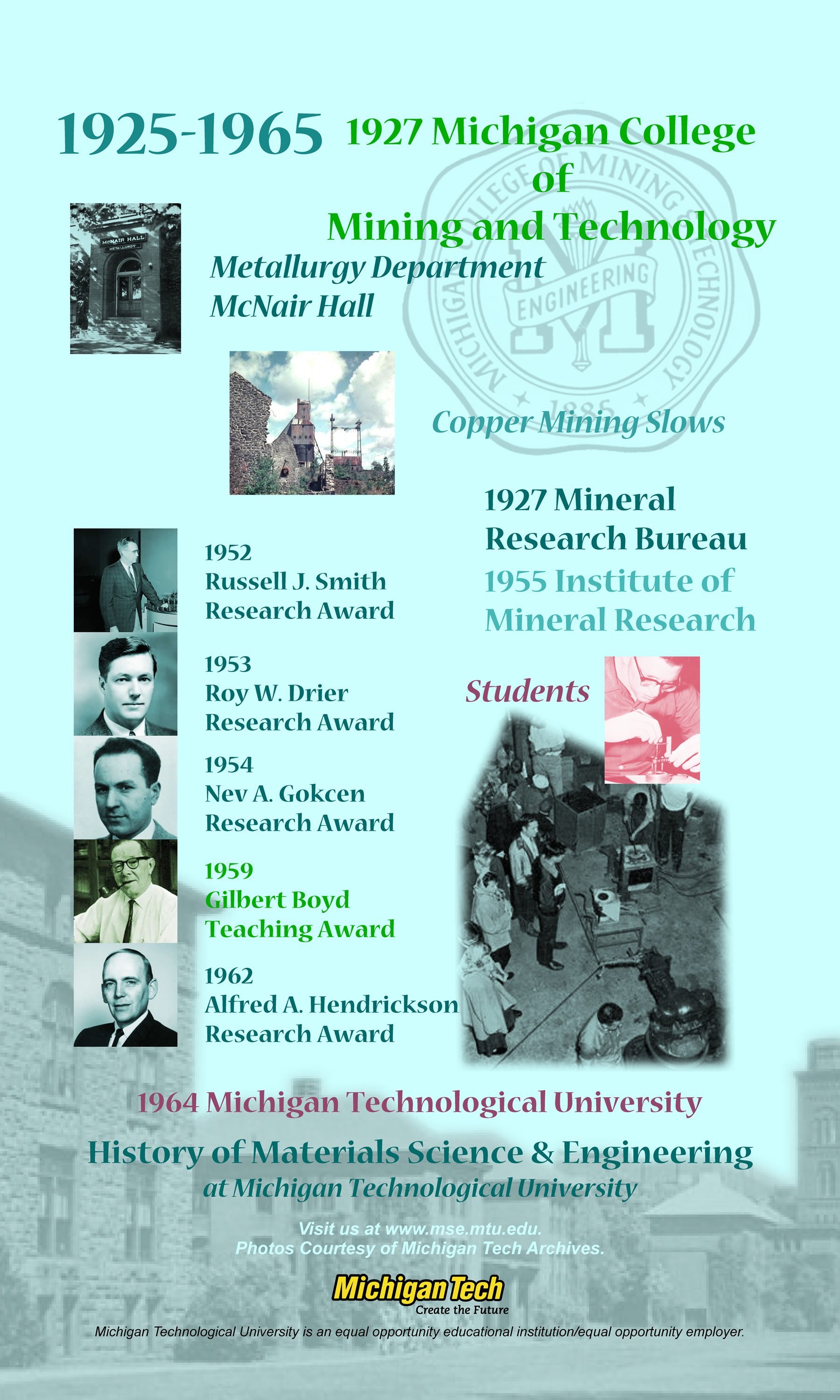
In the mid-1920s, the Great Depression reduced the demand for mining engineers, and the Michigan College of Mines began to consider diversifying its curriculum to attract a larger student body. After considerable controversy, the Michigan State Legislature and the governor first broadened the scope of the college's charter to permit three-year degrees in metallurgy and mining, and two-year degrees in several other engineering disciplines. In 1927, the state again changed the name of the college, this time to the Michigan College of Mining and Technology, from which the moniker "Michigan Tech" was coined. With this change in name, Michigan Tech further broadened the scope of its educational offerings, with the addition of four-year undergraduate programs, graduate programs at the master's level, and the authorization to conduct research. By the mid-1930s, Michigan Tech was authorized to grant PhD degrees, and in 1934, metallurgy faculty members Corbin Eddy and Roy Drier received the first two PhD degrees awarded by the college.
| Year | Event |
|---|---|
|
1926 |
First M.S. degrees established in Metallurgy, Chemistry, Geology, and Mechanical Engineering. |
|
1927 |
|
|
1928 |
|
|
1929 |
|
|
1930 |
|
|
1931 |
88 Enrolled in the Metallurgy Department . |
|
1932 |
|
|
1933 |
first degree awarded to a female student at MCMT. |
|
1934 |
|
|
1935 |
|
|
1936 |
The first meeting of the student chapter of ASM at MCMT is held. |
|
1937 |
|
|
1938 |
|
|
1939 |
|
|
1940 |
Corbin Eddy is appointed as Head of Metallurgical Engineering. |
|
1941 |
|
|
1942 |
|
|
1943 |
Dee Stadium given to MTU by James R. Dee. |
|
1944 |
|
|
1945 |
|
|
1946 |
M.S. degree name changes to Metallurgical Engineering. |
|
1947 |
Lilian Beck is first female BS recipient in Metallurgy / Metallurgical Engineering. |
|
1948 |
|
|
1949 |
|
|
1950 |
|
|
1951 |
|
|
1952 |
|
|
1953 |
Dr. Roy W. Drier helps to establish M.C.M.&T. Foundation. |
|
1954 |
|
|
1955 |
|
|
1956 |
J.R. VanPelt is elected president of MCMT. |
|
1957 |
|
|
1958 |
|
|
1959 |
Raymond Smith is appointed head of Metallurgical Engineering Department (1959-64). |
|
1960 |
|
|
1961 |
|
|
1962 |
|
|
1963 |
PhD degree name changes from Metallurgy to Metallurgical Engineering. |
|
1964 |
College becomes Michigan Technological University on January 1. |
|
1965 |
Raymond Lloyd Smith become President of MTU (1965-‘79). |
1965-1985: Department of Metallurgy
Michigan Technological University
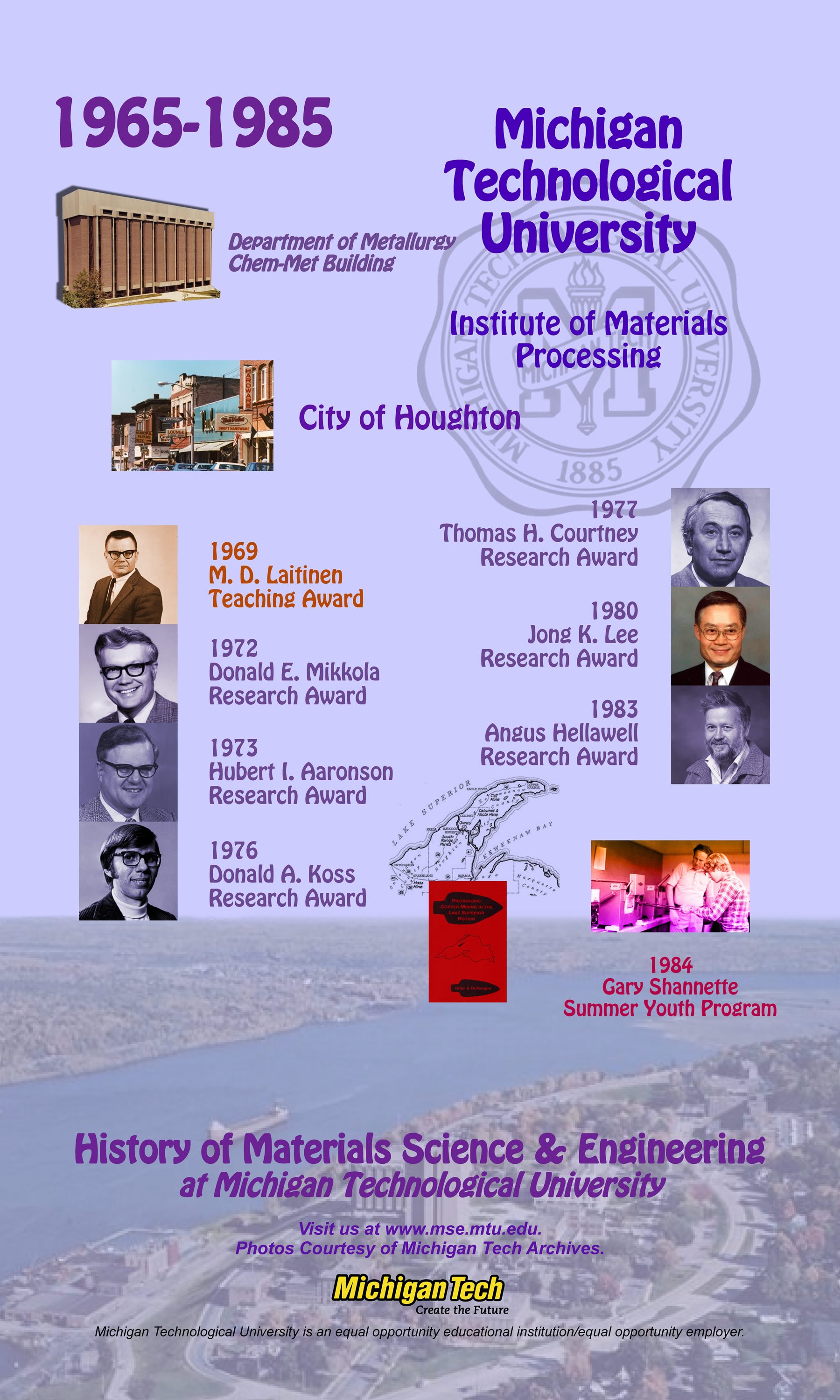
With the final decline of the local copper mining industry in the 1960s, the college began adding programs to the curriculum in diverse areas of study. In 1964, the name Michigan Technological University was officially adopted.
Since its inception in the late 1800s, our undergraduate program evolved from mineral dressing to metallurgy, to metallurgical engineering, to metallurgical and materials engineering. In July 2000, we became known as the Department of Materials Science and Engineering. The name change was made to better reflect the breadth of instructional and research activities in which our students and faculty are engaged. Our new name is also consistent with our sister departments in other institutions, including many that started out as "metallurgy" or "mineral dressing" departments.
| Year | Event |
|---|---|
|
1966 |
|
|
1967 |
Metallurgical Engineering Department becomes largest in the United States. |
|
1968 |
|
|
1969 |
Metallurgy Department gets $100,000 grant per year from NSF for Ph.D. program. R.W. Guard becomes Department Head. |
|
1970 |
|
|
1971 |
Dale Stein is appointed head of Metallurgical Engineering Department (1971-’77). |
|
1972 |
|
|
1973 |
|
|
1974 |
Dale Stein assumes the additional role as Head of Mining Engineering Department |
|
(1974-’77). |
|
|
1975 |
|
|
1976 |
|
|
1977 |
Dale Stein is named Academic Vice President (1977-’79). |
|
1978 |
Lloyd A. Heldt is appointed Head of Metallurgical Engineering Department (1978-’92). |
|
1979 |
Dale Stein is named President of MTU (1979-’91). |
|
1980 |
Metallurgical Engineering department sets all time undergraduate enrollment maximum at 310 students, a number that constitutes approximately 10% of all metallurgical engineering students nationwide at that time. |
|
1981 |
|
|
1982 |
|
|
1983 |
|
|
1984 |
|
|
1985 |
Dr. Stein is elected to U.S. National Academy of Engineering. |
|
1986 |
|
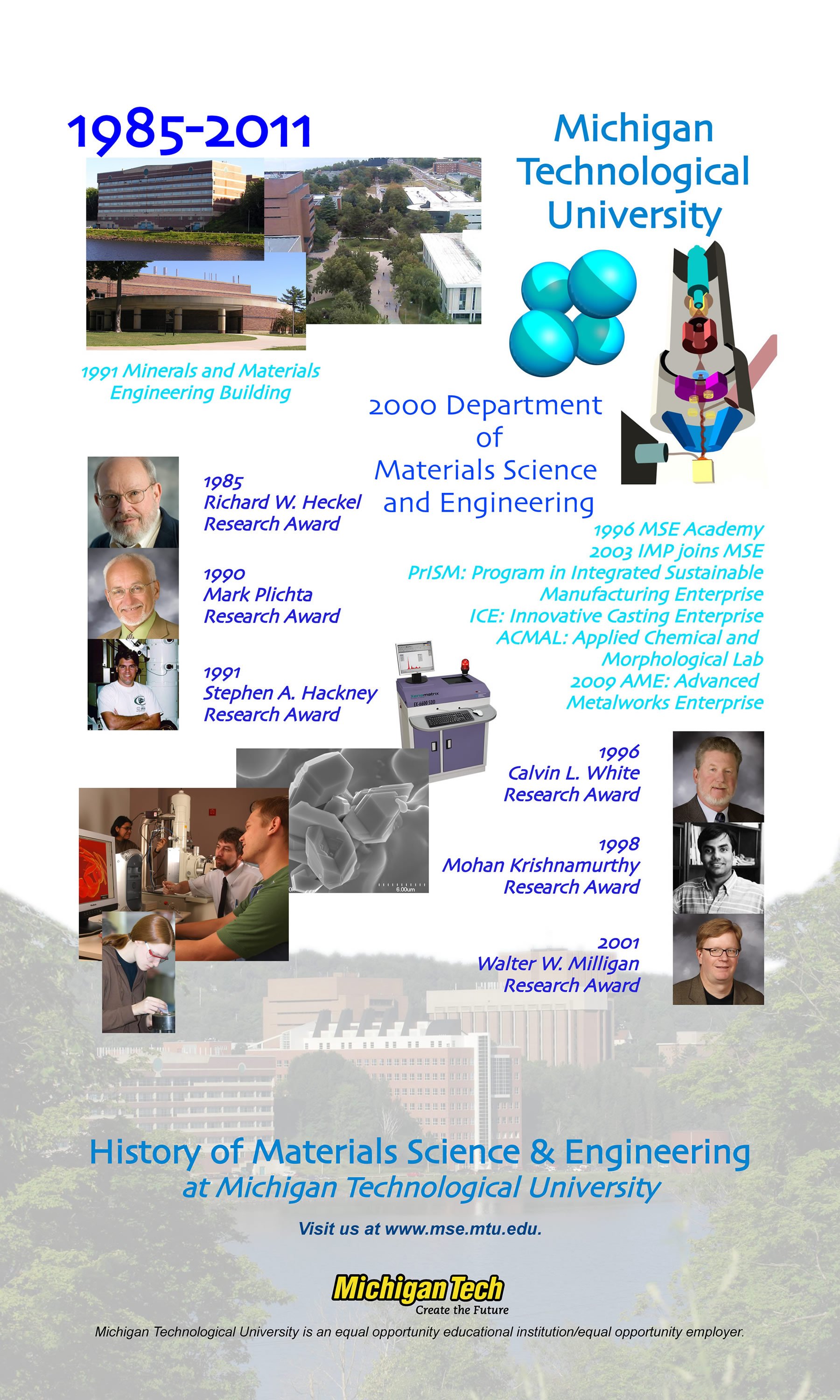
1985-Present: Department of Materials Science and Engineering
Michigan Technological University
The present scopes of our undergraduate program, including both instructional and research programs, encompass broad multidisciplinary approaches to the beneficiation, refining, processing, development, application, and recycling of engineering and engineered materials. We are extraordinarily proud of our graduates, many of whom have achieved national recognition in our profession and as entrepreneurs, researchers, and administrators.
| Year | Event |
|---|---|
|
1987 |
Jean Kampe is the first female to receive a PhD in the Metallurgical Engineering Department. |
|
1988 |
|
|
1989 |
|
|
1990 |
Department changes its name from Metallurgical Engineering to Metallurgical and Materials Engineering (MME). |
|
1991 |
|
|
1992 |
|
|
1993 |
Thomas H Courtney is named Chair of MSE (’93-’96). |
|
1994 |
|
|
1995 |
|
|
1996 |
|
|
1997 |
|
|
1998 |
|
|
1999 |
|
|
2000 |
|
|
2001 |
Mineral Processing option/concentration phased out of MSE and moved to Chemical Engineering as a concentration. |
|
2002 |
Mineral Process Engineering Option formally eliminated by the MTU Senate and BOC. |
|
2003 |
Mark R. Plichta is named Chair of MSE (2003-‘12). |
|
2004 |
|
|
2005 |
|
|
2006 |
|
|
2007 |
|
|
2008 |
|
|
2009 |
|
|
2010 |
|
|
2011 |
|
|
2012 |
|
|
2013 |
MSE Course-only (non-thesis) MS degree approved by MSE faculty. First class of 6 course-only MS students admitted for Fall 2014 semester. |
|
2014 |
|
|
2015 |
|