

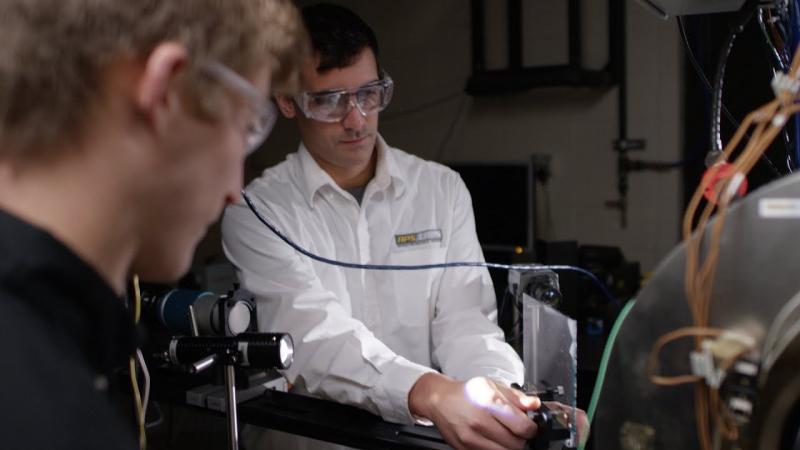
The Advanced Power Systems Research Center (APS LABS) conducts cutting-edge research to drive innovation in clean, efficient, and sustainable power systems. Their state-of-the-art facilities support advancements in combustion, emissions, biomass, power transmission, and energy sustainability.
Research at APS LABS spans a wide range of disciplines, including engine and emissions testing, alternative fuels, rail transportation, microgrid development, and intelligent mechatronics. With specialized laboratories, advanced diagnostic tools, and hands-on training programs, APS LABS provides industry-relevant expertise and technological advancements that push the boundaries of power and energy research.
Tomorrow Needs Sustainable Fuels
This group also focuses on energy system optimization to ensure efficient use of future fuel supplies.
Thermal-fluid experts are working to characterize two-phase flows in heat exchangers, enhance flows in fuel cells, and develop methods and technologies that will allow the utilization of gasified natural material in power generation systems. Researchers are also investigating ways to optimize the flow of air across wind turbines in order to increase productivity. By investigating current and emerging technologies, the group is bridging the gap between today's fossil fuel economy and a multisource economy that promises a more stable and sustainable future.
Faculty + Research = Discovery
Our department boasts world-class faculty who have access to numerous innovative research labs and are committed to discovery and learning.
This encompasses a range of research areas, experiences, and expertise related to advanced power systems.
Solvent-targeted Recovery and Precipitation (STRAP) Application is for applying restoration of contaminated plastics to their original state of use.
Learn more about our faculty and their research interests:
Research Projects
Our faculty engage in a number of research projects, many of which are publicly funded.
A sample listing of research projects appears below. You can also view a broader list of research projects taking place across the mechanical engineering-engineering mechanics department.
- College/School: College of Engineering
- Department(s): Mechanical and Aerospace Engineering
- Awarded Amount: 115,000
- Sponsor: U.S. Department of Defense, Army-TARDEC
Overview:
TARDEC has specifically requested delivery of Hands-On short courses in Hybrid Electric Vehicles, Instrumentation and Experimentation, and High Voltage Safety.
The Mobile Lab, as a whole, consists of a range of facilities and equipment including:
- A spacious classroom with thermostatically controlled heating and air-conditioning, a whiteboard, and large screen TV's for slides and video's.
- Two full-functional powertrain test cells; AC Dynamometers, combustion analysis, emissions analysis, measurements of torque, flows, pressures, temperatures, etc., embedded I distributed rapid prototyping powertrain controls systems, and automated testing capability.
- Fleet of instrumented test vehicles consisting of conventional powertrains, mild hybrids, strong hybrids, range extenders, and full electric vehicles.
- Transport truck with capacity for 8 vehicles. The truck is also used to elevate vehicles for certain coursework activities requiring underbody access.
- Wide array of cutaway engines and transmissions, and various components used for teaching aids.
All standard courses are 2.5 days in duration and are suitable for Engineers, Managers,
and
Technicians. As with any course, smaller class sizes are always better, but the Mobile
Lab can comfortably accommodate group sizes as large as 16 participants with overflow
potential to 20 if needed.
There are several advantages of professional development training offered through
the Michigan
Tech Mobile Lab as compared to other available options:
- The Mobile Lab is entirely self-supportive and is setup at the client's location, thus course participants do not need to travel to training, and remain on-site should a job related emergency arise.
- All courses are delivered by professional educators with research and development expertise in their field.
- All courses include both direct learning through slides and whiteboard combined with fully integrated hands-on experiments. It has been consistently proven, that experiential learning such as this significantly enhances the participant's comprehension and retention the subject matter.
- As a University we can offer college credit for each course. This can be beneficial to employees pursuing an advanced degree.
- College/School: College of Engineering
- Department(s): Mechanical and Aerospace Engineering
- Awarded Amount: $3,505,540
- Sponsor: U.S. Department of Energy, ARPA-e
Summary for Public Release:
Michigan Technological University in partnership with General Motors will develop, validate and demonstrate on a fleet of eight model year 2016 Chevrolet Volts and a mobile connected cloud computing center, a model based vehicle and powertrain controller. The selected vehicle, the MY16 Volt contains a unique powertrain architecture and enables five distinct operating modes including all electric (EV), plug-in-electric hybrid (PHEV), and hybrid electric vehicles (HEV). The model based controller will encompass a full real-time physics based coupled powertrain vehicle dynamics model leveraging vehicle conductivity with vehicle-to-vehicle and infrastructure to vehicle communications with real-time traffic modeling and predictive speed horizons and eco-routing. The goal is to achieve at least a 20% reduction in energy consumption (electrical + fuel) and a 6% increase in electric range through the first ever implementation and connection of route planning, powertrain energy management model predictive controller algorithms. Connectivity data from other vehicles, infrastructure, GPS, traffic, and desired route planning combined with a physical model of the powertrain-vehicle system allows prediction of the vehicle's future speed and enables forward looking powertrain mode selection and reduction of the energy utilization from the battery and fuel.
- College/School: College of Engineering
- Department(s): Mechanical and Aerospace Engineering
- Awarded Amount: $226,438
- Sponsor: MAHLE Powertrain, LLC
- College/School: College of Engineering
- Department(s): Mechanical and Aerospace Engineering
- Awarded Amount: $165,000
- Sponsor: Ford Motor Company
Overview:
This is continues work from the Ford DOE Program1 on "Advanced Gasoline Turbocharged Direct Injection (GTDI) Engine Development," and from work completed in 2014-2016 under Ford departmental budget working on Closed Loop Combustion Control (CLCC). As a separate activity a URP is underway working on metrics for combustion control, air-charge estimation, statistically significant combustion control decisions.Work focuses on a Ford 2.0L engine platform with integrated control via strategies connected through the Ford PCM to a Delphi Combustion Pressure Development Controller (CPDC).
Objective:
Develop and employ closed loop combustion control (CLLC) via in-cylinder sensors with closed loop control for individual cylinder fuel, spark, and overall engine dilution on engine dynamometer with study of steady-state and transient performance. Additionally other sensors including exhaust pressure, integrated and standalone ion sensing will be added to the instrumentation and evaluated with respect to providing information for CLCC.
- College/School: College of Engineering
- Department(s): Mechanical and Aerospace Engineering
- Awarded Amount: $115,000
- Sponsor: Ford Motor Company
Objective:
Utilize the optical engine to examine the interactions of in-cylinder flow with the ignition process (manipulating discharge characteristics & spark plug design variables) as supplemented by multiple locations of ion sensing.
Fundamental understating of how to optimize the ignition system's design attributes for different engine applications. Increased understanding will result in more efficient & cost effective hardware & controls. This continues work from the Ford funded work through 2016 focused on ignition with optical engine. The work enables the development of a critical understanding of the ignition process and its interaction with the in-cylinder flow. Results will provide quantitative data on ignition processes including the initial flame kernel development, growth and transition to turbulent flame propagation in-cylinder. The results will also provide quantitative data on flow characteristic via high resolution particle image velocimetry (PIV) around the electrode in the optical engine.
Continue studies of combined imaging with high resolution PIV. High speed imaging and analysis shows high variability cycle to cycle of arc stretch and strong correlation of the arc stretch and flame development and burn rates. Areas of study for this year include:
- Studies to be conducted under higher in-cylinder flows with tumble planks installed in the intake port
- Studies of alternative geometry plugs
- Studies of plug orientation and gap
- Chemiluminescent imaging for combustion signature
- College/School: College of Engineering
- Department(s): Mechanical and Aerospace Engineering
- Awarded Amount: $275,000
- Sponsor: Mitsubishi Heavy Industries, LTD
- College/School: College of Engineering
- Department(s): Mechanical and Aerospace Engineering
- Awarded Amount: $386,400
- Sponsor: Various Sponsors
Advanced Engine Technologies for Light Duty Vehicles Consortium
This year, the consortium research is focused on:
- Advanced boosted engine cycle.
- Assessment of instrumentation used for combustion analysis.
- Advanced ignition studies.
- How gases move around in the cylinder in high-flow ignition systems.
- Developing best practices for cylinder pressure data analysis.
Next year, the consortium will choose a new group of industry-proposed projects based on needs of the members at that time.
- College/School: College of Engineering
- Department(s): Mechanical and Aerospace Engineering
- Awarded Amount: $137,905
- Sponsor: Westport Power Inc
- College/School: College of Engineering
- Department(s): Mechanical and Aerospace Engineering
- Awarded Amount: $108,932
- Sponsor: Argonne National Laboratory
Overview:
The scope of research to be performed by a graduate student to be conducted over the time period from May 1, 2016 to April 30, 2017 in collaboration with Argonne National Laboratory. The research is intended to support ongoing research programs in the areas of alternative fuels and advanced ignition systems for automotive spark ignition engines.
Scope of Work:
The experimental research is to be conducted on a single cylinder research engine operated at the Fuels,Engine and Aftertreatment Research Section at Argonne National Laboratory's Center for Transportation Research. The graduate student will support planning, execution and analysis of the three project tasks:
- Task 1 - Co-Optimization of Fuels and Engines (OPTIMA)The OPTIMA effort aims at reducing per-vehicle petroleum consumption by introducing advanced low carbon fuels to reduce greenhouse gas emissions, while at the same time advancing engine technology to perform optimally on the advanced fuels. A range of fuel blends covering laminar burning velocities and evaporation behavior of likely OPTIMA fuel candidates will be tested on a state-of-the-art research engine. The objective of the experimental activities is to quantify the impact of fuel properties on dilution tolerance of spark ignition engines.
- Task 2 - Efficiency-Optimized Dual Fuel Engine with In-Cylinder Gasoline/CNG Blending The goal of the research is to improve engine efficiency over the baseline gasoline and natural gas operation by blending both fuels, as well as provide a 50% reduction in petroleum consumption. While natural gas has the potential to reduce greenhouse gas emissions, traditional methods of injecting natural gas has shown to reduce engine performance. Improvements in natural gas operation are to be achieved through the use of direct injection (DI) hardware. The experimental work to be performed will be focused on demonstrating efficiency and performance benefits of an advanced engine configuration and improved operating strategies.
- Task 3 - High Efficiency GD/ Engine Research with Emphasis on Ignition SystemsThe goal of this research is to maximize the efficiency of an automotive gasoline direct injection (GDI) engine by improving the dilution tolerance through the use of advanced ignition systems. Dilution will be achieved by either exhaust gas recirculation (EGR) or lean combustion. The potential benefits of a corona ignition, non-thermal transient plasma, and kinetic spark ignition system will be explored. Endoscopic visualization techniques will also be used to determine the interaction of the advanced ignition system with added dilution.
- College/School: College of Engineering
- Department(s): Mechanical and Aerospace Engineering
- Awarded Amount: $1,229,000
- Sponsor: U.S. Department of Energy
Objectives:
The objective of this project is to develop the combustion system for a low-cost, low diesel contribution, high brake mean effective pressure (BMEP), high-efficiency premixed charge medium/heavy duty (MHD) natural gas engine and demonstrate the technology on an engine with peak thermal efficiency of up to 44%, diesel pilot contribution of 1-5%, and BMEP up to 25 bar. Emissions will be compliant with current Environmental Protection Agency (EPA) standards for heavy-duty (HD) on-road engines by using a three-way catalyst.
Scope of Work:
This project will evaluate and develop solutions to the barriers to micro-pilot combustion in a stoichiometric natural gas engine. A combination of combustion vessel (CV) testing and computational fluid dynamics (CFD) simulation will evaluate fundamental limitations and develop solutions. The results will then be applied to a multi-cylinder engine test bed, where the combustion system will be developed and emissions and efficiency demonstrated.The project will be conducted in 3 budget periods:
- Budget Period 1:Fundamental study of micro-pilot NG ignition In BP 1, prior art on micro-pilot natural gas (NG) ignition will be investigated, CV will be set up and used to conduct some preliminary study on micro-pilot NG ignition, combustions models will be validated using existing data, and engine baseline will be established.
- Budget Period 2:Development of micro-pilot NG combustion In BP2, more CV testing will be conducted to further develop the micro-pilot NG ignition concept.Engine testing will then be carried out using the promising design and operating conditions determined by the CV and CFD simulation.
- Budget Period 3:Optimization of micro-pilot NG engine In BP3, micro-pilot NG engine concept will be further optimized on the engine with the help of both CV testing and CFD simulation. Based on that, design specifications will be provided and the readiness of the technology for commercialization will be assessed.
- College/School: College of Engineering
- Department(s): Mechanical and Aerospace Engineering
- Awarded Amount: $107,380
- Sponsor: Leidos Engineering LLC
The Advanced Power Systems Research Center (APS LABS) of Michigan Technological University (MTU) will conduct for Leidos Engineering on a natural gas (NG) combined heat and power (CHP) generator set to determine the destruction of volatile organic compounds (VOCs) in the engine combustion process. The testing will be conducted on a lean burn NG engine setup at Michigan Tech's Advanced Power Systems Research Center Building.
Objective:
Determine destruction of seven VOC's via combustion in a NG lean burn spark-ignition generator - combined heat and power (CHP) system.
Tasks: Project tasks to be completed by Michigan Tech in this program are as follows:
- Setup VOC injection system
- Setup emission bench
- Setup generator system
- Conduct testing
- Report results
- College/School: College of Engineering
- Department(s): Mechanical and Aerospace Engineering
- Awarded Amount: $115,000
- Sponsor: Ford Motor Company
A continuation of research that Michigan Technological University (MTU) is conducting in conjunction with the Ford research team.
This continues work from the Ford funded work through 2014 - 2015 focused on ignition with three components: (1) metal engine, (2) optical engine and (3) combustion laboratory. It also follows on from the Ford DOE Program on "Advanced Gasoline Turbocharged Direct Injection (GTDI) Engine Development'. The continuation of the ignition research areas (Tasks 1 & 2) with studies on an existing 2.0l. Ford Metal Engine and a Single Cylinder Mahle Optical engine. The project period is from December 1, 2015 to December 31, 2016.
The work enables the development of a critical understanding of the ignition process and its interaction with the in-cylinder flow. Results will provide quantitative data on ignition processes including the initial flame kernel development, growth and transition to turbulent flame propagation in-cylinder. The results will also provide quantitative data on flow characteristic via high resolution particle image velocimetry (PIV) around the electrode in the optical engine.
In the past year (2015) efforts have focused on developing an understanding of ignition of single and dual coil discharges based upon optical engine studies using high speed imaging and correlating parameters quantified from the visualization with electrical discharge characteristic measured on the secondary of the coil, and combustion as quantified from mass fraction bum characteristics as measured from the cylinder pressure.
There are three phases - components of the work plan (i) optical engine, (ii) metal engine and (iii) anemometry bench studies proposed.
- Optical Engine
Continue studies of combined imaging with high resolution PIV. High speed and analysis shows high variability cycle to cycle of arc stretch and strong correlation of the arc stretch and flame development and burn rates. Areas of study for this year include:- Studies to be conducted under higher in-cylinder flows with tumble planks installed in the intake port
- Studies of alternative geometry plugs
- Studies of plug orientation and gap
- Chemiluminescent imaging for combustion signature
- Metal-Engine
- Subsets of studies matching conditions from the optical engine
- Discharge quenching and effectiveness of discharge energy and duration
- Spark Anemometry Bench
- Supplemental test plans
- Studies with alternative geometry spark plugs including rotation, tilt and flow velocity
- College/School: College of Engineering
- Department(s): Mechanical and Aerospace Engineering
- Awarded Amount: $187,711
- Sponsor: Nostrum Energy LLC
Project Description:
This work continues activities from the previous sessions with testing, analysis, and evaluation of novel injectors for application to direct-injection (DI) spark-ignition (SI) engines. The primary work is to be conducted in the MEEM SB013 engine labs on the single cylinder Hydra engine. This work covers the evaluation and validation testing of a Nostrum impinging injectors and PFI injectors in comparison to a production injector on the direct injection single cylinder Hydra SI engine. Work will cover nominal flow injectors and high flow injectors for aftermarket needs. It also covers supplemental testing and analysis needs through this period.
Objective:
Quantify the performance in comparison to the production Bosch injector of sets ofNostrum provided impinging injectors. This will provide evaluation and validation of the injector performance for ranking of nozzle geometry based upon engine performance and emissions. Modifications to the engine setup will be made to improve correlation to the Cadillac engine I vehicle studies. Resources includes one graduate student, staff, engine, combustion, and gaseous and PN/PM emissions.
- College/School: College of Engineering
- Department(s): Mechanical and Aerospace Engineering
- Awarded Amount: $655,159
- Sponsor: U.S. Department of Energy - Office of Energy Efficient and Renewable Energy
Background of Project Partners:
A multi-institutional team has been established including Michigan Technological University (MTU), University of Massachusetts Dartmouth (UMassD), and Argonne National Laboratory (ANL). The team has diverse capabilities in high-pressure diesel and gasoline sprays in applications to advanced engine combustion systems, CFD of spray dynamics with transient two-phase fluid, and turbulent-combustion interaction simulation under engine conditions.
Project Goals:
The goal of this work is to develop and validate an advanced spray-wall interaction and associated film formation and vaporization modeling approach via application of a VOF method with an integrated evaporation sub-model (eVOF). With the inclusion of a vaporization sub-model for the film and the results of the DNS analysis of spray-wall impingement, accurate predictive simulations of sprays and their impingement can be eventually performed without need of extensive parameter tuning. This research will also develop sub-models for droplet formation characteristics post-wall impingement via details DNS and LES models which are supported by accurate experimentation. Targeted experimentation of the spray-wall interactions and liquid wall film under conditions matching the thermodynamic charge state and surface temperatures to those of engines will be performed to support development and validation of the spray-wall interaction models.
Impact:
The unique and innovative approach of this concept is the development of an increasingly physics-based improved accuracy CFD modeling approach with fewer parameter-tuning requirements for predicting spray-wall interactions including wall-film characteristics. It is anticipated these new sub-models will yield considerably higher accuracy and predictive capability than those employed in current CFD codes. This technology has the potential for significant near term impact via the understanding of the high-density ratio vaporizing processes occurring in spray wall wetting and following combustion.Technical risks and issues are in the ability to extend a VOF model to evaporating conditions with impinging wall-jet interaction under high ambient pressure conditions.
- College/School: College of Engineering
- Department(s): Mechanical and Aerospace Engineering
- Awarded Amount: $188,515
- Sponsor: Korea institute of Machinery and Materials
- College/School: College of Engineering
- Department(s): Mechanical and Aerospace Engineering
- Awarded Amount: $189,014
- Sponsor: Nostrum Energy, LLC
The objective of this project is to develop a spark-ignited (SI), boosted engine test bed capable of producing a peak load of 50 bar BMEP. With an SI engine these high loads will only be attainable with advanced combustion strategies such as water injection. As such, a test bed will be used for studies in the proof of concept, development, and demonstration of Nostrum Energy technologies including water injection strategies and advanced fuel injectors. Results and knowledge obtained will directly support OEM and aftermarket business opportunities.
The 50 bar BMEP target is extremely aggressive but obtainable with the correct hardware and technology Integration. It is believed that such an aggressive goal will surely secure the attention of OEM and the aftermarket as this level of BMEP is simply unachievable without successful Implementation of advanced technologies.
- College/School: College of Engineering
- Department(s): Mechanical and Aerospace Engineering
- Awarded Amount: $124,107
- Sponsor: Nostrum Energy, LLC
Objective:
Quantify the performance in comparison to the production Bosch injector of sets of Nostrum provided impinging injectors. This will provide evaluation and validation of the injector performance for ranking of nozzle geometry based upon engine performance and emissions.
This work continues activities with testing, analysis, and evaluation of novel injectors for application to direct-injection (DI) spark-ignition (SI) engines. The primary work is to be conducted in the MEEM engine labs on the single cylinder Hydra engine. This work covers the evaluation and validation testing of a Nostrum impinging injectors and PFI injectors in comparison to a production injector on the direct injection single cylinder Hydra SI engine.
The specific tasks are as follows:
- Continue testing at two load conditions at A=1.00, for new Nostrum impinging injectors,
comparing to Baseline Bosch HDEV-5.
- 330 kPa NMEP 1300 RPM
- 800 kPa NMEP 2200 RPM
- The follow data is to be collected, analyzed and reported.
- Combustion metrics
- Emissions
- Vaporization via skip injection tests over range of SOI
- Particle number emissions testing at the two load points for Bosch and Nostrum Injectors
- Port Injector testing at two load points with Bosch and Nostrum Injectors
- Combustion metrics
- Lean operation testing with Bosch and Nostrum Injectors
- Test at the low load condition at lambda values greater than 1.00 up to a 3% COV of IMEP threshold to find lowest ISFC.
- Report Combustion Metrics
- College/School: College of Engineering
- Department(s): Mechanical and Aerospace Engineering
- Awarded Amount: $285,613
- Sponsor: U.S. Endowment for Forestry and Communities
Background:
Biocoal is considered a replacement for fossil coal in coal power plants because it
conforms to carbon reduction requirements by EPA. Biocoal is produced by torrefaction
which is a mild thermal treatment in absence of oxygen. There are many attempts to
develop torrefaction technologies that would be produce biocoal in an economical viable
way in commercial quantities.
A significant challenge in the utilization of biocoal for the commercial application in coal fired utilities for electric power generation is the reduction of the cost of the feedstock which can be up to 70% of the total cost of the biocoal. There are enormous amounts of un-merchantable wood from dead forests, forest residues, and decaying wood that are not used and cause severe wild fires. Using these woods can solve three issues: (I) dramatic decrease in feedstock cost for torrefaction, (2) turn a hurdle into an asset, and (3) reduce risks of wild fires. While the main motivation of US Endowment for Forestry and Communities is to increase the value of these un-merchantable woods, the Forest Service is mostly interested in reducing wild fires which consumes 50% of its budget. Forest Service has been looking for new approaches to minimize fire risks of dead forests for some time and this is the major reason for participating in the CA WES consortium and providing financial support to it.An essential requirement from biocoal is that it should be compacted to densities close to those of fossil coals; this in order to use existing coal mills that are operating based on the volume flow rates. Densities of biocoal that are not matched will cause significant reduction of boiler loads. Compaction has other important considerations such as safety, storage and logistics.
Woody feedstock has significant amount of lignin that acts as a binder essential for biocoal compaction. The feedstock types mentioned above have all one major drawback – significant deterioration of the lignin and therefore the biocoal produced from these materials will not bind and will not compact. Biocoal produced from these materials require external binders to compact. The common binders used so far are organic materials, such as starch, synthetic glues, and the like. Although, these materials have been shown to work as good binders that produced good densified biocoal, they have two major drawbacks: (I) they are extremely expensive, and (2) they are hydrophilic and hence the densified biocoal degrades when exposed to water. Using these binders require the very expensive indoor storage, which makes this biocoal economically prohibitive.
Some mineral materials were another option to act as binders, however, they were not considered because of the potential damage they can cause to the coal boilers due to slagging. A recently developed a densification process using a family of minerals that produce strong compacted biocoal, however without the potential damage to the boiler water wall tubes. These minerals are rather abundant with a reasonable price. Adding a few percent of these materials will not affect: (i) the operating cost of biocoal, and (ii) the electrostatic precipitators that are normally designed to capture ash of up to 15% of the fuel.
The project is aimed at proving the process at a pilot scale environment of I ton/hour compacted biocoal at Michigan Tech. Upon success, results of this project will be implemented in a semi-industrial torrefaction facility at the torrefaction facility at the 600MW Boardman Coal Power Plant of Portland General Electric (PGE).
- College/School: College of Engineering
- Department(s): Mechanical and Aerospace Engineering
- Awarded Amount: $109,825
- Sponsor: Hitachi America, Ltd
This project covers the study of port fuel-injected (PFI) natural gas (NG), gasoline direct injection (GDI) in a boosted single cylinder spark-ignition (SI) engine. The statement of work includes setup, testing, analysis, and reporting.
Objective:
Study and characterize the performance and emissions with NG PFI, and gasoline DI fueling in a spark-ignition engine under NG only, gasoline only, and blended fueling under a set of 12 operating conditions.
- College/School: College of Engineering
- Department(s): Mechanical and Aerospace Engineering
- Awarded Amount: $128,090
- Sponsor: Nostrum Energy, LLC
Test, analyze, and evaluate the Nostrum converted Cummins 260 hp 6. 7L ISB diesel engine in the MTU 465 hp AC dyno test cell at the APSRC in several stages and configurations.
Objective:
Test and quantify the performance of Nostrum's converted Cummins 260 hp 6.7L ISB 6.7L diesel engine. Results are to include specific fuel consumption, combustion, and NOXand PM emissions under several different configurations. Tests to be conducted in the APSRC AC dynamometer test cell.
Deliverables:
- Testing per above tasks and RASIC,
- Data packages for tests,
- Summary Excel Sheet with Test Results.
Nostrum will provide hardware and engineering support for the tests. MTU with work with the Nostrum team to setup the engine in the test cell.
MTU recently purchased a TSI Engine Exhaust Particle Sizer (EEPS) spectrometer for use in characterizing particulate number concentrations and particulate size. This will be incorporated into the testing to characterize the particulate emissions, where PM is indicated.
- College/School: College of Engineering
- Department(s): Mechanical and Aerospace Engineering
- Awarded Amount: $214,487
- Sponsor: Chrysler Group, LLC
Objective:
Investigate and characterize a Chrysler supplied fuel injector to provide data for injector evaluation and model validation. Tests will be conducted under a set of ambient and injection conditions as defined by Chrysler.
Overview:
Tests will be conducted in Michigan Tech's optically accessible combustion vessel (CV) research facility. Existing hardware in the facility will be used; including a gasoline fuel system which will be modified to reach the target injection pressure of 250 bar, high speed imaging for liquid and vapor, and PLIEF diagnostics for fuel vapor distribution. Chrysler will provide the injector, fuel rail or other fuel system connections needed, electrical connector, and injector driver unit.
A fixture will need to be designed and fabricated to interface the injector into the combustion vessel. Chrysler will provide the injector mounting hold down and drawings required for this design. Note that the injector hold down may need to be modified to install into the combustion vessel. This injector fixture will include a heating-cooling system to control the injector temperature independent of the charge gas conditions and chamber wall temperature, if required for the tests.
- College/School: College of Engineering
- Department(s): Mechanical and Aerospace Engineering
- Awarded Amount: $115,000
- Sponsor: Ford Motor Company
This is a program for a continuation of research that Michigan Technological University is conducting in conjunction with the Ford research team. It continues work on ignition with three components: (1) metal engine, (2) optical engine and (3) combustion laboratory. It follows on from the Ford DOE Program on "Advanced Gasoline Turbocharged Direct Injection (GTDI) Engine Development," The work enables the development of a critical understanding of the ignition process and its interaction with the in-cylinder flow. Results will provide quantitative data on ignition processes including the initial flame kernel development, growth and transition to turbulent flame propagation in-cylinder. The results will also provide quantitative data on flow characteristic via high resolution particle image velocimetry (PIV) around the electrode in the optical engine. This work will provide needed data for LES flame kernel model development and validation.
- College/School: College of Engineering
- Department(s): Mechanical and Aerospace Engineering
- Awarded Amount: $198,390
- Sponsor: National Science Foundation
Overview:
Verification and Validation (V&V) of controller designs for complex dynamic systems is currently too costly and time consuming. The V&V process for a typical modem automotive electronic control unit can take about two man-years, and it can easily cost 5-6 million dollars. A large number of errors detected during independent VV are errors that are introduced during the initial stages of controller development. VV would cost 10 times less if those errors could be identified and fixed during the early stages of controller software design. Reducing cost and time of VV is a major challenge for all complex control systems - a challenge that will be addressed in this project.
A critical gap occurs when uncertainty in controller software/hardware implementation is not considered as part of the controller design. This gap leads to the need for many V&V iterations and results in costly controller design. This project intends to fill this gap by (i) modeling and quantification of uncertainty that arises from controller implementation imprecisions, (ii) design of robust controllers to overcome implementation uncertainty, and (iii) development of an adaptive control framework to update uncertainty bounds from implementation imprecisions.
The outcome of this project will be a novel, easily verifiable controller design that can minimize V&V iterations for complex industrial control systems, thereby reducing cost. The control framework will be generic, and it will be applicable to a wide range of nonlinear control systems.
This multi-disciplinary research will be carried by scholars from UC Berkeley and Michigan Tech. Toyota Motor Company will be the industrial partner for this project. The project will broadly reach industry and K-12 students through outreach activities that will be designed and implemented.
Intellectual Merit:
There are three main areas of intellectual merit for this project. The first area is filling the gap between control engineering and software/hardware engineering disciplines for improved controller design. The second area is the development of a novel generic control theory for easily verifiable controllers that can be widely applied to complex industrial control systems.
The third area is the development of control-oriented uncertainty models to characterize the implementation imprecision for industrial controllers, particularly for quantization and fixed-point arithmetic imprecisions. The overall expected outcome from these three main contributions will be an uncertainty-adaptive, easily verifiable control theory framework that industry can adapt to controller design processes to minimize the time and cost of controller development.
- College/School: College of Engineering
- Department(s): Mechanical and Aerospace Engineering
- Awarded Amount: $2,107,965
- Sponsor: Southwestern Energy
A group of researchers at Michigan Tech and REL propose to design, develop, integrate, and test a CNG tank that will have a conformable shape for efficient storage in a light-duty pick-up truck. Michigan Tech is well known for its research in automotive technology, design optimization via simulation, and aluminum material research. REL is the leader in design and manufacturing of aluminum conformable pressure tanks.
This research will be conducted in two phases. Phase 1 (1 year) will be a proof-of concept phase in which existing technology will be used to fabricate, integrate, and test a conformable tank for a light-duty truck using existing materials technology and fabrication techniques. In Phase 1, the materials development effort will initiate.
The Phase 1 tank is a simple rectangular box geometry to demonstrate capability of non-cylindrical shapes. The end of Phase 2 (2 years) will result in a conformable tank with an optimized internal structure and improved lightweight material for greater efficiency, capacity and durability. The optimized tank will be integrated and tested on a light-duty pick-up truck that has been converted for CNG.
- College/School: College of Engineering
- Department(s): Mechanical and Aerospace Engineering
- Awarded Amount: $712,274
- Sponsor: National Science Foundation/Dept of Energy
- College/School: College of Engineering
- Department(s): Mechanical and Aerospace Engineering
- Awarded Amount: $1,218,935
- Sponsor: John Deere, Cummins, Johnson Matthey, Corning, Tenneco, Daimler Trucks
MTU Consortium in Diesel Engine Aftertreatment Research:
Starting from a well-established research program and as a result of a Dept. of Energy 3 year project, we have significantly enhanced our laboratory, experimental methods and procedures, and modeling/estimator capability. The faculty and students have produced thirteen publications from this research.
Consortium Goal:
The underling goal of the consortium is to develop and conduct precompetitive research on advanced aftertreatment systems through experimental engine methods, development and calibration of high fidelity models, and development and application of estimators and controllers. Achieving this goal will provide an improved understanding of the systems under dynamic and low temperature conditions characteristic of advanced medium and heavy duty diesel engines allowing the consortium members to apply this knowledge and models to improve system performance, reduce cost, and develop new approaches to diagnostics and increase robustness of their on-board-diagnostics.
Research Activities:
The existing facilities and an extensive model base will be used as developed in previous research including the current DOE program. This includes temperature controlled exhaust, positive torque drive cycles, and validated component models and estimators. Additionally we will add real-time functionality to perform aftertreatment estimation and control in the engine test cell.
The consortium research themes integrate fundamental and applied aspects of (1) Experimental Engine Studies (2) Modeling and Simulation and (3) Estimation, Control, and diagnostics. The proposed research is split into three major themes (I) Experimental, (II) Modeling, and (III) Estimation and Controls with a number of outcomes from the composite research program.
Areas of study will be determined based upon proposed research by MTU with input from the Partners to direct the research.
Based upon input from our partners and continuing some efforts from the DOE program, the following have been identified as key areas from which yearly research topics will be selected.
- Experimentally validated reduced order models and state estimation algorithms of aftertreatment components which are accurate for low temperature and dynamic operation.
- Quantify particulate matter (PM) maldistribution, loading, and NO2/PM ratio effects on passive and active regeneration, bio-fuel blends, and aging for catalyzed particulate filters (CPFs).
- Increased knowledge of ammonia (NH3) storage behavior, optimal NH3 loading, hydrocarbon (HC) poisoning, and aging for selective catalytic reduction (SCR) catalysts
- Understanding effect of sensor type/configuration on state estimation quality.
- Optimal reductant strategies for SCR operation and CPF regeneration.
- Integrated response and optimization of engine feedgas and aftertreatment systems
- Thermal control of the aftertreatment components for light-off, maintaining operational temperature, and regeneration relevant to engine low temperature operation and integration with exhaust energy recovery systems
- Fundamental studies of DEF introduction and functional responses – hydrolysis and pyrolysis
- Diagnostic concept development: Based upon existing virtual sensor and estimator work this will be translated into system and component diagnostics
- Sensor displacement by applying estimators and virtual sensors. For example, determining whether a NH3 sensor is needed if an accurate SCR NH3 storage model is available.
- Improved DPF PM estimation and measurement. Although systems are going to increase passive oxidation with engines moving to higher NOX and lower PM, this is still an important research area to improve methods to accurately estimate CPF loading.
- Alternative and integrated aftertreatment technologies such as integrated SCR with PM filtration. Many fundamental questions remain about this technology including architecture of combining functions that still enable high passive PM oxidation and high NOX conversion.
- PM Sampling and related diagnostic use. Quantifying the effect of sensor location on the ability to detect failures. does it matter where the sensor is and what the type of failure is. e.g. For example, how does the location of the PM sensor impact the speed of CPF melt down detection and can this speed of detection be optimized?
- College/School: College of Engineering
- Department(s): Mechanical and Aerospace Engineering
- Awarded Amount: $192,578
- Sponsor: Minnesota Corn Growers Association
Project Relevance:
The Renewable Fuel Standard within the Energy Independence and Security Act of 2007 sets the required quantities of renewable fuels required in the marketplace, over a 14-year period. In order to meet the renewable fuel requirement of 2012, the ethanol content in gasoline increased above 10%.
E15 is slowly replacing E10 at fuel stations, which means snowmobiles and other recreational vehicles will be required to operate on a fuel that they have not been calibrated for. While a majority of current research projects focus on automotive applications of renewable fuels, little work to date has focused on recreational power sports applications. The effects of renewable fuels on open-loop systems, such as those on most recreational vehicles, are highly unknown and thus produce concern on the part of owners and manufacturers.
The state of Minnesota has over 250,000 registered snowmobiles, the highest number in the United States. However, E15 is not currently approved for use in these vehicles due to detrimental impacts and limited test data. A recent study conducted by Michigan Technological University and funded by the Department of Energy, found that E15 fuel in snowmobiles caused increased exhaust system temperature and NOx emissions, reduced carbon monoxide and 1,3 butadiene emissions, degraded cold-start performance, and increased fuel consumption. The engine calibrations were not modified for E15, and thus the data represents the situation of misfuelling a snowmobile with E15.
The goal of this project is to determine the required calibration changes to minimize the negative impacts from higher oxygen concentration fuel while also taking advantage of improved fuel properties to increase fuel economy, reduce emissions, and improve performance. In addition, evaluating what sensors are required to implement the calibration changes in a real-time manner will be assessed. This data ultimately improves the recreational manufacturer's acceptance of these new fuels, because they understand the required changes necessary to successfully implement the fuels.
Benefit of the Project to Minnesota Corn Farmers:
Creating a high demand for corn products is important for Minnesota farmers. E15 fuel has increased the demand for corn-based fuel but it is not approved for use in recreational engines and vehicles. To maximize the demand for higher alcohol content fuel, all vehicles must be legally allowed to use it. This project provides real-world data that recreational engine and vehicle manufacturers can use to determine the impact of higher oxygen concentration fuel on their products and thus implement the necessary changes to take advantage of the new fuel properties. Exploiting the benefits of ethanol blended fuels helps offset the reduction in fuel economy and increased exhaust temperature. This in turn improves the acceptance of these new blends and ultimately the demand for corn-based fuel.
- College/School: College of Engineering
- Department(s): Mechanical and Aerospace Engineering
- Awarded Amount: $202,694
- Sponsor: Nostrum Energy, LLC
- College/School: College of Engineering
- Department(s): Mechanical and Aerospace Engineering
- Awarded Amount: $121,395
- Sponsor: Illinois Tool Works (ITW)
Overview:
Following a project to evaluate the AUTOEKG FSA8 on four vehicles "Diagnosing Induction System Degradation and Evaluation of Remedial Chemicals in Automotive Engines," it has been mutually determined by ITW and Michigan Tech that additional testing should take place. The additional testing will be done on a population of 30 vehicles, but will not include the extensive tests and measurements taken during the first study.
The population of 30 vehicles will allow for more statistically significant results. The study will be advertised in a Michigan Tech newsletter to find willing participants. Participants will be incentivized with a pre-paid gift card. The volunteered vehicles will first be examined by the research team to ensure the vehicles meet the requirements of the project. After choosing 30 suitable vehicles, each vehicle will be scheduled for an appointment at the Advanced Power Systems Research Center. During this appointment each of the vehicles will have borescope images taken of at least 1 intake valve, and have EKGFSA scores recorded. A portion of the vehicles will have their fuel systems cleaned using ITW chemical products, while a portion will remain as a control group. The owners will be instructed to consume 1 tank of fuel, then bring their vehicle back In for a follow-up appointment, where once again EKGFSA scores will be recorded and borescope images collected. Following this work, results will be summarized and presented to ITW in a web conference. A written report will also be issued.
- College/School: College of Engineering
- Department(s): Mechanical and Aerospace Engineering
- Awarded Amount: $150,000
- Sponsor: EB Clean Energy
- College/School: College of Engineering
- Department(s): Mechanical and Aerospace Engineering
- Awarded Amount: $121,469
- Sponsor: Nostrum Energy, LLC
- College/School: College of Engineering
- Department(s): Mechanical and Aerospace Engineering
- Awarded Amount: $113,827
- Sponsor: Ford Motor Company
Overview
This is continues work from the Ford Dept. of Energy Program on "Advanced Gasoline Turbocharged Direct Injection (GTDI) Engine Development."
Work will continue on the 3.SL IVCT engine that is instrumented and controlled at Michigan Tech. It has the Ford PCM with ability to integrate prototype code via ATI no-hooks, a prototype EGR system controlled by a prototyping ECU, a prototyping Ford Tribox controller for closed loop pressure sensing and combustion control, and instrumentation including cylinder pressure transducers.
At Ford's discretion a different engine will be provided by Ford to instrument and replace the 3.SL. MTU will instrument and install the engine according to the tasks below.
Objectives:
Combustion Sensing and Control via feedback from in-cylinder pressure sensors is broken down into the following subtasks.
- Evaluation of production intent sensors on engine via comparison of signal to instrument grade sensors.
- Optimization of combustion metrics for combustion phasing and stability.
- Development of methods of improved torque estimation from cylinder pressure measures (e.g, net IMEP).
- Develop combustion control techniques for dynamic engine conditions.
- Investigate cylinder Air/Fuel balancing and cylinder air charge estimation.
- Develop adaptive correction techniques for combustion control and integrate and test.
- Provide analytical analysis of dynamic vehicle traces provided by Ford.
- College/School: College of Engineering
- Department(s): Civil & Environmental Engineering
- Awarded Amount: $346,476
- Sponsor: National Science Foundation
- College/School: College of Engineering
- Department(s): Mechanical and Aerospace Engineering
- Awarded Amount: $120,275
- Sponsor: Titan Tire
Introduction:
Soil compaction is a function of numerous variables such as vertical tire load, lug and cavity shape, tire width and diameter, bias or radial construction, dynamic loading, tire pressure, soil type, moisture content and wheel slippage. Soil compaction testing facilities utilize various methods for loading the tire, measuring compaction and tire-soil interface for a broad range of tires, loading conditions, soil moisture, etc.
Problem Statement:
The proposed work is the design and fabrication of a tire test fixture to measure the influence of tire pressure, vertical and draw bar loads on soil compaction for agricultural and off-road tires. The fixture will apply calibrated vertical and draw bar loads. The stress distribution in the soil pan will be measured with pressure pads.
- College/School: College of Engineering
- Department(s): Mechanical and Aerospace Engineering
- Awarded Amount: $653,620
- Sponsor: 3M Corporate R&D
Water Management Modeling for Cold Start
Material Property and Segmented Cell Measurements The objective of this task is measurement of material and transport properties required as inputs for the Anode GDL Model and FEA Model being developed at Michigan Technological University (MTU) and Los Alamos National Lab (LANL) respectively.
GDL Modeling for Cold Start The objective of this task is to determine the most relevant GDL material and transport properties for enabling improved cold-start response. An existing water transport model for hydrophobic GDLs will be modified to accommodate hydrophilic anode GDLs in conjunction with state-of-the-art catalyst layers and membranes. The Anode GDL model will be used to develop a mechanistic understanding of anode GDL material properties that have a significant affect on low-temperature transient response and cold startup. GDL, MEA Model Integration The Anode GDL model is a 'local' model focused on a land-channel section of the GDL. This model can be used to track the location of the product water and where evaporation will occur. However the Anode GDL model cannot predict cell performance. The FEA model is a 'cell-level' model that can be used to predict performance response, but requires bulk property relationships for the GDL-FEA interface. For this task, the parameter output of the two models will be integrated. The Anode GDL model will, based on a land-channel unit cell provide bulk transport predictions as source terms for the FEA model. The FEA model will provide the flux conditions for the Anode GDL model. The model integration will be iterative and will need to be conditioned with single-cell experiments.
The objective of this task is to develop a design methodology, or design tool, that can be used to predict fuel cell performance for unique combinations of fuel cell component. Michigan Tech will work closely with LANL on this task. Model Validation This task is focused on the design and conduct single-cell experiments for the purpose of generating data sets specifically for model validation; as opposed to cell performance or durability testing. Experiments may incorporate segmentation in order to collect spatially and temporally varying current distribution and to potentially control voltage and current distribution for model validation purposes. The experiments will be conducted at 3M. Michigan Tech and LANL will provide guidance on experiment conditions to use for validation tests
- College/School: College of Engineering
- Department(s): Mechanical and Aerospace Engineering
- Awarded Amount: $548,111
Project Summary:
Studying the nonlinear dynamics of fluid-structure interaction provides insights into a widespread physical topic which makes appearances in many scientific disciplines and several branches of Engineering. These phenomena manifest themselves at a wide range of scales and present excellent opportunities for scientific discovery with a richness of technical application. In cases like a rotor blade or an insect wing, where a body is subject to a complex motion due to the intrinsic operation of a certain mechanism or the dynamics of its control system, the scientific challenge is still greater.
The objective of the CAREER program proposed is to provide a better understanding of the underlying physics in slender-body aeroelastic dynamics through improved mathematical computational models of the multiphysics process. The program is divided into three overlapping phases each of them building upon previous work the PI has published. The first phase focuses on a new series of adaptive algorithms, based on the hybrid (or vorticity-velocity) formulation of the Navier-Stokes equations. The kinematic laplacian equation (KLE) technique will be used to create a complete decoupling of the two hybrid variables in a vorticity-in-time/velocity-in-space split approach. The resulting global scheme is intrinsically compatible with non-linear adaptive ODE algorithms, providing a way in which the submodels for the different problems involved (flow, structure, control-system dynamics, etc.) may be treated individually as rnodules that interface with the main ODE routine. This allows for the simultaneous analysis of the aeroelastic problem together with any innovative control strategy into a single computationally-efficient self-adaptive algorithm. The second phase consists of qualitative studies on vortex-shedding and wake dynamics behind oscillating bodies, which play a critical role in the aeroelastic problem. In the third phase, quantitative studies on prototypes of innovative wind-turbine blades, and their associated control strategies, will be conducted.
Intellectual Merit:
The intellectual merit of this work is the advancement of computational mathematical models for the complex multiphysics problems involving fluid-structure-control interaction that are present in many engineering designs, providing also a fundamental tool for a better understanding of the underlying physics. The experimental analysis of these coupled multiphysics problems is extremely difficult. In some cases (like wind-turbine blades), huge size differences complicate extrapolation of experimental data from the wind tunnel to the prototype scale. In others (like the lifting surfaces used in Micro-Air-Vehicle applications inspired in the flapping-wing biological mechanisms observed in bird and insect flight), the sheer task of placing sensors on a small-scale mechanism in complex rototranslational motion becomes almost insurmountable. If successful, the innovative mathematical models proposed here would improve the efficiency and flexibility of the computational implementation and provide a way to tackle these difficulties.