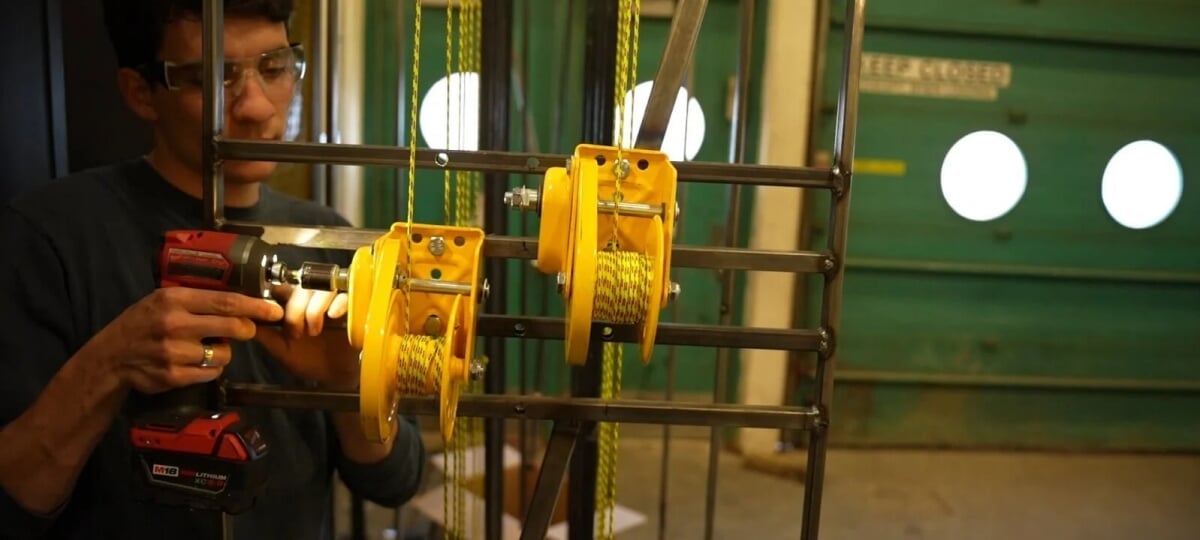
As NASA's Artemis Program prepares to return humans to the surface of the moon, Michigan Technological University students are conducting research to ensure astronauts can hit the ground running.
Before graduating in 2025, Michigan Tech engineering students Parker Courte-Rathwell, Danny Ezzo and Ingrid Halverson developed a hypogravity simulator prototype as part of their NASA-funded capstone Senior Design project. A year later, their work is being used to better understand astronaut musculoskeletal health for future lunar missions.
At Tech, students in the College of Engineering's Senior Design program put their design-thinking skills to the test in small teams, collaborating on year-long industry and research projects. Often described as "more of a first job than a last class," the program focuses on the nuts and bolts of real-world solutions, as students create working prototypes and conduct meaningful research in Tech's labs, testing facilities and design studios.
Some Senior Design teams have the opportunity to work with world-renowned Michigan Tech faculty members on projects with interstellar impacts. That was the case for Courte-Rathwell, Ezzo and Halverson. Their prototype hypogravity simulator project MoonStep was developed with Assistant Professor Tan Chen in Tech's Department of Electrical and Computer Engineering and Steven Elmer, associate professor at St. Catherine University and an affiliated professor in MTU's Department of Kinesiology and Integrative Physiology.
See Senior Design Projects at the 2026 Design Expo
Michigan Tech's Design Expo is happening from 10 a.m. to 2 p.m. on Tuesday, April 14, in the Van Pelt and Opie Library. More than a thousand students from Senior Design and Enterprise teams will showcase their work and compete for awards at this annual event open to the campus and community.
The trio completed MoonStep in Chen's Robotics, Locomotion, and Applied Control (ROLAC) Lab during the 2024-2025 academic year. The lab's researchers investigate robotics, dynamical systems and machine learning, with an emphasis on legged and humanoid robotics.
In summer 2024, Chen received a National Aeronautics and Space Administration grant related to the ROLAC Lab's work on locomotion and mobility. The ongoing project, titled "Investigating Lunar Bipedal Locomotion Mechanics and Predicting Human Musculoskeletal Health on the Moon," is taking place in collaboration with Elmer and the Doctor of Physical Therapy program at St. Catherine University.
NASA's Artemis Program, which recently launched its first-crewed flight, seeks to explore more of the moon for scientific discovery and build a foundation for the first human missions to Mars. Chen's project is part of the larger matrix of research and development endeavors aimed at putting humans back on the moon.
"For the NASA project, we are studying human gaits on the moon to find a robust and efficient gait pattern and how that affects skeletal and muscular health," said Chen. "This project will help ensure the well-being and functionality of astronauts during space exploration missions and guide the design of rehabilitation programs for astronauts after returning to the Earth."
MoonStep: A Prototype Case Study
Every Senior Design project at Michigan Tech looks different. Students working with industry partners may collaborate on new technology for companies like Microsoft, Boston Scientific or Whirlpool. For students working with on-campus partners, their work is just as expansive, whether it's designing prosthetics for the Department of Biomedical Engineering or developing audio control systems for the Department of Visual and Performing Arts.

MoonStep: Hypogravity Simulator for Lunar Locomotion Modeling
For their Senior Design project, MoonStep members Courte-Rathwell, Ezzo and Halverson developed a working prototype of a hypogravity simulator to mimic the moon's gravity to help research metabolic costs of different lunar gait patterns. While the team has graduated, their work continues on in Chen's Robotics, Locomotion, and Applied Control Lab.
For MoonStep's three students, the process involved building a hypogravity simulator from scratch. Each Husky brought the strengths of their studies to the task, Courte-Rathwell as dual major in mechanical engineering and exercise science, Ezzo as a mechanical engineering technology major and Halverson as a robotics engineering major.
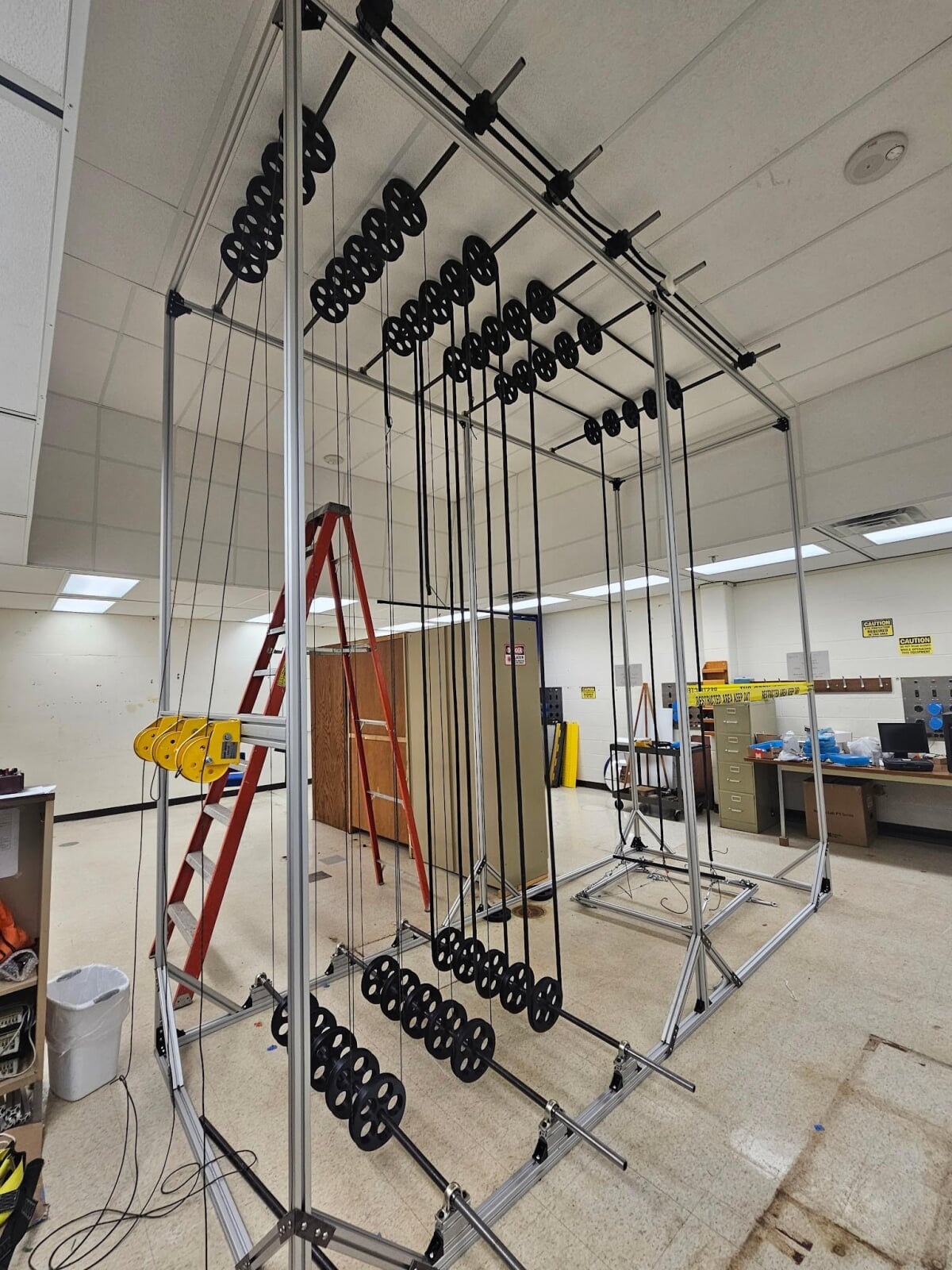
Their hypogravity simulator mimics the gravitational conditions on the moon by offloading five-sixths of a person's body weight. Replicating the lunar environment enables the ROLAC Lab to develop a musculoskeletal model and reinforcement learning algorithm, with the simulator serving a key role in understanding and testing those models.
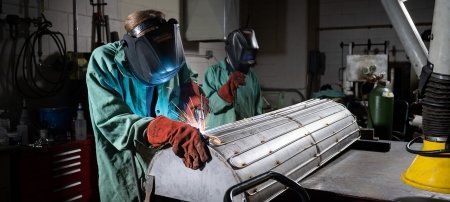
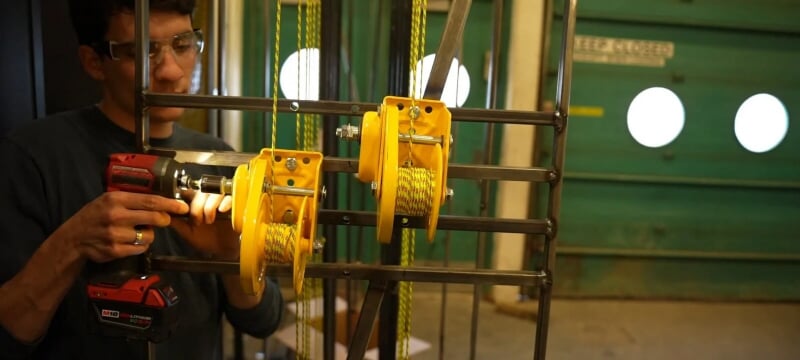
Developing the simulator involved hours in the lab fabricating a large steel structure. Where previous simulators used springs or automated winches, the MoonStep Senior Design team chose a series of elastics and pulleys to simulate the moon's linear gravity and reduce energy loss.
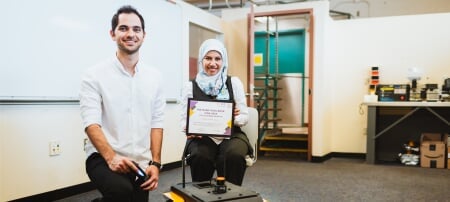
MoonStep's simulator was completed in time for Design Expo 2025, where Courte-Rathwell, Ezzo and Halverson received two awards: an Honorable Mention in the overall Senior Design competition and the Audience Choice Award for Senior Design. Now, the three Tech alumni look back with gratitude at the multidisciplinary, practical experience they received as part of a Senior Design team.

"When different disciplines of engineering come together toward a common goal, everyone gets a chance to add their flair to the project," said Courte-Rathwell.
MoonStep's design also allowed for quick assembly and breakdown, making it possible to demonstrate the simulator reassembled across campus and the region. In summer 2025, the MoonStep team brought their innovation to the Minnesota State Fair, the largest state fair in the country, for its annual STEM Day event.
The simulator was a big hit with the K-12 students who tested it out, walking and jumping like an astronaut would on the moon. The community engagement, a shared priority for both NASA-funded projects and Michigan Tech's Senior Design program, was a joy for all involved.
"This is like a dream come true," said Halverson, who is originally from Minnesota. "It's so special for me to see something I worked on be inspiring for kids in my home state."
To the Moon and Beyond
Because the work is meant to have lasting impact, many Senior Design projects are multiple-year endeavors. While MoonStep's first team members have graduated and gone on to fruitful careers, the MoonStep work in Chen's ROLAC Lab continues. This year, PhD student Anders Smitterberg and undergraduate students Isabella Langmaid, an electrical engineering and robotics engineering junior, and Will Ditmore, a mechanical engineering technology senior, are expanding on the original team's work.
"We're in the process of finalizing the build of a new hypogravity simulator and getting it ready for testing," said Langmaid, who said she appreciates the opportunity to expand her research horizons.
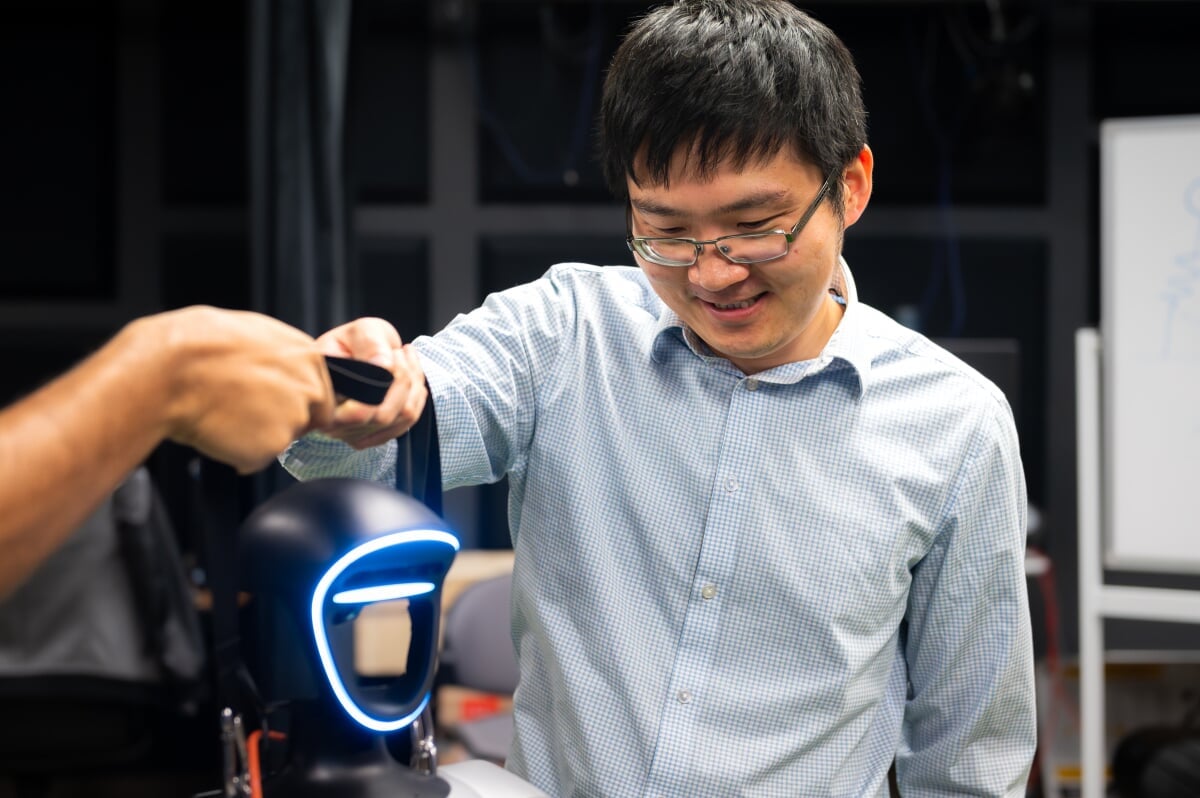
"As a robotics and electrical engineering student, I don't take many mechanical or design classes, but I have found that I really enjoy this type of work," she said. "My current work in the lab has allowed me to further develop those skills."
Chen said the new hypogravity simulator is expanding possibilities for the MoonStep project and future programs.
"Once the second prototype is completed, we will begin conducting experiments with human subjects to validate the theoretical and simulation results," said Chen. "The hypogravity simulator will also serve as a research facility that enables further studies in hypogravity environments, supporting future proposals and funded projects."
The NASA-funded research on astronaut mobility is not the only lunar-focused ROLAC Lab project. In another ongoing project funded by the National Science Foundation, Chen is investigating how bipedal robots could expand the scope of future work on the moon.
The lab's work assessing, understanding and designing robust controllers for robotic locomotion on the moon benefits future lunar missions and also expands the robotics curriculum offering at Michigan Tech for both graduate and undergraduate students.
While it may be many years before we see humanoid robots on the moon's surface, Chen and students in his ROLAC Lab are guaranteeing we are prepared for that seemingly inevitable future.
Michigan Technological University is an R1 public research university founded in 1885 in Houghton, and is home to nearly 7,500 students from more than 60 countries around the world. Consistently ranked among the best universities in the country for return on investment, Michigan's flagship technological university offers more than 185 undergraduate and graduate degree programs in science, technology, engineering, mathematics, computing, forestry, business, health professions, robotics, psychology, social sciences, humanities, and the arts. The rural campus is situated just miles from Lake Superior in Michigan's Upper Peninsula, offering year-round opportunities for outdoor adventure.