
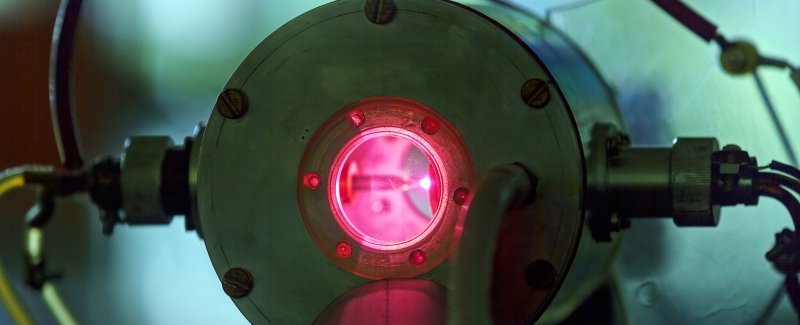
Applied physics bridges the gap between physics, engineering, and other sciences. While engineers solve well-defined problems, applied physicists focus on applying physics interdisciplinarily. At Michigan Technological University, the applied physics program targets areas such as nanoscale condensed matter, materials science, atmospheric physics, optics/photonics, optoelectronics, plasmonics, and biomedical science.
Students choosing the applied physics major create a customized program of study. In addition to taking some core graduate level physics courses, students choose from a wider selection of courses, inside and outside the Department of Physics to gain specialized knowledge in their chosen interdisciplinary research area.
"Having a pure physics background, but wanting to study the atmosphere, I was thrilled to discover that Michigan Tech had an applied physics program that allowed for specialization in atmospheric science. I was able to combine traditional graduate physics courses with special courses in cloud physics, geophysical fluid dynamics, and remote sensing. My research focused on investigating cloud drop size distributions using a lidar-radar system"
State-Of-The-Art Laboratory Facilities
The physics department boasts exceptional research labs and facilities. A recent $2.5 million renovation provided major upgrades in physics classroom technology, and a new $700,000 gift is enabling a major upgrade to physics research facilities. Physics hosts seven labs, ranging from computer labs with state-of-the-art software packages to atomic and molecular laser spectroscopy labs. Researchers also have access to other departments’ research labs, including scanning electron microscopy labs and other advanced characterization and fabrication facilities.
PhD Versus MS
The PhD program (regarded as the terminal degree within the field) consists of substantial graduate-level coursework combined with original research leading to significant contributions to the field of physics through publications in peer-reviewed journals. An MS in physics may be obtained while in pursuit of the PhD.
Both the MS and PhD programs build on a foundational set of six core courses plus additional electives. Well-prepared students will need a minimum of two years to complete their MS degree requirements while PhD students typically spend five years.
Accelerated MS Versus MS
An accelerated master's degree program is a way for students to begin work toward a master's degree while finishing their bachelor's, allowing completion with only one additional year of study. For an accelerated master's, you can double count 9 credit hours toward both your master's and bachelor's degrees. Undergraduate students may apply to the program after they achieve junior status. Those who graduated in Fall 2022 or later can apply up until six semesters (including summer) after they are awarded their bachelor's degrees.
Research Opportunities
- Chemical and biological sensors
- Gamma-ray observations
- Nonlinear Raman Spectroscopy
- Parity-time symmetry in optics
- Theory and modeling of single-electron transport devices
- Nonreciprocal phenomena
- Instrument development and environmental optics
- Dielectric response of molecules under external electrostatic fields
- Modeling molecular electronic devices
- Modeling of materials
- Time-resolved laser spectroscopy and nanofabrications
- Controlled synthesis of 0-D, 1-D, and 2-D materials
- Cloud physics
Degree Requirements
Credit requirements, degree options, time limits, examinations, and other requirements vary by degree:
Qualifying Exam
Students accepted into the Applied Physics PhD program must pass a Qualifying (Comprehensive) Examination, which is composed of a physics component and an application component. The physics component of the Qualifying Examination will be the same as for students in the Physics PhD program, except Applied Physics PhD students will select, in advance, two out of the three areas to take. The student's advisory committee shall formulate the application component of the qualifying examination appropriate to the student's chosen area of applied physics interest—focusing on fundamentals related to but not on the student's current research.
Core Courses
Certain courses are considered foundational for all graduate students (both MS or PhD) in physics, regardless of research specialty. Course work has been selected to provide a general physics education and a foundation for future study and a career in engineering and the sciences.
A minimum of 6 and 9 credits is needed from the list of core courses (PH5010 is compulsory) for MS and PhD, respectively. Additionally, a minimum of 10 PH credits at the 4000-level or higher from the list of electives. The elective credits can be substituted with courses suggested by the research advisor.
Electives
To take advantage of Michigan Tech's breadth and depth of engineering and scientific areas of specialty, additional courses may be chosen from the list of application elective course list, as approved by the student's advisory committee.
Atmospheric Physics
Biophysics
Photonics
Physics at Nanoscale
For a complete listing of graduate courses available, visit the registrar's office.
Suggested Course Schedules - Accelerated Master's
Students in the accelerated master's program can choose the coursework, report, or thesis option. Suggested schedules for each option are below.
- Accelerated Master's - Coursework Option
- Accelerated Master's - Report Option
- Accelerated Master's - Thesis Option
Careers in Applied Physics
Applied physicists are well suited to work in any career that requires strong mathematical, experimental, and/or theoretical skills. The applied physics program provides excellent flexibility enabling majors to work in academia, industry, law, and government. Past students and their employers include:
- Jiang Lu, artificial intelligence/deep learning expert at FutureWei Technology in Seattle, WA
- Michael Larsen, associate professor of physics at the College of Charleston in Charleston, SC
- Teresa Wilson, research scientist at the United States Naval Observatory, Washington DC.