
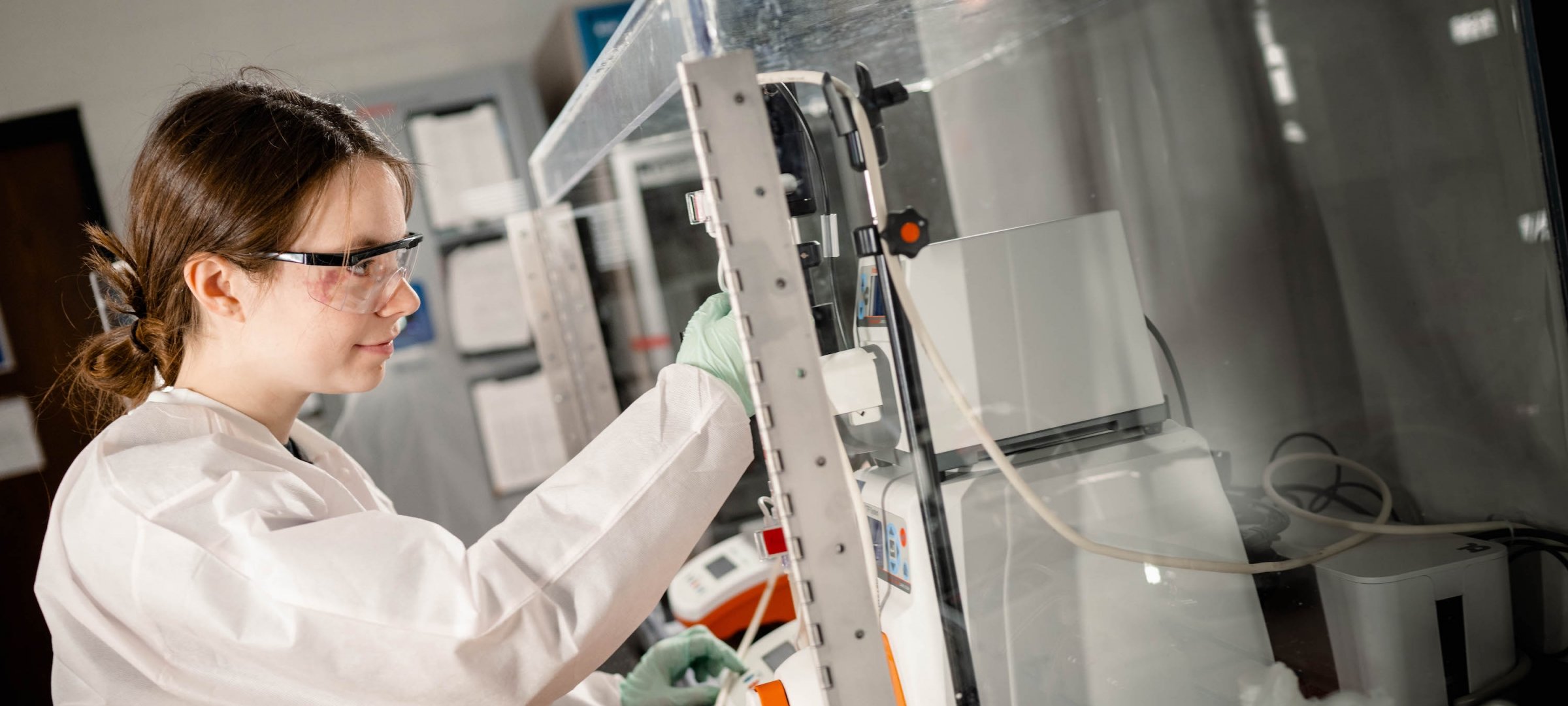
Graduate students pursuing MS and PhD degrees in Chemical Engineering at Michigan Tech work alongside faculty to advance fundamental and applied knowledge in chemical engineering and related fields.
Graduate research opportunities available to students are often interdisciplinary, with strong industry collaborations. Becoming part of nationally recognized research that improves the lives of people makes Michigan Tech chemical engineering an excellent choice for graduate study.
Current departmental research includes pioneering a microdevice—an entire miniature chemical plant on a silicon wafer—to rapidly determine a patient's blood type, as well as designing process equipment to sequester CO2 using industrial waste materials.
Many of our new research projects are driven by University initiatives in sustainability, biotechnology, and alternative energy. Our core research thrust areas are
- Process safety;
- Process systems engineering;
- Energy production and storage;
- Sustainable engineering;
- Applied thermodynamics;
- Polymer processing;
- New materials synthesis;
- Minerals processing;
- Iron and steel making; and
- Biochemical engineering.
Extensive Funding Sources
Chemical and materials industries fund 25 percent of the department's research programs. Federal and state agencies support the majority of our projects, highlighted by funding from the National Science Foundation, the Department of Education, the National Institute of Health, and the US Department of Energy. The current level of external funding is approximately $3 million, with about $1 million in annual research expenditures.
Cutting-Edge Research Facilities
Fully equipped laboratory facilities and analytical equipment support the department's research efforts. Resources are available to study inorganic and biochemical systems and processes ranging in size from nanoscale to pilot plant. Students receive training in measurement and imaging methods needed for their research.
Projects go well beyond small-scale laboratory demonstrations. At three stories tall and 6,500 square feet, our Unit Operations Laboratory simulates a real-world chemical-processing facility. Students receive industrially relevant, hands-on experience with state-of-the-art equipment for chemical processing, instrumentation, control, and data acquisition.
MS Plans
Whether your interests lie in research or course work, we offer a master plan to suit your educational goals. A detailed explanation of degree requirements can be found on the Graduate School's Master of Science requirements page.
This option requires a research thesis prepared under the supervision of the advisor. The thesis describes a research investigation and its results. The scope of the research topic for the thesis should be defined in such a way that a full-time student could complete the requirements for a master’s degree in 12 months or three semesters following the completion of coursework by regularly scheduling graduate research credits.
The minimum requirements are as follows:
| Option Parts | Credits |
|---|---|
| Coursework (minimum) | 20 Credits |
| Thesis research | 6-10 Credits |
| Total (minimum) | 30 Credits |
| Distribution | Credits |
|---|---|
| 5000-6000 series (minimum) | 12 Credits |
| 3000-4000 (maximum) | 12 Credits |
Programs may have stricter requirements and may require more than the minimum number of credits listed here.
This option requires a report describing the results of an independent study project. The scope of the research topic should be defined in such a way that a full-time student could complete the requirements for a master’s degree in twelve months or three semesters following the completion of coursework by regularly scheduling graduate research credits.
Of the minimum total of 30 credits, at least 24 must be earned in coursework other than the project:
| Option Parts | Credits |
|---|---|
| Coursework (minimum) | 24 Credits |
| Report | 2-6 Credits |
| Total (minimum) | 30 Credits |
| Distribution | Credits |
|---|---|
| 5000-6000 series (minimum) | 12 Credits |
| 3000-4000 (maximum) | 12 Credits |
Programs may have stricter requirements and may require more than the minimum number of credits listed here.
This option requires a minimum of 30 credits be earned through coursework. A limited number of research credits may be used with the approval of the advisor, department, and Graduate School. See degree requirements for more information.
A graduate program may require an oral or written examination before conferring the degree and may require more than the minimum credits listed here:
| Distribution | Credits |
|---|---|
| 5000-6000 series (minimum) | 18 Credits |
| 3000-4000 (maximum) | 12 Credits |
Accelerated Option
Are you a highly motivated student seeking to accelerate your education? Get on the fast track with the Chemical Engineering Accelerated Master’s program and earn a bachelor’s and a master’s in five years, and you will graduate with an advanced degree and start your career or PhD studies one year earlier than the average.
You will earn both a Bachelor of Science in Chemical Engineering and a Master of Science in Chemical Engineering in ten semesters (five academic years) of full-time course work. Students enrolled in the accelerated program begin graduate course work in their fourth year and finish the master’s degree requirements within two semesters of study beyond completion of their bachelor’s degree.
Upon graduation, you will be prepared to succeed in a wide range of positions in the chemical industry or in a chemical engineering doctoral program.
- Students may apply for admission to the Chemical Engineering Accelerated Master’s program anytime after junior-level class standing is attained and before a bachelor’s degree is awarded.
- Students must apply for admission to the accelerated program though the standard Graduate School application process. Applications will be reviewed by the Department of Chemical Engineering’s graduate program according to the normal procedure.
- Only students who intend to complete both a bachelor’s and a master’s degree at Michigan Tech are eligible to enroll in the accelerated program.
- Students already enrolled in a graduate program may not retroactively enroll in the Chemical Engineering Accelerated Master’s program.
- Each student’s preliminary plan for the accelerated master’s program must be approved by the Department of Chemical Engineering prior to acceptance into the graduate program; therefore, the student is required to meet with the chemical engineering graduate program director/advisor at the time of application to develop a plan for completion of the degree and to designate courses taken while an undergraduate student that will be applied toward the master’s degree requirements.
- Upon acceptance into the program, the student is required to attend an advising meeting each semester to review the plan for completion and make adjustments as necessary.
- The maximum time to degree for the Chemical Engineering Accelerated Master’s program is five years from the time the student is accepted into the program.
- Through the accelerated program, a minimum of 155 total credits must be completed to meet the combined requirements of the Bachelor of Science and Master of Science in Chemical Engineering. Both degrees must be earned in chemical engineering.
- Up to 6 undergraduate engineering credits earned at the 3000 level or higher may be applied toward both the bachelor’s and master’s degrees. Prior to completion of the master’s degree, students must indicate on their master’s degree schedule which undergraduate-level courses, along with the corresponding number of credits (a maximum of 6), should be applied to both their bachelor’s and master’s degrees.
Note: This is not an official list of degree requirements. Adjustments may be required due to curriculum changes.
Year One
Fall Semester
| Course | Title | Credits |
| CH1150 | University Chemistry I | 3 |
| CH1151 | University Chemistry I Lab | 1 |
| CH1153 | University Chemistry I Rec | 1 |
| ENG1101 | Eng Analysis and Problem Solving | 3 |
| MA1160 | Calculus with Technology I | 4 |
| PH1100 | Physics by Inquiry I | 1 |
| UN1001 | Perspectives | 3 |
| TBD | Cocurricular (1 unit) | |
| Total: 16 |
Spring Semester
| Course | Title | Credits |
| CH1160 | University Chemistry II | 3 |
| CH1161 | University Chemistry II Lab | 1 |
| ENG1102 | Eng Modeling and Design | 3 |
| MA2160 | Calculus with Technology II | 4 |
| PH2100 | University Physics I | 3 |
| UN1002 | World Cultures | 4 |
| Total: 18 |
Year Two
Fall Semester
| Course | Title | Credits |
| CH2410 | Organic Chemistry I | 3 |
| CH2411 | Organic Chemistry I Lab | 1 |
| CH2110 | Fundamentals of ChE I | 3 |
| MA3160 | Multivariable Calc with Technology | 4 |
| PH1200 | Physics by Inquiry II | 1 |
| UN2001 | Composition Cocurricular | 3 |
| TBD | Cocurricular (1 unit) | |
| Total: 15 |
Spring Semester
| Course | Title | Credits |
| CH2420 | Organic Chemistry II | 3 |
| CH2120 | Fundamentals of ChE II | 3 |
| MA2321 | Elementary Linear Algebra | 2 |
| MA3521 | Elementary Differential Equations | 2 |
| PH2200 | University Physics II | 3 |
| UN2002 | Institutions | 3 |
| TBD | Cocurricular (1 unit) | |
| Total: 16 |
Year Three
Fall Semester
| Course | Title | Credits |
| CH3510 | Physical Chemistry I | 2 |
| CH3511 | Physical Chemistry Lab I | 3 |
| CM3110 | Transport/Unit Operations I | 2 |
| CM3215 | Fundamentals of ChE Lab | 3 |
| CM3410 | Tech Comm for ChE | 3 |
| TBD | HASS (Gen Ed) Distribution | 3 |
| Total: 16 |
Spring Semester
| Course | Title | Credits |
| CM3120 | Transport/Unit Operations II | 3 |
| CM3230 | Thermodynamics for ChE | 4 |
| CM3310 | Process Control | 3 |
| CM3510 | Chemical Reaction Eng | 3 |
| TBD | HASS (Gen Ed) Distribution | 3 |
| Total: 16 |
Year Four
Fall Semester
| Course | Title | Credits |
| CM4110 | Unit Operations Lab | 3 |
| CM4310 | Process Safety/Environment | 3 |
| CM4855 | ChE Proc Analysis and Design I | 3 |
| TBD | 4000-level Technical Elective | 3 |
| TBD | Free Elective | 3 |
| TBD | HASS (Gen Ed) Distribution | 3 |
| Total: 18 |
Spring Semester
| Course | Title | Credits |
| CM4120 | Chemical Plant Operations Lab | 3 |
| CM4860 | ChE Proc Analysis and Design Lab II | 2 |
| CM4861 | ChE Design Lab II | 1 |
| TBD | 4000-level Technical Elective | 3 |
| TBD | Technical Elective | 4 |
| TBD | HASS (Gen Ed) Distribution | 3 |
| Total: 16 |
Year Five
Fall Semester
| Course | Title | Credits |
| CM5100 | Applied Math for Chem Eng | 3 |
| CM5200 | Advanced Thermodynamics | 3 |
| CM5310 | Laboratory Safety | 1 |
| CM5621 | Research Essentials | 2 |
| TBD | Master's Technical Elective | 3 |
| Total: 12 |
Spring Semester
| Course | Title | Credits |
| CM5300 | Advanced Transport Phenomena | 3 |
| CM5400 | Advanced Reactive Systems Analysis | 3 |
| TBD | Master's Technical Elective | 3 |
| TBD | Master's Technical Elective | 3 |
| Total: 12 |
Only students in good academic standing, as defined by the Graduate School, are eligible to enter the Chemical Engineering Accelerated Master’s program. Students must maintain a cumulative GPA of 3.0 or above on a 4.0 scale to be in good standing with the Graduate School.
- A student enrolled in the accelerated program will be considered an undergraduate student until the bachelor’s degree has been awarded.
- Once the bachelor’s degree is awarded, the student is considered a graduate student and will be expected to adhere to all Michigan Tech Graduate School policies and procedures.
Core Course Requirements
Students in the Chemical Engineering Accelerated Master’s program must complete the following required core courses (15 credits total).
Core Courses Offered in Fall
The solution to basic equations for momentum, mass, and heat transfer by use of separation of variables, numerical methods, and other mathematical techniques.
- Credits: 3.0
- Lec-Rec-Lab: (3-0-0)
- Semesters Offered: Fall
- Restrictions: Must be enrolled in one of the following Level(s): Graduate
Emphasis in phase equilibria and related concepts, such as molecular or statistical thermodynamics, nonideal fluids and solids.
- Credits: 3.0
- Lec-Rec-Lab: (3-0-0)
- Semesters Offered: Fall
- Restrictions: Must be enrolled in one of the following Level(s): Graduate
Provides the technical and cultural background necessary to operate and manage a safe Laboratory.
- Credits: 1.0
- Lec-Rec-Lab: (1-0-0)
- Semesters Offered: Fall
This course is intended to improve skills necessary for planning, conducting, analyzing, and presenting research; ethical and responsible conduct, critical evaluation of existing literature, written and oral communication, and experimental design and analysis.
- Credits: 2.0
- Lec-Rec-Lab: (0-0-3)
- Semesters Offered: Fall
- Restrictions: Must be enrolled in one of the following Level(s): Graduate
Core Courses Offered in Spring
Single- and multi-component mass, energy, and momentum transport. Derivation and use of the general transport equations for Newtonian and non-Newtonian flows, convective flows, and mass transport in flowing systems. Applications to complex systems.
- Credits: 3.0
- Lec-Rec-Lab: (3-0-0)
- Semesters Offered: Spring
- Restrictions: Must be enrolled in one of the following Level(s): Graduate
- Pre-Requisite(s): CM 5100
An analytical study of various aspects of chemical reactor behavior, such as multiple steady-states, dynamics, stability, and control. Also covers transport phenomena in packed beds of solids and mathematical modeling of packed-bed reactors.
- Credits: 3.0
- Lec-Rec-Lab: (3-0-0)
- Semesters Offered: Spring
- Restrictions: Must be enrolled in one of the following Level(s): Graduate
Technical Course Requirements
In addition to the core requirements, 15 credits of technical courses (e.g., engineering and mathematics courses) are required to earn the 30 credits needed for the accelerated master’s program. Up to 6 of the technical course credits may be taken during the undergraduate years and double counted for the master’s degree. Note that a maximum of 12 credits earned at the 3000 level or 4000 level can be applied toward a master’s degree, whether those courses were taken as an undergraduate student or as a graduate student.
Chemical Engineering Technical Courses Offered
The following courses may be used to fulfill the 15-credit technical course requirement for the accelerated master’s program. Other courses, including those outside of chemical engineering, may also be acceptable, with the approval of the graduate program director.
The use of modern software packages in chemical engineering. Packages include spreadsheet, symbolic manipulator, chemical process calculator, statistical and modeling software. Course develops knowledge and skills in using computer tools that will complement chemical engineering courses and practice.
- Credits: 3.0
- Lec-Rec-Lab: (0-0-6)
- Semesters Offered: Fall
- Pre-Requisite(s): CM 2110(C) and MA 2160
Introductory study of the properties of polymers. Includes structure and characterization of polymers in the solid state, in solution, and as melts. Topics include viscoelasticity, rubbery elasticity, rheology and polymer processing. Applications discussed include coatings, adhesives, and composites.
- Credits: 3.0
- Lec-Rec-Lab: (3-0-0)
- Semesters Offered: Fall
- Pre-Requisite(s): CH 1122 or (CH 1160 and CH 1161)
Study of polymer chemistry dealing with the mechanisms of polymerization and copolymerization. Study of the chemistry of polymers, including polymer modification and degradation. Topics include methods of measuring and predicting the path of degradation and stabilization.
- Credits: 3.0
- Lec-Rec-Lab: (3-0-0)
- Semesters Offered: Spring
- Pre-Requisite(s): CH 2420
Introduction to fundamental and applied industrial biochemical processing. Topics may include basic cell and genetic design, enzymes, metabolism, bioreactor analysis and design, bioseparations and industrial applications.
- Credits: 3.0
- Lec-Rec-Lab: (3-0-0)
- Semesters Offered: Fall, in odd years
- Restrictions: May not be enrolled in one of the following Class(es): Freshman, Sophomore
- Pre-Requisite(s): CH 2410
Covers chemical engineering topics not included in regular courses, which may include biochemical engineering, design of biochemical reactions, composite materials, and numerical analysis of transport processes.
- Credits: variable to 3.0; Repeatable to a Max of 12
- Semesters Offered: On Demand
- Restrictions: Permission of instructor required
A discussion of chemical engineering topics of current interest not included in regular graduate courses.
- Credits: variable to 3.0; Repeatable to a Max of 9
- Semesters Offered: On Demand
- Restrictions: Permission of instructor required; Must be enrolled in one of the following Level(s): Graduate
PhD Plan
A detailed explanation of degree requirements can be found on the Graduate School's Doctor of Philosophy requirements page.
To complete a doctoral degree, students must complete the following milestones:
- Complete all coursework and research credits (see credit requirements below)
- Pass Qualifying Examination
- Pass Research Proposal Examination
- Prepare and Submit Approved Dissertation
- Pass Final Oral Defense
The minimum credit requirements are as follows:
| Degrees | Credits |
|---|---|
| MS-PhD (minimum) | 30 Credits |
| BS-PhD (minimum) | 60 Credits |
Individual programs may have higher standards and students are expected to know their program's requirements. See the Doctor of Philosophy Requirements website for more information about PhD milestones and related timelines.