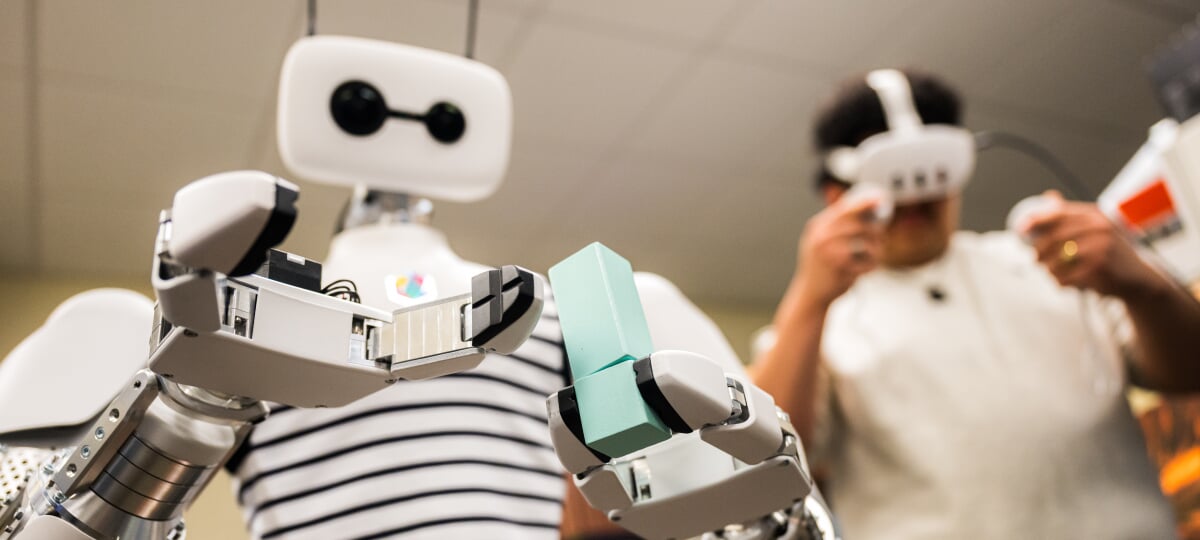
In Michigan Tech's Human-Robot Interaction Lab, Huskies teach the lab's newest occupant the basics: how to wave, glide and hold a steady grip. Guided by their faculty mentor, they're on a mission to make advanced robotics more accessible.
Inside Michael Walker's Human-Robot Interaction (HRI) Lab at Michigan Technological University, the clinical atmosphere often associated with high-tech research is nowhere to be found. Instead, the air is filled with the low hum of motors and mechanical clicks along with enthusiastic conversation between student and faculty researchers.
At the center of it all is Reachy the Robot.
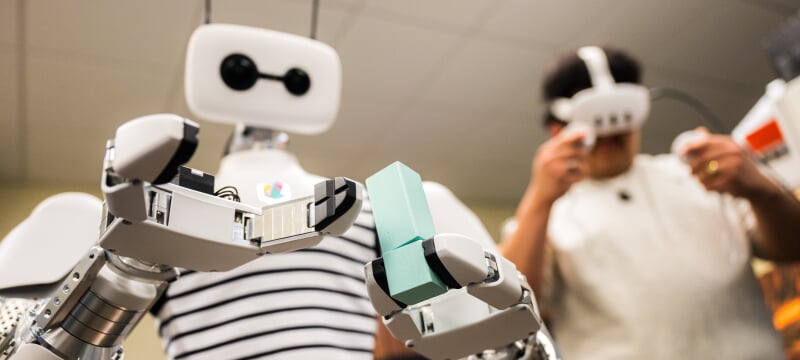
With an expressive head on a swiveling neck and gangly, bio-inspired arms, Reachy's look, complete with its standard-issue black-and-white striped tank top, leans more toward endearing companion than sci-fi overlord. Walker chose to bring Reachy to Michigan Tech for that precise reason. In the new era of human-robot interactions, Reachy has the potential to make inroads with one of the oldest challenges in the robotics field: surmounting the uncanny valley.
The uncanny valley is the creeped-out sensation some people feel when interacting with an object resembling a human. It's a highly subjective emotional response. As Walker explains, we tend to gravitate toward cute, rather than being drawn to something artificial that's trying too hard to simulate reality. The uncomfortable, uneasy or repulsed feeling, which can also be triggered by photographs generated by artificial intelligence, is a hallmark of the uncanny valley.
And that presents a challenge, said Walker, an assistant professor of computer science. "The next phase of robotics will be in the humanoid space," Walker said. "How can we make that experience more cohesive and welcoming?"
Reachy's design is an antidote to the entry-level trepidation of human-robot interaction. Its sleek white exterior and human-inspired motions, such as a head tilt conveying curiosity, let it mimic humanity without trying to pass for a biological person.
Another huge advantage is Reachy's open-source status, meaning communities around the world using the robot can compare and share knowledge. Both functional and approachable, Reachy helps Walker's lab explore how robots can integrate into our daily lives — places like hospitals, workspaces and homes — without triggering the ick factor.
Meet 'Reachy Wrangler' Jose Manuel Padilla
While the robot's capabilities are remarkable, the accomplishments of student researcher Jose Manuel Padilla are even more impressive. The robotics engineering undergraduate is a first-generation student from a Mexican household in Chicago. Overcoming the obstacles of an underfunded school system, Padilla sought out every STEM opportunity he could find, including Saturday morning programs in the city that required a parent to attend. His childhood memories include grabbing an old screwdriver that his dad had put aside, using it to satisfy his curiosity.
"I'd open up random toys that I had, then put them back together and see how everything worked," he said. "I grew up watching 'Transformers.' I saw how people in my family were mechanics. I was always seeing things get put together."
When Padilla arrived at Tech, he cold-emailed Walker, whom he'd heard about through Tech's Summer Bridge Program — part of the University's S-STEM Husky PAWS Scholarship offered to Pell-eligible undergraduate students who are majoring in engineering, computing or physics programs.
"I'm in the place where my dreams can come true if I work hard enough," Padilla said. "I sent an email to Dr. Walker and said, 'Hey, I want to pursue robotics. I'm really interested in what you're doing.' If people say no, what's going to happen? They're not going to hurt you."
Walker said yes. He invited the incoming first-year Husky into his graduate-level HRI class. Before Reachy's arrival on campus, Padilla worked in Reachy's simulation space, a virtual environment where users can develop AI algorithms, run applications and practice motion control. By the time the physical robot showed up, graduate students were coming to Padilla for help. He'd become, in Walker's words, the "Reachy Wrangler."
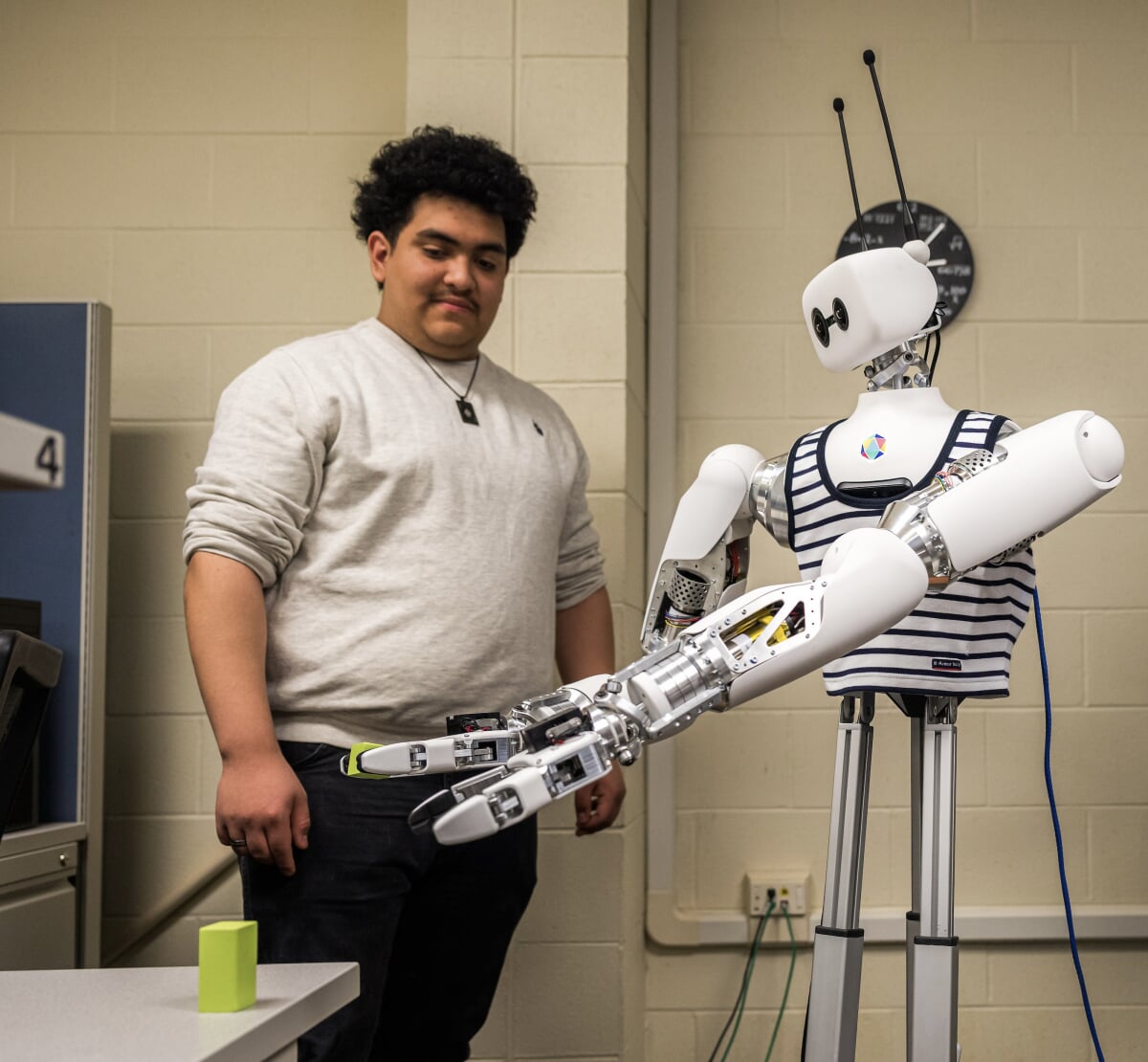
In Walker's lab, undergraduates aren't sidelined. It's the exact opposite of Walker's own experience as a student.
"When I was an undergrad, it was like, 'Don't touch the robots. You have to wait until you're getting your advanced degree.' That's what inspired me to open my lab to students at all levels," he said.
To make the robots even more accessible — and to prevent expensive accidents — the lab utilizes advanced simulations. Just like Padilla, before students at any level are able to work with the physical Reachy, they learn the ropes on its digital twin.
"We made a virtual version of Reachy that doesn't know it's not the real version," Walker explained. "It runs the robot software behind the scenes. Now we can simulate three Reachy robots instead of just one. It keeps us productive and makes everyone more comfortable about not breaking things."
Because all the Reachys are open source, information can be quickly exchanged, meaning others with the same model can share solutions.
"In all these labs and in papers, when researchers say, 'Here's the source code,' it never works, because it's so unique to their systems and their sensor packages. So now, this developer is trying to make it so that we can do that," said Walker.
Rubbing Elbows with Graduate Students
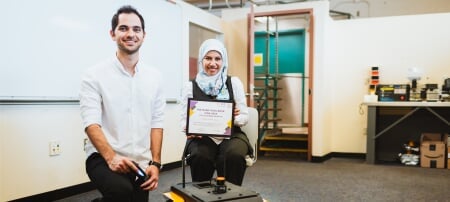
Walker's lab also includes master's student Asma Abid Karim and doctoral student Lilly Nekervis, both studying computer science.
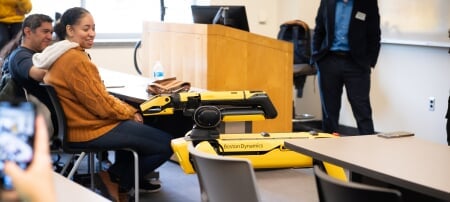
Nekervis, who previously worked with the Boston Dynamics quadruped robot Spot in North Carolina — Michigan Tech's version of the robot dog is known as Balto — was drawn to work in Walker's lab because of the hands-on culture. Her background isn't traditional robotics. She studied information sciences, focusing on software lifecycles and database work.
"Coming up here and seeing the robotics initiative's initial rollout, it's fabulous to be a part of it," Nekervis said, noting that the mix of student levels is one of the lab's strengths. "I love having the undergrads here that can do the work and are excited to be hands-on."
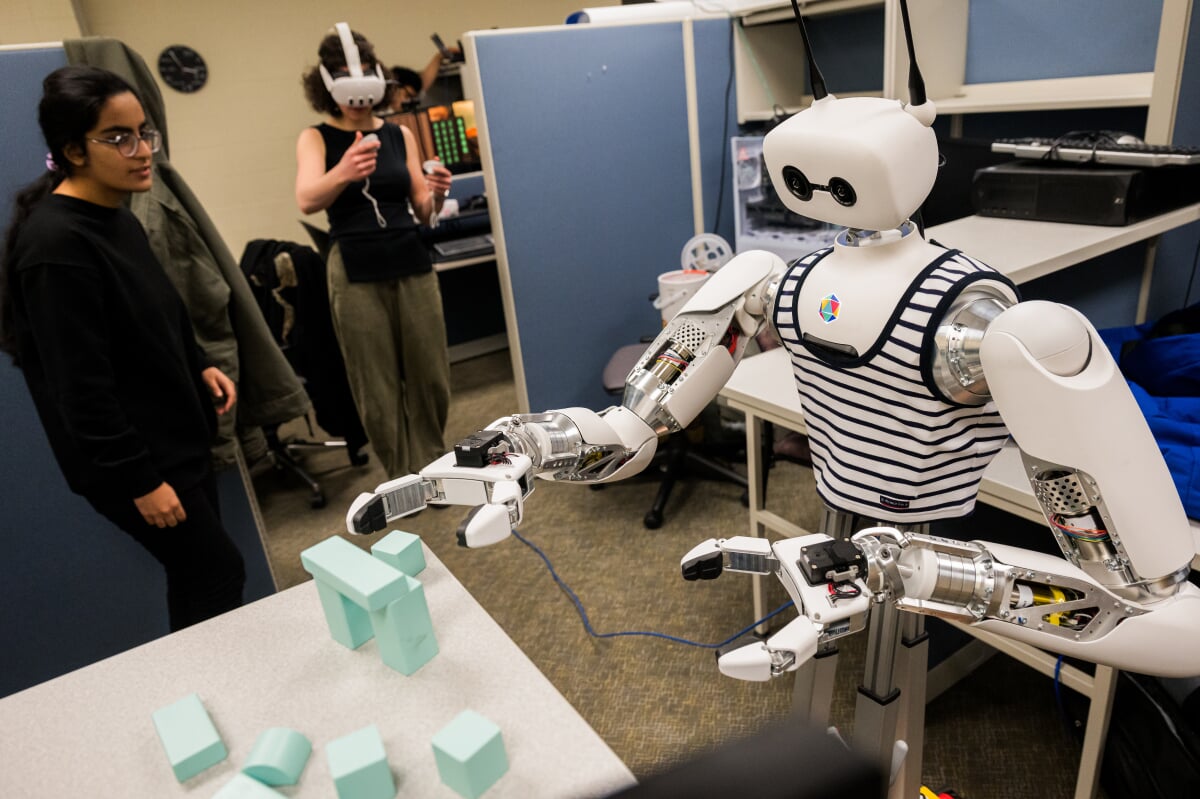
Human-to-robot interaction is one direction for the HRI Lab. Walker is also exploring the possibilities for increased robot-to-robot interaction. With Reachy (the humanoid) and Balto (the robotic dog) in the same room, the lab is uniquely positioned to study how different robotic forms collaborate, especially when one is being controlled by a human via virtual reality (VR).
Human-centered Robotics Serving Humanity
For Padilla, who deftly runs Reachy through its paces, the research is personal. He doesn't see robots as a threat to his family's blue-collar roots; he sees them as a way to make those jobs safer.
His father is a forklift driver who works 14-hour shifts, often in high-risk environments where pallets can fall. Padilla's dream? A robotic forklift that his father can pilot from home using a VR headset.
"If the unfortunate outcome were that things fall on the forklift, there's no human casualty," Padilla said. "My dad is still working, still doing all these great things, but without the risk. It helps the person, and economically, it helps the company with insurance. It's a lot easier to fix a robot than a life lost."
The HRI Lab is growing. Reachy was recently joined by Reachy Mini, adding another layer of cuteness to the robot corps at Michigan Tech, where humans and humanoids are working together to help students learn and lead the next phase of robot interaction.
Michigan Technological University is an R1 public research university founded in 1885 in Houghton, and is home to nearly 7,500 students from more than 60 countries around the world. Consistently ranked among the best universities in the country for return on investment, Michigan's flagship technological university offers more than 185 undergraduate and graduate degree programs in science, technology, engineering, mathematics, computing, forestry, business, health professions, robotics, psychology, social sciences, humanities, and the arts. The rural campus is situated just miles from Lake Superior in Michigan's Upper Peninsula, offering year-round opportunities for outdoor adventure.