
For more than seven decades, the Copper Country has been a hub for engineering, manufacturing, testing, and research aimed at national security. Now, Michigan Tech and local business leaders have banded together to strengthen their collective voice amid the United States' booming defense industry.
The modern battlefield is evolving as fast as technology advances, and both the United States and the State of Michigan are investing heavily to stay ahead of the pace. In 2026, the federal government slated over $1 trillion for defense spending requests and authorizations. In Michigan, defense is the third-largest industry in the state, employing more than 166,000 people in the automotive, aerospace, and advanced manufacturing sectors and contributing $30 billion in annual economic activity. The Keweenaw Peninsula has been a modest but influential contributor to this effort for decades—and as technology advances, that influence is poised to grow.
When Andrew Barnard took the reins of Michigan Tech's research enterprise as the University's vice president for research in 2024, one of the first things he did was organize the Keweenaw Defense Industry Consortium—a group of companies in Houghton and Keweenaw Counties that develop next-generation defense technologies as part or all of their business portfolios. Having seen the surge in defense investment happening both nationally and in Michigan, Barnard seized the opportunity for Michigan Tech to collaborate with these local businesses in a more coordinated way.
"It's not just one business working on one thing," says Barnard. "It's a really extensive and vibrant defense industry ecosystem. And with us all working together, we can better tell the story of all the national security efforts happening here in the Copper Country."
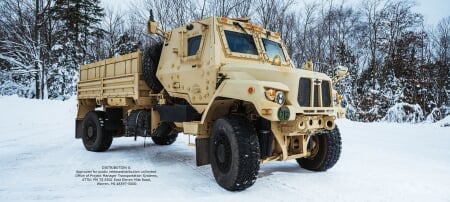
Part of the vibrancy Barnard speaks of is due, of course, to the Keweenaw's unique location. The region's abundant lake effect snowfall and rugged landscape have long provided unique opportunities for ground vehicle development for the US Army and other defense entities. The area's proximity to the world's largest freshwater lake offers similar advantages to the US Navy and others. However, perhaps the most important feature of the region, says Barnard, is Michigan Tech, which gives defense contractors and companies access to cutting-edge research and top-notch talent.
"Having an R1 university in your backyard is really transformational for small, mid-sized, and large businesses alike," Barnard says. "If you look at the 10 companies currently in the consortium, their engineering and management talent is almost 100 percent Michigan Tech graduates. Those are amazing students who came to Tech, who want to stay in the area, and who want to support national security."
Roots in Research
The Copper Country's involvement with defense work traces back more than 70 years to a patch of land near the Houghton County Memorial Airport. There, the US Army opened the Keweenaw Field Station in an ideal location for various Cold War-era laboratories to test military vehicles on rugged and variable terrain. In 1965, the University established the Keweenaw Research Center within the field station. Among the KRC's earliest research projects was designing a new track for the M1 Abrams main battle tank, one of the Army's heaviest tanks. Larger military projects followed that early success. Soon the KRC was well-known in the defense and automotive industries for its engineering design, analysis, and testing—and for working in one of the nation's snowiest climates. Interest in defense work grew in the local community, and a talented workforce with specialties specific to the defense industry began to take shape.

Michigan Tech officially purchased the Keweenaw Field Station from the US Army in 1993 after the Soviet Union collapsed and the US Army turned its focus from Siberia to the desert environments of the Middle East. Many of the region's thriving defense-oriented businesses began at the KRC during this era. ThermoAnalytics, which specializes in infrared signature modeling and software, was a research group of KRC before spinning off in 1996 to become its own private entity. Other companies followed the same pattern—including Signature Research Inc. in 1992, REL in 1993, Great Lakes Sound and Vibration in 1996, and GS Engineering in 2001.
Traci Webb '05, GS Engineering's director of business development and marketing, is one of the many Huskies who cut their teeth in the defense industry while studying mechanical engineering at Tech. Her first exposure to defense vehicle engineering came during the two years she worked part-time at the KRC under executive director Scott Bradley. This experience set the trajectory for the rest of her career.
"Scott was a great mentor. He let me know the promise he saw in me, which helped me believe in myself and my capabilities and confidence," Webb says. "I was also super inspired by the mission-driven nature of defense vehicle engineering, a path I had never considered before my time at KRC."
After graduating, Webb worked as a federal employee with the US Department of Defense before seizing an opportunity to return to the Keweenaw. "I moved back here to raise my family in a place that I love, doing work that I believe in," she says. "People who work here love to live here, and they tend to keep their positions for a very long time. This builds stable teams, which in turn delivers successful outcomes to our clients."
A Region on the Rise
The KRC and its spinoff companies are growing in tandem with the research portfolio at Michigan Tech. The University has quickly become a significant player in defense research and testing, says Barnard, especially compared to peer universities—and especially in the domains of ground vehicles and remote sensing.
Fueled by the University's expertise in these areas, Tech's annual research expenditures topped $35 million in 2004. That number grew steadily over the next two decades, surpassing $100 million for the first time in 2023. More local companies specializing in defense work were founded in the region, including IR Telemetrics, Mohawk Technology, Orbion Space Technology, and Loukus Technologies. And other long-standing companies began incorporating defense work into their operations—like Calumet Electronics, which manufactures printed circuit boards and other next-generation electronics technologies integral to national security. By 2025, the year the University was formally designated an R1 research institution, the Department of Defense accounted for over 35 percent of the University's federal research awards.

The impact of this growth on the region is as hard to overstate as it is difficult to precisely quantify—but leave it to Huskies to do the math. In 2023, a Michigan Tech study led by Associate Professor Jenny Apriesnig in the College of Business showed that every $1 million in research expenditures in rural micropolitan areas like the Keweenaw adds $711,000 in value to the local economy, creates 10 jobs, and generates $159,000 in annual tax revenue. Given that a portion—about $13 million—of the University's defense research awards are affiliated with the Michigan Tech Research Institute in Ann Arbor, Barnard puts the Copper Country's share at around $27 million.
"So, if you take that $27 million, that's 270 jobs created and almost $20 million in value added to Houghton and Keweenaw Counties, plus another $4 million in state and federal taxes," says Barnard. "And that's just the economic impact generated from Michigan Tech research. That doesn't include the additional impact from the companies in our consortium, which is huge."
Shared Voices, Shared Goals
The Copper Country's decades of expertise in the defense sector bodes well not just for the region, but also the State of Michigan, which is actively seeking to expand on its long-established status as the country's premier hub of Army ground vehicle manufacturing and testing. In 2024, when announcing the state's new Office of Defense and Aerospace Innovation (ODAI) alongside the Michigan Economic Development Corporation, Governor Gretchen Whitmer said Michigan is "all-in on defense." The ODAI's mission is to grow the state's defense and aerospace ecosystems, with a focus on fostering business growth and innovation, as well as amplifying the Great Lakes State's unique advantages in land, water, air, and space.
Many of those same advantages overlap with the Keweenaw Defense Industry Consortium (KDIC) members' areas of expertise. The ODAI's Michigan Maritime Manufacturers initiative, for instance, expands education and skill development in advanced maritime manufacturing. KDIC member Great Lakes Sound and Vibration has already built a national reputation in this area making stack silencers for Navy vessels. Barnard says Michigan leaders have expressed strong interest in using the advanced manufacturing skills in the state to produce parts for surface ships and submarines.

"That's going to include a lot of advanced welding and other trade skills," says Barnard. "There's a lot of advanced engineering that goes with these types of things as well, and Michigan Tech will hopefully have a role to play in that."
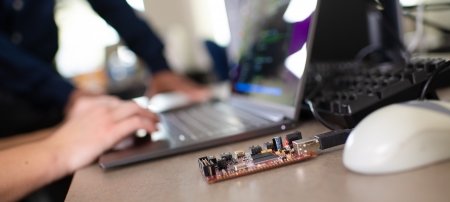
Both the KRC and Michigan Tech's Advanced Power Systems Research Center, known as APS Labs, continue to make significant contributions to the state's expertise in ground vehicle defense work. Barnard says other areas of future growth that Michigan Tech and Keweenaw companies specialize in include remote sensing, satellite-based sensing, and autonomy. He also expects to see exponential investment nationally in cybersecurity—an area in which Michigan Tech is already ahead of the curve.
Michigan Tech is a National Center of Academic Excellence in Cyber Defense recognized by the National Security Agency. The designation promotes and supports the University's work to build the United States' cyber defense workforce through high-quality academic programs. Michigan Tech also holds an NSA designation as a National Center of Excellence in Cyber Research—making Tech the only university in Michigan to receive both distinctions.
"One of the things that we're interested in and good at here at Michigan Tech is not just the cybersecurity of protecting data, but the cybersecurity of physical assets—protecting actual machines from getting hacked," Barnard notes. "That's a unique niche for us here at Michigan Tech."
All for One, One for All
KDIC members meet every other month to talk about challenges they are facing, opportunities they are seeing for federal funding, and how they can work together to take advantage of those opportunities. Barnard hopes to see more project-based collaboration between members in the future. As the consortium grows, he also hopes the innovation and commercialization efforts at Michigan Tech can help spin off more defense industry technologies, and possibly more companies.
KDIC members are also looking for opportunities for shared facilities in the Keweenaw—locations that could help all KDIC members, but that none could afford to build or operate on their own.
"As we do more defense work, we'll need more and more specialized facilities for that work, be it secure spaces or testing facilities," says Barnard.
Jocelyn Anderson '14, quality and systems engineer at Loukus Technologies, which specializes in advanced materials products for the defense and energy sectors, says the KDIC has helped create a platform for Keweenaw companies to demonstrate and discuss their individual capabilities.
"Through these regular discussions, an up-to-date understanding of all surrounding companies and potential collaborations is regularly brought to the forefront," Anderson says. "We all have our areas of expertise, and knowing the strengths of those around us only helps to continue to grow our collective capabilities and bring work to the area."
Webb agrees with Anderson about the influence of the KDIC and the unique strengths of its members. Among the competitive advantages the Keweenaw region offers the defense industry in the 21st century, Webb says the top benefits are the steady talent pipeline from Michigan Tech and the easily accessible lab facilities at the University. Beyond that, she notes that KDIC members are agile and flexible, making them uniquely capable of responding to the rapidly evolving needs of the defense industry.
"The local area consists of defense businesses that are not generally competitors, but rather complement each other's capabilities. Collaboration between the companies has been limited over the years, but the KDIC has us meeting, talking, and thinking about our collective future," she says. "Now we can face defense challenges together through skill-sharing, collaboration, and advocating for our interests as a group."
Webb believes that, working together, KDIC members can build a very powerful team. It's a sentiment Barnard shares—one that motivated him to start the KDIC in the first place.
"We have a really strong small business defense industrial base in the Keweenaw," he says. "Now is the time for us to come together and say, 'Hey, defense work is our specialty. This is where we're producing real talent. This is where we're having real impact. And we're not afraid to talk about it.'"
Michigan Technological University is an R1 public research university founded in 1885 in Houghton, and is home to nearly 7,500 students from more than 60 countries around the world. Consistently ranked among the best universities in the country for return on investment, Michigan's flagship technological university offers more than 185 undergraduate and graduate degree programs in science and technology, engineering, computing, forestry, business, health professions, humanities, mathematics, social sciences, and the arts. The rural campus is situated just miles from Lake Superior in Michigan's Upper Peninsula, offering year-round opportunities for outdoor adventure.