
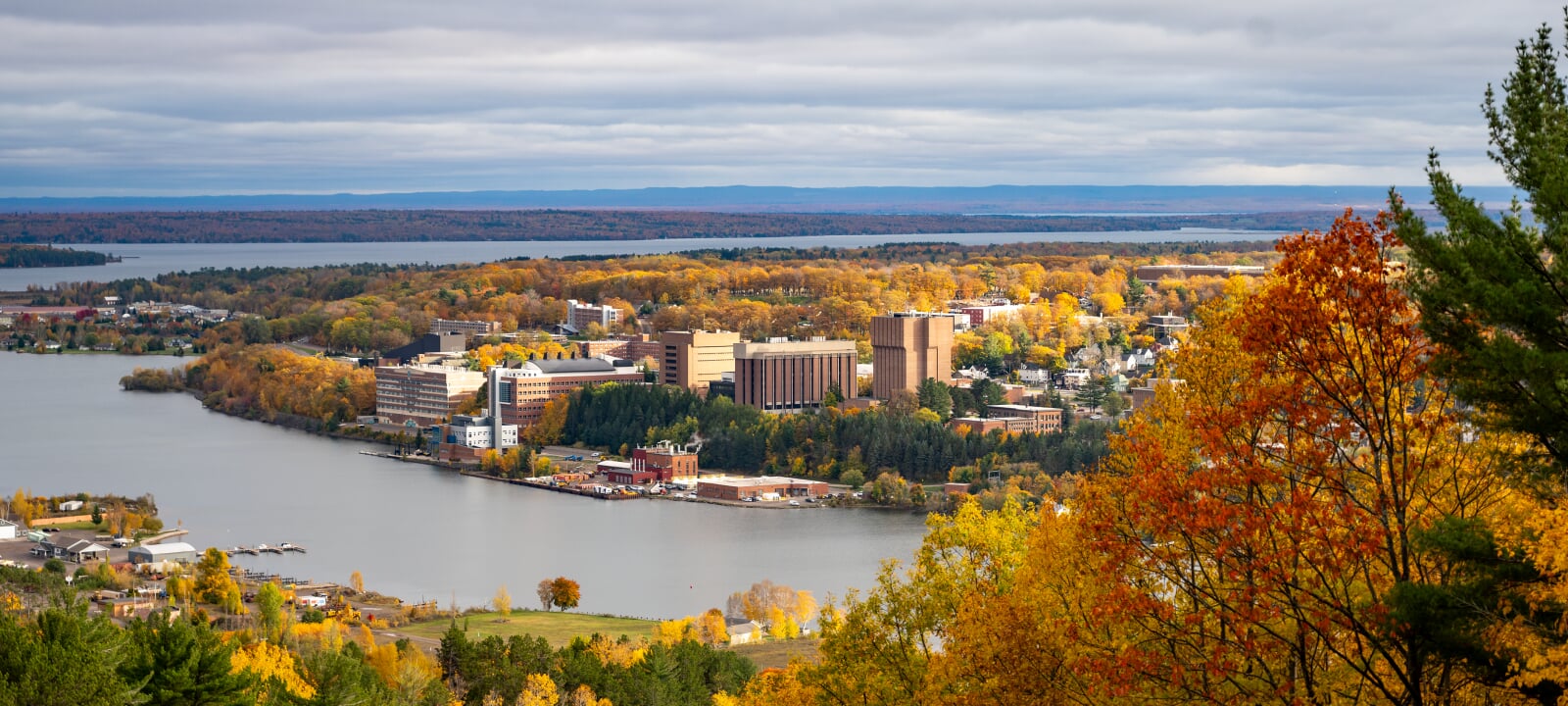

Winter here has its own rhythm. By January the light has gone thin, and the snowbanks stand taller than the cars parked beneath them. This is, by most rankings, the snowiest campus in the country. Those who’ve lived here for a long time will tell you that the Keweenaw (an Ojibwe word meaning “the crossing place”) has always asked something of the people who stay: a little more patience, a little more attention, a willingness to take the world on its own terms rather than yours. I’ve come to think that’s not incidental to who we are as a department, but close to the center of it.
This is a strange and wonderful place to house a humanities department. Michigan Tech is, understandably and rightly, a university built to solve problems, to model them, engineer them, work them out. We’re proud to sit inside that project. But we also know that not every hard problem yields to that method. Some of the deepest challenges in front of us now -- uncertainty, the felt loss of futures we assumed we’d have, the question of how to live well and not merely efficiently -- don’t have an equation waiting on the other side. They require the oldest tools we have: story, argument, memory, and the stubborn work of imagining what doesn’t yet exist. That has always been the humanities’ inheritance, and it has rarely felt more necessary than it does right now.
We are also shaped, unavoidably, by this particular ground. The Keweenaw carries a layered history most places don’t have to reckon with so directly – we still live in the shadow of a copper mining industry that once seemed permanent and then was gone, and we live among forests reshaped by the timber industry that came alongside it. This is also a place with an Indigenous presence far older than either industry, and still very much here. It has much to teach us, if we’re willing to listen, about what it means to be in right relationship with land and with each other. The climate is extreme enough to ask something like the old Finnish sisu of anyone who calls it home: a stubborn, quiet grit. We’re pretty good at it. We have to be. We want our work to be legibly, unmistakably of the Keweenaw: informed by its history, in full partnership with the sciences and engineering disciplines that share this campus with us, writing, thinking, and teaching alongside them rather than simply about them, and genuinely engaged with the world beyond it.
That is the spirit in which we’re beginning to ask what it might mean to do this work differently. We’re in active, hopeful conversation with colleagues across the university, in the sciences, in health, in natural resource fields, and in the arts, about where the humanities can be partners in building what comes next, both here and in the wider world. For me, the humanities have never been more necessary than they are right now, and our department will meet that moment with seriousness and imagination.
Thank you for your interest in the Department of Humanities. We’d love to have you with us as our next chapter takes shape, as a collaborator, a co-creator, a fellow traveler.
Michael Paul Nelson, Chair
Department of Humanities
Michigan Technological University