
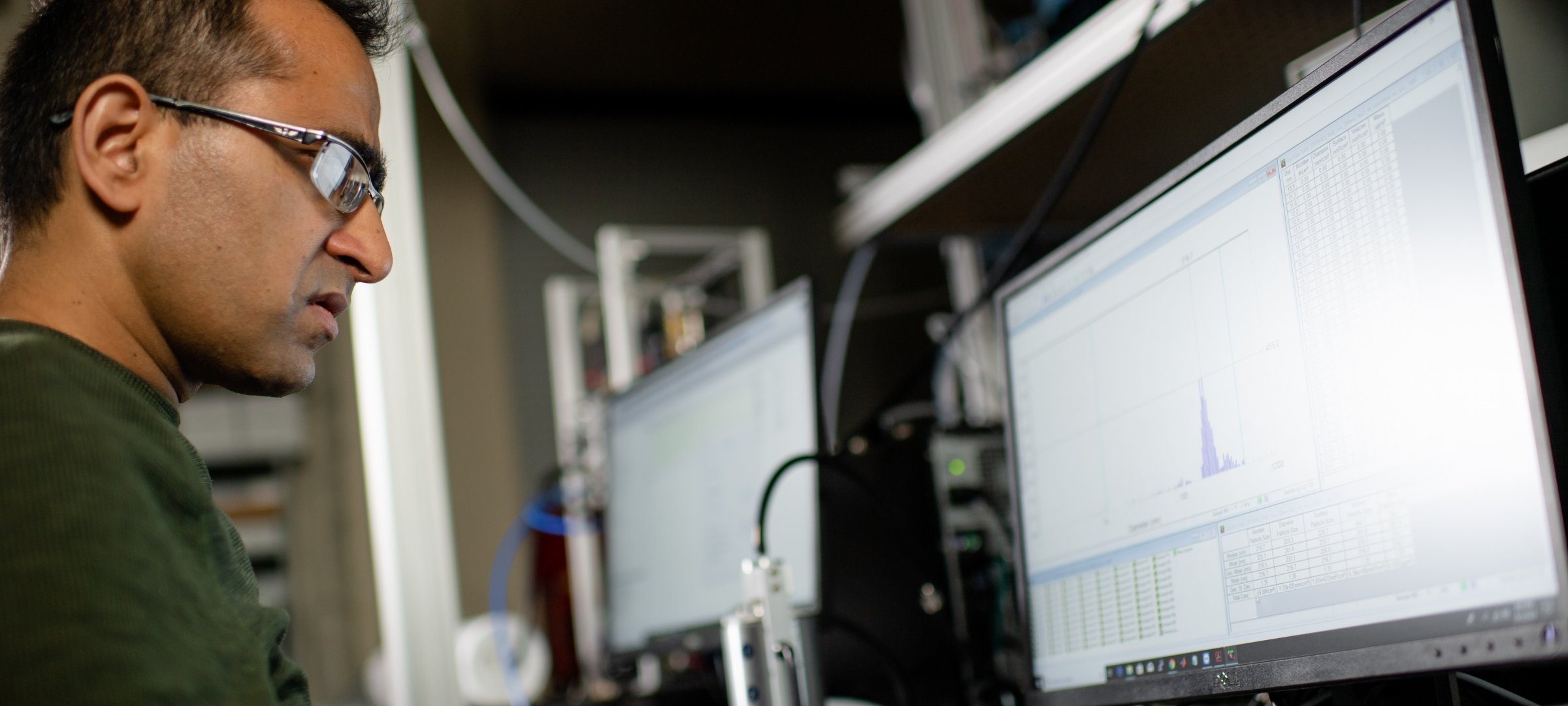
Where do the highest-energy cosmic rays come from? Can nanotubes of boron nitride be used to make new electronic devices? Why do some clouds rain while others don’t? These are just some of the questions that motivate faculty and students alike in the physics department at Michigan Technological University. From the smallest particles to the largest structures in the universe, physics asks how the natural world works. Michigan Tech’s MS and PhD in Physics let you pursue tough questions through advanced theory, experiments, and computation in areas ranging from astrophysics and atmospheric science to materials and light–matter interactions.
TheAccelerated Master's Program is available for current Michigan Tech students.
Who is This Program For?
If you want to investigate fundamental physical principles through theory, experiments, or computation, this degree offers several directions. MTU's master's degree or PhD in physics may be good fit if you'd like to investigate fundamental questions through theory, experiment, or computation; study astrophysics, atmospheric physics, materials, or optical phenomena; or develop depth in a defined physics research area.
What You'll Study
In your master's or doctorate in physicsyou can choose to study five areas of research interest: astrophysics and particle astrophysics; atmospheric physics; materials physics; photonics and quantum optics; and atomic, molecular, and optical physics. Some of the current research projects include first principles studies of structure-property relationships in 2-D nanomaterials beyond graphene for defense applications, and the influence of nucleation on ice microphysical properties of mixed-phase stratiform clouds and many additional projects.
Where You'll Apply Your Knowledge and Skills
Advanced physics knowledge can lead to careers in scientific research, technology development, and specialized industries. Apply your expertise to developing optical technologies, analyzing materials for electronic devices, modeling atmospheric processes, or investigating astrophysical phenomena. Your analytical, experimental, and computational skills can support research and innovation in universities, government laboratories, and private industry. Depending on your specialization and experience, you could pursue roles as a research scientist, computational physicist, materials scientist, optical scientist, or research and development specialist.
-
Delivery Options
- Accelerated: MS
- On-Campus: MS, PhD
Physics Program Details
Choose a specific degree option or delivery type to learn more about the physics program at Michigan Tech. For international students, Physics is a designated STEM program.
On-Campus Programs
Additional Program Information
Want to learn more about physics at Michigan Tech? Visit the department for more information:
Sample Areas of Interest
Select areas of interest to help customize your physics MS or PhD. Sample areas include:
- Astrophysics
- Atmospheric Physics
- Computational Physics (Quantum, Statistical, Biological)
- Atomic and Molecular Physics - Theory