
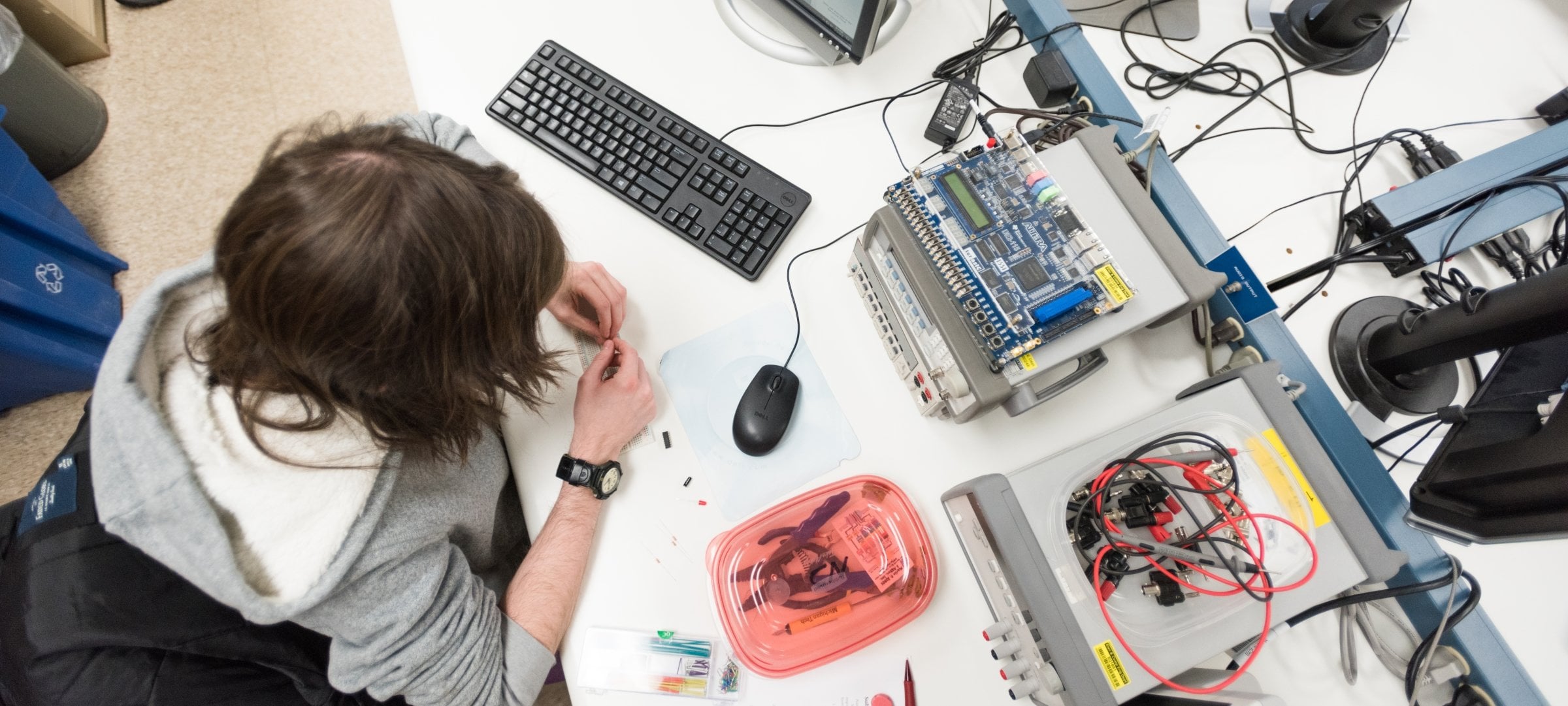
Electrical and Computer Engineering MS, PhD Programs

Power grids, connected devices, autonomous machines, and communication networks may look different, but they share a need for advanced electrical and computer engineering. Michigan Tech’s MS and PhD in Electrical and Computer Engineering lets you deepen your expertise in the hardware, software, signals, and physical systems behind today’s technologies.

The Accelerated Master's Program is available for current Michigan Tech students. Explore our Online Master's Program.

Who is This Program For?

The MS or PhD in Electrical and Computer Engineering may fit your goals if you want advanced study in electrical engineering, computer engineering, or a closely connected specialty. It is also ideal for working professionals who want to collaborate with their employers to develop specialized programs that meet their workplaces' needs.

What You'll Study

Pursue advanced topics in electrical energy systems, communications, embedded systems, robotics, signal and image processing, electromagnetics, optics, and photonics. You can focus on one area while drawing on knowledge from computing, control, and related engineering fields. The courses and research available to you depend on your degree option and whether you study online or on campus.

Where You'll Apply Your Knowledge and Skills

You can use this MS in ECE degree to apply specialized knowledge to evaluate power-system performance, develop embedded or autonomous technologies, interpret signals and images, or investigate electronic and photonic devices.

Electric and computer engineers with advanced degrees are often employed by electronics and mobility manufacturers, medical-technology developers, and government laboratories. For instance, Ford employs engineers to design controls and advanced vehicle technologies whereas Medtronic employs them to develop medical technologies.

  • Delivery Options

    • Online: MS, PhD
    • Accelerated: MS
    • On-Campus: MS, PhD

Electrical and Computer Engineering Program Details

Choose a specific degree option or delivery type to learn more about the electrical and computer engineering program at Michigan Tech. For international students, Electrical and Computer Engineering is a designated STEM program.

On-Campus Programs

Online Programs

Additional Program Information

Want to learn more about electrical and computer engineering at Michigan Tech? Visit the department for more information:

Contact

Graduate Director

Aurenice Oliveira

Graduate Assistant

Lynn McCormick


Sample Areas of Interest

Select areas of interest to help customize your Electrical and Computer Engineering MS. Sample areas include:

  • Automatic Control
  • Nanotechnology
  • Big Data
  • Information Networks

View full listing for this program

Application Process and Admissions Requirements

Using a holistic approach, our graduate admissions team reviews applications on an individual and ongoing basis. Fill out our free graduate application online to apply to any of our programs. Official transcripts and scores are not required for the initial application, but you will need to upload them later.

Accredited by HLC

Michigan Tech has been accredited by the Higher Learning Commission (HLC) since 1928. We offer over 125 graduate certificates, master's degrees, and PhD programs to provide our students and the world with what tomorrow needs.

Who You'll Learn From and Work With

Learn from and collaborate with faculty whose research connects electrical and computer engineering with fields such as physics, mathematics, computer science, and mechanical engineering. Their work, which spans power, wireless technologies, computing systems, photonics, and robotics, has received research support from organizations such as the National Science Foundation, Electrical Power Research Institute, and Teledyne Scientific and Imaging. 

Benefit from faculty who have published in and edited for disciplinary journals like IEEE Transactions on Image Processing, Applied Optics, and International Journal of Modeling and Simulation. Because of this research environment, you'll be able to contribute to interdisciplinary projects with real world implications for both industry and society. 

Your concentration and delivery format will shape which faculty expertise and opportunities are part of your experience.

Where You'll Study and Do Research

Join a department that has been a world leader since 1928, setting the standard for electrical and computer engineering research and scholarship. Occupying 50,000 square feet of space, you'll have access to labs and facilities that include the Microfabrication Facility, the Paul and Susan Williams Center for Computer Systems Research, the Wireless Positioning Laboratory, the Energy Storage Laboratory, and the Smart Grid Control Center, along with other spaces for research in power, photonics, microgrids, and robotics. 


Faculty Spotlight

Elena Semouchkina

Elena Semouchkina
Professor of Electrical and Computer Engineering

"Novel devices can be created, operating from radio frequencies to visible light."

Semouchkina engineers artificial materials with unusual properties and employs them to control electromagnetic wave paths. This makes it possible to modify antenna radiation patterns and build devices with unprecedented functionalities, such as invisibility cloaks.

Program Faculty