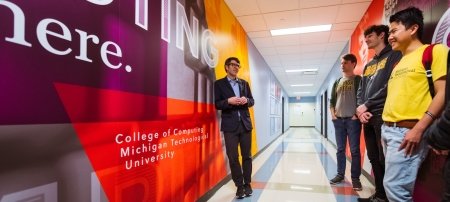
When Michigan Tech announced our new bachelor's degree in artificial intelligence, the response on the University's social media platforms was immediate—and impassioned. I was surprised by the fear and anger in many comments. But I was not surprised that AI prompted difficult questions.
Those questions are being asked everywhere. What will AI mean for jobs, privacy, culture, energy use, education, and human creativity? The concerns are real. So is the technology's potential. In the College of Computing, we aren't looking away from either.
Huskies have never been afraid of consequential technology or the hard conversations that come with it. AI gives Michigan Tech another opportunity to do what we do best: move beyond the hype, break complex problems into solvable parts, and build technology that serves people.
The complexity associated with learning how to program is an apt analogy. We start small, with activities like a student talking through their code with a little yellow rubber duck (which has become our de facto mascot). The work expands by building the systems and structure needed to support student success.
These systems are often built around people—as they should be—but unfortunately that approach doesn't scale well. Enter one of our faculty, Leo Ureel, who is building WebTA: an automated code critique system designed to support students learning programming in introductory and discipline-specific computing courses. Through WebTA and the faculty overseeing it, AI promises to provide productive, individualized help to our students.
This is what AI at Michigan Tech looks like: strengthening Great Lakes conservation, optimizing power grids, advancing healthcare diagnostics, and expanding access to computing. Keith Vertanen and his students are developing technologies that help people communicate and compute more privately and accessibly. In Soner Onder's lab, students are pioneering next-generation computer architecture to make computing faster, more affordable, and ultimately more energy efficient.
"This work is not new here. Huskies have been advancing AI for decades."
Tim Havens, the 2026 Michigan Tech Research Award winner, is one example of our sustained leadership in the field.
The College of Computing's approach is not limited to technical performance. We're partnering with Tech's STEM-centric humanities and social sciences programs to examine AI's ethical, social, environmental, and policy implications. Green AI facets are a core component of our curriculum, while current projects and practices include using small language models that reduce energy demands and protect private information.
The rigor we ask of our students, faculty, and researchers goes far beyond the casual use of large language model chatbots. We aren't teaching students to prompt products that someone else created. We're training AI instrumentalists—conscious engineers and scientists who can understand, build, test, question, and improve AI systems. They're learning to create faster and more efficient algorithms while accounting for the people and communities these systems affect.
We're not focused on writing with AI. We're focused on writing AI's future.
Our new BS in Artificial Intelligence and our Applied AI concentration in our BS in Information Technology degrees are important parts of that future. So are seven new academic programs across the College and a new Department of Data Science, which create more pathways into the increasingly varied world of computing.
Students help shape those pathways. Our new Student Advisory Council gives them a direct voice in the College's direction. This fall, we will launch our first College-funded undergraduate research program. We've revamped our External Advisory Board, naming alumna and software engineering leader Dianne Marsh as its first chair, and we've also partnered with Michigan Tech's College of Engineering on the first Dave House Computational Innovation Fellowship.
These investments come during a period of strong research growth. College research expenditures reached $8 million in fiscal year 2026, and for the third consecutive year, Michigan Tech ranked among the nation's top 100 institutions for computer and information science research expenditures in the National Science Foundation's Higher Education Research and Development Survey.
We're investing just as deliberately in students' readiness for a changing job market. Computing Huskies work with real clients through Enterprise, lead complex and purpose-driven student organizations, and build professional experience through co-ops and internships. By graduation, "entry-level" is already in the rearview mirror.
The current job market has significant headwinds. We acknowledge that. But computer science remains the College's largest major and one of Tech's largest. Students are also seeking more specialized pathways in data science, AI, and applied computing. We're responding with programs grounded in technological depth and real-world experience.
In this issue of Gateway Magazine, you'll meet some of the people doing the work, including students who share how AI fits into their studies, aspirations, and everyday lives—and why they chose Michigan Tech as the place to build their careers.
AI will continue changing. So will computing. Our responsibility is to prepare Huskies not merely to adapt to those changes, but to shape them.
Keep watching. We're just getting started.
Michigan Technological University is an R1 public research university founded in 1885 in Houghton, and is home to nearly 7,500 students from more than 60 countries around the world. Consistently ranked among the best universities in the country for return on investment, Michigan's flagship technological university offers more than 185 undergraduate and graduate degree programs in science, technology, engineering, mathematics, computing, forestry, business, health professions, robotics, psychology, social sciences, humanities, and the arts. The rural campus is situated just miles from Lake Superior in Michigan's Upper Peninsula, offering year-round opportunities for outdoor adventure.