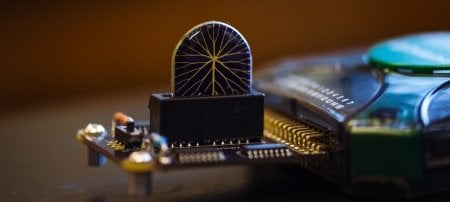
In a world thirsty for computing power and energy savings, Soner Onder and his graduate students are working to lower computing costs while increasing function.
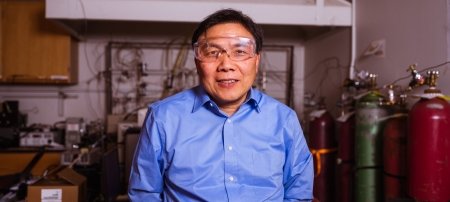
When a visitor remarked on the garden view and abundant light in Onder's Science of Architecture (SCIA) Lab, his smile held a touch of irony as he set the record straight: "Every day I step in here, it's dark and I turn on the lights. The moment I leave, lights off, blinds down, screens!"
The shades regularly go up and down in Onder's lab, but his research funding remains as uninterrupted as his presence at Michigan Tech. Since arriving on campus 26 years ago, the professor of computer science has received continuous National Science Foundation (NSF) funding in one form or another. In all of his collaborative grants, Michigan Tech has been the lead institution and Onder has served as principal investigator.
"I haven't verified it, but I don't believe there are many faculty with that kind of record. I've been lucky a little bit," he said, eyes twinkling. "But I was also successful in creating my own luck."
Soner Onder's long history of National Science Foundation support includes his 2004 NSF CAREER Award. Recent highlights include:
- In 2019, he was recognized as a top College of Computing researcher with expenditures totaling more than $174,000. He also received year-one funding for a $1.2 million NSF SCALE project.
- In 2020, he was co-recipient of a $1.2 million NSF grant aimed at making computer processors execute applications more energy-efficiently.
- In 2021, he was co-recipient of a $300,000 grant from the NSF Office of International Science and Engineering and International Research Experience for Students. This provided funding for Michigan Tech and Florida State University (FSU) PhD students to pursue summer research at the Norwegian University of Science and Technology.
- In 2022, he was co-recipient of a $1.2 million NSF collaborative grant with FSU, raising his concurrently active NSF awards to four and bringing the Michigan Tech share of that active funding to more than $1.6 million.
Onder's research funding track record illustrates the continued relevance of the work conducted by Onder and his graduate students in the SCIA Lab. Their research targets improved computer function at a lower cost.
"We work on the next generation of computer systems. Literally." said Onder. "We don't produce them, but we produce the knowledge necessary to build them."
The research impacts everyday life, from computing's basic building blocks to artificial intelligence.
"If you can produce something better, it will affect AI tools, data centers, your cell phone—it's gonna affect everything," Onder explained. "In computing, here at the very bottom, we are really working on the workhorse of that computer, rather than the fancy stuff that you normally see in advertisements."
The lab's work doesn't deal directly with power consumption processes, but it has potential energy-saving benefits.
"Everything needs a better CPU," said Onder, referring to the central processing unit, sometimes described as the brain of a computer. "If you can build a better CPU, you may be using less power. That's gonna reduce the impact on the environment."
A Mentor Who Makes All the Difference
Onder's Science of Architecture Lab is aptly named, with its SCIA abbreviation doubling as the Latin term for knowledge, "scia." Onder's generosity in sharing his own knowledge is a key factor in his successful, long-running mentorship of graduate students. All six of his current PhD students earned their undergraduate degrees at Tech. Once Huskies take an architecture course with "Dr. Soner," a good number of them tend to be hooked on advanced studies in the field.
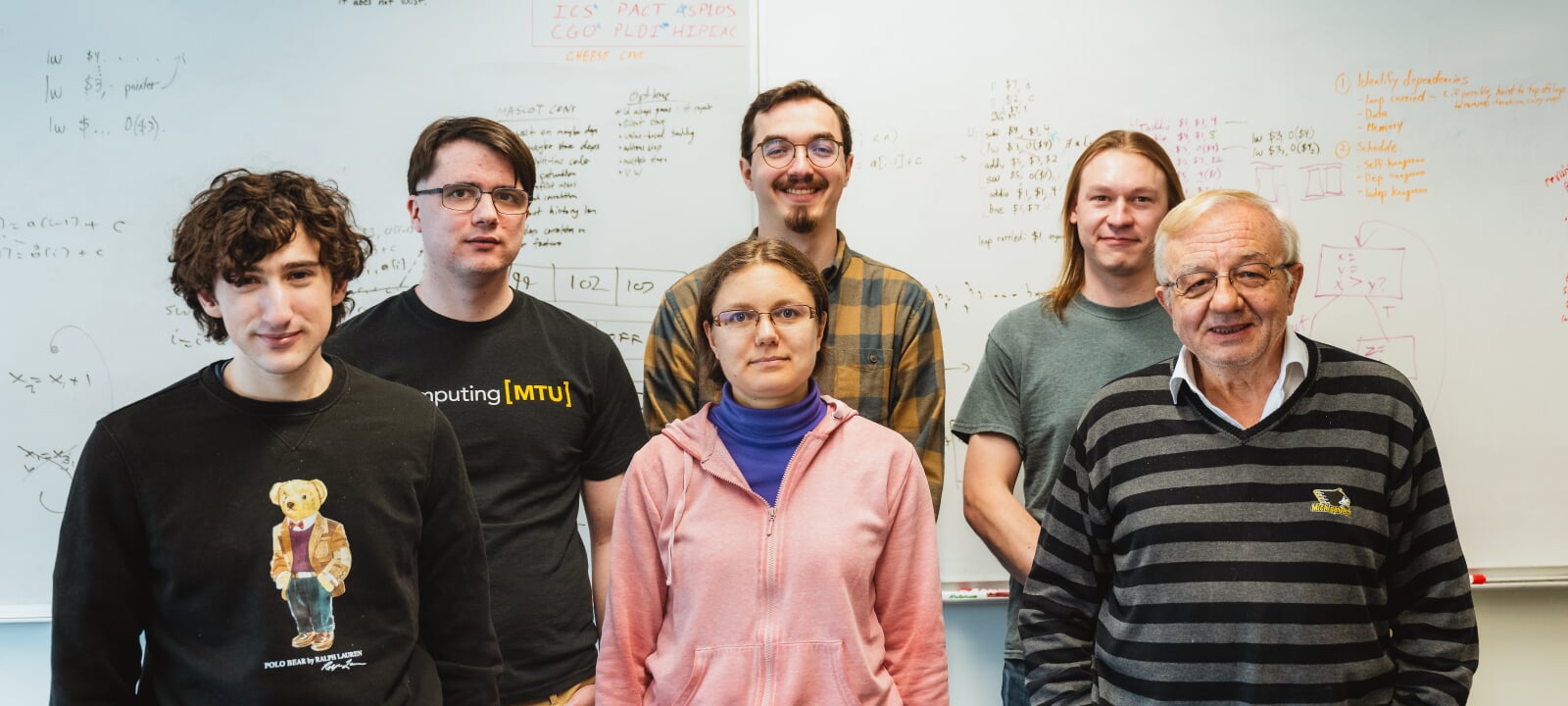
That's how it happened for Kieran Young, who earned his bachelor's in computer science with a math minor in 2020 and a master's degree in computer science in 2021. He was recruited from Onder's undergraduate architecture course.
"In that way, research chose me first," said Young, who values Onder's unique perspectives and thought-provoking discussions, which he said often "create intrigue" in otherwise mundane topics. "Of course, such discussions then lead to research ideas," he noted.
Young's research centers on high-performance, non-speculative memory disambiguation, and he is also attempting to find new multipath execution solutions to the instruction fetch problem. "To study computer micro-architecture is to study how computers work—knowledge that is crucial in writing fast and efficient programs. For me, it is the final piece of the puzzle," he said.
Like Onder, he hopes to provide perspectives and ideas others can build on.
PhD student Caleb Swain earned his bachelor's degree in computer science in 2021. He originally planned to immediately go into industry, perhaps returning later in life to earn his graduate degree. Onder persuaded him to continue his studies at Tech, where Swain enjoyed Onder's courses as an undergraduate and felt aligned with the research.
Swain appreciates the potent combination of foundational knowledge and fresh perspectives that Onder brings to his students. He noted that Onder's breadth and depth of expertise help his students understand what's been done before in the field, germinating ideas that can lead to solving problems that have previously been left behind or are completely novel.
"He always has new ideas. This is especially helpful when we get into ruts and need a fresh angle of attack to find solutions to our problems," said Swain. "He's always in and out of the lab, which allows us to have very open and ad hoc meetings to help us solve problems in the moment."
In the SCIA Lab, Swain's current research focuses on memory optimization. "When computers perform computations, they create data that must be stored. As with all things, there are trade-offs between storage types. Fast storage is ideal; however, as the size of a storage area increases, its access speed typically decreases," he said, explaining that fast storage is expensive.
Swain said the conundrum of needing both fast and affordable computing leads architects to design systems that include both small, fast storage and large, slow, cheap storage. "Fast storage is used for frequently accessed data, while slow storage handles infrequently accessed data," he said. "Our research goals are to reduce the penalties associated with accessing slower storage."
Optimizing techniques can include speculative or non-speculative approaches, he explained, noting that the main difference between the two is that speculative optimizations are assumed to be correct until proven otherwise. When there is a problem, repairs to preserve program semantics cost time and power. Non-speculative optimizations are error-free, but take longer to validate and have limited use cases. In the SCIA Lab, Swain and the other researchers strive to balance the two approaches and determine when it makes sense to use one over the other.
Swain enjoys his research area because it blends a variety of computer science disciplines, meshing theory with practice that encompasses fields including electrical and computer engineering.
"Systems/architecture research is the driving force behind future developments in computer processor performance and efficiency, which is quite cool to be a part of," he said. "I hope that our research allows us to take insights from practical design to discover more fundamental theoretical concepts. When we can apply our work back onto the theory, it really helps to drive our understanding of the phenomena observed and creates better pathways to explore future work as well as broaden the impact of our insights to other areas in the computer science domain."
PhD student Andrew Frey graduated in spring 2023 with bachelor's degrees in computer science and computer engineering. His interest in computer architecture sprang from wanting to understand the low-level details of how computers work.
His research focus is on how data value redundancy can be used to enhance data-level parallelism. "Or in more plain terms, how the redundancy present in program datasets can be used to apply the same operation to multiple data points. The hope is that data redundancy can be used to get better performance in common programs," he said.
"I appreciate Dr Soner's belief in his students. He has high expectations for all of us and believes very strongly that we can do very high-quality work. I feel as if this helps push us to grow as researchers."
PhD student Sarah Larkin, who earned her bachelor's degree in computer science in 2021 and her master's degree in 2025, conducts research in micro-architecture, looking for ways to design simpler, more energy-efficient computers. Her current dissertation research is focused on developing a new instruction scheduling algorithm in tandem with new hardware to shorten a computer's critical path: the time it takes to complete a series of instructions that are dependent on each other.
To explain the critical path, Larkin has an analogy that anyone who has let laundry pile up can relate to.
"You can think of a computer processor as completing a task similar to doing laundry," she said. "If you have a lot of loads to complete, you'll want to schedule them as efficiently as possible, with one load in the washer, one in the dryer, and one being folded all at once, preferably with the times it takes to complete each step matched up so no time is wasted waiting for the next stage to become available."
"Current computer chips have an approach similar to running multiple washers and dryers at once," she explained. "However, because they don't remember which instruction goes with which, they have to do a process much like checking all waiting piles of laundry for which should go in next every time a washer or dryer cycle finishes. That checking takes a lot of time and energy. My research focuses on reducing the energy requirements by forming the schedule one check at a time and then remembering the schedule for next time."
As Larkin became increasingly fascinated with the workings of computer hardware and compilers, Onder helped her decide on a graduate research topic.
"Dr. Soner suggested a specific direction and challenge and got me started with a small step that eventually developed into my master's thesis," she said.
Larkin said she has always been interested in what computer scientists call the "scheduling problem" and finding efficient ways to complete tasks faster. Like many Huskies, she likes working with things that are measurable, as well as the design element of the research.
"It's a bit like working with LEGO in that there are standard pieces of a computer that are required, but you can always stop and ask, 'Why isn't there a piece that does X? What would be the benefit or drawback?'" she said. "If you decide that it has a benefit, you can find a way to create it and measure its impact."
Larkin appreciates Onder's generosity in making time to listen to student ideas while sharing his own.
"Dr. Soner has high standards and challenges all his students to work hard to live up to them," she said. "I especially like the way he has mentored me in how to write a good research paper and how to analyze other researchers' work to identify both the what and the how of their research."
Larkin said at one point Onder had all of his graduate students contribute sections to a grant proposal he submitted.
"He could probably have finished the grant proposal much faster on his own," she said, noting that he's an "amazingly fast" writer, "but he took the time to teach us about the process of coming up with ideas and evaluating them and about how the grant funding process works."
A relative newcomer to computer architecture, PhD student Josh Pearlman became familiarized with the field in spring 2025 after working with Onder as an undergraduate researcher. After earning his bachelor's in computer science in 2025, he's now delving into potential graduate research topics.
"Since my exposure to this field is so new, my interest right now is mostly in continuing to explore all the different parts of this field to see what specific area interests me the most," he said.
He described his broad goal as improving computer architecture in some way, such as increasing performance or lowering energy use. "I hope that by the end of my degree I've completed multiple pieces of work that contribute to this field in some meaningful way," he said.
Of the many reasons that Pearlman appreciates working with Onder, one of the most valuable is the professor's vantage of having seen computing progress over decades.
"He understands what ideas and paths are worth pursuing and what others have tried and failed in. I also enjoy hearing some of his stories from different eras of computing, like when we still had mainframes that occupied a full room," he said.
Onder's sixth PhD student, Tino Moore, earned his bachelor's degrees in computer engineering and electrical engineering from Michigan Tech in 2017. He works remotely at AMD, performing research and development for high-performance CPU architecture.
Location Location Location
While his academic and research pursuits at Michigan Tech are rewarding, what enticed Onder to remain at Tech for nearly three decades goes beyond research. "What kept me is the beauty of winter," he said, eyes twinkling once again. "They tried to chase me away. The winters kept me here."
The allure of Michigan Tech's natural environment may actually be a multi-season obsession. The license plate on Onder's car includes both ski and swim.
Like their advisor, many of Onder's students were drawn to Michigan Tech by the University's surroundings.
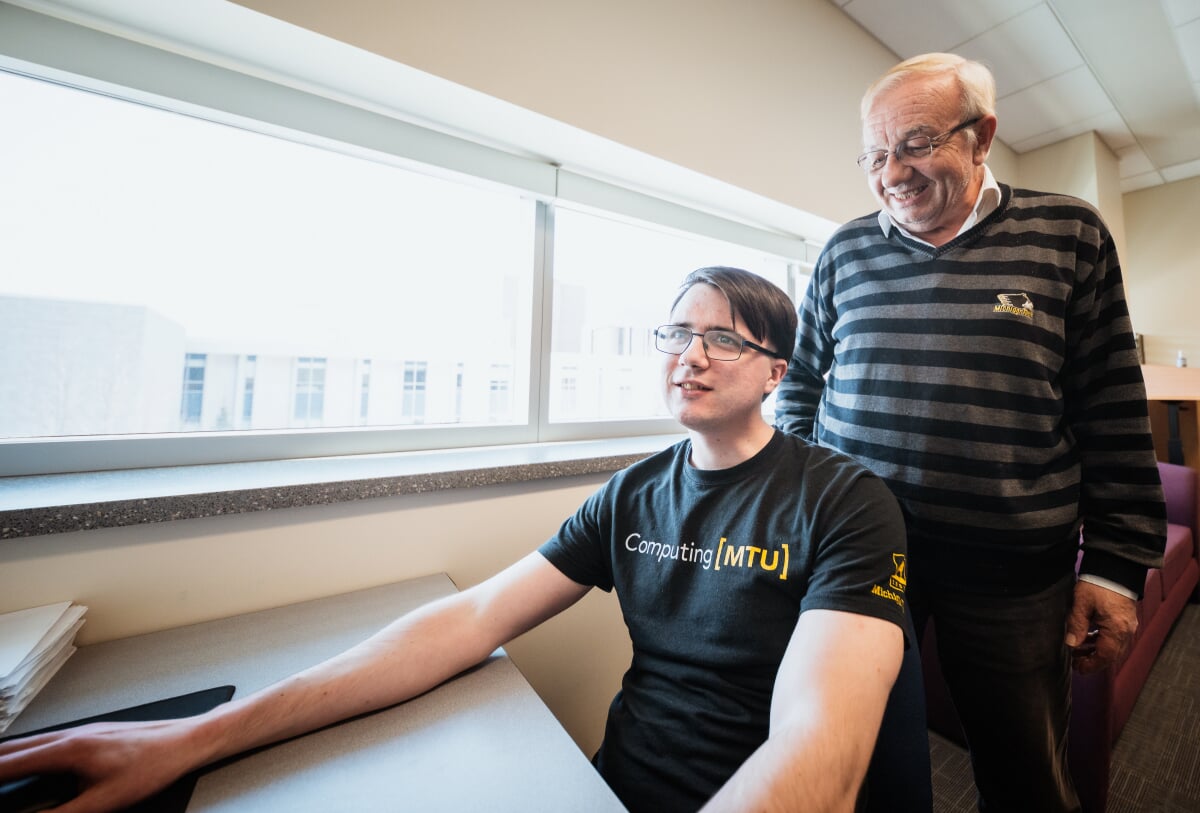
Frey enrolled as an undergrad because of Tech's opportunities for Huskies to gain experience while in school. "The Enterprise Program in particular was a selling point for me, but I also knew that there were good opportunities for undergrad research," he said. "I stayed for graduate work in part because I started working with Dr. Soner in undergrad, but also because I enjoy the area."
For Swain, location was the initial motivation. "Much of my family lives in the area and I really do enjoy the winters," he said. "Plus, I feel that the slower pace of life and remoteness helps me to focus on research and learning."
Young came to Tech for the opportunities. "Over my time here I have been able to teach full courses and contribute to ambitious grant-funded projects that span multiple universities. One such project even brought me to Norway for international collaboration," he said, referring to one of Onder's NSF-funded initiatives.
Pearlman chose Tech for his undergraduate degree because he was looking for a well-established and reputable STEM-focused school in an area that was very different from where he grew up in downstate Michigan. "I wanted to try living in a much smaller town, and I'd never seen such an extreme winter," he said.
Larkin, a Houghton native, got to know her hometown university early on. "I had the opportunity to interact with students and faculty both through Tech's community outreach and by taking a couple of computer science courses through dual enrollment. Receiving half-tuition through being a Leading Scholar finalist also helped," she said. But the game-changer was how comfortable she felt on campus.
"I think the biggest deciding factor was that Tech felt down-to-earth compared to other universities that I had visited, and people here really care about others," she said.
For all six Huskies, working with a professor who cared about their growth as researchers and believed in their potential has provided the staying power that is establishing their future careers.
In the SCIA Lab, that sense of belonging and purpose shines brightly whether the shades are up or down.
Michigan Technological University is an R1 public research university founded in 1885 in Houghton, and is home to nearly 7,500 students from more than 60 countries around the world. Consistently ranked among the best universities in the country for return on investment, Michigan's flagship technological university offers more than 185 undergraduate and graduate degree programs in science, technology, engineering, mathematics, computing, forestry, business, health professions, robotics, psychology, social sciences, humanities, and the arts. The rural campus is situated just miles from Lake Superior in Michigan's Upper Peninsula, offering year-round opportunities for outdoor adventure.