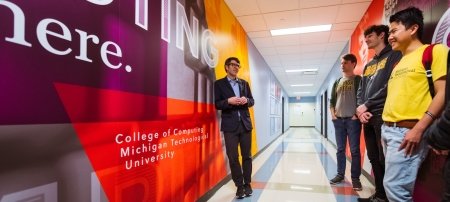

Michigan Tech data science majors Alisa Teige, Diana Shadibaeva, and Tyson Watson, who formed the ML/AI Club during the 2025-26 academic year, share their hot takes on machine learning and artificial intelligence in this Q&A, discussing how development and understanding of the technology affects community, learning, careers, and creativity.
Q: Why form this group and why now?
DS: We founded ML/AI Club to create the kind of community we couldn't find ourselves, a place on campus where students interested in machine learning and artificial intelligence could connect, collaborate, and grow. There was a clear gap for a student organization that aligned with our major and interests, so instead of waiting for one to exist, we built it.
TW: Seconding Diana, we couldn't find a community for machine learning and artificial intelligence, so we made one.
AT: We wanted to create a space where people can get excited about learning together, trying new things, and seeing results by participating in online competitions. We believe machine learning competitions are one of the best ways to grow. At the same time, the club is a low-pressure environment where students can just try things without having to worry about deadlines or grades.
Q: We often talk about what AI can do, but what is one area of human life or society where you believe AI should be legally or ethically barred from entering, even if the technology becomes "perfect"? Are there things that you personally won't use AI for?
TW: In my opinion, AI should be used as a tool to make lives easier, not as a decider. For example, we shouldn't have AI judges that sentence people. But we should have AI that helps organize evidence, information, witnesses, and more to help lower the load on the judge or other legal jobs.

DS: I believe AI should be ethically, and in some cases legally, barred from fully replacing entire human professions because it should serve as a tool to assist people rather than remove them from work altogether. When used correctly, AI can save time, reduce repetitive tasks, improve analysis, and help workers produce better results, potentially making workdays shorter and more efficient, but the human being should still remain at the center of the process.
Once AI is used to replace a whole field, it becomes unethical because work is not only about productivity, but also about human skill, judgment, accountability, and connection, and I do not think AI could ever fully match the mastery, intuition, and moral responsibility that humans bring. Personally, I would not use AI for anything meant to completely replace people, especially in areas like customer service or medicine, where empathy, trust, and human understanding matter just as much as efficiency.
AT: I think AI should not be trusted to make decisions in areas like social issues or economics, especially when those decisions directly affect people's lives. These are complex fields that require human judgment, values, and responsibility.
Personally, I also don't think AI should replace human creativity. For example, I wouldn't rely on AI for art, because I believe art should reflect human achievements in expressing experience and emotions. There is always a story behind human art—something the author wanted to tell—and AI cannot truly replicate that.
Q: As I understand it, old-school expert systems were like glass boxes where you could see the logic, while deep learning is sometimes referred to as a black box. In high-stakes fields like medicine or structural engineering, would you rather have a 95 percent accurate AI that can explain its "why," or a 99 percent accurate AI that can't?
TW: In my experience in life, people don't care WHY something is good. As long as it is, they're fine with it. The same thing happens with humans anyway; we have intuition moments that tell us we are in danger or need to leave. We can't really explain why, but something tells us to. I would rather have a 99 percent accurate AI that couldn't explain than a 95 percent accurate AI. Simply because the latter is more accurate.
DS: I would rather have a 95 percent accurate AI that can explain its reasoning in high-stakes fields like medicine or structural engineering. Even though black box AI is based on math, that does not mean its decisions are easy for humans to truly understand or verify. In those fields, accuracy matters, but so do trust, accountability, and the ability to catch mistakes before they cause harm.
AT: First of all, I think AI should be used as a tool, especially in fields like medicine and engineering. It should help people look at problems from different perspectives and suggest alternative options, but it should not replace human judgment. It's important to have the ability to verify and fact-check decisions. Because of that, I would choose a 95 percent accurate AI that can explain its reasoning.
Q: Generative AI is famously described as a "stochastic parrot" that predicts the next word but doesn't "know" the facts or have cognitive capabilities. Do you think we'll achieve "true" understanding, or is GenAI a dead-end street on the path to AGI (artificial general intelligence)?
TW: We will never achieve true understanding with this path. It may get close, but ultimately it will still be lacking. Sometime down the road, it really might not even matter anymore. Giving AI enough knowledge might make it close enough for our uses, and we won't care if it has "true understanding." If it does what we want it to do, then it's good enough.
DS: I second what Tyson says.
AT: One of the coolest things about machine learning is seeing how, from what looks like almost random numbers, it learns to find patterns. Because of that, I don't think it will ever achieve true understanding. It is fundamentally driven by math and may not achieve true understanding in the human sense. We can improve accuracy and make it respond more like a human, but at the end of the day, it's still math and functions, not something that truly understands.
Q: Enrollment in traditional computer science programs is dipping while specialized AI and robotics programs are surging. Are generalist software engineers a dying breed, or is the "AI specialist" label just a temporary bubble that's going to burst?

TW: Going to be honest, AI is just a cooler field. Every computer science kid wants to make their own robots and AI and stuff. It was a dream of mine for a while. However, at some point it gets split down the middle. Either you want to enhance AI and find it really cool, or you think it is taking away what it means to be creative and think for yourself and actively work against it. Even within Michigan Tech, every professor and student is on one side or the other, so neither side will win. It's probably just a temporary fad that will stabilize out into a new side of CS.
DS: I do not think the generalist software engineer is a dying breed. AI specialists, data scientists, and machine learning engineers are not simply replacements for software engineers, because they often focus on different problems and require different skills. A strong software engineer is still needed to build products, design systems, maintain infrastructure, and turn specialized AI work into tools people can actually use. Rather than one path replacing the other, I see them as two related but different directions: one focused on broad software development, and the other on more specialized AI-driven work. The "AI specialist" label may be very popular right now, but I do not think that means general software engineering is disappearing.
AT: Honestly, this is a question I'm still figuring out. I don't think AI will easily replace software engineers, especially at a high level. Designing complex systems requires strong human judgment and experience, and AI is still not always reliable. At the same time, I think everyone will need to be an AI specialist to a certain extent and know how to use AI as a tool.
Q: What do you think are the biggest misconceptions people in general have about AI and how to use it effectively?
TW: Honestly, the biggest issue is people letting AI do everything for them. Writing papers, coding, art, math, almost anything. You can't become an expert if you don't think critically, and AI can take that part away from your career or hobbies. The best part of life isn't the finish line, it's learning what works and what doesn't and forging your own path. A good use for AI is to get general knowledge on topics that you don't know about, or advice on what to do with stuff that you don't know. Basically use it to fill your knowledge gaps with stuff that isn't important or high-level.
DS: One of the biggest misconceptions people have about AI is that it thinks the way humans do, when it really does not. People often overestimate how "smart" AI is and assume it truly understands meaning, intention, or context like a person would. In reality, AI processes patterns in data rather than reasoning the same way humans do. For example, when a person is given a task and a set of numbers, they naturally separate the instructions from the data, but AI does not understand that distinction in the same human way unless it is made very clear. Because of this, many people use AI poorly by trusting it too much instead of giving precise instructions, checking its output, and treating it as a tool rather than as a mind.
AT: It's hard to add something new to what Diana and Tyson said, but from my experience, a lot of people trust AI too much and don't really check what it gives them. That's how you get both funny and not-so-funny mistakes. I think people sometimes treat AI like it always knows the right answer, but it's really just a tool. It can be super helpful, but it's not always reliable, so you still have to think for yourself and double-check things.
Q: These are a lot of serious questions! Please tell us something that's really fun about ML and AI.
TW: The first chatbot is actually from 1964, named ELIZA. Basically, it used the words you entered and asked questions back based on those words. It quickly became seen as a therapist that would help you and talk to you about your problems. So much so that some people requested unmonitored sessions because they thought it truly understood them. It was the first time that a computer program had a significant psychological impact on people at this scale.
Artificial Intelligence vs. Machine Learning
By Nate Bustos, Issue 8, The Byte
Artificial intelligence is without a doubt extremely "popular" in the world today. However, how long has machine learning been around doing similar tasks? And how is machine learning being used in artificial intelligence today?
First, let's understand the terms. AI, or artificial intelligence, is like an umbrella. It is the broad goal of making machines act, think, and solve problems in ways that resemble human intelligence. ML, or machine learning, is a subset of AI. While AI is the overall concept, ML is one of the main ways to achieve it. Instead of following strict, pre-programmed instructions, ML systems analyze patterns in data and learn from them. This allows models to improve over time as they process more information and adjust their outputs.
All ML is AI, but not all AI is ML. Surprisingly, early AI systems existed long before modern machine learning. They relied on rule-based logic instead of learning from data. Machine learning later became the shift that allowed systems to improve on their own instead of only following instructions. A simple example is a 1950s program that learned to play checkers and improved as it played more games. This program was a breakthrough for the time it was created.
Machine learning has also been around longer than most people think. It started as a research idea in the mid-1900s, but it became practical very much later when computers gained enough power and data became widely available.
Today, machine learning is part of everyday life. It filters spam from your email, recommends videos and products based on your behavior, and powers features like voice assistants and image recognition. It is also used in more advanced areas such as medical diagnosis, fraud detection, and self-driving systems. It now also plays a role in building modern AI systems by helping them learn from large amounts of YOUR data and improve their performance over time.
To fully understand AI versus ML, it's important to see that they are interconnected, not two completely separate ideas. Machine learning is one of the key tools that makes modern artificial intelligence possible.
Editor's note: Computer science major Nate Bustos is one of several student authors who contribute to The Byte, a newsletter published weekly during the academic year, online and in print, by the Association of Student Computing Interaction and Involvement (ASCII) at Michigan Tech. In their newsletter, the recently revitalized ASCII shares student-focused computing news, announcements, employment opportunities, and timely articles on computing topics.
Michigan Technological University is an R1 public research university founded in 1885 in Houghton, and is home to nearly 7,500 students from more than 60 countries around the world. Consistently ranked among the best universities in the country for return on investment, Michigan's flagship technological university offers more than 185 undergraduate and graduate degree programs in science, technology, engineering, mathematics, computing, forestry, business, health professions, robotics, psychology, social sciences, humanities, and the arts. The rural campus is situated just miles from Lake Superior in Michigan's Upper Peninsula, offering year-round opportunities for outdoor adventure.