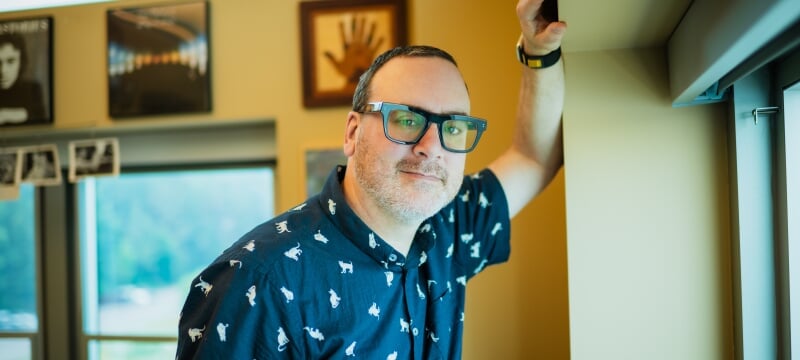
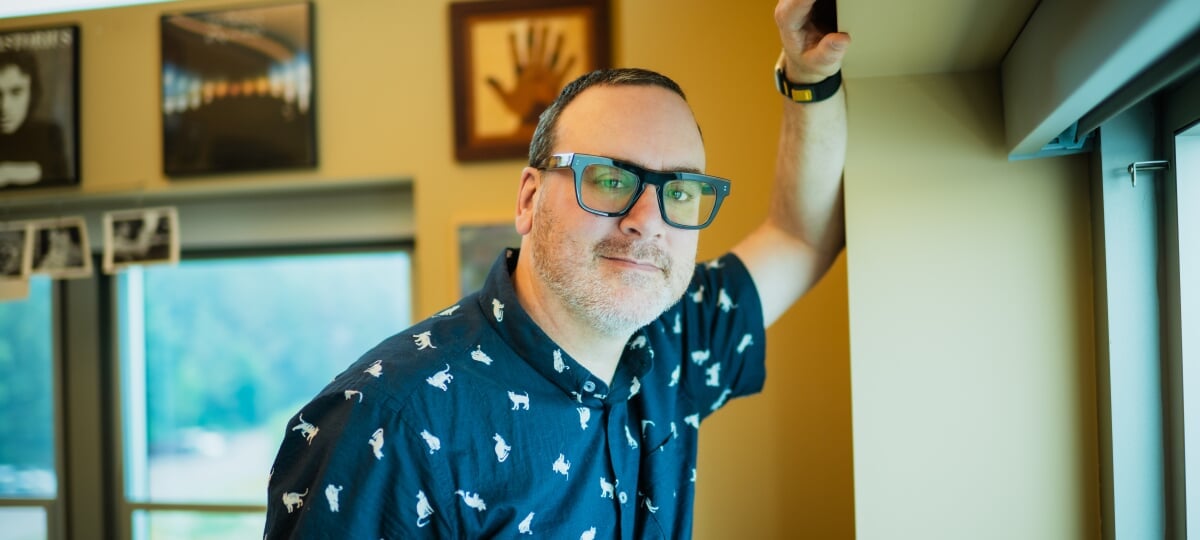
An internationally recognized research leader in computational intelligence, machine learning, data fusion and signal processing, Tim Havens is a community catalyst for advances in his fields. At Michigan Tech, he has also worked to develop a sustainable, interdisciplinary research infrastructure across campus. His achievements in research, teaching and service have earned the 2026 Michigan Technological University Research Award.
An electrical engineering alumnus, Havens is Michigan Tech's William and Gloria Jackson Professor of Computer Science. He returned to Michigan Tech in 2012 as an assistant professor in the electrical and computer engineering department, and has taken on several campus leadership roles, most recently as the executive director of Tech's Institute of Computing and Cybersystems and the University's Great Lakes Research Center.
Recognizing Tech's Best
The Michigan Tech Research Award is presented annually to an individual whose work is symbolic of Michigan Tech's high standard of research achievement. Recipients are selected based on either sustained, productive scholarly endeavors or a single noteworthy breakthrough. Learn more about the nomination and selection process and view a list of past winners.
Those supporting Havens' award nomination hail from both academia and industry.
Havens played a key role in helping Tech to partner with Signature Research (SGR) Inc., a spin-off of the Keweenaw Research Center and member of the Keweenaw Defense Industry Consortium. In his letter of support, SGR President Chris Downs noted that in 2019, when the concept of artificial-intelligence-based algorithms was an emerging concept in both technical application and general understanding, Havens "was almost instantly able to provide quantifiable results toward our funded government effort." Havens is still supporting SGR and its customers in the areas of aided target recognition algorithms and image classifiers, said Downs.
"I have also had the pleasure of working with Dr. Havens and MTU to advance SGR employees in their graduate studies," Downs said, noting that the unique approach of enabling students to pursue advanced studies while directly supporting contracted work has resulted in technology innovation as well as relevant, practical experiences for students.
In addition to lauding Havens' track records in high-quality publications, conference presentations and editorial reviews, IEEE Fellow Jonathan M. Garibaldi, provost and computer science professor of the University of Nottingham Ningbo, China, praised Havens for his communications style. "It is relatively rare in science to find someone who combines a very strong technical proficiency with the ability to communicate such technical details in a clear, comprehensible and interesting manner — Tim is one such scientist," he said.
Alina Zare, electrical and computing engineering professor at the University of Florida and director of UF's Artificial Intelligence and Informatics Research Institute and Machine Learning and Sensing Lab, praised Havens' work for both its breadth and consistency.
Havens' research has received funding from entities including the U.S. Army, Navy, and Coast Guard; the U.S. Defense Advanced Research Projects Agency (DARPA); the National Science Foundation; the National Geospatial-Intelligence Agency (NGA); and, in the private sector, Ford Motor Company.
"The repeated funding from these sponsors indicates high-quality progress and engagement," Zare said in her letter of support. "He has made significant contributions in the fields of computational intelligence, artificial intelligence and machine learning, particularly around large-scale data analysis … it is clear that the research community finds, like me, incredible value in his work."
In another letter, Professor Derek T. Anderson of the University of Missouri-Columbia, director of his university's Information and Data Fusion Laboratory, pointed to Havens' "remarkable contributions," "undeniable leadership," and "prolific output." He said working with Havens served as a catalyst for scholarly growth of numerous students and colleagues, including himself. "He has played a pivotal role in shaping my intellectual journey across various disciplines, from igniting creativity to refining mathematical skills and scholarly writing," Anderson said.
In this Michigan Tech News Q&A, Havens reflects on his roles at Tech — and how his path has led him to both career achievements and the satisfaction of bringing people and ideas together, connecting their expertise and visionary innovation in a supportive research community.
Q&A with Tim Havens
Q: Say you're in a coffee shop or another place where people strike up conversations, and someone asks you what you do. How do you describe your work?
TH: I spend most of my time helping others — faculty, staff and students — succeed in their, and our collective, research goals. My research program is very much a team effort, and my role as the head coach is to make sure we have the funding to accomplish our research goals, draw up the game plans (the proposals and the big ideas), provide critical feedback to the on-the-field researchers, make corrections in the heat of the moment and then share in the spoils of victory. Our team works at the intersection of computing, engineering and science; lately we've been doing a lot of work combining fundamental signal processing with machine learning and AI. But depending on the day, we might be working on autonomous systems, environmental monitoring, trustworthy AI or small multi-function synthetic aperture radars.
"Havens stands out as a polymath, excelling across a spectrum of domains including research, teaching and service. His success is not confined to a solitary realm; rather, it permeates through various dimensions of academia — from pioneering research theories to exemplary advising, community engagement, university service, and administration."
Q: You'll soon be stepping away from the Institute of Computing and Cybersystems (ICC), where you've been at the helm for the majority of its 10-year existence. You've said that it's one of the endeavors over the last decade that you're most proud of. What are you grateful to have achieved during your tenure as executive director and what are your hopes for the ICC's future?
TH: What I'm most proud of is helping build a community. When we launched the institute, we knew Michigan Tech had tremendous expertise in computing, but that expertise was distributed across many departments and colleges. Over the last decade, we brought together researchers who may never have otherwise collaborated and created an environment where new ideas and large-scale projects could emerge. I'm really grateful for the staff, faculty, students and partners who embraced that vision and made the ICC successful.
Looking ahead, I hope that the institute continues to be a catalyst for ambitious, interdisciplinary research. Computing is increasingly, if not fully, central to every discipline, and I believe the institute is uniquely positioned to help researchers leverage advances in AI, data science, cybersecurity and autonomy to address society's most pressing challenges.
Q: You've been at the helm of the Great Lakes Research Center (GLRC) since January 2022. What are the skills and expertise you brought to the role and how will the center continue to push the envelope of what can be learned about the Great Lakes and coastal ocean systems?
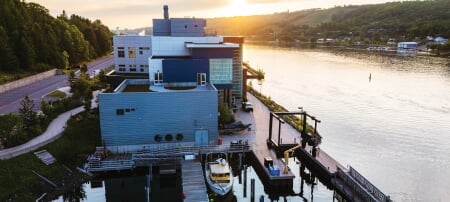
TH: My background is in computing, data science, engineering and interdisciplinary research leadership. While not a traditional Great Lakes scientist, I brought experience in building teams, developing research programs, applying emerging technologies to complex problems, and, in general, large research center administration. The Great Lakes are incredibly dynamic systems, and advances in autonomy, AI, remote sensing and modeling are creating opportunities to observe and understand them in ways that simply weren't possible before — and the GLRC has long been a hub for applied and basic science in this space. I also jumped into the captain's chair of the GLRC in a critical transition period. We started as a center focused on the Laurentian Great Lakes. That continues to be a big focus for us, but we now have grown to broadly support the natural and environmental sciences across campus.
In 2025, through a major reorganization of the research institutes at MTU, the GLRC now serves as the administrative home for the Ecosystem Science Center; Earth, Planetary, and Space Sciences Institute; and the Center for Innovations in Sustainability and Resilience. We also launched two new centers: the Center for Environmental Engineering, Sensing, and Integrated Modeling and the Center for Innovation and Incubation. My experiences in the ICC prepared me well for thinking big with the GLRC canvas.
Q: We're going to ask for another forecast! You played a major role in the formation of the College of Computing, serving as a key member of its forerunner, the Alliance for Computing, Information, and Automation at Tech. What excited you about the College then, and what excites you now?
TH: What excited me then was the recognition that computing had become a foundational discipline. Nearly every field was becoming more computational, yet computing itself deserved a home where it could grow and evolve as a discipline. The creation of the College represented a bold investment in Michigan Tech's future.
What excites me now is seeing that vision become reality. The College has grown rapidly, attracted outstanding faculty and students, and has established itself as a leader in areas ranging from AI and cybersecurity to robotics and software engineering. Perhaps most importantly, it serves as a bridge to the rest of the University (and literally to the Library!), helping bring computational thinking into every discipline.
Q: Letters of support for your Michigan Tech Research Award nomination mentioned your novel methods for involving students in meaningful research. Can you tell us about some of your methods and projects, including the development of the Computing[MTU] Showcase?
TH: One of my core beliefs is that everyone learns best by doing. I've always tried to involve students in authentic research experiences as early as possible, giving them opportunities to work on real problems with real stakeholders rather than simple classroom exercises. This is reflected in my leadership of the SENSE (Strategic Experiences for Naval Systems Education) Enterprise; we work on real-world challenges that do not have known solutions, and students from diverse disciplines must learn to work across conventional degree boundaries to produce viable solutions.
The Computing[MTU] Showcase is a celebration of all things computing at Michigan Tech, and our students are always a big part of the event. We put on a student poster competition, with generous cash prizes. It's always very well attended, giving students a great opportunity to talk with one another and faculty across campus about their research. We also bring in several external speakers and visitors, with emphasis on making sure that students get face time with them. So, the showcase not only gives us a chance to show the world what we're doing in computing at Michigan Tech, it's also a chance for students to learn more from our visitors about what's happening in computing around the world. It's such a fun week!
Q: What do you enjoy most about teaching?
TH: Watching students gain confidence in things that they previously didn't think possible is really satisfying, and is the thing I love most about teaching. It's incredibly rewarding to see someone move from uncertainty to mastery and realize they can solve problems they never thought they could tackle. This aspect of Michigan Tech students — their ability to effectively work outside their comfort zone — is what makes them so attractive to employers!
"Tim is an outstanding internationally recognised scholar who has made substantial international impact in a number of technical fields, as well as being a delightful person to know and to collaborate with."
Q: Your research, teaching and service branch off in so many directions — is there a central theme and motivation that we can trace?
TH: Decision-making has always fascinated me. That is, how does one make the best decision possible with a given set of data and goals or desired outcomes? Hence, the common thread of my research program, whether I'm working on AI and machine learning, environmental monitoring, autonomous systems or education is decision-making: helping people or systems make better decisions in the presence of complexity and uncertainty. Computing, engineering and mathematics give us powerful tools for extracting information from data, and what motivates me is developing tools that allow people and systems to make impactful and informed decisions. Follow the data.
Q: You've worked a long time at the intersection of engineering and computing. Can you tell us a little about that — and why interdisciplinary work across all disciplines is important to you?
TH: Some of the most interesting and important problems — e.g., environmental sustainability, healthcare, national security or infrastructure resilience — don't fit neatly within disciplinary boundaries. Bringing together the perspectives of computing, which provides powerful methods for modeling, analyzing and optimizing systems, with that of engineering, which brings a deep understanding of physical systems, is really impactful. And when you bring together people who can communicate across those boundaries and work toward a common goal, it is magical; the work becomes fun because the team is constantly learning and engaged.
Q: What's next for you in your research, teaching and service?
TH: I'm excited to continue building interdisciplinary research teams that leverage advances in AI, sensing and autonomy. At the Great Lakes Research Center, we have a growing team who excels at developing approaches for understanding freshwater and coastal systems while supporting economic development and environmental stewardship. I also look forward to continuing to mentor students and early-career researchers. One of the most rewarding aspects of academia is helping others succeed, and I hope to continue doing that for as long as I live.
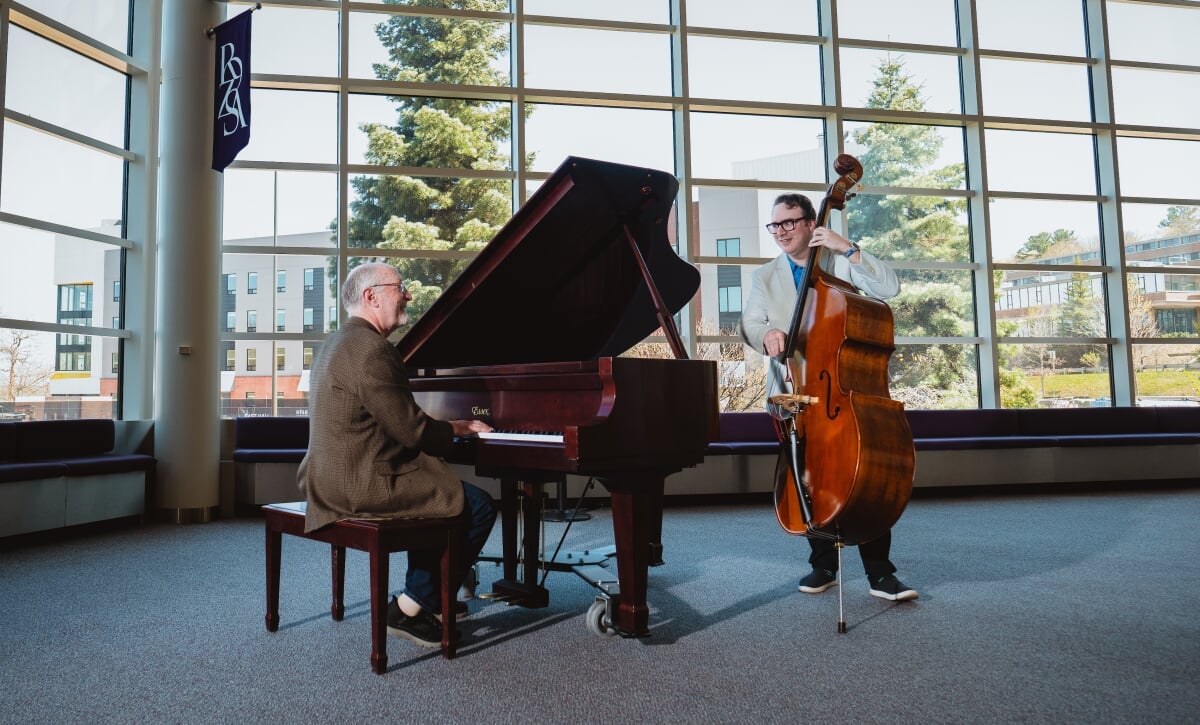
Q: You came to this discipline through music — and you credit playing music for keeping you in school as a college student. So we have to ask, where are you playing next? And, what else do you like to do in your free time?
TH: Music has always been a vital part of my being — it's like breathing to me. Music taught me discipline, creativity, collaboration and persistence long before I realized those same skills would be valuable in research and leadership (or really anything). It's one of the reasons I'm such an advocate for the arts and arts education and their role even in the most technologically focused academic halls. I often tell my students that a strong understanding of communication and fine arts will get them farther in their engineering or science career than the degree they leave school with. Everyone with an engineering degree can "build a bridge," but only holistic humans with engineering degrees can see the whole picture.
I love performing whenever I get the chance, whether it's in my living room for the cat, at community events or in gorgeous concert halls. Lately, I have two bands that I'm playing with. The first is Steve Jones and the Tall Grass Brass Band, an acoustic jazz quintet with Steve Jones (production manager at the Rozsa Center for the Performing Arts), well-known local musician Bob Hiltunen, Associate Professor Adam Meckler and Assistant Teaching Professor Drew Kilpela (both from Tech's Department of Visual and Performing Arts). The second is Ferrari Fast, a loud, rough-n-tumble cowpunk band.
Outside of my music obsession, I love kitty cats, fast cars and the outdoors.
Anything else you'd like to add?
TH: I've been incredibly fortunate throughout my career to work alongside talented colleagues, students and staff who are passionate about discovery and education. Any accomplishments that people associate with me are really the result of collaboration and shared effort. I'm grateful to have been part of the communities here and elsewhere, where collaboration and shared success is so valued.
Michigan Technological University is an R1 public research university founded in 1885 in Houghton, and is home to nearly 7,500 students from more than 60 countries around the world. Consistently ranked among the best universities in the country for return on investment, Michigan's flagship technological university offers more than 185 undergraduate and graduate degree programs in science, technology, engineering, mathematics, computing, forestry, business, health professions, robotics, psychology, social sciences, humanities, and the arts. The rural campus is situated just miles from Lake Superior in Michigan's Upper Peninsula, offering year-round opportunities for outdoor adventure.