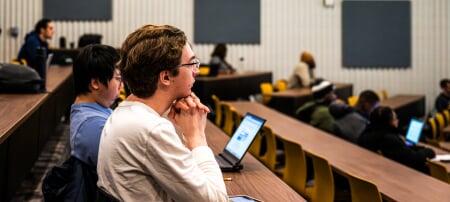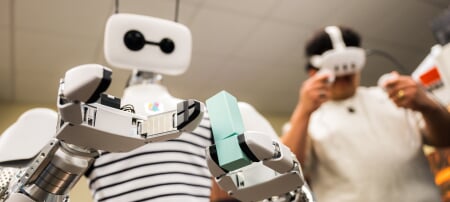
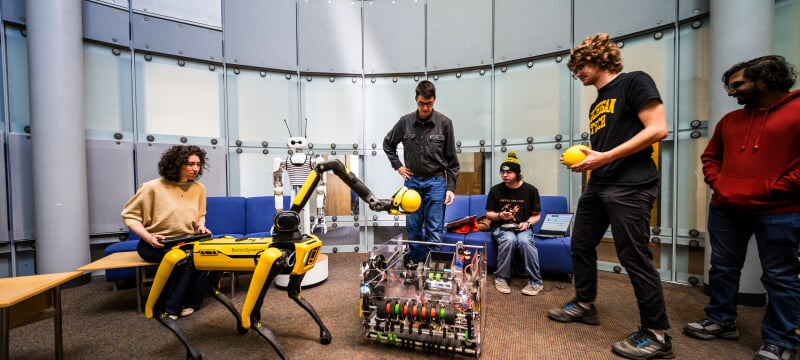
Leading conversations about the cultural and ethical implications of AI. Designing a sound app for Nissan and working on a Michigan Tech Enterprise project with a former astronaut. Uniting community through broomball, the rowing club, and Copper Country Robotics. From distinguished alumni who are already helping to change the world for the better to the next generation of students poised to make a difference, Huskies are making their mark. See how.
Computing Husky Leads the Way
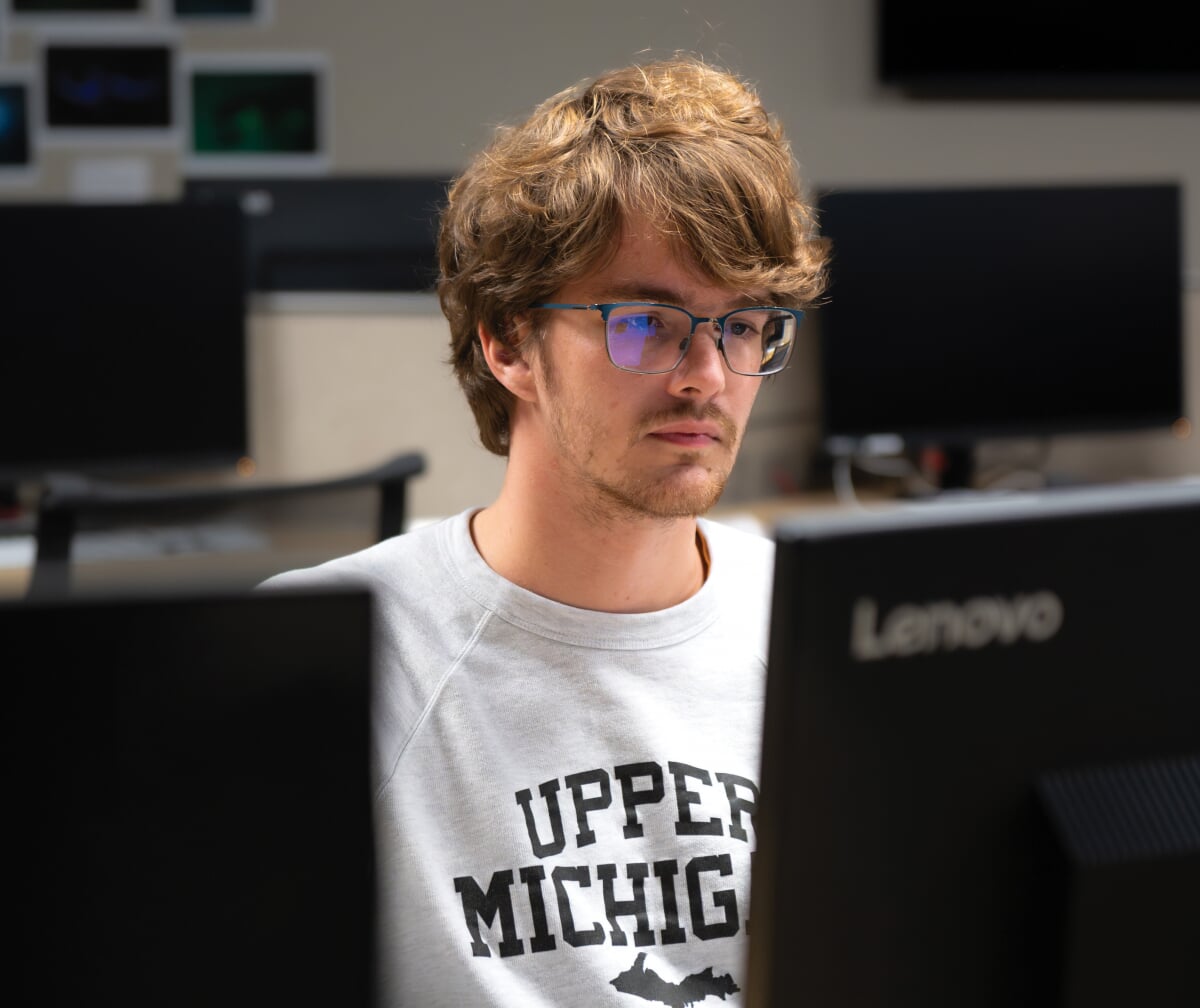
"Michigan Tech has been a wonderful door-opener for me, both inside the University with clubs and connections and outside with careers," says David Reeves, who graduated in spring 2026 with a bachelor's degree in computer science. Reeves led multiple student organizations, including the Rowing Club and Copper Country Robotics, while serving as Undergraduate Student Government treasurer. He was also a member of the 2024 Orientation Executive Staff team and subsequently became an Orientation team leader. "Michigan Tech has also helped me prosper outside of the University, as my first-ever internship over last summer was at IBM in Rochester, Minnesota, and I was super lucky to find it here during Career Fair!" he says.
Reeves is the 2026 recipient of the MTU President's Award for Leadership. Find more student profiles and happenings in the College of Computing on our social media channels.
Software Engineer Steers Toward Bright Horizon
From a young age, Elise Buzzell knew she wanted to go into computing. Her dad is a computer scientist, and she often watched him work in his home office.

"He just lit a fire under me when I was young and gave me the resources to try and fail early on," she said. "He showed me that there's a future in computing—and how influential computing can be."
The software engineering major's familiarity with computing's evolution helps explain why she isn't especially surprised or concerned about the rapid ascent of artificial intelligence or how AI might affect computing careers.
"I don't think AI is as dangerous as some people think," said Buzzell. "I'm in the industry. I'm actively working."
The 2026 winner of Michigan Tech Student Leadership and Involvement's prestigious Clair M. Donovan Award for outstanding service to the University, Buzzell manages public relations for both the Michigan Tech Rowing Club and Michigan Tech Inter-Residence Hall Council Broomball while maintaining 16.5 hours of co-op work with Sentry each week during the academic year and earning Dean's List honors.
She also remains a strong advocate for helping young women pursue computing careers, mentoring others as she was mentored.
"I share my story whenever I can with the hope that at least one girl will see it and know that she can also do it," said Buzzell.
Dip an oar into her story, "The Husky in the Boat," at Michigan Tech News.
The Closer: Computer Science Grad Takes Every Project to the Finish Line
Computer science graduate Ashley Baird '26 thrives on completing what she starts. As a Husky, she wrote code for Nissan's industry-first personalized sound app. She also led a machine learning project for the US Department of Defense.
Baird always knew she wanted to go into the field. Her dad owns a software company, and her older brother also earned his CS degree.
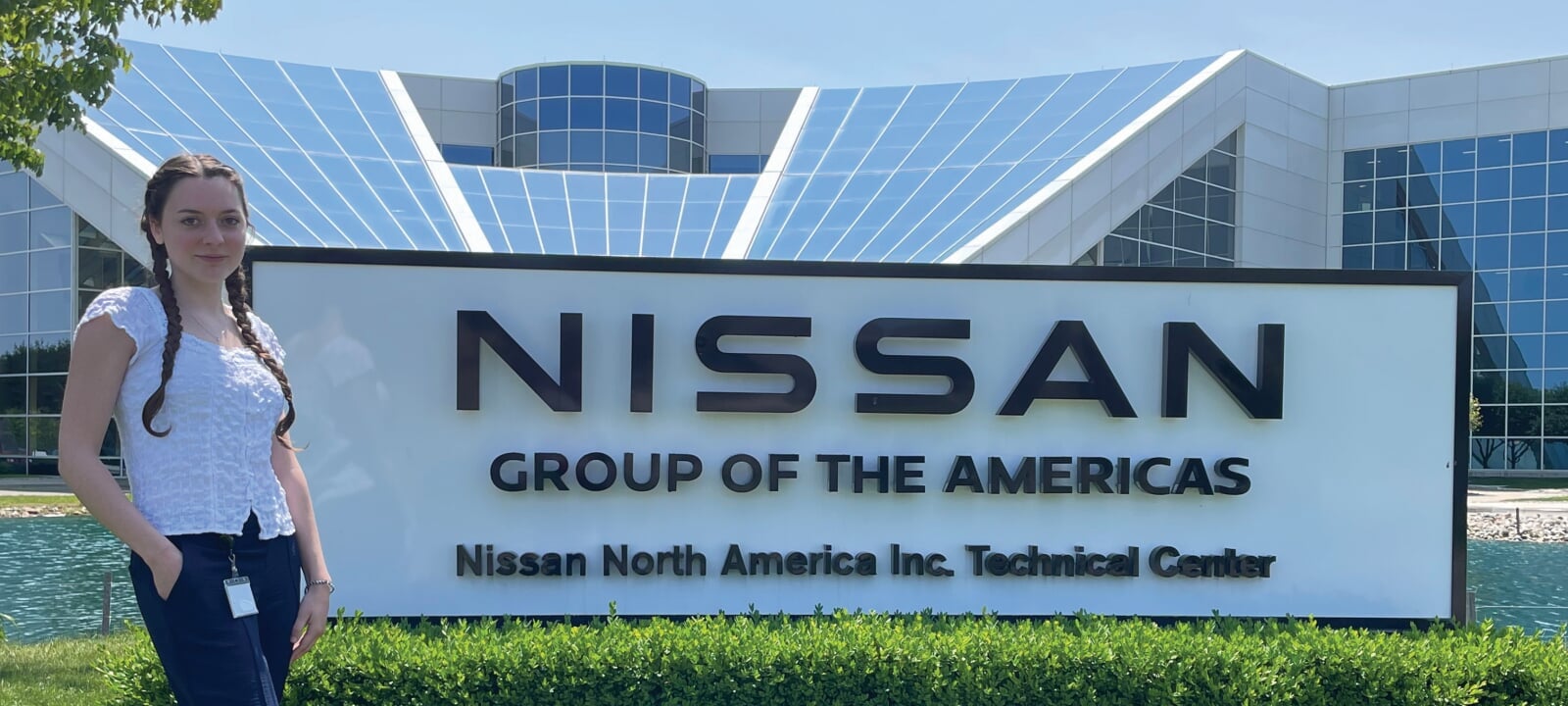
Before her summer 2025 internship at Nissan North America, Baird completed two internships as a software engineer at DocTract in Novi, Michigan. Full disclaimer: That's her dad's company. But that didn't mean the job was easy. To the contrary, said Baird.
Hear more from Baird at Michigan Tech News.
Keeping Humans at AI's Center
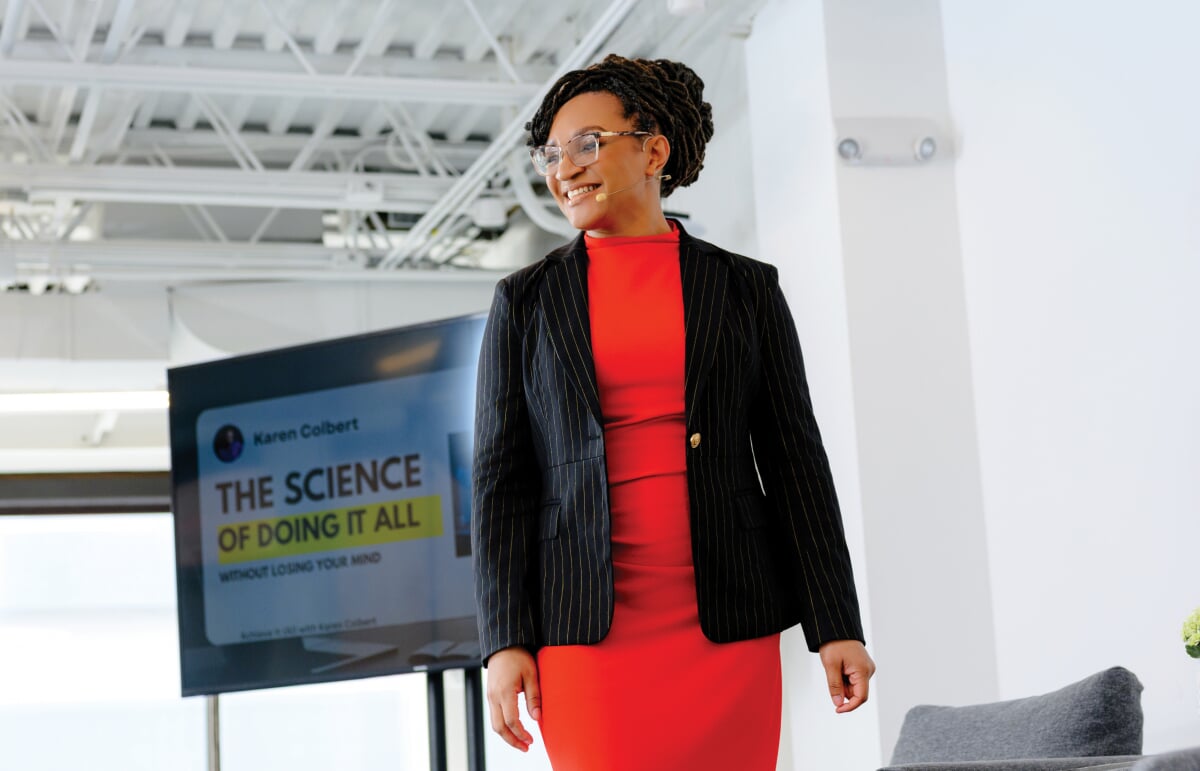
"AI is here to support your process, not replace your expertise," says strategist, data scientist, and coach Karen Colbert, Michigan Tech alumna and author of The Algorithm Wasn't Built for Us. The American Indian College Fund Faculty Advisory Council member notes that AI's statistical fluency is no substitute for wisdom—and that the confidence AI tools typically lead with should not be conflated as truth.
To navigate these systems, Colbert suggests we prioritize human vision. "We must ask: Who is missing? When a system doesn't know you, it cannot understand you or represent you. By re-centering authority on humans, we ensure that AI serves as a tool for accessibility rather than a replacement for our unique voices," she says.
Colbert, the 2026 keynote speaker for the Michigan Tech Institute of Computing and Cybersystems' annual Art in Silico event, received her bachelor's in electrical engineering in 2004, her master's degree in data science in 2018, and her PhD in Computational Science and Engineering in 2026.
Computer Science PhD Student Awarded NSF Fellowship
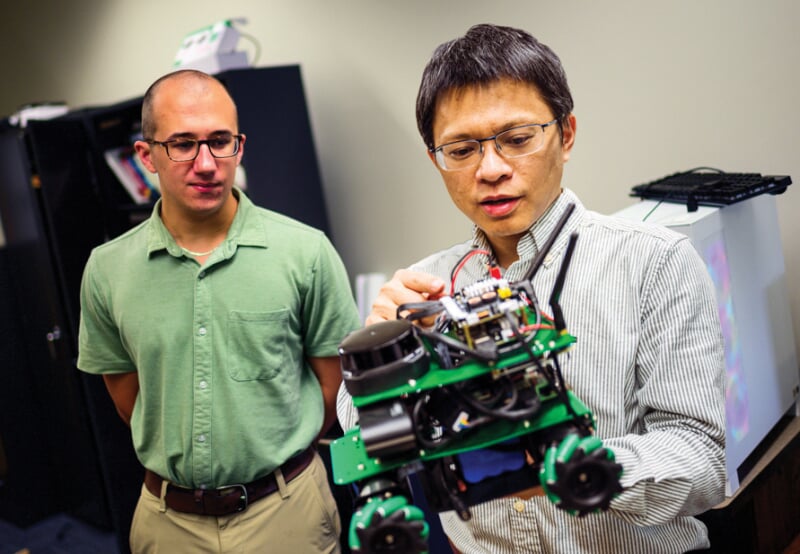
It was just another ordinary day at his desk for computer science PhD student Josh Dafoe. But everything changed when he heard that the National Science Foundation Graduate Research Fellowship (NSF GRFP) results had been released. Dafoe, a researcher in cybersecurity expert Bo Chen's Security and Privacy Lab at Michigan Tech, logged into the portal to find he had won the prestigious award, leaving him "surprised, grateful, and incredibly honored."
The NSF GRFP is one of the nation's most competitive honors for outstanding graduate students pursuing full-time research in STEM fields. Find out how Dafoe went From First-year Class to Fully Funded.
Inaugural Dave House Fellowship Sparks Computing and Engineering Cross-collaboration
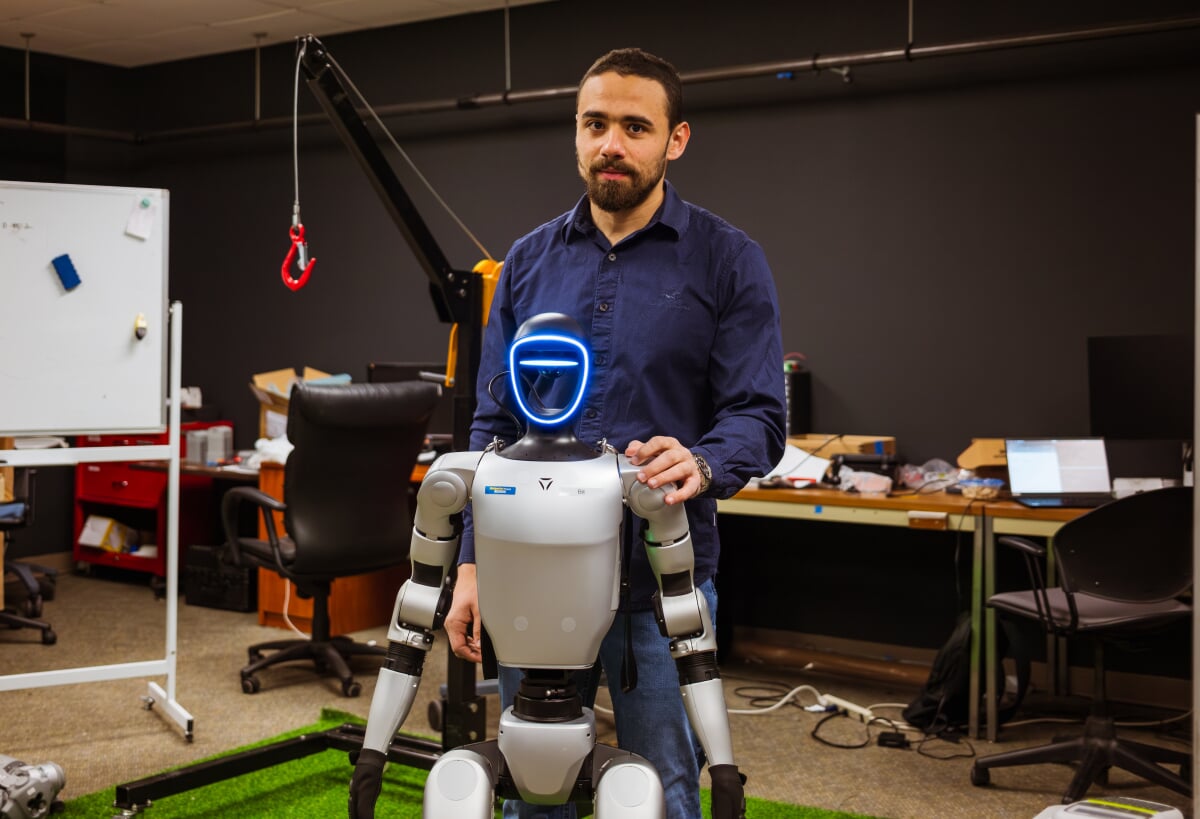
The College of Computing has teamed up with Michigan Tech's College of Engineering to launch a new doctoral fellowship to attract and nurture top-tier researchers from both fields.
Dennis Livesay, the Dave House Dean of Computing, and Michelle Scherer, dean of the College of Engineering, announced the inaugural Dave House Computational Innovation Fellowship. Supported by alumnus Dave House '65 and the House Family Foundation, the first-of-its-kind initiative bridges engineering and computing through deep, sustained faculty and student collaborations.
The inaugural fellowship was awarded to Tan Chen, assistant professor of electrical and computer engineering, and Michael Walker, assistant professor of computer science, for their project, "A Hybrid Autonomous-Human Control Framework for Safe Deployment of Humanoid Robots in Real-World Applications".
Get the full scoop on this new era of a PhD powerhouse.
Outstanding Alumni Inducted into Honor Academy

The College of Computing Honor Academy recognizes graduates of Michigan Technological University who have made a meaningful difference in their professions and communities. Honorees are leaders, innovators, and dedicated mentors whose impact extends beyond their own careers to create opportunities for others.
Meet our 2025 honorees—Mark Gauthier '85 and Dianne Marsh '86.
Rubber Ducking
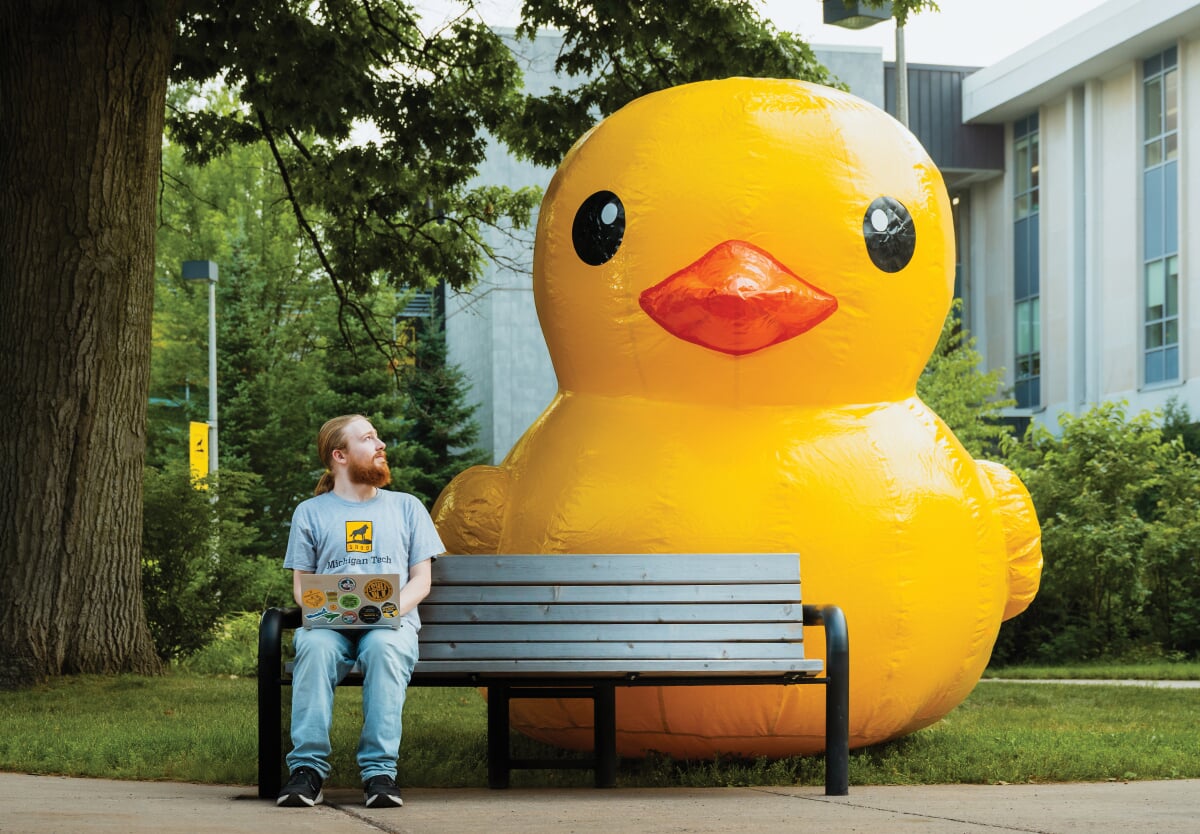
When you get stuck, talk to the duck. Introduced in 1999's The Pragmatic Programmer, rubber ducking helps people debug code by explaining it aloud to a cheerful, nonjudgmental listener. But as student Gabriel Belanger notes, the technique travels well beyond programming: articulating a problem exposes assumptions, sharpens critical thinking, and reveals solutions. Every College of Computing first-year student receives their own little duck while our giant de facto mascot spreads that curious, problem-solving spirit across campus.
Michigan Technological University is an R1 public research university founded in 1885 in Houghton, and is home to nearly 7,500 students from more than 60 countries around the world. Consistently ranked among the best universities in the country for return on investment, Michigan's flagship technological university offers more than 185 undergraduate and graduate degree programs in science, technology, engineering, mathematics, computing, forestry, business, health professions, robotics, psychology, social sciences, humanities, and the arts. The rural campus is situated just miles from Lake Superior in Michigan's Upper Peninsula, offering year-round opportunities for outdoor adventure.