

Universal Design for Learning (UDL) is a framework to enhance teaching and learning based on the science of how people learn. As an inclusive educational practice, it supports Michigan Tech’s goal of ensuring all learners (including learners with disabilities) can access their educational materials and demonstrate mastery of course learning goals.
The Higher Education Opportunity Act of 2008 says UDL:
-
provides flexibility in the ways information is presented, in the ways students respond or demonstrate knowledge and skills, and in the ways students are engaged; and
-
reduces barriers in instruction, provides appropriate accommodations, supports and challenges, and maintains high achievement expectations for all students, including students with disabilities and students who are limited English proficient.
The UDL framework is composed of three principles; provide multiple means of engagement, representation, and action & expression. These principles are supported by specific guidelines and more detailed considerations. The UDL guidelines are designed as a set of suggestions to reduce instructional barriers and increase access to instructional materials and methods.
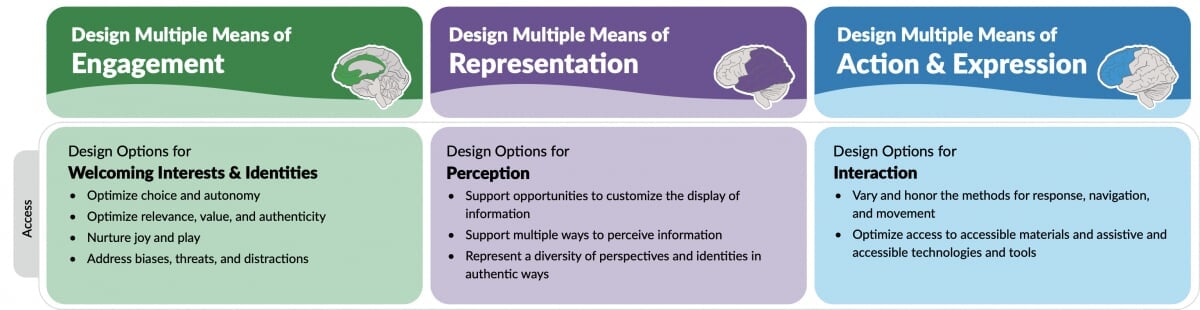
The three UDL principles are linked to the major networks of the learning brain: affective, recognition, and strategic regions. Short descriptions of the principles are provided below. Links go to the UDL Guidelines website, which has significantly more detail on each principle and its guidelines for supporting students. For example, each guideline has multiple considerations and each consideration has a specific design tips and suggestions.
These principles and guidelines are a logical starting point as you begin learning about and applying UDL in your instruction.
Design Multiple Means of Engagement
Affective Networks: the "WHY" of Learning
Strategies that engage and motivate students to be successful learners are reflective of their diverse characteristics and backgrounds. While some students like a well-structured approach where course activities are well defined and predictable, other students may prefer flexibility and spontaneity. Some students prefer independent study while others value interactions with their peers. Providing multiple means of engagement is important to better address the needs of all students.
Guidelines for Supporting Learners
- To support learner access we can design options for: Welcoming Interests and Identities.
- To support the learning process we can design options for: Sustaining Effort and Persistence.
- To support learners’ executive functioning by designing options for: Emotional Capacity.
Design Multiple Means of Representation
Recognition Networks: the "WHAT" of Learning
Learners perceive and comprehend information differently. Those with various sensory or cognitive disabilities require different approaches to assessing the information. Some learners process information more efficiently in visual or auditory formats versus printed text. Because one means of representation cannot be optimal for everyone, providing options is important.
Guidelines for Supporting Learners
- To support learner access we can design options for: Perception.
- To support the learning process we can design options for: Language and Symbols.
- To support learners’ executive functioning by designing options for: Building Knowledge.
Design Multiple Means of Action and Expression
Strategic Networks: the "HOW" of Learning
Learners have diverse strategies for engaging learning environments and in demonstrating their mastery. Those with physical impairments (e.g., cerebral palsy), problems with organizational abilities (executive function disorders), or language barriers, engage learning tasks differently.
Guidelines for Supporting Learners
- To support learner access we can design options for: Interaction.
- To support the learning process we can design options for: Expression and Communication.
- To support learners’ executive functioning by designing options for: Strategy Development.
Formal Time Accommodations and UDL
Guidance for Faculty
Michigan Tech is supportive of instructors who choose to utilize Universal Design for Learning (UDL) practices such as providing extended time on quizzes, tests, and exams for the entire class as a way to remove time constraints or barriers for students. Instructors should be communicating to the entire class that they are using UDL so that all students are aware of this practice (e.g. “This test was designed to be completed in 45 minutes. To relieve time pressures, I am giving everyone 90 minutes to complete the test.”).
Students who utilize disability accommodations must be provided their accommodations in addition to this practice (in the example above, if they have a 2x accommodation, they must receive 3 hours to complete the test). A student using an accommodation may choose not to use their accommodation if they feel the extended time given to the entire class is sufficient. If instructors choose to use Universal Design (UDL) practices, it would be appropriate to include this information on their syllabi in addition to making announcements to the class before each quiz, test, or exam.
Additional UDL Resources
- UDL Guidelines from CAST
- Graphic Organizer (2024 version) showing complete UDL framework and supporting guidelines.
- UDL Research Evidence
- UDL Tips Documents for Higher Ed
- UDL Articles for Higher Education Audiences
- Watch 2019 Upper Peninsula Teaching and Learning Conference Keynote: "Reach Everyone and Teach Everyone with Universal Design for Learning" (presented by Thomas J. Tobin)
Consultations are available if you would like to discuss ways of applying UDL principles to your teaching.