

Start with Course Learning Objectives
When you begin creating a course, you want to design with the end in mind. The best way to approach this is to start by writing measurable course learning objectives. Course learning objectives are the destinations on your course map. They state where you want students to go. A learning objective is a statement that clearly and precisely describes what the learner will know and be able to DO by the end of the course, module or unit.
Learning objectives need to specify student actions that are observable and measurable. That way they can be assessed in an objective manner. Frequently the verbs understand and learn will appear in learning objectives that are not observable and measurable. When you encounter this situation, ask yourself “how will I know my students understand
this?” Your answer to that question will often provide the action verb you need to
create an observable and measurable learning objective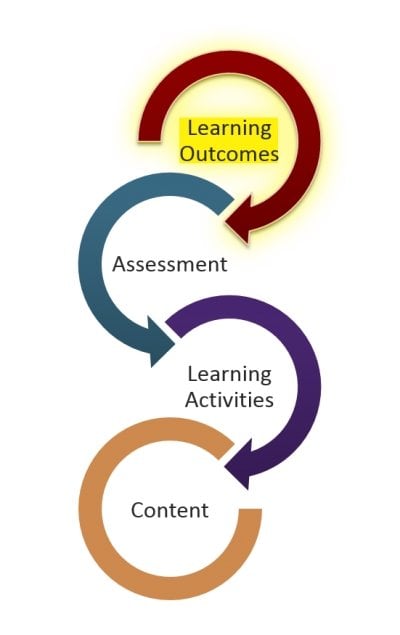
In addition to being observable and measurable, learning outcome statements have to focus on student action. They are about students showing what they have learned, not about the instructor describing how they are teaching. For example, "The students can accurately describe the process of photosynthesis" is a learning objective while "I will show a PowerPoint presentation on photosynthesis and give the students a quiz" is not.
Generally speaking, you will have 3-6 course learning objectives. Course learning objectives are generally higher-order thinking skills that require multiple subordinal skills or knowledge to achieve. Once you’ve decided your course learning objectives, you then need to break them down into module or unit learning objectives.
Writing Good Learning Objectives
In their basic form, learning objectives are typically structured as:
By the end of the course, students will be able to...[action verb] + [object].
The place where learning objectives often fall short is the verb, the action that students will do to demonstrate their learning.
Bloom's (Revised) Taxonomy
Many faculty members start their verb search with the cognitive domain of "Bloom's Taxonomy". This framework was originally developed in 1956 (and revised in 2001) and has six levels that rely on the acquisition of previous cognitive skills:
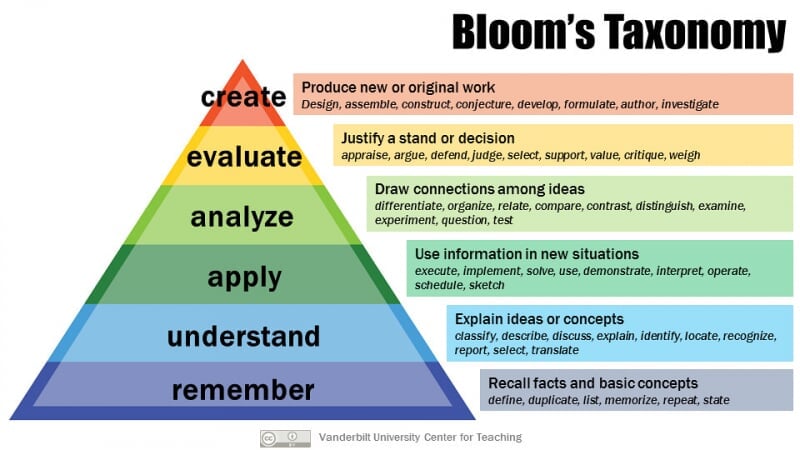
Illustration by Vanderbilt University Center for Teaching, used under a creative commons license.
Foundational to Complex Thinking Skills and Verbs
- Remember: Recall facts and basic concepts
- define, duplicate, list, memorize, repeat, state
- Understand: Explain ideas or concepts
- classify, describe, discuss, explain, identify, locate, recognize, report, select, translate
- Apply: Use information in new situations
- execute, implement, solve, use, demonstrate, interpret, operate, schedule, sketch
- Analyze: Draw connections among ideas
- differentiate, organize, relate, compare, contrast, distinguish, examine, experiment, question, test
- Evaluate: Justify a stand or decision
- appraise, argue, defend, judge, select, support, value, critique, weigh
- Create: Produce new or original work
- Design, assemble, construct, conjecture, develop, formulate, author, investigate
Resources
If you'd like to review active verbs for learning outcomes based on Bloom's Cognitive Taxonomy, please examine the resources below:
- List of Bloom's Cognitive Taxonomy Verbs (note, this is based on the original taxonomy so uses some different category names than shown above).
- Bloom's Taxonomy Three Domains, with sample learning outcomes and assessments for each, from University of Waterloo.
- Using Bloom's to Plan Instruction from Iowa State. Verbs, sample question stems, and products linked to each level of the revised taxonomy.
- A Model of Learning Objectives from Iowa State, with a 3-dimensional representation of the intersection of the Cognitive Process Dimension (the revised Bloom's Taxonomy shown above) and the Knowledge Dimension (four types of knowledge from concrete to abstract). This may be helpful for understanding the varying complexity of different verb choices for learning objectives.
- GenAI and Bloom's Taxonomy: tips for how GenAI can supplement the learning process at each cognitive level, from Oregon State University.