
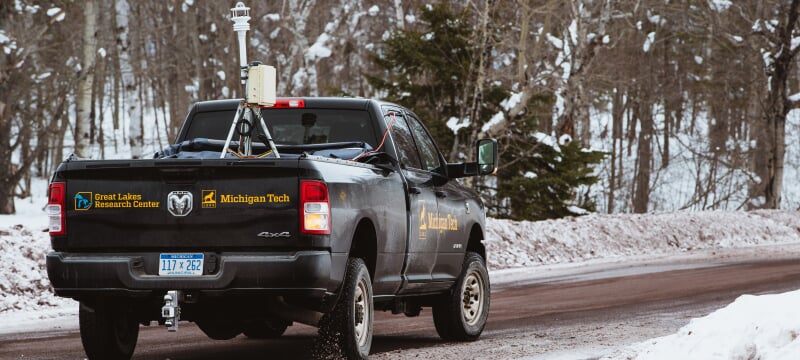
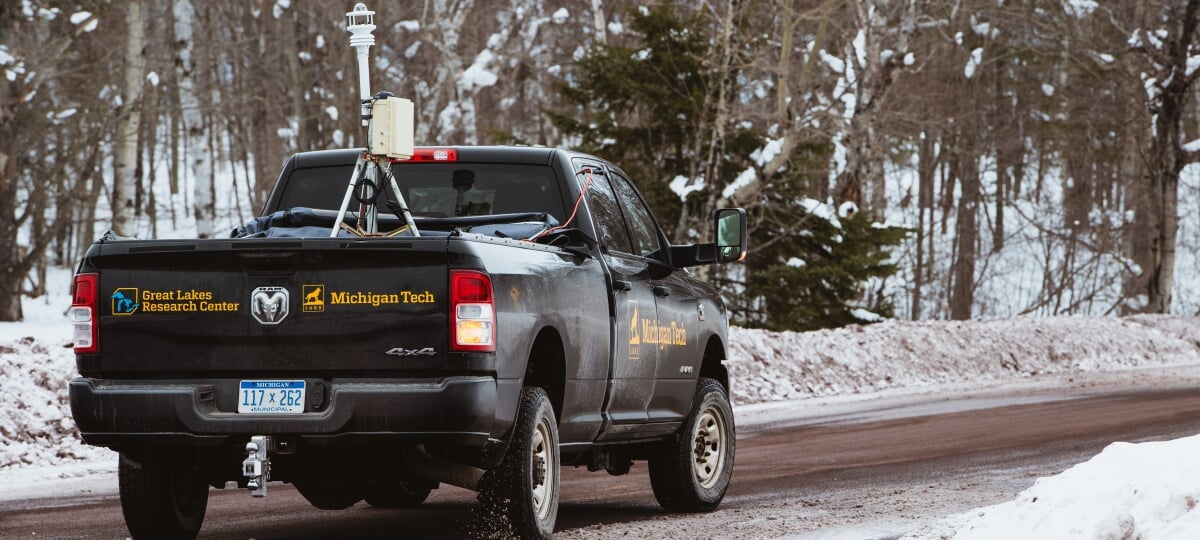
With breakthrough new technology that measures water isotopes on the move, Michigan Tech research scientist Ben Kopec and his team are driving, boating and snowmobiling around the Keweenaw to help make lake-effect snow more predictable.
In the Keweenaw Peninsula, home to Michigan Technological University, lake-effect snow is par for the course. When the annual snowfall average is more than 200 inches, Keweenaw residents know to expect high volumes of snow between the months of October and March. But without adequate weather radar systems in the area, specific winter precipitation events can be notoriously difficult to predict.
Ben Kopec, assistant research scientist with Michigan Tech's Great Lakes Research Center (GLRC), is trying to make snow prediction easier. An accomplished hydrologist, Kopec studies water isotopes — unique signatures determined by the structure of water molecules that allow scientists to identify water vapor's point of origin and follow it through the water cycle. This tracking process is known as water cycle tracing or isotope hydrology.
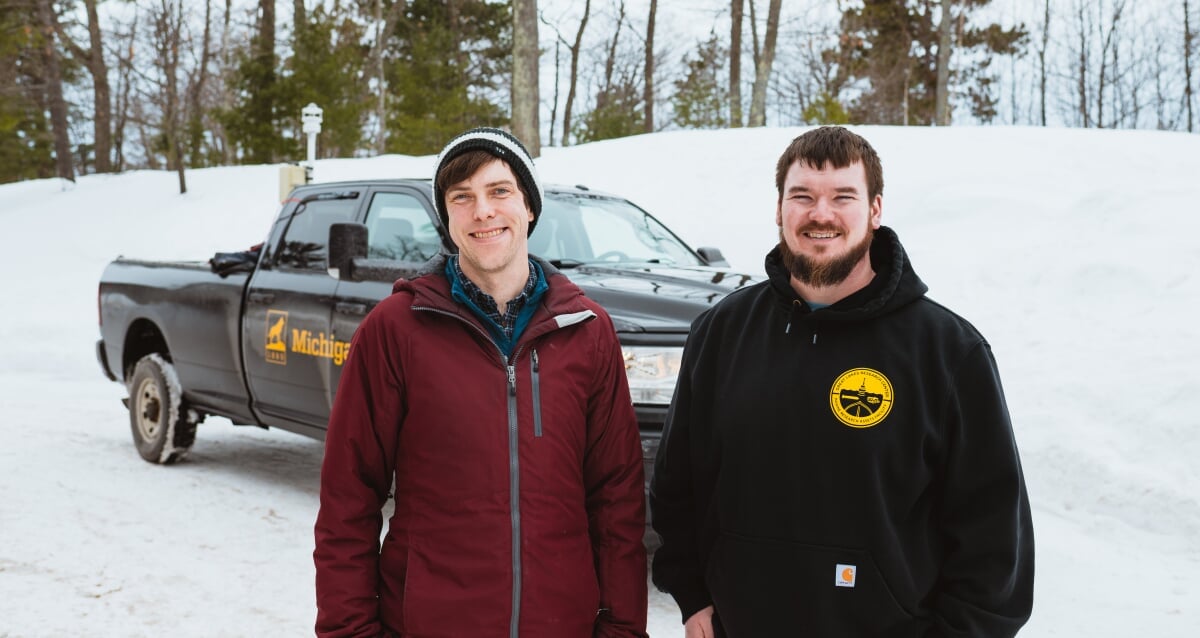
"When water evaporates from all sorts of different sources, the temperature of that water will dictate a unique signal that can be identified in isotopic measuring," explained Kopec, who also serves as an adjunct assistant professor in the Department of Civil, Environmental, and Geospatial Engineering. "These water isotopic tracers allow us to quantitatively measure how much water is moving through different parts of the water cycle, where the water is coming from and what conditions affect the different processes."
"We have a qualitative understanding of how this works, but putting numbers to that process so we know more specifically how much lake evaporation leads to snow precipitation is the goal of our research," said Kopec. "We can use these isotopes to identify just how much water vapor is coming from the lake."
Water cycle tracing requires a near-continuous collection of isotopic measurements. Kopec works with GLRC senior research engineer Hayden Henderson and research technician Nick Yeager to measure how much water from Lake Superior is evaporating, condensing and precipitating. To do it, they collect samples from the lake water itself, from the vapor in the air and from the snowpack on ground.
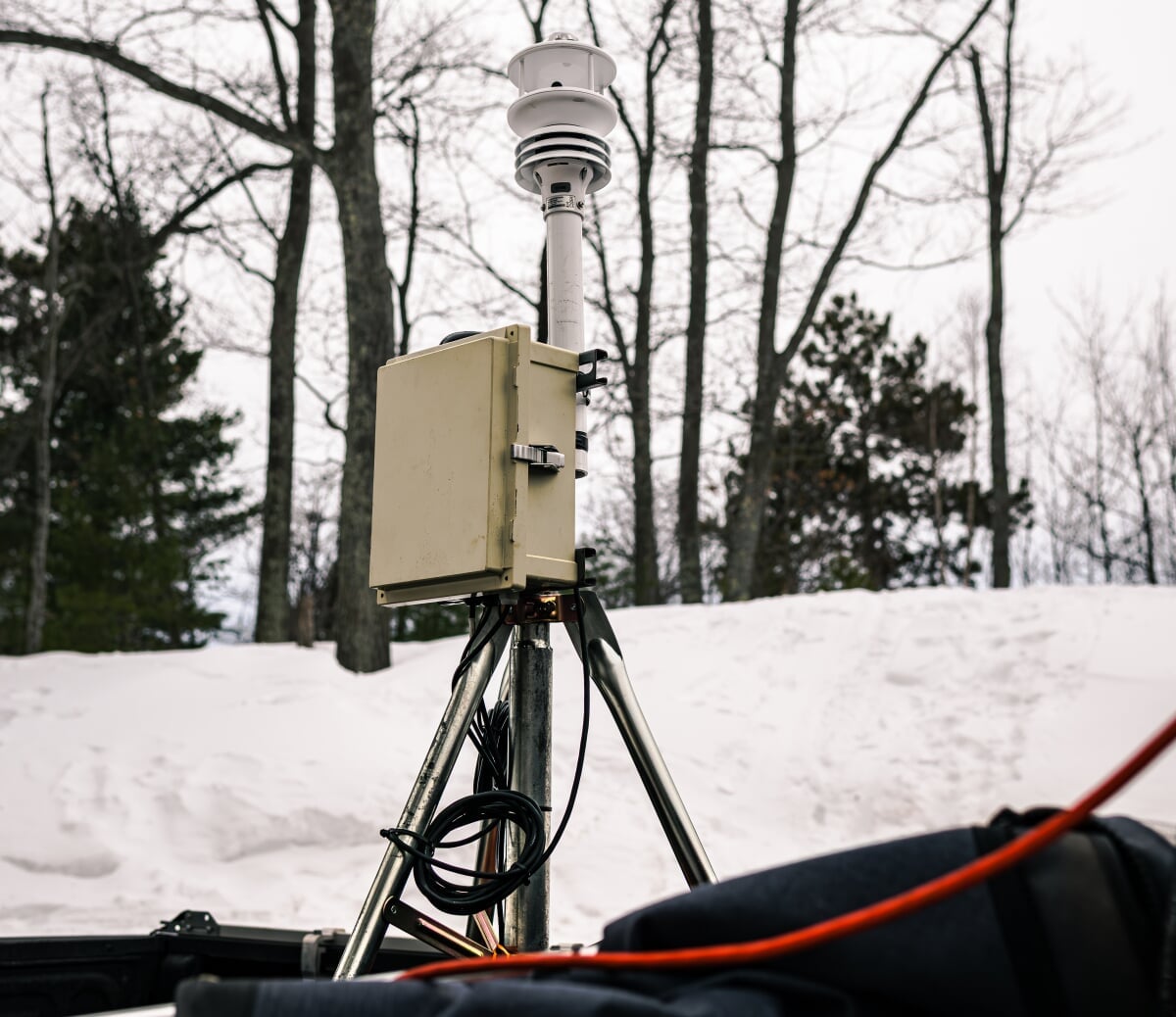
Measuring volumes of water vapor in the air is perhaps the most important element of this research. The process is made possible thanks to the relatively new technology of isotopic analyzers.
"For decades, scientists have been collecting discrete samples and bringing them back to a lab to measure them using large, stationary mass spectrometers," said Kopec. "In that case, you're limited to how many samples you can physically collect and the rate of measurement. With these new high-resolution analyzers, we can do a lot more things."
Isotopic Intuition
While Kopec and his team are using water isotopes to predict climate futures, the process gained notoriety for its ability to determine climate history through ice cores. In places like Greenland and Antarctica, where snow and ice piles up over thousands of years, drilled-out ice cores serve as a record of past climate systems.
"Water isotopes are like the Holy Grail tracer," said Kopec. "Because isotopic signatures can determine the temperature of water vapor in clouds, scientists can use these isotopic measurements of ice cores to understand past temperatures over hundreds of thousands of years."
The applications for water cycle tracing have expanded to help determine the sources of water pollution, investigate surface-groundwater interaction, study human impacts on water cycles and more. Kopec began working with water isotopes as a doctoral student studying changing water cycle processes in the Arctic region.
"In the Arctic Ocean, there are large amounts of permanent sea ice, but with warming temperatures in the Arctic, that ice is shrinking with a lot more open water," he said. "That leads to more evaporation and thus more precipitation. A lot of my work is thinking about how to quantify those relationships between the loss of ice in the ocean and precipitation in the area."
Kopec's research has taken him on expeditions to Alaska and Greenland, and it's also what brought him to Michigan Tech. As the Great Lakes region experiences its own changes over time, the area's already unpredictable winter weather is becoming even harder to pin down.
"A lot of those same questions I was asking in the Arctic apply directly to changes we see here locally. There's a dramatic reduction in the ice coverage we are seeing in the Great Lakes, changes particularly in timing and whether the ice comes at all. If we have on average higher temperatures and less lake ice, then we have more time for this lake evaporation and precipitation. I am curious as to how those processes are evolving over time."
"The water that is evaporating from Lake Superior has a considerably different composition than what would be coming from an ocean source, say the Gulf of Mexico or the Pacific Ocean," he said. "We can use these isotopic signatures — I can measure them in the water vapor — to say ultimately how much water vapor is coming from the lake or other distant sources."
Kopec's research project, funded by Michigan Tech's Research Excellence Fund, brings together the components of his work for the potential benefit of Keweenaw residents and beyond. By linking lake evaporation volumes to precipitation levels, researchers may be able to more accurately predict lake-effect snow across the Great Lakes region.
This new forecasting model will help communities make informed, evidence-based decisions to prepare for lake-effect snow events, providing adequate lead time for storm preparations, snow removal, and school and municipal closures. In order to reach that point, Kopec and his team must quickly collect and assess high volumes of data. Isotopic analyzers make the process possible.
Data Collection in Motion
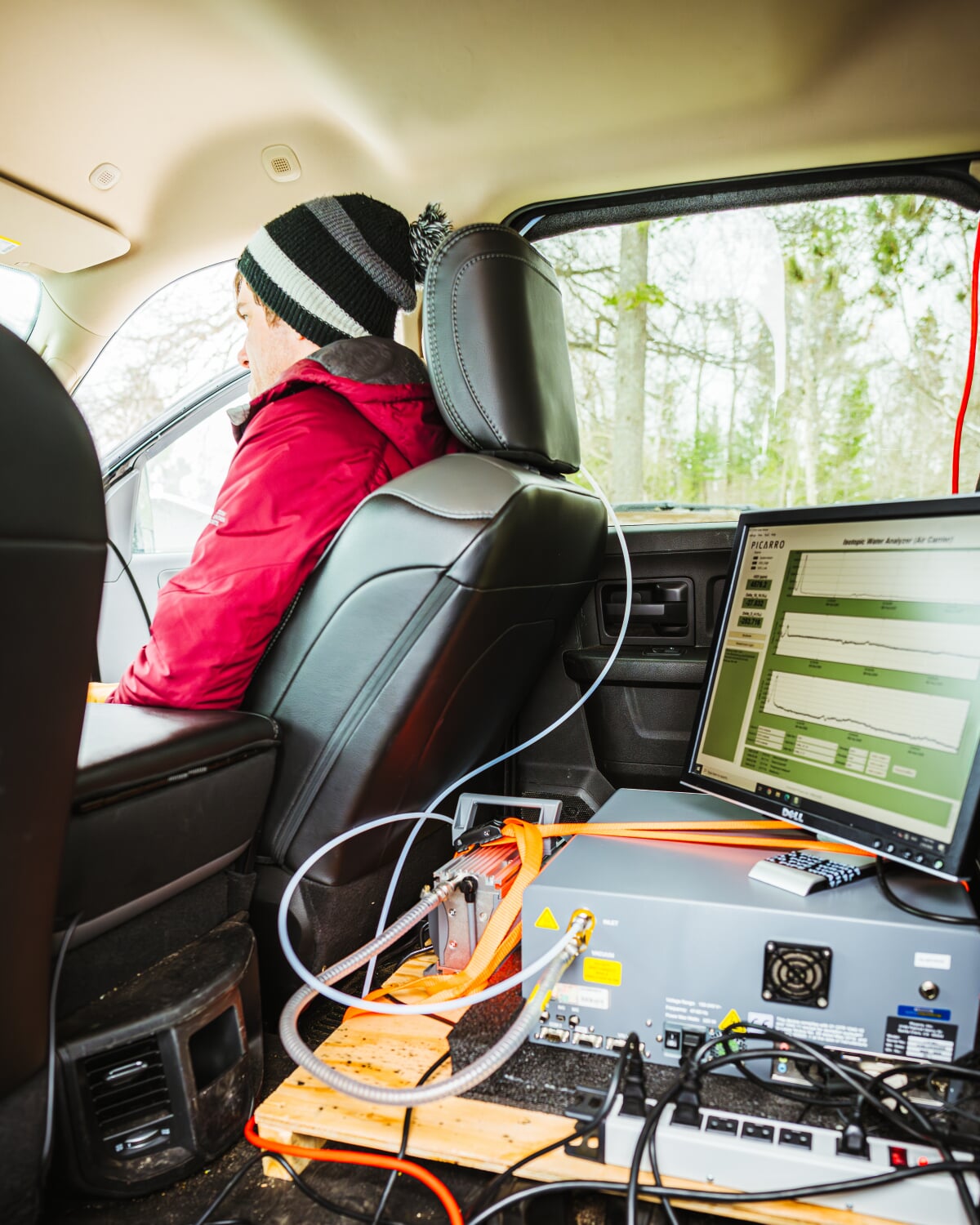
Isotopic analyzers are small enough to collect data in the field, including in a mobile environment. Kopec and his teammates use a device manufactured by Picarro, which they attach to the GLRC's research vessel Agassiz. Out on Lake Superior, the analyzer measures vapor from the lake water directly — a critical first step in their data collection.
"We are limited in the seasons we can go out and do that, but those are important measurements, particularly to identify that isotopic signal for the next stages of the project," said Kopec.
Once the isotopic signature of the vapor from Lake Superior has been identified, the isotopic analyzer gets mounted to a GLRC truck to measure atmospheric conditions as the team drives around the Keweenaw. This is where the device really shines.
"The analyzer we use is measuring continuously," said Kopec. "It takes a data point at every second; we are taking in water vapor as we drive along. It's able to measure in motion, which allows us to take in so much data, rather than just collecting data at discrete locations and intervals."
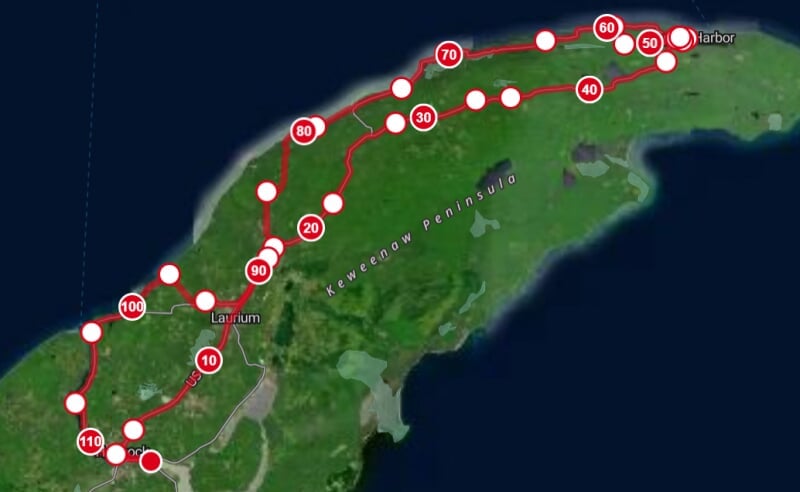
The analyzer's efficient data collection allows Kopec and his team to better understand how the geography of the Keweenaw affects snowfall. By collecting data at various elevation points, they are able to capture a gradient of water vapor levels across the peninsula.
"By driving over and over again around the area in different conditions, we can develop a better quantitative and predictive understanding of these water vapor fluxes coming off the lake as the vapor moves across the Keweenaw and the broader region," said Kopec.
While this project is currently focused on data collection, there are clear next steps for this research, including intriguing cross-campus collaborations. Kopec's data has direct links to GLRC Associate Director Pengfei Xue's Great Lakes regional climate modeling work.
"This data collection can work as a perfect in situ data test of some of the same types of models Xue is using that help forecast how lake-effect precipitation will be changing moving forward," said Kopec.
A research collaboration is already underway in the University's Department of Physics, where the isotopic analyzer is assisting in Distinguished Professor Claudio Mazzoleni's aerosol and air quality research. Kopec is also excited to be able to expand the spatial assessments of the isotopic analyzer by attaching it to a snowmobile, in true Michigan Tech fashion.
Kopec's work based at Tech also informs the work he continues in the Arctic. He's grateful to be able to conduct the related research locally.
"The Keweenaw is essentially the Arctic, in some respects; we have a lot of the same atmospheric conditions as parts of Alaska," he said. "We can measure our processes here to better understand the processes there. I love doing the Arctic fieldwork, I have a lot of experience in that, but it's nice to be able to do a lot of that right in our backyard."
Tracing a Scientist's Path
Even before his Arctic expeditions and the advent of isotopic analyzers, Kopec had an interest in hydrology.
"Since I was a little kid, I have loved water," he said. "I find it deeply fascinating. I knew that I wanted to be a scientist, before I even really knew what that meant."
Growing up in Rochester, New York, near Lake Ontario, the Great Lakes have always been a part of Kopec's life. He studied environmental science at Susquehanna University and continued on to earn his Ph.D. in Earth Sciences from Dartmouth College.
"That's where I learned this unique tool of water isotopes," said Kopec. "I didn't know anything about using water isotopes in this way before coming to grad school and really lucked into that. I quickly learned this was an amazing tool to help measure our water cycle."
Kopec has long been fascinated by the Arctic. In graduate school, he began working with his advisor on isotopic research in the region.
"It's the system where we are seeing unbelievable rates of change with warming and all those downstream impacts," he said. "It's terrifying to some degree, very much so, but from a scientific perspective, it's fascinating to be able to be witness to such dramatic changes so quickly."
Kopec continued to study Arctic water cycles after earning his Ph.D., holding teaching and research positions in Minnesota, Alaska and Finland. It was that same research that brought him back to the familiar Great Lakes region. When a research position with Michigan Tech's GLRC opened up, he jumped at the opportunity, joining the research institute's staff in 2024.
"The job here was incredibly intriguing to me," said Kopec. "A lot of those same Arctic questions pertain to the Great Lakes region."
"The Great Lakes are one of this country's most important natural resources. Understanding how they are changing is an incredibly important question, and being able to do local, highly impactful science means a lot to me. I'm grateful to be able to pursue this work here."
Kopec appreciates the resources of the GLRC that allow him to study the water cycle in his backyard, a welcome opportunity both professionally and personally for the husband and father.
"I've had the opportunity to take research voyages in the Arctic where I'm out at sea for weeks at a time," he said. "They are really amazing but also challenging, especially now with two young children. Having our own research vessels here at the GLRC, I can go out for the day and be home for dinner."
It's a little too early to introduce his 2-year-old and 6-month-old to his favorite winter activity, snowboarding, but Kopec is determined to pass on his love for the Keweenaw's coldest season to his children.
"Being outside in the snow in any way is magical," he said. "Even just taking hikes and sledding, it's a lot of fun being able to show my kids all the natural wonders of this region."
Michigan Technological University is an R1 public research university founded in 1885 in Houghton, and is home to nearly 7,500 students from more than 60 countries around the world. Consistently ranked among the best universities in the country for return on investment, Michigan's flagship technological university offers more than 185 undergraduate and graduate degree programs in science, technology, engineering, mathematics, computing, forestry, business, health professions, robotics, psychology, social sciences, humanities, and the arts. The rural campus is situated just miles from Lake Superior in Michigan's Upper Peninsula, offering year-round opportunities for outdoor adventure.

Comments