
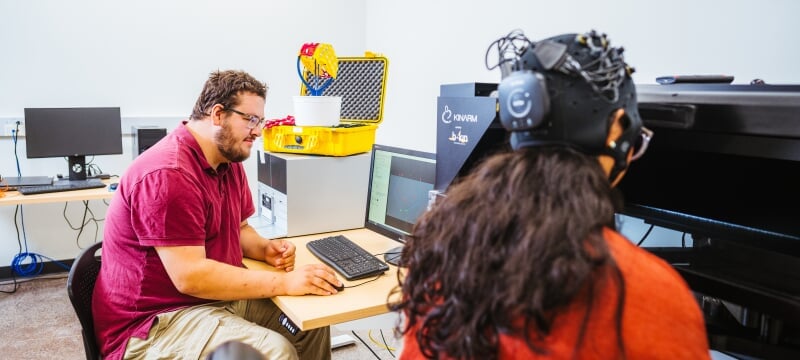
Inside Michigan Tech's Aging, Cognition and Action Lab, space debris rains down on a screen as players scramble to deflect it before it crashes. Although the fast-paced chaos feels like a classic arcade, there's something much more ambitious behind the gameplay.
The video game Space Trash is a neuroscience research tool created by faculty and students across three departments at Michigan Technological University — psychology and human factors, computer science, and kinesiology and integrative physiology (KIP) — along with the University's Health Research Institute. The game, one of several projects emerging from the work of members in Michigan Tech's Computer Science Education Research Group (CS-ERG), is transforming how researchers study motor control by turning data collection into something surprisingly engaging.
Turning Research Into Play
The idea started with a simple question: Could a video game replicate the complex motor tasks typically measured by expensive robotics in clinical labs?
Psychology and human factors graduate researcher Brandon Woolman and faculty collaborators Kevin Trewartha, associate professor in psychology and human factors and KIP, and Leo Ureel II, assistant professor in computer science and psychology and human factors, believed the answer might be yes.
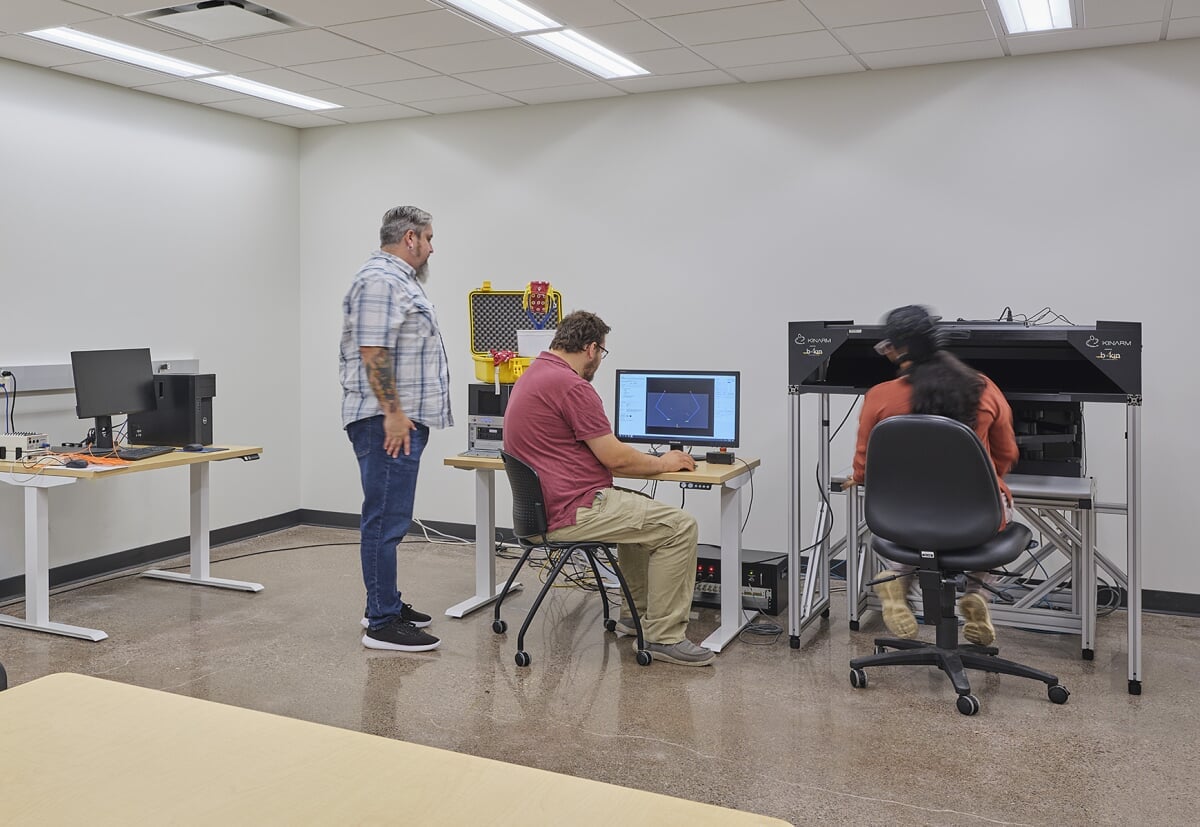
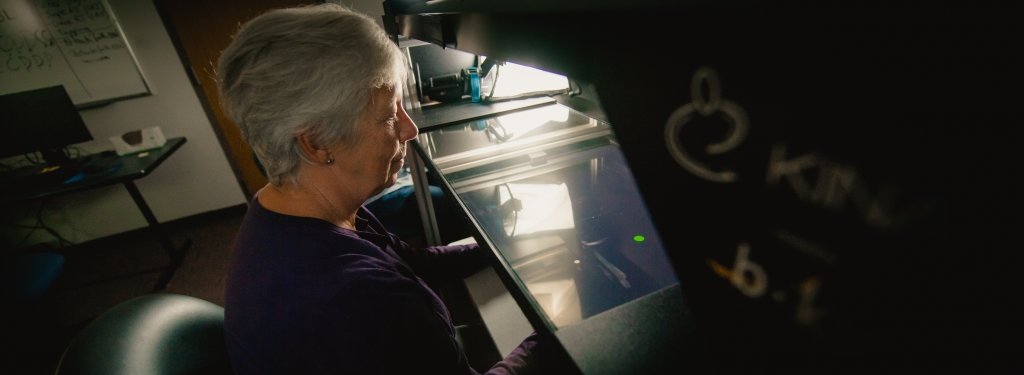
Their team looked to the Kinarm robotic system, a two-handed research and diagnostic tool widely used to study sensory, motor and cognitive function. One of Kinarm's hallmark tasks — object hit and avoid — measures visuomotor control, or how the brain coordinates movement. But the device is costly, requires specialized equipment and is hard to access outside of research centers.
Space Trash aims to solve that problem. By recreating the Kinarm task in a game environment, the project could make motor-control testing portable, approachable and even fun.
What Playing Space Trash Really Measures
On the surface, Space Trash feels like a high-energy challenge. Players use two paddles controlled by PlayStation Move motion sensors to knock away falling shapes while avoiding others. The speed escalates. New object types appear. Precision and reaction time become everything.
Each swipe and split-second decision is unobtrusively recorded. The game tracks reaction time, hand dominance, motor adjustments and accuracy, giving researchers a detailed picture of a player's motor behavior.
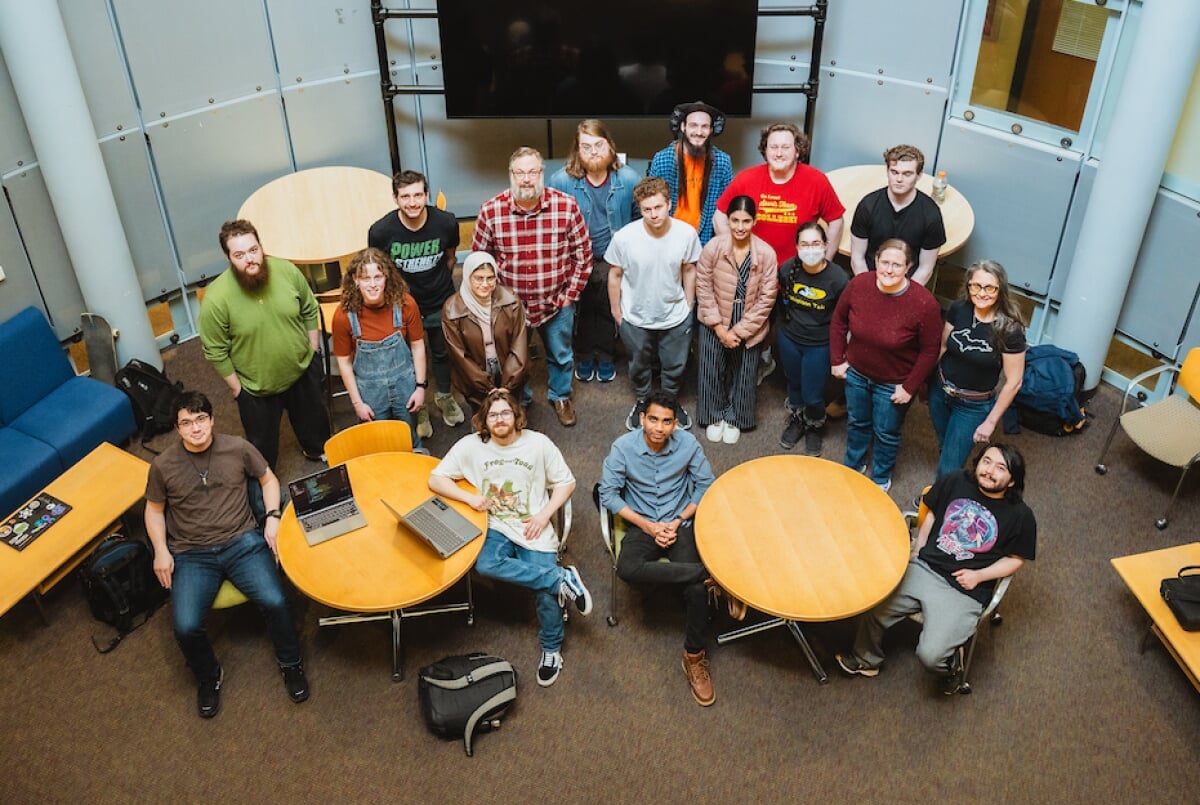
All are welcome to be part of the project group, which includes Michigan Tech faculty and staff as well as graduate and undergraduate students.
A team of undergraduates, including software engineering major Jonathon Oestringer '25 and computer science majors Jaylin Pigeon '25, Robby Johnson III '27 and Caeden Kidd '28, helped bring the game to life. Using JavaFX and Maven, they connected the controllers to the system, refined gameplay and built visual dashboards that allow researchers to see movement patterns in real time. Their work helped turn a fast-paced game into a powerful research dataset.
Johnson served as main developer. "I was tasked with setting up the main codebase that the game runs on. When I got stuck, I had lots of help and guidance from CS-ERG," he said. "CS-ERG is where I first heard about the project idea from Brandon and Dr. Ureel. From there I decided it would be a good idea to try and get some funding from URIP (Tech's Undergraduate Research Internship Program), which led me here."
Kidd also got involved in the project through CS-ERG. "When I arrived at Michigan Tech, the first thing I wanted to do was join a research team, because I had some great experiences working with research projects in high school through clubs like HOSA (Health Occupations Students of America)," he said. "I met Dr. Ureel, Brandon, Kevin and Robby and heard about the project. I thought it was really interesting, so I asked if I could join."
"It was a great experience being part of the Space Trash project, getting an opportunity to work with some amazing people and develop a technology that has the ability to help people."
Why Gamifying the Lab Matters
Traditional motor-control studies rely on repetitive tasks that can tire or disengage participants. The Space Trash team wanted to change the experience without compromising scientific rigor.
"By blending entertainment with experimentation, we get more natural responses," said Woolman. "People forget they're being tested. They're just playing."
This approach allows researchers to observe how players adapt to increasing difficulty and identify subtle shifts in coordination patterns that may someday support early detection of neurological conditions such as Alzheimer's or Parkinson's disease.
The team is working toward a future where Space Trash can be downloaded from digital storefront platforms like Steam or Itch.io, making the tool accessible to researchers, educators and clinicians — and even curious gamers.
That mainstream accessibility has the potential to transform the game's data collection. Instead of relying solely on laboratory settings, researchers could gather motor-control data from participants in their homes, classrooms or community spaces, something that is rarely feasible in neuroscience research — and made even more challenging by geographical location. Trewartha said that's a major reason why this project is so important.
"We want to recruit folks living with neurological conditions in rural communities like ours. Developing ways to engage participants in data collection that can help us evaluate motor function outside of a traditional brick and mortar lab space can open up our research approach to much larger populations, since they don't need to travel to Michigan Tech to participate," he said. "Space Trash has the potential to provide us with data from larger numbers of diverse participants with various neurological conditions to identify subtle differences in motor performance that may help us distinguish the early stages of Alzheimer's disease, Parkinson's disease, and healthy aging, for example."
What's Next for the Research Project?
Space Trash is currently undergoing validation studies to compare its results with the established Kinarm system. If the data align, the implications could be significant: a low-cost, widely accessible tool that bridges entertainment technology and medical diagnostics.
The pilot project is currently being funded through existing lab sources. Researchers are exploring funding opportunities, with plans to submit grant applications in the future.
For Space Trash's student developers, the project represents the best of what Michigan Tech has to offer — creativity, computation and human-centered science coming together to reimagine what research can look like.
"It's really fun and exciting to be working on something that can help so many people and has such a big impact," said Johnson.
Michigan Technological University is an R1 public research university founded in 1885 in Houghton, and is home to nearly 7,500 students from more than 60 countries around the world. Consistently ranked among the best universities in the country for return on investment, Michigan's flagship technological university offers more than 185 undergraduate and graduate degree programs in science, technology, engineering, mathematics, computing, forestry, business, health professions, robotics, psychology, social sciences, humanities, and the arts. The rural campus is situated just miles from Lake Superior in Michigan's Upper Peninsula, offering year-round opportunities for outdoor adventure.



Comments