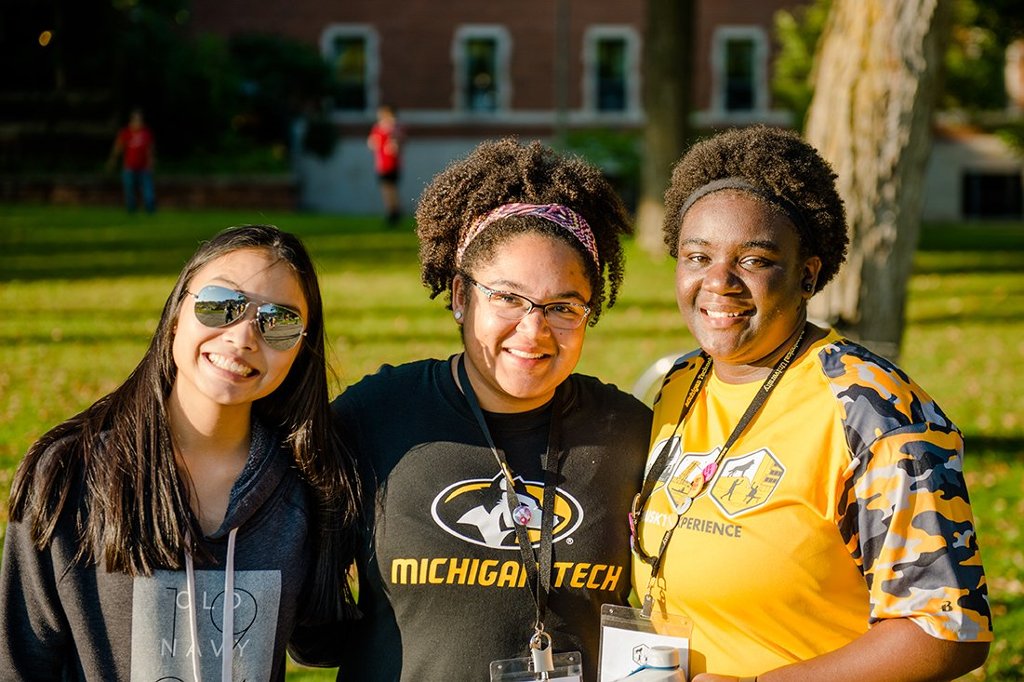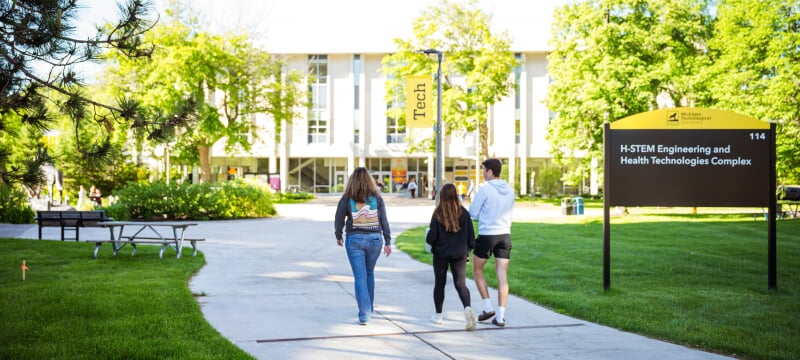
This fall, Michigan Technological University welcomes a new class of Huskies who bring strong academic preparation and leadership experiences from beyond the classroom.
As colleges and universities nationwide navigate long-anticipated demographic shifts affecting the number of traditional college-age students, Michigan Tech enrolled 7,054 students for fall 2026, a drop of 4.8% from last year.
This year's incoming Huskies arrive particularly well prepared for college-level work, with an average SAT score of 1234, up from 1225 last year and among roughly the top 20% of SAT test takers nationally. As high schoolers, Tech's Class of 2030 maintained an average GPA of 3.86, matching last year's University record, with 35% of incoming students earning a high school GPA above 4.0.
Many first-year students also arrived with a significant head start on college coursework. Of those students, incoming Huskies brought more than 23,000 college credits with them to Tech through Advanced Placement, dual enrollment and other sources. These credit-bearing students earned approximately 22 credits per student, on average.
John Lehman, vice president for university relations and enrollment, said Michigan Tech has pursued strategic, measured enrollment growth for many years in preparation for the demographic and international enrollment pressures now facing the higher education sector. While the University is not immune to shifting enrollment pressures and cycles, he said, what does not change year-to-year is what Michigan Tech looks for in its students.
"Choosing Michigan Tech has always been an intentional decision. Students come here for rigorous academics, hands-on education and a distinctive campus environment that challenges them to grow. The students making that choice come to campus with impressive preparation, experiences and accomplishments, and they arrive ready to do Michigan Tech-level work."
Michigan Tech graduates continue to see strong returns on their investment, with a median early career salary of $84,560 and a 94.6% placement rate. That value begins well before they complete their college degree. Through internships, co-ops and other applied learning opportunities like the Enterprise Program and Senior Design, many Huskies graduate with a wealth of professional experience and connections, preparing them to contribute from the start of their careers.
Career Connections
Each year, Michigan Tech's Career Fair brings more than 400 companies and 2,000 recruiters to campus, connecting Huskies with employers across every industry. More than half of Tech's student body participates in the semiannual event, making it one of the best opportunities for students to explore career paths, build networks and launch their professional journeys.
Michigan Tech has long invested in academic programs, resources and experiences designed to build on and strengthen what distinguishes a Tech education. This fall, such investments include new opportunities in artificial intelligence and data science, continued interest in emerging engineering fields, and stronger connections among programs focused on health, human and biological systems.
New Opportunities in AI and Data Science
Students interested in artificial intelligence now have three new ways to make it part of their Michigan Tech education. This fall, the University launched a Bachelor of Science in Artificial Intelligence, an Applied AI concentration within the Bachelor of Science in Information Technology, and an artificial intelligence minor.
The new bachelor's degree focuses on designing, developing and deploying intelligent systems. The Applied AI concentration emphasizes the practical use of AI tools in business and industry. The minor gives students in fields such as engineering, business and forestry another way to build technical AI skills alongside their primary area of study.
The new programs launched July 1 alongside Michigan Tech's Department of Data Science within the College of Computing. The new department is home to Michigan Tech's bachelor's and master's programs in data science and the University's master's program in health informatics, creating a dedicated academic home for a field that increasingly intersects with computing, health, manufacturing and other disciplines.
"This has been our most productive year yet in terms of new program development. Launching the BS and minor in AI, alongside expanded options in robotics and applied AI, is all about positioning Michigan Tech at the forefront of computing education and giving our students a clear edge in an AI-driven economy."
Engineering Across Disciplines
Huskies are increasingly choosing engineering programs that cross traditional disciplinary lines, combining Michigan Tech's long-standing strengths in mechanical, electrical, computing and environmental fields with emerging applications in aerospace, robotics and ecological engineering.
Michigan Tech's aerospace engineering bachelor's program continues to build momentum. After welcoming its first incoming class of 68 students last fall, the program is welcoming approximately 130 new students this year, nearly doubling its incoming class in one year. Students learn aerodynamics, propulsion and space systems while putting that knowledge to work through hands-on design, testing and research.
Students put their coursework into practice through Michigan Tech's Enterprise Program, including the Aeronautics and Rocketry Enterprise and Multiplanetary INnovation Enterprise (MINE). This spring, MINE's Astro-Huskies placed third overall in NASA's Lunabotics Challenge, where students design, build and test prototype lunar construction robots.
Student interest is also growing in robotics engineering and mechatronics, interdisciplinary programs that integrate mechanical systems, electronics, computing and controls to develop technologies that can sense, respond and operate in complex environments. Students test those skills across more than 15,000 square feet of dedicated robotics lab space and through hands-on projects ranging from lunar rovers and autonomous vehicles to custom drones.
A newer bachelor's degree option, ecological engineering, is also gaining traction with students. The interdisciplinary program combines civil and environmental engineering with ecology and environmental science to help students design sustainable systems for natural and urban environments. A partnership between the College of Engineering and College of Forest Resources and Environmental Science, the program gives students hands-on experience working on real environmental and ecological challenges in the Upper Peninsula and around Lake Superior.
Together, the programs reflect the breadth of the real-world problems Michigan Tech students are preparing to solve in their careers.
"Students choose Michigan Tech because they want to learn by doing. Our programs are intentionally designed for students to work alongside each other and our faculty — doing real work, making mistakes, learning from them and solving real problems together. That's where the magic happens."
Connecting Health, Human and Biological Systems
Because technology increasingly influences every aspect of biology, health and human performance, these disciplines are also increasingly interconnected. Michigan Tech responded to these dynamic shifts by launching the School of Health, Human, and Biological Systems in July. The School brings together the University's expertise in biological sciences, kinesiology and integrative physiology, and psychology and human factors, and it prepares students to work at the intersection of science, people and technology.
The new School takes advantage of Michigan Tech's strengths, combining the resources of an R1 technological university with the accessibility of a close-knit academic community. Students in the School work directly with faculty — a hallmark of the Michigan Tech experience — and participate in research early in their academic careers. They also apply classroom learning through laboratories, field experiences, design projects, internships and community partnerships. Through these opportunities, Tech students gain both disciplinary expertise and the ability to approach complex problems from multiple perspectives.
Depending on their interests, Huskies in the School of Health, Human, and Biological Systems may study:
- Biological systems, from molecules to ecosystems
- Human movement and performance
- Cognition, behavior and mental health
- Human interaction with technology
- Neuroscience
- Environmental influences on health
- Preparation for professional healthcare programs
Bringing these programs into a single School is intended to make cross-disciplinary opportunities more visible to students and build on collaborations already taking place across those fields. Huskies graduate prepared for careers in healthcare, biotechnology and many emerging professions that require interdisciplinary thinking and the ability to adapt quickly.
"Our students are well served by the combination of deep expertise in a discipline and the ability to work across different fields. With that combination, students are poised to solve complex real-world problems and adapt to changing job markets."
The students beginning their Michigan Tech education this fall came to Houghton intentionally, and the Tech experience is equally purposeful. The University continues to evolve in tandem with the careers that await graduates after they cross the commencement stage. New programs, new connections across disciplines and sustained connections to industries, employers and the challenges of the real world: These have been Michigan Tech specialties since 1885, and this year is no different.
Michigan Technological University is an R1 public research university founded in 1885 in Houghton, and is home to nearly 7,500 students from more than 60 countries around the world. Consistently ranked among the best universities in the country for return on investment, Michigan's flagship technological university offers more than 185 undergraduate and graduate degree programs in science, technology, engineering, mathematics, computing, forestry, business, health professions, robotics, psychology, social sciences, humanities, and the arts. The rural campus is situated just miles from Lake Superior in Michigan's Upper Peninsula, offering year-round opportunities for outdoor adventure.