Rooted in discovery-based learning for 26 years, Michigan Tech's Enterprise Program continues to grow, offering new aerospace, data science and publishing teams with a fresh take on interdisciplinary teamwork to produce measurable results for real clients.
On a campus where hands-on, practical education is the universal standard, Michigan Technological University's Enterprise Program has long pushed the needle of innovative, student-led education. Students collaborate across disciplines on over 25 teams, working on multi-year projects. They design and manufacture real working prototypes, test groundbreaking software and technology, and compete in international and national competitions. Open to all Michigan Tech students, Enterprise supports teams working in aerospace, renewable energy, video game development, robotics, product manufacturing and much more.
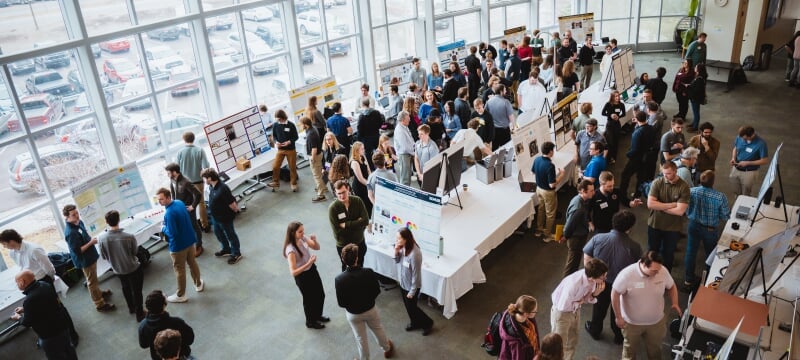
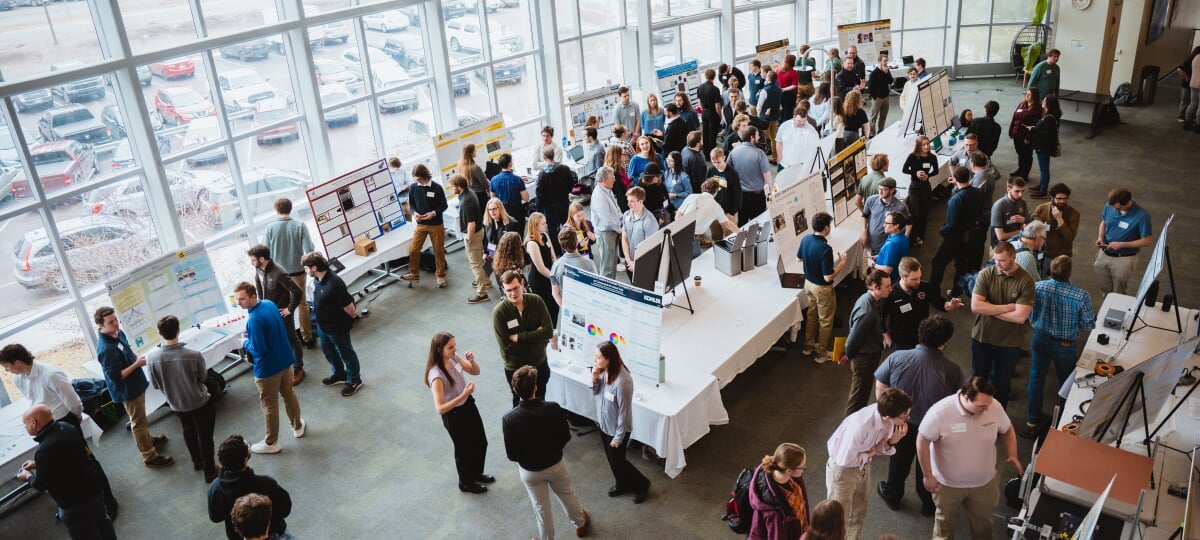
Last year, the Enterprise Program celebrated 25 years of excellence and innovation alongside Michigan Tech's Design Expo, the annual showcase event for both Enterprise and Senior Design teams. Continuing forward as a hallmark of the Michigan Tech experience, Enterprise has added three new teams: Aeronautics and Rocketry, Urban Intelligence Lab, and Ink & Ore.
Nagesh Hatti, Enterprise Program director, sees the continued growth as a natural progression as Enterprise continues to respond to both the industry demands and the educational resources students have come to expect.
"The emergence of Enterprise teams in areas like aeronautics, urban intelligence and the humanities highlights the breadth of experiential learning we offer," said Hatti. "Whether students are working on rockets, designing systems that support human interaction in complex environments, or creating literary work, they gain real-world, interdisciplinary skills aligned with today's industries."
"That continued relevance is why the Enterprise Program continues to grow and thrive after 26 years."
While the trio of teams are the newest players on the roster, all three are already proving their worth in international competitions and community engagement. Team members are pouring the well-known ingenuity of Michigan Tech Huskies into the hands-on creation of distinctive firsthand learning experiences. For Huskies on all three teams, that means participating in one-of-a-kind opportunities they've helped to build from the ground up.
AERE: A Long Time Coming
While the Aeronautics and Rocketry Enterprise (AERE) is only a year old, it has a much longer history on campus. Members of the Michigan Tech student organizations Keweenaw Rocket Range (KRR) and Society of Automotive Engineers (SAE) Aero initially joined forces to help secure more funding for national and international competitions.
During the fall 2024 semester, KRR member Jase Edwards, a junior studying computer science, along with five other students and their faculty advisor Kazuya Tajiri, an associate professor of mechanical and aerospace engineering, met weekly to lay the groundwork of what would eventually become the Enterprise team. AERE was officially founded in spring 2025. Since then, it's grown quickly.
"The idea of AERE has existed since before I was a student at Michigan Tech," said Edwards, AERE founder and program manager. "Even though this is only our third semester, we currently have over 65 members, making us one of the larger Enterprise teams."
With members from a range of degree programs, AERE pushes the boundaries of aerospace innovation. Members are involved in propulsion research, autonomous flight systems, and design and testing for rocketry and remote control aircraft. AERE consists of four teams: the High Powered Rocketry Team, Keweenaw Propulsion Lab, Husky Air and Project Theseus.
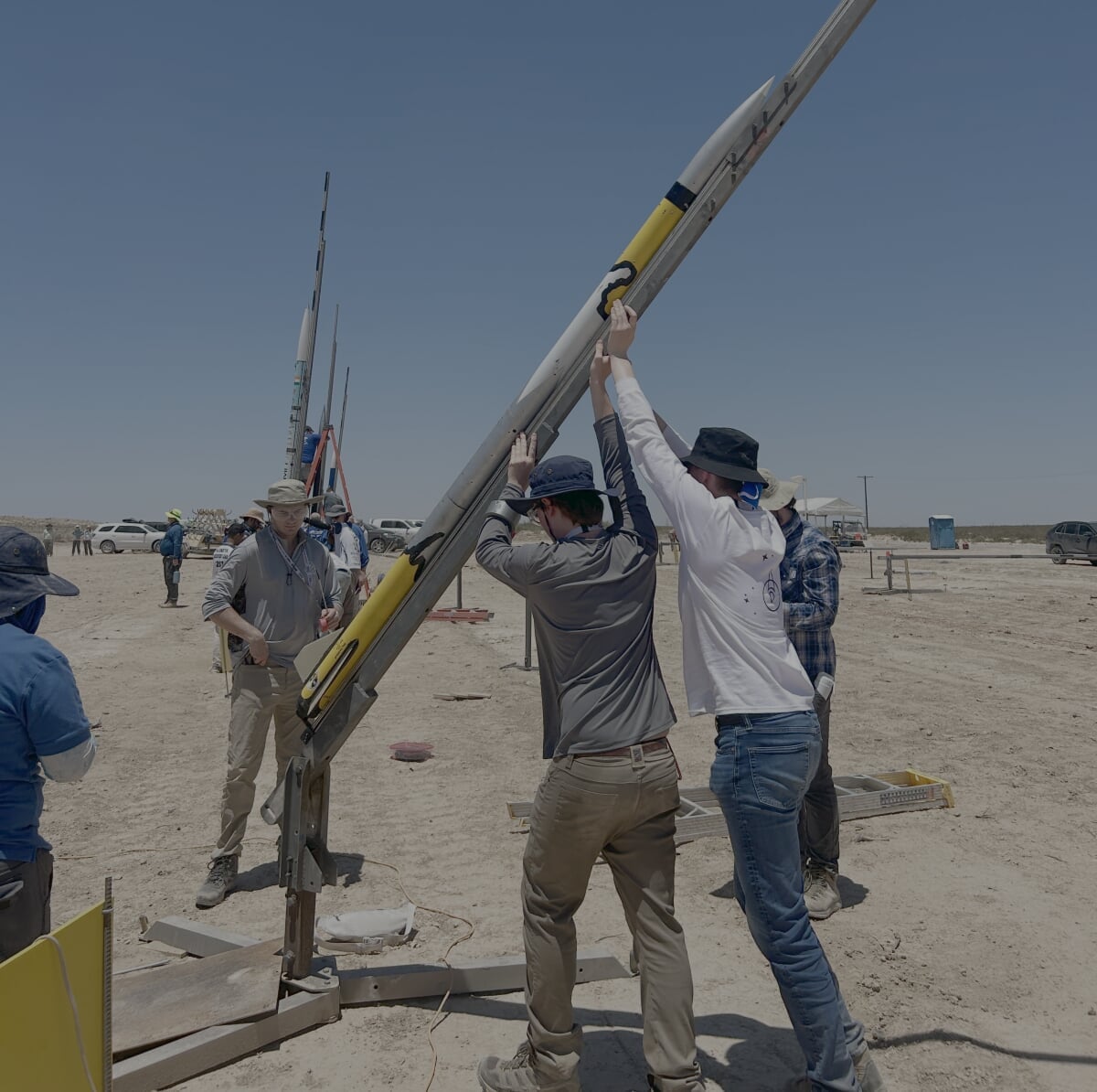
During their first semester of operation, AERE's High Powered Rocketry Team collaborated with KRR to compete in the 2025 International Rocket Engineering Competition (IREC), the world's largest rocket engineering competition. They placed in the top third of competitors in their IREC debut and will be competing again this June.
What was once Michigan Tech's SAE Aero club has now become Husky Air. This subteam continues to compete in the annual SAE Aero Design competition, where students design, build, test and fly large remote-controlled airplanes, gaining experience in the full engineering lifecycle. Before AERE's founding, Tech's SAE Aero team was nearly out of commission due to low membership, but Husky Air has continued to grow on the foundations of the former student organization. This year, they competed in the SAE Aero Design Regular Class competition with their 10-foot wingspan aircraft.
AERE's research arm consists of the Keweenaw Propulsion Lab, which is working on an open-source liquid rocket engine with a long term goal of propulsively landing a rocket. Project Theseus, the newest subteam, is developing drones in order to test autonomous flight in complex environments.
Edwards initially joined KRR and eventually AERE to apply their computing acumen in the aerospace field, an industry they hope to break into following graduation. Now, they are gaining new skills as a program manager.
"Last spring, I was chief engineer of the High Powered Rocketry Team," they said. "Now, as program manager, I oversee the entire Enterprise team and manage our operations and communications."
Edwards also feels a sense of responsibility for fellow Enterprise teammates. As AERE continues to grow rapidly, they are committed to keeping the heart of the team focused on experiential education.
"I see Enterprise as a place for students to learn rather than just succeed. I always tell the team leads that my first goal is safety, my second goal is that they learn something and my third goal is success."
Edwards said that while they miss some of the hands-on work that they've had to forego in order to lead the team, they're proud of how far AERE has come. "It feels nice to be in charge of something that has grown this much in such little time," they said. "I feel like a key cornerstone of this team."
Edwards hopes that AERE continues to grow. They're also looking forward to some cross-team collaboration in the future.
"What would be really nice to see would be for us to compete in multiple categories in the International Rocket Engineering Competition, potentially using a rocket engine developed by Keweenaw Propulsion Lab," they said. "It would be nice to see those two teams coming together to launch a completely in-house designed and built rocket."
While that goal may be a while off, Edwards is still thinking about safety first. "I'd want everything to be thoroughly tested before we do that," they said.
Urban Intelligence Lab: Tapping Into Local Data
With a growing focus on artificial intelligence (AI) and data science, both in industry and on Michigan Tech's campus, the new Urban Intelligence Lab Enterprise (UI Lab) is giving students the opportunity to connect people, data and cities to make communities more sustainable and resilient. Founded in fall 2025, the UI Lab started its work right here in the Keweenaw.
When data science junior Anna Tolles heard there was going to be a new Enterprise team focused on AI, she was immediately intrigued and reached out to the faculty advisor Gabriel Draughon, assistant teaching professor in the Department of Engineering Fundamentals.
"He sent me a lot of information. I read it all and was really interested!" she said. Tolles ended up being on campus over summer 2025, working with Summer Youth Programs, and had a hand in establishing the new Enterprise team.
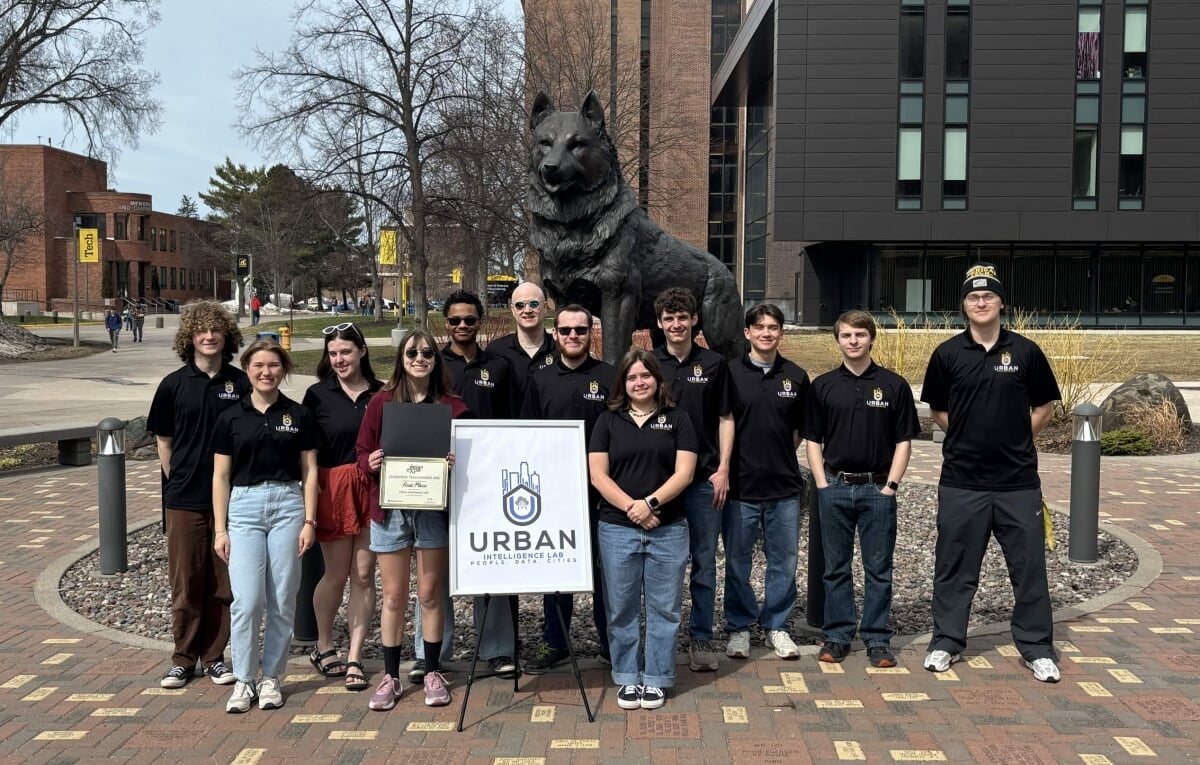
"I helped make the website and get things up and running," she said. "That's how I became president, because I was the one up here."
As UI Lab president, Tolles oversees the logistics of the Enterprise team, but still has the opportunity to work on team projects, all of which currently have a local focus.
Last fall, Tolles was working on the campus activity tracking project. Using computer vision from the William J. Bernard Jr. Family Clock Tower webcam stream, the project detects, tracks and maps how students move through campus and interact with its infrastructure. This project allows new UI Lab students to practice some of the skills necessary for other human-centered data projects.
"We made a 2D map out of a 3D space so the camera could understand what was happening," explained Tolles. "We know when we see someone far away that they aren't actually small and getting bigger as they approach, but the camera doesn't know that, so we try to make an aerial view so the camera can understand."
In just one academic year, UI Lab has expanded to new local projects, working with Tech's Great Lakes Research Center to track and classify vessels traveling through the Keweenaw Waterway and collaborating with Mont Ripley ski area to track skier use for potential improvements. Tolles is a member of the Mont Ripley winter sports team, which utilizes cameras in ways similar to the campus activity tracking project.
"With Mont Ripley, we are looking for what paths people use most, how many people are on the paths and in specific areas, which paths are faster than others and so on," said Tolles. "Our goal is to hopefully create a dashboard for the Mont Ripley staff to use to help predict how many people will be on the mountain at this time, based on weather, temperature, day of the week, etc. Down the line, we could be able to include crash detection to automatically flag ski patrol."
Their work has been recognized for its originality and promise, winning first place at this year's Design Expo Awards in the Enterprise Team category recognizing outstanding work.
Tolles said the rewards go beyond prizes to include valuable experience. She's personally gained skills in team building, technical communications and public speaking, and is helping other UI Lab team members do the same.
"Being a part of an Enterprise is really good professional development. That's essentially how I got my internships for this semester and this summer. Having projects under my belt and being able to talk about that work is impressive to hiring managers."
Being a new, small Enterprise team has its learning curve, but Tolles is eager to keep moving forward and see the team grow.
"We are a constantly developing Enterprise, so things are changing all the time," she said. "Anyone interested in data science in general would make a good fit, but we have members who study software engineering, civil engineering and even some mechanical and aerospace engineering members. We are open to anyone who is interested."
UI Lab's projects and local focus are expanding right along with membership. The team is currently working with the city of Houghton to use municipal street cameras for a future project. For Tolles, that growth means that UI Lab will continue to get better and better.
"We are running on minimal data right now just because we haven't had a super long time to collect it yet," she said. "I'm excited for us to have more data to work with and create predictive models for the future. The more data you have, the more accurate you will be at predicting things."
Ink & Ore: Telling Student Stories
Branching into new territory for the Enterprise Program, the Ink & Ore Enterprise is a student-run team of publishers, editors and communicators founded in fall 2025. Advised by Holly Hassel, professor of writing studies and director of the First-Year Writing Program, and M. Bartley Seigel, professor of humanities and director of the Michigan Tech Writing Center, the team currently oversees three student publications.
The Ink & Ore team manages the University's 105-year-old student-run newspaper, The Lode, as well as the newer publications Paw Prints: The Michigan Tech Journal of First-Year Writing and the literary magazine Kupari.
By combining both long-standing tradition and adding new publications to the campus culture, students test their writing, editing and communication skills, working directly with their peers. Paw Prints enables students across academic disciplines to publish their coursework as meaningful scholarship, while The Lode continues to foster a journalistic community of practice for the benefit of both student contributors and the campus community.
While The Lode and Paw Prints both predate the establishment of Ink & Ore, the team recently celebrated the debut of Kupari, which published its first issue of short stories, poetry and photographs from Michigan Tech students last month.
The debut issue features works by more than 10 students. As editors Max Meyer, Charles Driscoll and Kupari Lead Devin Palczewski noted in the introduction, "By creating a place to compile the endeavors of our student community, we aim to amplify their voices and inspire further creativity throughout Michigan Tech." In a year-end celebration, contributors and editors gathered to highlight this new kind of publishing experience for Tech students, who gain both useful feedback and bylines.
Open to all students across all majors, Ink & Ore is housed in the Department of Humanities. Continuing the legacy of the Enterprise Program's commitment to career readiness, students gain technical expertise in design, project management and rhetorical communication.
Through their various publications, Ink & Ore team members work directly with student authors to turn their ideas into articulate and thought-provoking articles and stories, all while promoting a richer, student-focused publishing culture on campus.
The successful launch of these three Enterprise teams opens up new avenues for discovery-based learning, helping to shape industry-ready Michigan Tech graduates.
Michigan Technological University is an R1 public research university founded in 1885 in Houghton, and is home to nearly 7,500 students from more than 60 countries around the world. Consistently ranked among the best universities in the country for return on investment, Michigan's flagship technological university offers more than 185 undergraduate and graduate degree programs in science, technology, engineering, mathematics, computing, forestry, business, health professions, robotics, psychology, social sciences, humanities, and the arts. The rural campus is situated just miles from Lake Superior in Michigan's Upper Peninsula, offering year-round opportunities for outdoor adventure.