In Michigan Tech's biology teaching lab, undergraduate students research potential cancer cures with help from the humble worm.
At Michigan Tech, undergraduate students join the quest for new cancer treatment under the guiding hand of Paul Goetsch, a biological sciences assistant professor focused on inspiring a passion for research. Many biological sciences students contribute to an ongoing research project through CUREs—Goetsch's course-based undergraduate research experiences. Though each CURE tackles its own line of inquiry, they are all part of larger research goals at Michigan Tech.
"In our lab, we aim to build a strong functional genomics pipeline from teaching lab to research, integrating CRISPR/Cas9 genome editing tools, high-throughput sequencing analysis, genetics, biochemistry, and cell biology," says Goetsch. "The main goal of the CURE is for students to gain an appreciation for scientific research and how it impacts them now and in the future."
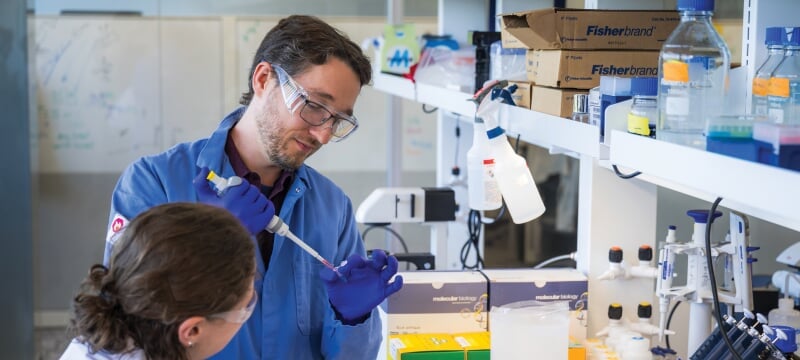
Goetsch's education-focused research approach is supported by a National Science Foundation CAREER Award. The CURE also helped earn him a William G. Jackson Center for Teaching and Learning innovative or out-of-class teaching award in 2025. His outside-the-box approach encourages students to pursue training that fits their career goals and provides an entry to authentic research. Students are set up in the lab in small groups, working directly with Goetsch or a graduate student to learn key techniques for their project. Goetsch guides students to first focus on one small, achievable goal that contributes to a piece of publishable work.
"The main goal of the undergraduate research experience is to learn how to ask good questions and figure out what is needed to start answering those questions."
"I work side by side with my students, sharing my own successes and my failures," says Goetsch. "Especially the failures, as one of the most important takeaways from research is that experiments don't always succeed."
In all of his CUREs, Goetsch focuses on helping undergraduates build the skills necessary to succeed as researchers.
Unlocking the Secrets of Cell Identity
The most successful project in Goetsch's teaching lab is the WormFood CURE, to which around 150 students have contributed since it started in 2021. The research is part of a wider question explored in the lab.
"Our primary goal is to understand what proteins play a role in the 'soma-to-germline transition' observed in cancer cells and how they may contribute to cancer development," says Goetsch.
Germ cells in sexually reproductive species are the cells that develop into eggs and sperm, and carry the ability to pass on genetic information from one generation to the next. Somatic cells are not involved in passing genetic information from one generation to the next, and normally follow a regulated cycle of growth, division, and death. When somatic cells become cancerous, they adopt properties often only seen in germ cells, including resistance to genomic stress.
"Ultimately, we're interested in understanding what machinery is turning on these germline genes, to understand how they contribute to cancer, but also in the hope of using this knowledge to develop early diagnostic methods for detecting tumors," says Goetsch.
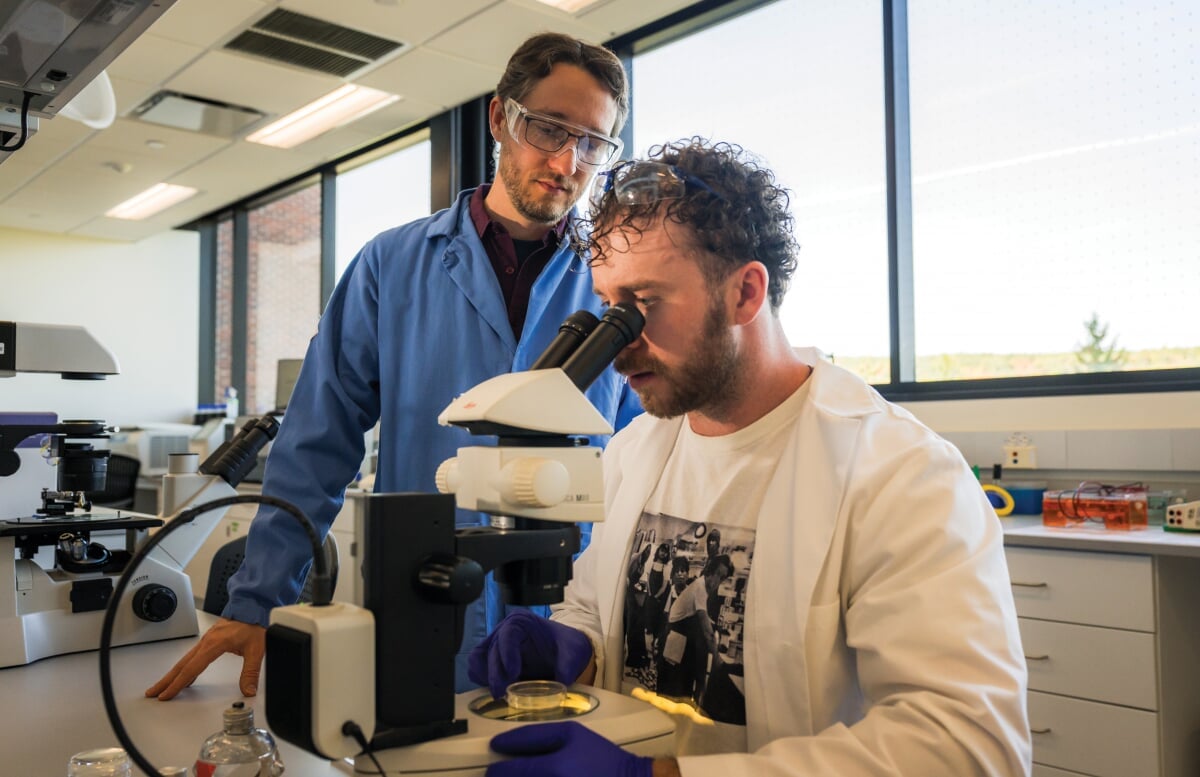
To dive further into these questions of cell identity, undergraduates need a little help from Caenorhabditis elegans, a soil nematode model organism commonly known as a roundworm. A teaching lab, Goetsch says, requires a simple but robust subject for data collection, making WormFood an excellent project for his CURE students. "Nothing is more robust than observing and counting worms under a microscope," says Goetsch.
Counting worms under a microscope might be an oversimplification of the methods Goetsch's students use to understand genetic pathways and cell identity. Students feed the C. elegans wild isolated bacteria and observe which bacteria suppress germ cell identity. This is identifiable using a classic genetic phenotype known as synthetic multivulval, or SynMuv. SynMuv results from the RAS/RAF pathway—a pathway overactivated in many human cancers. Bacteria that suppress SynMuv in the nematodes may contain a protein or molecule with the same suppressive impact on human cancer cells.
For Megan Guyer, a 2023 biochemistry and molecular biology alumna, the biggest takeaway from Goetsch's instruction in the WormFood CURE was good old-fashioned Husky tenacity.
"Many obstacles can arise when pursuing research, and my undergraduate research experience taught me how to overcome those obstacles and be resilient in pursuing important research questions," says Guyer.
Research from Goetsch's lab shows that about 10 percent of all tested bacterial isolates suppress the worm SynMuv phenotype. Goetsch and his students are hard at work seeking the small molecules, proteins, or potential drugs causing this observation. Their research has uncovered two species of bacteria in the Bacillus genus that produce a secondary metabolite, a potential drug that significantly suppresses SynMuv.
The lab's next step is identifying the metabolite and whether it is a novel drug—a multitiered problem with much work left to be done.
"Our results show an incredible proof of concept that we can use C. elegans and wild bacteria as a system for drug discovery," says Goetsch. "We expect that our system could be adapted to screen for a whole panel of important phenotypes associated with human health."
Undergrads Get Their Feet Wet in a Dry Lab
Goetsch invites his students into the realm of scientific discovery in both traditional and nontraditional research spaces. He emphasizes to his students how genetics research touches much of the biological and ecological research ongoing at Tech, and offers multiple avenues for them to get involved.
"I'm aware that not all students are interested in traditional wet lab, on-the-bench type research," says Goetsch. "In fact, much of my traditional research incorporates computational biology approaches that do not require working at the bench."
A wet lab is a laboratory involving hands-on experiments with physical substances, as opposed to a dry lab, which focuses on computational research. With emerging data science technology in mind, Goetsch has adapted and incorporated work from the national collaborative Genomics Education Partnership (GEP) to provide an alternative computational research track for students in the genetics dry lab. There, Huskies work together within a national CURE directed by the GEP to learn more about the structure of eukaryotic genes.
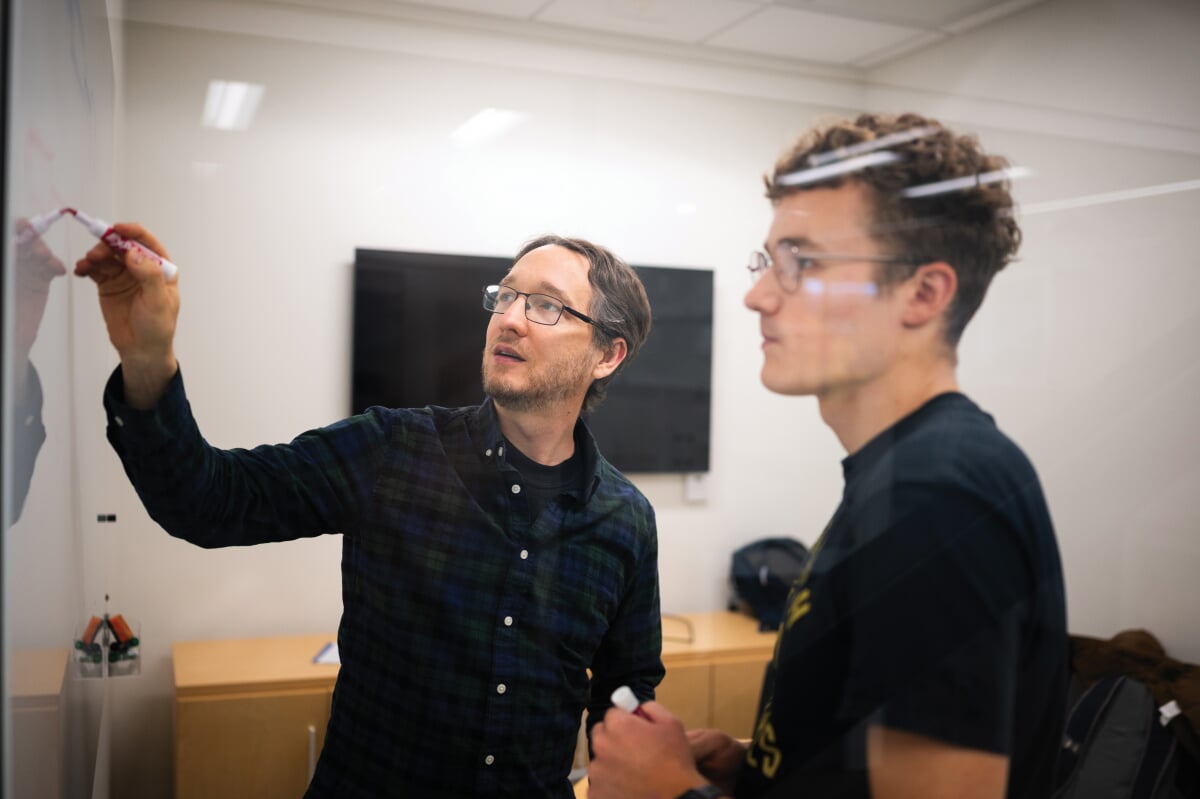
Connor Donahue, a 2025 computational biology graduate, was part of the Goetsch lab data science team studying the evolutionary conservation of the DREAM complex—a protein complex that represses genes related to cell cycle progression and cell reproduction. The data science team combines and curates databases of nucleotide and protein sequences, storing them in one place to more efficiently identify DREAM-related genes and measure changes in protein-coding genes.
"It has been eye-opening to not only see how scientific research is conducted, but also to play an active role in it," says Donahue. "This research, in particular, has given me an appreciation for the diversity of life in the animal kingdom and how important proteins will prevail throughout evolutionary history despite the genomic landscape being constantly in flux."
Donahue's initial interest in research came from reading books by popular scientists before he enrolled at Tech. Getting involved with the Goetsch lab, Donahue says, has taught him the diligence and curiosity necessary to all researchers.
"I've found that research is both daunting and exciting because it breaks free from the constrictive format of a guided worksheet or homework assignment," says Donahue. "Dr. Goetsch is very eager to incorporate undergraduates into his lab. He has a passion for research that is evident in both his course instruction and his projects."
Mentoring the Next Generation of Researchers
In addition to teaching, Goetsch has mentored more than 40 students in his lab, including Guyer. She worked on several CURE projects as a student, including WormFood and the DREAM complex, and completed a SURF—a Summer Undergraduate Research Fellowship—under Goetsch's guidance. Her research in his lab used live microscopy of C. elegans and fluorescent reporter proteins to observe the nematodes' responses to different bacterial strains in real time.
"I was always excited by the idea that different bacterial strains could suppress the SynMuv phenotype, thus potentially elucidating how bacterial metabolites could lead to tumor suppression," says Guyer. "These sorts of ideas got me really excited about studying cell fate and identity."
"My undergraduate research experience was very collaborative. I became friends with a lot of my lab mates."
Her excitement led her from one research opportunity to another, encouraged at each step of her journey by Goetsch's passion for student research. Guyer credits her undergraduate research experience in Goetsch's lab for her decision to pursue a PhD in Genetics at the University of Wisconsin-Madison. She also thanks Goetsch's encouragement for helping her earn a National Science Foundation Graduate Research Fellowship.
"Dr. Goetsch was a great mentor to me," says Guyer. "During my SURF experience, he pushed me to be more independent in my project, which was initially scary but turned out to be exactly what I needed. He supported me in pursuing opportunities at Tech and beyond."
This kind of infatuation with research is exactly what Goetsch strives to inspire in his lab. The most exciting part of working with undergraduates, Goetsch says, is when they head down their own research rabbit holes.
"I know the process works when the students start asking questions and head off in their own directions," says Goetsch. "That's what got me into research, and it's fun when the same spark is lit in up-and-coming researchers. It's everything I would have liked to do as an undergraduate."
Michigan Technological University is an R1 public research university founded in 1885 in Houghton, and is home to nearly 7,500 students from more than 60 countries around the world. Consistently ranked among the best universities in the country for return on investment, Michigan's flagship technological university offers more than 185 undergraduate and graduate degree programs in science, technology, engineering, mathematics, computing, forestry, business, health professions, robotics, psychology, social sciences, humanities, and the arts. The rural campus is situated just miles from Lake Superior in Michigan's Upper Peninsula, offering year-round opportunities for outdoor adventure.