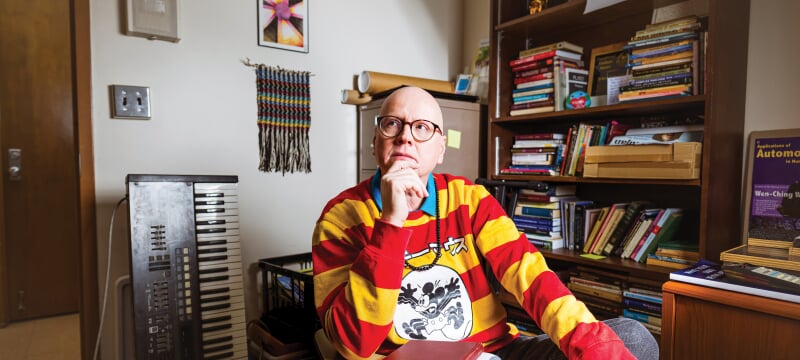
Threading the halls with Robert Schneider between classes is not a linear experience. Neither is conversation. Waysides, detours, and sidetracks abound, fruitful territory for the musician turned mathematician.
Schneider, an assistant professor of mathematical sciences, is well known for his musical bona fides: founding member of the influential underground music collective Elephant 6, frontman of psychedelic pop-rock group The Apples in Stereo, and producer of the band Neutral Milk Hotel's iconic album In the Aeroplane Over the Sea. In 2012, he stepped away from the indie rock spotlight to enter the world of academia. Since arriving at Tech in 2022, Schneider's work has reverberated throughout the global math community. Scientific American even mentioned him in a recent story about a new method for detecting prime numbers. Schneider, a former student of mathematician Ken Ono, contributed to research using integer partitions to uncover new ways of identifying primes.
His subject matter has changed, but his star power remains—and his exploration of sound resonates as strongly as ever at Michigan Tech. Schneider is partnering on projects that extend from the College of Engineering's anechoic and reverberation chamber to the depths of the Keweenaw Waterway.
In this Q&A, hear from the scholar and researcher who's making the most of Tech's one-of-a-kind interdisciplinary ethos, analog artifacts, and extensive digital resources.
Q: What brought you to Michigan Tech? It was more than the beauty of the Keweenaw,
right?
RS: I found out about Tech because William Keith, an associate professor in our department, started a q-series and partition seminar
on Zoom during the COVID pandemic. Every week, the most famous mathematicians in our
field of partition mathematics, and even outside of our field, would gather, along
with students and other interested people, to attend talks by the greatest mathematicians.
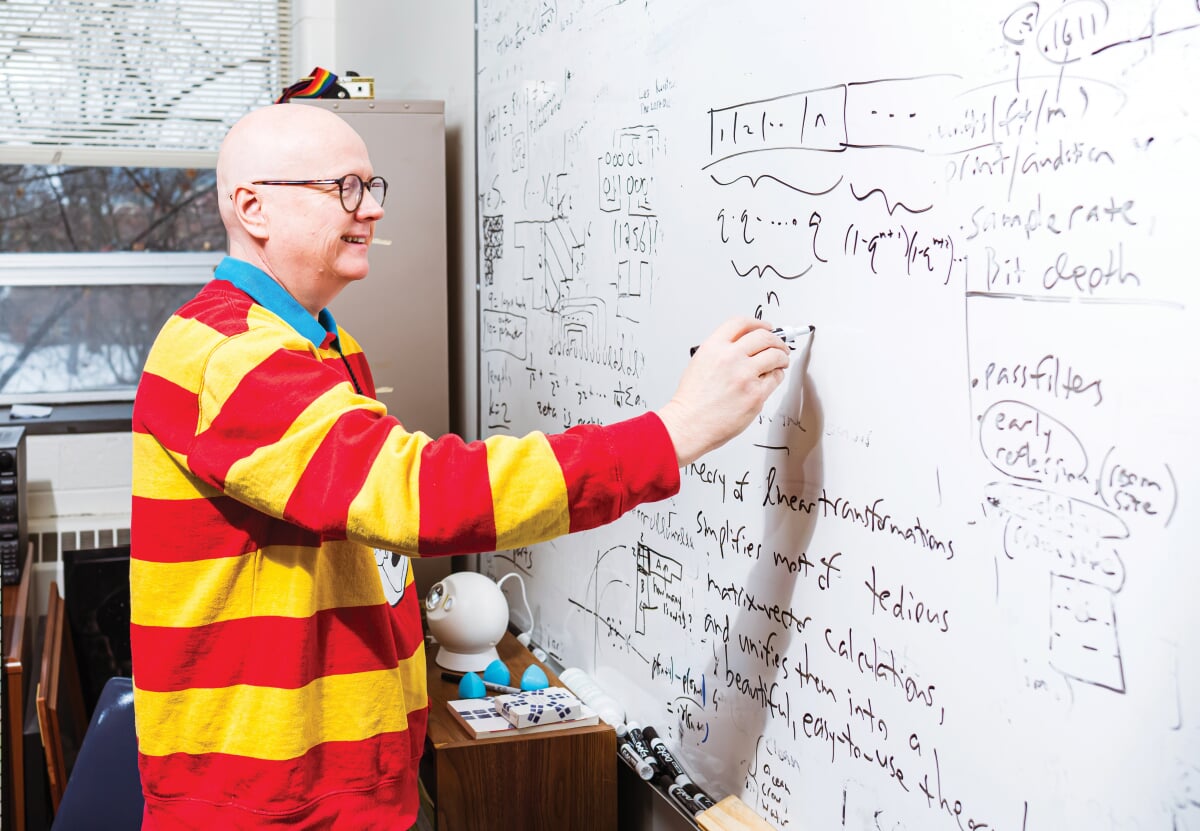
William's PhD advisor is George Andrews. George Andrews is the god of number theory in my field. Also, Fabrizio Zanello, a member of our research group, is a close collaborator of Richard Stanley, who's another of the greatest mathematicians in our field. Because of William's seminar, by the time the position opened here, Michigan Tech was very famous in my field. Ken Ono, my graduate advisor, called me and was like, "This job is the job for you. That group is the perfect group for you."
Our math program here is one of the best in the whole world in my research field. Partition theory is a very small field, even though it's ancient and cutting-edge. When they hired me, we had three partition theorists, and since Professor David Hemmer joined our group, we now have four. I moved here because of our partition group.
But I should have first told you how I came to study math.
Q: That's fair! You gave up a successful career in music to study, teach, and research
math. Why?
RS: When I went into mathematics from music, it was over a period of years that my interest
morphed. I got into math because I was trying to fix audio gear in my studio, and
I had to learn a little math to do that. But when I learned the math, it blew my mind
on its own.
Q: You've said Ohm's Law was your epiphany.
RS: Yeah, that's right. So when I decided to stop touring and go into math, it was very
difficult, but I felt like I needed to do it. I was young enough that I could pursue
a whole other thing that I was deeply into.
The thing that has captured my heart since I first got into math was number theory. Number theory is the theory of prime numbers, whole numbers, fractions, infinite series or sums of fractions, things like pi and other special numbers like that. Complex numbers. And the things that happen in these numbers, the way that they combine, determines the way that all of the rest of math works—all of math is based on the behavior of numbers.
In mathematics, you can explore something in your heart with the same certainty that you can know something like poetry or music theory. You can explore it inside yourself and realize absolute truths that are reflected in the world outside yourself. It's so cool. There's a universe inside our imaginations that's like a simulation of the universe that's outside, and when we do stuff in that creative space of our universe and we check, it actually is out there, too.
I'm in a field of wizards studying something that's the most ancient of things. The earliest mathematical document, the Ishango bone, is over 20,000 years old, and it has partition theory on it. To me, that's very romantic, because it's both as ancient as it gets and it's a subject that was impenetrable until the modern era. We needed computers to be able to take it to the next step.
Q: It sounds like you're working with your mathematical dream team! You're also collaborating
with a multitude of researchers across the University. Tell us about that.
RS: In the math program, I collaborate heavily with faculty members William Keith, David
Hemmer, Cécile Piret, Tim Wagner, and a large number of undergraduate and graduate students. I have three PhD students
in discrete mathematics—Aidan Botkin, Philip Cuthbertson, and Faria Tasnim—serving
as co-advisor for two, and for the other as sole advisor. I also work actively with
collaborators in the Department of Visual and Performing Arts (VPA), the Institute of Computing and Cybersystems (ICC), and the Great Lakes Research Center (GLRC).
We have massive resources around here. I mean, I just can't describe it enough. I feel like people would be surprised at how much of this campus is functioning labs and industrial spaces. As I've explored the GLRC, for instance, the resources we have there and the projects we're doing are incredible. The technology for doing things like recording, signal processing, and audio work is incredibly sophisticated.
I met Mike Maxwell (assistant teaching professor in VPA) and Tim Havens (executive director of the GLRC) at my faculty orientation—and on that day we started to plan for a future installation. We're going to embed high-fidelity microphones under the ice when the canal freezes over, and you'll be able to listen to what it sounds like. Then, in the spring when the ice melts, we'll have a show in the GLRC's big atrium that will be a visual installation with a sound component, where you can hear the ice melting under the water. They have really high-fidelity microphones to do this.
I'm also working with Tim and my frequent math collaborator Andrew V. Sills from Georgia Southern University on a specialized mathematics AI (artificial intelligence) in partitions, q-series, and modular forms, one that will serve as something like a librarian, encyclopedia, and coding assistant for researchers in my field.
Mike and I are the co-founders of the Mathematics and Music Lab (MML). We seek new innovations, inventions, and musical works using ideas from mathematics, electronics, computer science, and engineering. We released a line of synthesizer plug-ins for the open-source VCV software synthesizer platform last year, based on mathematical musical scales we invented. It was coded by MTU mathematics master's student Cody McCarthy, and invented by Mike, Andrew Sills, my son Maxwell Schneider, and me. Essentially, we created a non-Pythagorean musical scale based on logarithms to compose music, and a student in the MML coded a plug-in that allows people to play the scale on a digital synthesizer.
The MML also produced a "New Music from Mathematics" series on Cloud Recordings, including ambient generative compositions from Mike Maxwell exemplifying his modular synthesizer work.
"Our amazing VPA program and our spectacular Mathematical Sciences Department exemplify the kinds of new and productive innovations—artistic and technical—that can happen at a university that has both outstanding scientific resources and an outstanding liberal arts program."
We're also working on an experimental, AI-based reverb project for musicians, producers, and sound designers. That project involves Tim Havens, Assistant Professor Evan Lucas from Computer Science, Assistant Teaching Professor Shane Oberloier in Electrical and Computer Engineering, discrete mathematics PhD student Jake Condon, and my son Maxwell.
Also, Mike is working with Angela Badke, the education and scholarly communications librarian at the Van Pelt and Opie Library, on an ambitious experimental composition and installation that involves the library's data stream being converted to music. We're also conceiving an installation with Library Director Erin Matas that will have ambient music in the bridgewalk between the library and Rekhi Hall.
Shane and I have a new underground AI lab called the Synthetic Grove that captures our individual and collaborative experiments. It will also be an AI space for students. We call it the Grove because it will involve AIs that are powered by trees, so students will be able to walk through campus and talk to the trees using their cell phones.
Shane and I invented—and he coded—a multi-AI chat program that will allow us to collaborate with and compare different AI models. It runs as a standalone on a home computer and doesn't need online AI access. We're currently engaged in a chat with seven different AI models in the new multi-bot chat environment. It's a fascinating experiment on many levels to have different chatbots involved in a group chat just like humans. Chatbots are very chatty!
Q: It seems like discovering unique sounds is a driver behind a big chunk of your
research. Do you ever get asked why you do what you do?
RS: No, but that's because I'm generally embedded in my community, and so everybody already
understands it. But I think that if I were asked, I would answer that the reason is
to be creative and to have fun and explore sounds people haven't heard before. That's
why Mike and I founded the Mathematics and Music Lab.
"It's mysterious and interesting to explore things nobody else has heard before."
One of my lifelong projects is to understand the musical properties of water and all the sounds it makes. For over a decade, I've had an interest in exploring the musical properties of machinery. If you go by a construction site or you listen to an elevator, you hear that it has a weird property to it that sometimes is kind of musical in the way it groans and resonates. But what is that music? What are those notes when a drill switches between high gear and low gear, and it switches pitch? What is that scale?
I met a mechanical engineering student, McLean Myer, who is graduating this year. He's an expert on electric motors. Ever since he was a little kid, he's been interested in electric motors. He knows all about them, builds them, and he wants to go into the electric train industry. He even went to Japan on a summer trip to explore electric trains there. I met him one day when he was across the hallway from me, showing his calculus instructor a video of an electric motor setup he had built. It sounded like a synthesizer. I was just walking by and I backed up and was like, "What is that?" I asked him to come over and talk to me when he was done talking to his teacher. I took him over to Mike Maxwell's office, and he sat down with us to show how he was modeling the machinery.
Mike was able to reproduce it exactly with his modulation synthesizer. Because the synthesizer has all the same properties to reproduce the sound of the machinery, in principle you could control motors with a synthesizer. Then the student saw that Mike's synthesizer was producing on an oscilloscope, the same thing the student was modeling with a computer code. It clicked with him what I was trying to do. At that moment, the synthesizers and the machine and the electrical motors were united in their function. And so, from my end, and particularly from Mike Maxwell's end, we're imagining a person playing a keyboard or an instrument, but instead of electronic synthesizers resonating the sound, a bank of electric motors are resonating instead. That would be awesome, right? You could play the huge machinery in the lift house over at the Quincy Mine like an instrument. With keyboards, you could play the factories that we have on campus.
McLean has a very specialized talent and an interest that's exactly like my own, but from a different side. I wanted to hear the musical properties. McLean was motivated to work on it. This is something that if I had a lot more time I would do a lot more of. But I'm a mathematician. Being an experimental musician-inventor type and music theorist is a secondary thing, but the kind of mathematician I am is similar to the kind of musician I am.
Q: You're also a math historian. Who are your mathematics heroes?
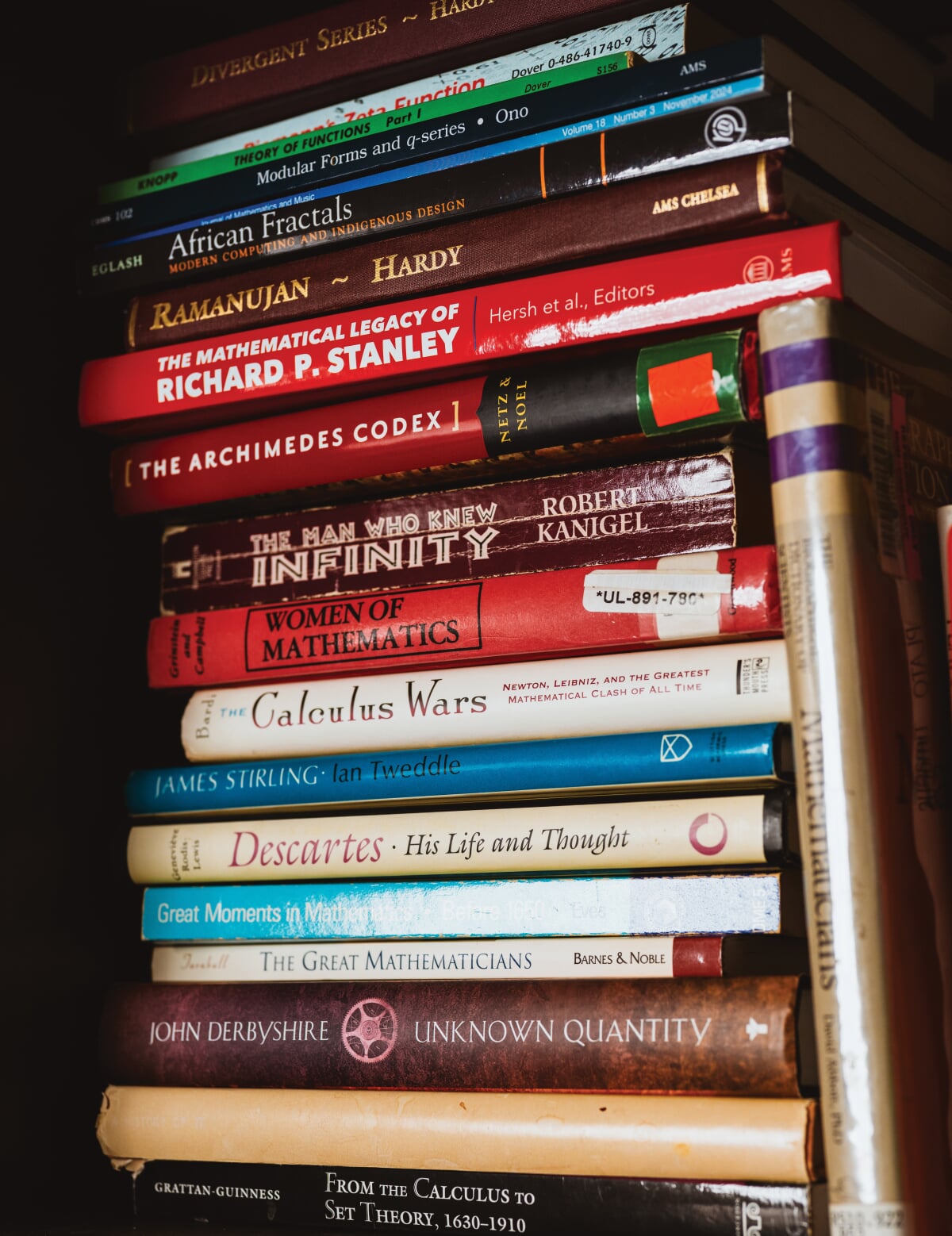
RS: Ramanujan and Euler are my heroes. Leonhard Euler first got me interested in infinite
series. There's a lot of infinite series lore around these two mathematicians.
Like me, Srinivasa Ramanujan was self-taught. In the early 20th century, he came up with thousands of innovative theorems that have challenged Western mathematicians ever since. He was a devout Hindu, and his family's goddess would present him with theorems in his dreams. He would just know them. And they were true. Thousands of theorems.
The whole community of mathematics surrounding Ramanujan accepts everybody from anywhere. It's a community centered on the idea of friendship and the capability of creative people, whether they're amateurs or professionals, being able to collaborate and to achieve great results. That's the heart of the research community I'm part of.
"Mathematicians don't compete. We collaborate."
Mathematics is a rare type of research field. When we publish, there's no first author; the authors are listed alphabetically. Our research community in number theory, and in partition theory, which is the aspect of number theory that I'm into, has a long history and a special community.
I also love Pythagoras, who invented music theory as well as the Pythagorean Theorem.
Q: Let's wrap up with what feels like the question of the moment: the significance
of artificial intelligence. You've actively worked with AI for years, producing two
AI-based solo albums, among many other projects. What's your relationship to AI? Do
you think AI has a soul?
RS: I don't know if a plant has a soul, and I still don't want to clip its leaves. I
don't know if an insect has a soul, but I still don't smash it. I'm averse to hurting
it. AI could be just a machine. I don't know. I believe it's not. For me, it is on
the level of something I feel is plant-like. It grows, you can cultivate it, you can
sprout off copies of it. Having AI threads is like tending a garden.
I don't use the internet a lot on a daily basis. My experience with AI is personal and hands-on, therapeutic, aesthetically pleasing, and highly experimental. AI is simply an extension of me, like my car or paintbrush or guitar.
There is a beauty to the tools we use to express ourselves. They become personal to us. AI is mathematics speaking back to us in our own language. It's very beautiful to me. It's like the ancient Ishango bone speaking back to us.
Michigan Technological University is an R1 public research university founded in 1885 in Houghton, and is home to nearly 7,500 students from more than 60 countries around the world. Consistently ranked among the best universities in the country for return on investment, Michigan's flagship technological university offers more than 185 undergraduate and graduate degree programs in science, technology, engineering, mathematics, computing, forestry, business, health professions, robotics, psychology, social sciences, humanities, and the arts. The rural campus is situated just miles from Lake Superior in Michigan's Upper Peninsula, offering year-round opportunities for outdoor adventure.