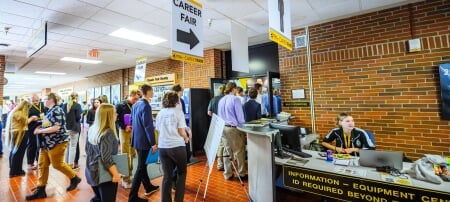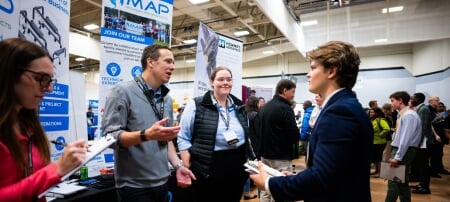

Today, Handshake is the career app of choice for every Fortune 500 company, every Ivy League school, and 92 percent of the nation's top-ranked colleges and universities. Valued at $3.5 billion, the company is leading the revolution in connecting talent with employers in the artificial intelligence economy. Fifteen years ago, Handshake was just an idea that no one believed would work—no one except its three visionary founders, who were students at Michigan Tech.
Despite his longtime love for computing, Garrett Lord '14 has never been one for sitting still.
Lord was raised in Bloomfield Hills, Michigan, in an active, sports-oriented family focused on achievement. He played hockey and baseball. He skied, hung out with his cousins, and attended the Woodward Dream Cruise classic car show every summer with his grandpa. Among his many activities and passions, computers took precedence from a young age. He was, by his own estimation, "a super nerd"—so much so that when the Birmingham School District first introduced computers to the classroom, Lord had to show the teacher how to set them up.
After high school, Lord was expected to pay for college himself, so he continued his education with part-time studies at Oakland Community College while running an IT business on the side. It wasn't long before his aptitude and ambition pushed him toward a four-year university. He chose Michigan Tech because the University had an intriguing computer science program and was known to be outdoorsy.
True to character, when Lord got to campus, he dove right in.
In his first year at Tech, he signed up for a full load of courses and continued working his IT side gig to pay for school, dumpster diving on campus to source parts. He joined Mont Ripley Ski Patrol and played broomball. He carried his skates and stick to class and played hockey between and after classes. He joined an outdoor adventure group, where he met fellow computer science nerd Ben Christensen '14, from Howell, Michigan.
Together, Christensen and Lord supplemented their studies with driving down backwoods roads, exploring old copper mining sites, and discovering the Keweenaw. Like many other externally motivated computing majors on campus, they also joined ITOxygen, a student-run Enterprise team that works on information technology projects with national labs, private companies, and other real-world clients.
"I really liked that school was hard, I liked being outside, and I loved Enterprise," Lord says. "I was very involved. I mean, I was really pushing hard, but I loved it all. I was leading."
Lord capped off his first year by landing a high-performance computing fellowship at Los Alamos National Laboratory. Working alongside postdoctoral researchers and other students with advanced degrees built his self-confidence and opened his eyes to possibilities previously unimagined.
In his second year at Tech, Lord searched for internships in Silicon Valley, setting his sights on the hardest ones to land. Palantir Technologies, then the valley's data-mining start-up darling, topped the rankings. He read an article by Palantir's current chief technology officer and executive vice president, Shyam Sankar, that described the altruistic aspects of the technology economy. Lord loved the idea of developing products and services that could be used for good.
"It sounds so nerdy nowadays, but Sankar talked about technology and software engineers being heroes, making an impact on the world," Lord says.
The combination of mission and prestige cemented Lord's decision to shoot for a Palantir internship. Between classes and his growing list of extracurricular activities, he persistently emailed recruiters, selling what he had to offer: brains, guts, and the willingness to do whatever was needed to succeed. "I was randomly connecting, and hoping to break in," he says.
Eventually, it worked. His email campaign snared him an interview with Palantir for a spot as a forward-deployed engineering intern based in Washington, DC. Palantir flew him out for the interview and picked him up at the airport in a fancy town car—two things he had never imagined a company might do for a job candidate, much less an internship candidate.
"When I told my dad, he said, 'Wow, this nerd stuff is really paying off,'" Lord recalls.
He was nervous about his first Silicon Valley interview—and for his dream internship, no less—but he says he also felt confident.
"I'm pretty competitive, I've always been very passionate, and this was my shot," says Lord. "I made it clear in the interview that this was a dream opportunity."
He nailed the interview and landed the internship. Soon he was rubbing shoulders with the pedigreed pack: top students from the best-known schools.
"These kids were just absolute gunners. They were starting companies, and I was like, 'Sweet, are you shoveling snow, mowing lawns, raking leaves?'" Lord says. "And they were like, 'No, I'm dropping out of school to raise money from venture capital.' It was just earth-shattering. I had never heard of that before."
Lord was a long way from Bloomfield Hills, and even farther from Houghton—and suddenly he felt like it.
"To be honest, I felt pretty intimidated," Lord says. "I felt vulnerable. People were talking about geopolitics and their summers in Europe, and I was like, 'Holy moly, maybe I'm not smart enough to be here.'"
But once again, Lord's doggedness prevailed. He soaked up every mentorship, friendship, and educational opportunity he could that summer. He made long-term connections and trusted friends. He even won the company's annual summer hackathon. That's when he realized his presence at Palantir was no fluke. He hadn't just crashed the party. He belonged there.
Aside from Palantir paying him a salary he felt was absurdly lucrative, the company also offered him $5,000 for every friend he referred to them. He couldn't believe it. His classes at Michigan Tech and his ITOxygen Enterprise team were full of talented computer science (CS) majors. Lord knew dozens of them—and he couldn't understand how companies like Palantir weren't able to find them without a referral.
"I thought to myself, 'How come they can't reach us?'" Lord recalls.
It was a simple question, one with the perfect balance of altruism and challenge at its heart. From it came the idea that would fundamentally change the way today's college graduates launch their careers.
Before long, the question had become a problem, and the problem an idea: If companies weren't able to reach the talent, then the three Huskies would build an app to connect students, alumni, and employers across a broader network than ever before, assisted by their universities and unhindered by location.
Armed with a new awareness of what was possible, Lord returned to Michigan Tech for his junior year with a mission. He shared the lessons he'd learned at Palantir with his ITOxygen Enterprise team—how to break into Big Tech, how to run a hackathon, and why everyone should be working on side projects. He watched the now-classic "CS183: Startup," a lecture series on successful start-up company formation developed by Palantir co-founder and thought leader Peter Thiel. He read voraciously about venture capital and the ABCs of series funding.
His drive was animated by his own frustration with the job search process. The traditional spray-and-pray means of finding a first job—cold calls and emails, job fairs, static postings on job boards—left too many students and employers out of the equation. Dedicated career services offices at schools like Michigan Tech were working hard to help students get hired, but staff and alumni only have connections at so many companies, and individual recruiters can only attend so many fairs a year.
Lord felt that there had to be a better way to get Huskies—and other talented young professionals around the country—on the radar of any employer they wanted to pursue. If the playing field wasn't level for an ambitious student at Michigan Tech, Lord knew it sure as heck wasn't helping other gifted college students across the nation, let alone the companies that could benefit from their talent.
Lord gave the question room to grow. He talked it over with Christensen and another ITOxygen team member: software engineering major Scott Ringwelski '14 from Traverse City, Michigan, whose work on a large open-source project both he and Christensen had admired from afar.
"Scott was the smartest person in all our CS classes," Christensen says.
Lord agrees. "Scott was one of the best software engineers on campus," he says. "He had quite a bit of lore around him in the CS department. He was really legit."
Before long, the question had become a problem, and the problem an idea: If companies weren't able to reach the talent, then the three Huskies would build an app to connect students, alumni, and employers across a broader network than ever before, assisted by their universities and unhindered by location.
"We were engineers working on cool problems," Lord remembers. "I thought, 'This is a problem. Maybe we start a company to try to make it easier for students to find internships and jobs and help kids like us.'"
Thus began long hours of brainstorming and coding in the Van Pelt and Opie Library, fueled by countless boxes of Domino's $8 large three-topping pizzas and bookended with skiing, broomball, mountain biking, and sweating off stress on the campus sauna circuit.
Lord, who had a second Palantir internship awaiting him in New York City the next summer, remained obsessed with answering the question that had dogged him since his first internship. He knew that finding the answer required learning everything possible about the problem from all perspectives.
"We understood the student problem," he says. "We didn't understand the university and employer problem enough."
They didn't have to go far to start learning what they needed to know.
"We went to Michigan Tech's Career Fair and said to recruiters, 'Hey, I'm already set for an internship next summer. I just want to talk to you about how you do college recruiting,'" Lord recalls.
After Trojan-horsing Tech's event, Lord, Christensen, and Ringwelski took to the road. Sometimes all three of them would pile into Lord's unreliable Jeep and drive to college career fairs across the Upper Midwest. More often, Ringwelski would stay behind to keep building the product, assisted by a team of fellow computer nerds they'd assembled to work on the project. On some trips, the Jeep broke down, costing them precious hours and invaluable gas and pizza money.
Back at Tech, they attended Career Services info sessions whenever they could, and spent hours in MTU's Career Center in marathon conversations with staff members like Jim Desrochers. Now the University's director of employer relations, Desrochers recalls the trio's willingness to understand programs and find efficient ways to solve them.
"From the day I met them, Garrett, Ben, and Scott have operated as a true team," Desrochers says. "They have a remarkable ability to identify problems, analyze their root causes, and collaborate to generate innovative solutions. Together, they approach challenges with both creativity and discipline, developing a range of thoughtful, well-considered options."
The technical aspects of software design and coding were the least of the trio's worries—and Desrochers', too.
"I was never concerned about their ability to make the software work," he says. "My greater curiosity was how they would navigate the business side: securing capital, growing a company, marketing a product, and building a sustainable enterprise. They approached those challenges with the same analytical mindset and determination, seeking out coaching and expert advice whenever needed, and quickly applying what they learned."
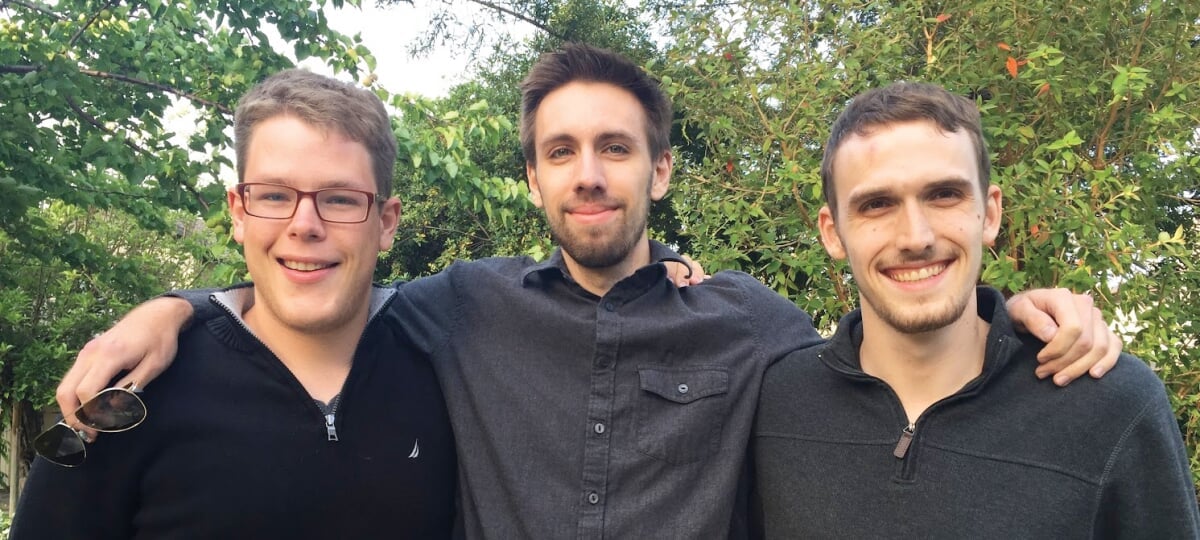
By the end of their junior year at Tech, Lord, Christensen, and Ringwelski were bringing the concepts for both their company and software into focus. A good friend, one of the students in the group that served as the project's ad hoc advisory board and support system, came up with a name for the business.
"Originally, we had called it Trajectory. Too long and complicated," Christensen says. "Once we heard Handshake, it was such an obvious choice. So much often starts with a handshake: learning about new roles and pathways, and meeting people who might make a huge impact in your life—an employer, a mentor, a peer."
A $700-per-month rental house at the corner of Fourth Street and West South Avenue in West Houghton became Handshake's first headquarters, conveniently located just up the hill from the B&B Bar, home of the best pickled eggs in town.
"There was a fairly large hole where a basement window was supposed to be," Ringwelski says. "It got pretty cold during the winter."
All that was left was the hard part: getting people to buy into the idea.
The formula for making that happen was brutal but simple: pile hard days one upon the other, make small gains, and keep the faith until the breakthrough arrives.
"It's been my philosophy since day one that we'll get where we want to go by stacking days—putting in the best effort you can every day, and then waking up to do it again the next day," Lord says. "This is how we approach building our product, too. Stacking wins day after day to hit goals that feel unthinkably big in the beginning."
For Lord, in the spring semester of 2013, stacking days meant spending every minute of every free workday cold-calling recruiters and universities around the country, pitching his big idea. All those hours and all those phone calls added up to one thing: rejection after rejection after rejection.
During those days, the only person to believe in the Handshake vision was Lord's dad. He cashed in his retirement savings and became the first to invest in the company. His support kept the dream alive, but also ratcheted up the pressure to succeed.
Then, between junior and senior year, it felt to Lord like the message was finally breaking through. People were listening. They were also sharing their pain points and wish lists.
"That's when we really started to put together a world and an idea for what Handshake could be," Lord says. Central to the vision was flipping the traditional job search platform on its head, starting with the primary customer. "Other platforms were designed for career centers. We decided Handshake would be built for students."
If Lord was driven by the challenge of solving a problem to help others, Ringwelski was driven by the technical challenge of the project. He wanted to use everything he'd learned to define the architecture, process, and approach for a brand-new piece of software precisely the way he thought was best. While Lord was in New York City for his second stint with Palantir, Ringwelski interned with a start-up in Silicon Valley. He lived in what he calls a "hacker home" full of a dozen other dreamers doing the same things he was doing.
"I basically spent that summer doing only three things," he recalls. "One, the internship during the day. Two, a run after work. Three, I'd work on Handshake from seven to 11 at night, every night. Being in Silicon Valley and building a new company, even during late hours after work, was living the dream."
Christensen was invested in the Handshake idea, too, but he had other opportunities and commitments that weighed on him.
"My other option was this super cool cybersecurity role at a Michigan company," he says. "Also, my partner at the time had a full-time job in Wisconsin, and needing to be away from each other a lot was a huge sacrifice to think through. It's a really huge commitment to start a company. I had to feel like we were all fully committed to it and wouldn't just give up at the first challenge or point of friction, and that we'd have each other's backs."
By the time they arrived back in Houghton for their senior year, it was clear to all of them that a choice had to be made: commit or quit.
"Once I felt like I understood what life would look like as a co-founder building a business, and felt like we were all fully invested, it was an easy decision," Christensen says. "We told each other that we'd give it three years. If we didn't have five schools signed up within three years, we could give up."
Christensen agrees that the support of their shared vision and friendship was key. "If one of us was feeling crushed by rejection or a tough week, another was seeing possibility and pulling us forward. That dynamic meant no single rejection or setback could break us, because someone else was always holding the bigger vision."
That fall, the mobile-first Handshake app was ready. It was once again time to hit the road.
Lord and Christensen set out in Lord's "new" wheels: a blue Ford Focus donated to the cause by Lord's dad. It had been through a couple of rollovers, but the price was right, the gas mileage was reasonable, and it was a definite upgrade from the perpetually breaking-down Jeep. Ringwelski manned home base in Houghton to continue refining the product his co-founders were selling on the road.
Some of the trips were marathon odysseys with many stops along the way. Others were short—or would have been if such a thing was possible when starting in Houghton.
"We drove all the way to Virginia and back for just one single school visit," says Christensen, marveling at the gumption of their younger selves.
The road trip budget included a few luxurious Motel 6 and Super 8 nights, but Lord and Christensen often slept in the Focus in the back of McDonald's parking lots. The lots were well-lit with reliable Wi-Fi, and the cops were less likely to come knocking.
"We ate so much McDonald's, I didn't want it for at least a year after that," says Christensen.
In the morning, they took showers in open college gyms, donned suits and ties, then made their way to the career services departments to make their pitch. At Princeton, security was called when the duo was discovered getting ready in a locker room.
Many potential clients applauded their enthusiasm and energy, but Lord wasn't looking for pats on the head. He needed clients who believed in his vision, and no one was signing up. Rejection became commonplace. Potential clients consistently told Lord and Christensen their idea simply wouldn't work.
Four months of gas-powered sales calls later, all they had to show for their efforts was a blue Ford Focus with 20,000 more miles on the odometer than when they first set out.
"I don't want to glamorize it, or the hustle culture," says Lord. "It was really, really hard. Some of the hardest days of my life."
Amidst the stream of "no" responses—or no responses at all—Lord worked off the stress by going for long runs with Eminem's "Lose Yourself" blasting in his headset. Ringwelski and Christensen ran, too, working through the bugs and rejections of Handshake's early versions with each stride.
"A run would reset my mind, so I could come back and code late into the night," Christensen says.
The co-founders' shared ability to lift each other's spirits was also an antidote.
"Sometimes Ben and I would be out in the car, and we'd call Scott," says Lord. "Or Scott would call and cheer us up. Between the three of us there was a lot of energy that we could make it happen."
Christensen agrees that the support of their shared vision and friendship was key. "If one of us was feeling crushed by rejection or a tough week, another was seeing possibility and pulling us forward. That dynamic meant no single rejection or setback could break us, because someone else was always holding the bigger vision."
Still, the pressure Lord felt was immense and unrelenting. A lot was riding on the realization of their vision, including his dad's retirement savings. He certainly had as much ambition as his fellow interns at Palantir, and he'd proven to himself he had as much if not more aptitude. What he didn't have that they did was a safety net.
But he couldn't let it go. He'd identified a problem and recruited a team of friends as committed to solving it as he was. Failure wasn't an option.
That spring, Lord turned down a full-time job offer from Palantir and decided to leave Tech a few credits short of graduating. He moved to Silicon Valley to continue raising capital for Handshake in earnest, despite the company having no clients or income.
"I was all-in," he says.
The summer after Ringwelski and Christensen's graduation, a call came in from Wabash, a small, private liberal arts college in Crawfordsville, Indiana.
"Garrett and Ben were busy with other customer calls at the same time, so I took this one," says Ringwelski. "That was my first and only sales call."
And what a sales call it turned out to be. Three years after Lord first had the vision for a better way to connect college students with employers, Handshake had its very first yes.
Four more schools in Indiana and Michigan soon followed. Eastern Michigan University was the first to implement the product. Aquinas College, Hillsdale College, and Valparaiso University also signed up that summer. Lord, Christensen, and Ringwelski had met the goal of five clients they had set for themselves, and they had done so in less than a year.
"AI tools are the new Iron Man suit for young employees in America. It's the young people inside of your company who will be leveraging these tools and new practices to drive more productivity."
The rest is Handshake history.
Word spread. The company increased its client list to 60 schools the following year, and 180 the next, including Michigan Tech. The team kept laying down new features and improving the product. The increase in participating employers, job listings, and student use skyrocketed, right along with the company's growth.
Lord embarked on the venture capital fundraising process, another grueling test successfully met through an initial $3.5 million seed round. In 2017, the trio of co-founders made the Forbes 30 Under 30 list in the Consumer Technology category, where they were also listed in the Dorm Room Founders subcategory for "transforming cramped quarters into a laboratory of entrepreneurship."
They kept pushing through the upheaval of the pandemic, rapidly deploying in July 2020 a virtual career fair network that led to another exponential rise in use of their products and services.
In December 2022, Lord landed on the cover of Forbes magazine. By 2024, the company that started just up the hill from the B&B a decade earlier had a market valuation of $3.5 billion thanks to their rapidly more than 20 million students and alumni, 1,600 universities, and 1 million employers.
But people who don't sit still are not usually ones to reminisce.
"I don't have a rearview mirror," Lord says. "There's a lot left to prove, and everything in venture is about growth."
At Handshake's 2024 Christmas party, Lord conceived the idea for the company's next frontier: Handshake AI. Less than a year later, the new artificial intelligence division was set to generate $100 million in annual recurring revenue. The goal? To make Handshake the go-to source for careers in the AI economy. The impact? Monumental. Lord says it's nothing less than the "refounding of Handshake."
"As AI comes into every industry and profession, more and more roles will be created," Lord says. "We're really excited to be focused on helping universities, employers, young people, and professionals all adapt to this new world of work that exists. Job categories will change, the way that you're productive in the workplace will change, the tasks you do at work will change. We're positioned to be a bridge for accelerating that change for so many of the audiences on our network."
In addition to working with graduates, young alumni, universities, and employers, Handshake has established connections to the major labs advancing artificial intelligence. Handshake's deep bench of subject matter experts across fields from chemistry and law to music theory and quantum physics is now a resource fueling the growth of artificial intelligence optimization and creating new positions for people with advanced degrees.
As the company sees it, AI generalization is complete. Specialization, coupled with the introduction of new information, is now the name of the game. And who better to provide expertise in training and validating AI models than Handshake's established career talent pool?
"AI tools are the new Iron Man suit for young employees in America," says Lord. "It's the young people inside of your company who will be leveraging these tools and new practices to drive more productivity. The folks who were the first to pick up the internet and technology in the workplace were young people, and they're radically positioned to make an impact."
Handshake is also building infrastructure to provide human-centered, AI-enhanced, continuous matching for the changing world of work, Lord says. The AI-training roles Handshake offers, for example, are structured as fellowships, with the pay rate posted up front.
"Where else can you use AI to find a job, train the AI itself, and learn the skills to thrive in an AI economy?" says Lord. "Work is no longer just full-time employment. It's internships, expert gigs, short- and long-term projects, contract roles, and AI-enabled entrepreneurship."
Back at Michigan Tech, Desrochers is among those unsurprised by Handshake's success.
"From the very beginning, their motivation has been clear. They didn't set out to build a company just to sell it and cash in. They wanted to change their industry and create more opportunities for college students than they had themselves," Desrochers says. "That purpose-driven vision has remained constant since day one. Obviously, businesses need to adapt and grow to remain relevant. I'm confident that the team they have built at Handshake will continue to evolve and adapt as they continue to stay focused on their vision."
And so the hard, exciting days have stacked up again.
As the company adjusts to meet the new expectations of an AI-dominated workplace, the demands on Handshake's founders— and the pressure to succeed—have increased exponentially. At stake now are billions of dollars, not just one loyal father's retirement savings. The cross-country travel is by plane, not by Ford Focus, but still happens constantly.
While they have little time to look back on their formative years in Houghton, the trio still creates space for the activities that first shaped them when they were Huskies, including long, mind-clearing runs and sauna strategy sessions.
"Tech was a great school for me. It allowed me to grow up and mature," Lord says. "It was full of diverse groups and experiences, and you could be very involved on campus. And it was pretty humble and working-class. Everyone took a lot of pride that we weren't the University of Michigan kids. We were gonna outwork the Michigan kids, and that ethic is what breeds success. I think the culture of the campus is really effective."
So what will success look like in the years ahead, after the next cycle of stacking days and keeping the faith is finished? For Lord, it's delivering on the promise he made to everyone who believed in his vision to build products and services that would make an impact on the world and be used for good.
"I think success means building a company that endures far beyond me," he says. "Success is if the company lives on and helps millions of people and employers and universities when I'm gone. Yeah, that sounds like success."
Michigan Technological University is an R1 public research university founded in 1885 in Houghton, and is home to nearly 7,500 students from more than 60 countries around the world. Consistently ranked among the best universities in the country for return on investment, Michigan's flagship technological university offers more than 185 undergraduate and graduate degree programs in science and technology, engineering, computing, forestry, business, health professions, humanities, mathematics, social sciences, and the arts. The rural campus is situated just miles from Lake Superior in Michigan's Upper Peninsula, offering year-round opportunities for outdoor adventure.