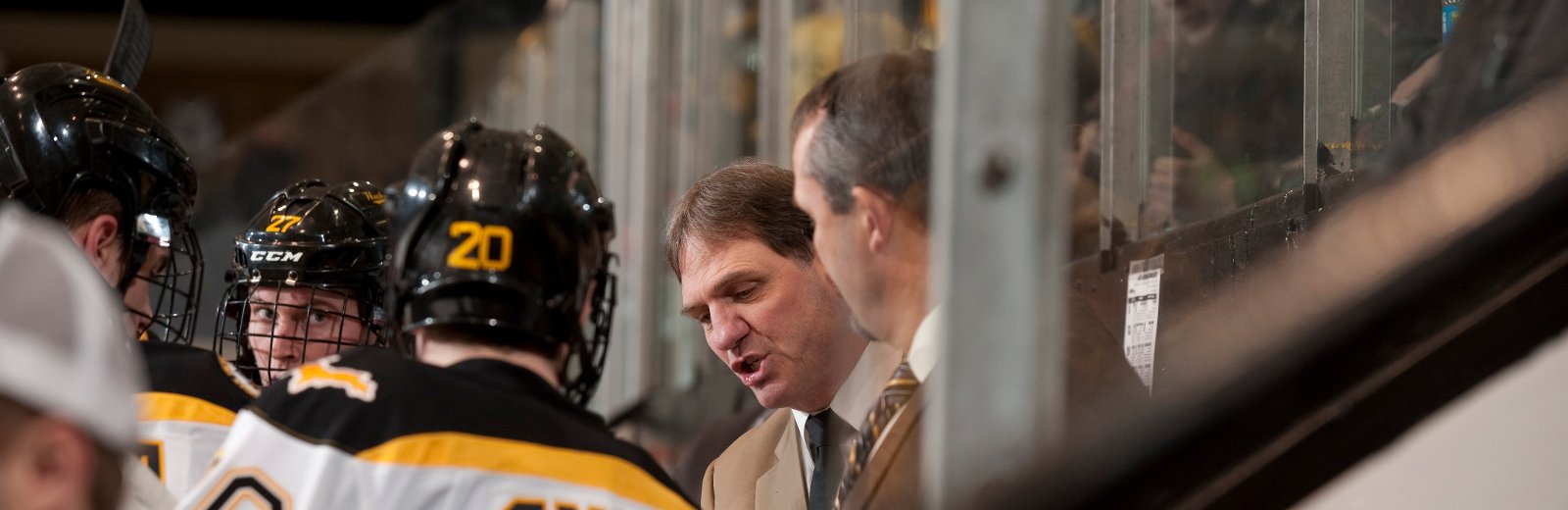

Bill Muckalt was named Michigan Tech's 23rd head hockey coach last May. The Huskies welcomed him back to Tech, where he served as an assistant coach from 2011 to 2015.
Muckalt grew up in Surrey, British Columbia. He won a pair of NCAA championships at the University of Michigan as a student-athlete before playing five years and 256 games in the National Hockey League. He has since held various coaching and managing positions with teams in the NCAA, the Western States Hockey League, the North American Hockey League, and the United States Hockey League. In 2024-25, prior to returning to Michigan Tech, he was head coach at Lindenwood University.
With 63 NCAA Division I head coaching jobs out there, what makes the one at Michigan
Tech so desirable?
BM: The tradition of excellence in this program is incredible. From an academic standpoint,
Michigan Tech has such a great reputation. We're an R1 institution and have expanded to be so much more than just an engineering school, with the business
programs and all the other great degrees. The commitment level from President Koubek on down is important. We have a great alumni base, and we know our student-athletes
are going to go into the real world and be set up for success.
What's your coaching style?
BM: I think we're in the entertainment business. I want to be offensive and score goals.
I want to play fast, I want us to be quick, and I want us to play good transition
hockey. We want to be rock-solid defensively, and the better we play defensively,
the more time we can spend in the offensive zone. I want to be disciplined and be
a group that plays for each other and plays for the name on the front of the jersey
and not the back of the jersey.
Has your coaching style changed at your various jobs?
BM: It can vary with the skill set of your roster, but it stays the same for the most
part: the culture, the growth mindset, and the process. As coaches, we're building
people or growing people. How you communicate and connect with players is really important.
You probably wanted to be an NHL player forever. When did you decide that coaching
was going to be your next path?
BM: I think when the injuries and surgeries started to pile up, I knew I couldn't be
the player I wanted to be anymore. I had about 15 surgeries on my neck, both shoulders,
right knee, and left hand, which was very humbling. I took time away from the game
and then started to help with Eastern Michigan's club team. I really fell in love
with those kids and was excited to be around the game again. I started wanting to
help kids grow, and I found I had a passion for that. It wasn't about me anymore;
it was about helping others and leading others.
What's your job on the bench on game days?
BM: The tradition is for the head coach to run the forward lines. I also share a lot
of information with my assistant coaches, and we discuss a lot internally. I'm really
just trying to have a pulse on the group and understand what the message needs to
be and what we need to have success.
What are the goals of this job leading the Huskies?
BM: I'm well aware of the program's rich history and tradition. Our goal is to win the
MacNaughton Cup, win our league, get into the NCAA tournament, and ultimately win
a national championship. We're also building and growing men. We talk about the National
Hockey League, and we talk about setting our student-athletes up for success as husbands,
as fathers, and as leaders in the community. That's what success will look like for
me.
Who is your biggest career influence?
BM: I've been lucky to have so many people in my life to help me. Brian Barrett, my coach
in junior hockey, was a big influence. I got some good life lessons from my dad and
my uncle to get me to go to college to play hockey. Red Berenson and Mel Pearson,
and some NHL coaches I played for. I would even say my college classmates Marty Turco
and Chris Fox really had an impact on me.
How is your partner Jolie adjusting to the UP and the snow?
BM: Oh, she loves it. She fit right into the community. I think she's been so impressed
with the people we've met or reconnected with. She loves the outdoors and the four
seasons. We are both really enjoying being up here.
Who's the most famous person in your phone contact list?
BM: Oh, boy. I don't know. A lot of people in the hockey world, for sure.
How many text messages do you think you get a day?
BM: Depends. When we're winning, I get a lot. I had about 500 the day I was hired at
Tech, and it took me many days to get back to everyone.
What's your favorite UP restaurant that you guys frequent?
BM: Fitzgerald's in Eagle River, and we've been liking the new La Catrina in Houghton.
Where's your favorite place to watch a hockey game?
BM: I love the energy in the Mac. I love the environment with our band and our fans.
It's a special place and as good as any hockey arena.
Who was your favorite NHL team growing up?
BM: The Calgary Flames were my favorite team growing up, and then the Red Wings when
I got to college in the late '90s. They were so good, and being around Detroit was
pretty exciting then.
And did you have a favorite NHL player?
BM: My favorite players were Lanny McDonald, Brett Hull, and Steve Yzerman.
What's your favorite sport to watch or pay attention to other than hockey?
BM: Golf.
And your favorite non-sport TV show?
BM: Right now, it's probably Landman or Mayor of Kingstown. I enjoyed Yellowstone, too.
Do you have a guilty pleasure?
BM: I love great food.
What's a meal from Chef Muckalt?
BM: Honestly, I love to cook, and I'm not a one-trick pony anymore. I used to be just
steak, but I've progressed. My cooking is kind of like hockey. I can't just make something
halfway. I gotta push all the chips in and make it the best I can. I'm probably a
little obsessive-compulsive in that area.
Do you have a specific pregame ritual?
BM: I was really superstitious as a player, but now I just try and get a quick pregame
nap.
Michigan Technological University is an R1 public research university founded in 1885 in Houghton, and is home to nearly 7,500 students from more than 60 countries around the world. Consistently ranked among the best universities in the country for return on investment, Michigan's flagship technological university offers more than 185 undergraduate and graduate degree programs in science, technology, engineering, mathematics, computing, forestry, business, health professions, robotics, psychology, social sciences, humanities, and the arts. The rural campus is situated just miles from Lake Superior in Michigan's Upper Peninsula, offering year-round opportunities for outdoor adventure.