
A degree from Michigan Tech can land you the career of your dreams. Just ask these alumni.
Ben Stelzer '15 | NBA Video Coordinator
by Wes Frahm
When Ben Stelzer '15 earned NCAA Division II All-America status his senior season for Michigan Tech men's basketball, there was good reason to believe it would be the pinnacle of his basketball career. Turns out, he was just getting started.

During his four years at Michigan Tech, the six-foot-one guard from Manitowoc, Wisconsin, helped the Huskies to 80 wins against 38 losses. As a junior, he led the team to its first NCAA Regional final in 2013-14. The next year, he followed up with All-America and Academic All-America honors, averaging 22.1 points per game and finishing second nationally in three-pointers made per game.
After graduation, Stelzer took an opportunity to play professionally in Spain's second-division league, Leyma Basquet Coruna, where he led the league in total three-pointers made. A stress fracture in his foot ended his playing career after one pro season.
Stelzer launched a coaching career and quickly built an enviable resume: two years as an assistant to Josh Buettner at Michigan Tech, helping the Huskies to a regular-season conference title and a tournament runner-up finish; two years at the University of Wisconsin-Oshkosh, winning an NCAA Division III national title; one year working in player development with the Dallas Mavericks of the National Basketball Association; and two seasons with the Golden State Warriors' G League affiliate in Santa Cruz, California.
In September, Stelzer became head video coordinator for the Warriors, a team trying to prove its dynasty isn't over. Four championships in the last 10 years have made head coach Steve Kerr and guard Stephen Curry household names. Stelzer is in charge of editing video from every game and practice for the coaching staff. He supervises a small staff, travels with the team, sits in every coach and player meeting, and even spends time on the court helping with player development.
"The first time I came into the practice facility, it was surreal to see the players," says Stelzer. "As a smaller guard, I grew up studying Stephen Curry and trying to model my game after his."
"It's a dream opportunity," he says. "To be with so many great coaches every day who have spent their lives doing basketball, my learning curve is really steep right now. It's awesome."
Megan Baker '15 | Snarge Inspector
by Jordan Shawhan
How exactly does an airplane strike a deer while flying at 30,000 feet? Ask Megan Baker. For the 2015 wildlife ecology and management alumna, questions like that are all part of the job.

As an airport wildlife biologist with SES Environmental Resource Solutions, Baker works to reduce the risk of bird and wildlife strikes to military aircraft through the US Department of Defense's Bird/Wildlife Aircraft Strike Hazard (BASH) program. She travels to US Air National Guard bases across the country, where she reviews and rewrites wildlife management plans, conducts ground and aerial tours, and provides training for both biologists and military personnel. The role is a unique blend of ecology, aviation, and detective work—and she wouldn't have it any other way. A self-described extrovert and problem-solver, Baker loves the people side of her work just as much as the wildlife.
"I love going to unique places and building off my experiences, networking with the people there, and creating connections so we can all do our jobs better," she says.
To determine the cause of a collision, Baker's work often begins with a clue called snarge: the biological remains left on an airplane after an animal strike. Scraped off the aircraft, these traces are sent to the Smithsonian Institution's Feather Identification Lab in Washington, DC. There, feather fragments, blood, and tissue are analyzed to determine which species were involved. Then it's up to Baker to figure out what really happened.
While birds are always the biggest concern, Baker says every location presents a unique challenge.
"In Alaska, we were dealing with moose and bear. Out west there are pronghorn. I've even been to Puerto Rico, where they have issues with giant lizards and mongoose. So wherever I go, it's like, 'What's the problem here?'"
In one memorable case, answering that question meant getting to the bottom of an alleged deer strike at 30,000 feet above sea level. While the initial snarge report caused quite a stir, additional testing eventually revealed the real culprit—a vulture that had just finished lunch.
"I love to travel, so the job is a natural fit," says Baker. "I'm also big into wildlife, so I get to go birding everywhere I go and add to my life list. It's a dream job, 100 percent."
Dan Green '12 | Spacesuit Design Engineer
by Morgan Laajala
Some kids want to be astronauts when they grow up. Others want to be engineers. Dan Green '12 is living the best of both worlds, designing specialized suits that enable safe human travel to the moon and beyond.
Green's passion for the space industry began at Michigan Tech, where he majored in mechanical engineering, minored in psychology, and was an Aerospace Enterprise team member. After taking first place in the University Nanosat 6 competition, the Aerospace Enterprise earned a contract to build the Oculus-ASR satellite, which was launched on SpaceX Falcon Heavy in June 2019. Though Green had already graduated, he was able to travel to Florida to celebrate the launch with fellow Aerospace Enterprise students and alumni.
"The Aerospace Enterprise began my passion and focus into aerospace, and space specifically," he said. "I was interested not just in space, but in human space flight and exploration."
After earning his master's in aerospace engineering from the University of Colorado Boulder in 2014, Green found his current position as a design engineer at David Clark, where he works on a small team in the aerospace life support systems division to build space suits. In his 10 years at the company, the majority of Green's work has been on two projects: Starliner suits for Boeing and Orion Crew Survival System (OCSS) suits for NASA.
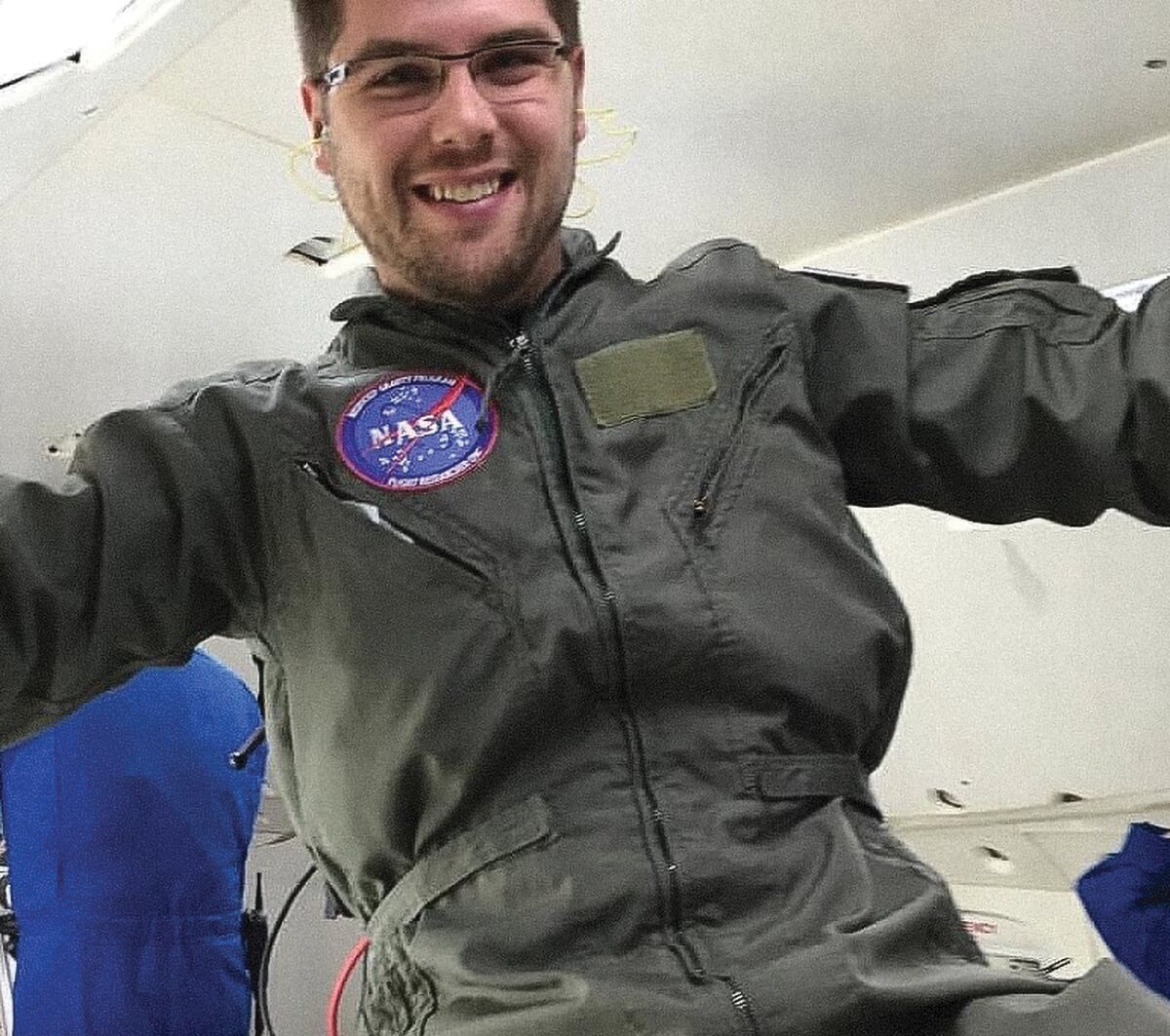
As a design engineer, Green is involved in all steps of the suit-building process, from development to manufacturing to testing. He has even had the opportunity to test out the suits in real-life scenarios before making iterations and improvements. To test the OCSS suits, Green took a ride on a parabolic flight—also known as the "vomit comet"—and experienced zero gravity.
Now, the David Clark team is focusing on NASA's Artemis II mission, which will send four astronauts around the moon. They are also building the boots for the next walk on the moon.
"It's really rewarding to have these experiences," Green says. "There just aren't a lot of places where you can do this work, be involved with all aspects of multiple different suits, have a direct impact on the space program, and be at the forefront of our human exploration program. This is definitely a dream job."
Send us details about your dream job or that of a Husky you know at alumni@mtu.edu.
Michigan Technological University is an R1 public research university founded in 1885 in Houghton, and is home to nearly 7,500 students from more than 60 countries around the world. Consistently ranked among the best universities in the country for return on investment, Michigan's flagship technological university offers more than 185 undergraduate and graduate degree programs in science and technology, engineering, computing, forestry, business, health professions, humanities, mathematics, social sciences, and the arts. The rural campus is situated just miles from Lake Superior in Michigan's Upper Peninsula, offering year-round opportunities for outdoor adventure.