
Assess Structural Risks Before Disasters Strike.
Earthquakes, high winds, and heavy snow can place significant stress on buildings, bridges, and other infrastructure. Understanding how structures respond to these forces is essential to designing safer, more resilient communities.
Hazard analysis is a specialized area of structural engineering that examines how natural hazards and environmental loads affect buildings and infrastructure. Engineers use analytical and computational methods to evaluate structural performance, identify vulnerabilities, and inform decisions about design, construction, and improvements to existing structures.
Michigan Tech's Online Hazard Analysis Graduate Certificate helps you develop the technical skills to assess structural risks, evaluate the effects of environmental loads, and contribute to safer, more resilient infrastructure.
Who is This Certificate For?
This certificate is designed for structural and civil engineering professionals who want to understand how buildings and infrastructure respond to hazards. It is especially relevant to those assessing wind, snow, earthquake, and other environmental loads as part of structural design, risk analysis, or resilience planning.
What You'll Study
In this online hazard analysis certificate, you will master the basics of performance-based design. In addition, you will study large deformation effects, post-yield behavior, non-standard geometries, and unusual geometries; as well as analyze loads from wind, snow, and earthquake ground motion.
You will take one required course: Probabilistic Analysis and Reliability (CEE 5730). Then, choose two more courses to master specific skills within the hazard analysis process.
When planning your program, remember to check class availability at the course registration page.
Required Course
Additional Courses (Choose Two)
Lay the Foundation For Future Graduate Study.
Our certificate in hazard analysis was created to help aspiring professionals like you build a strong foundation upon which to advance your career.
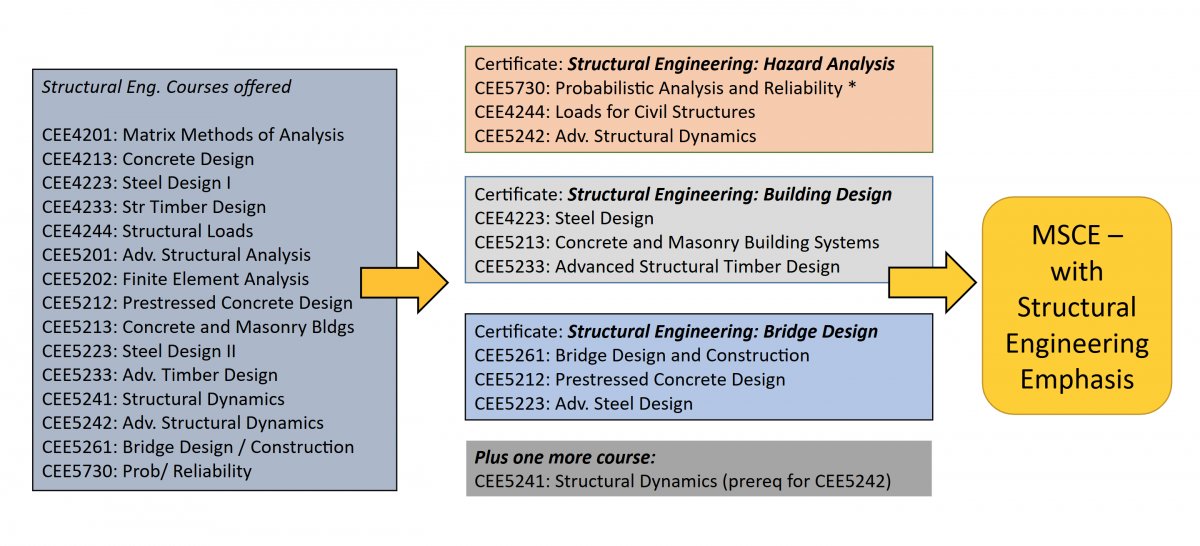
But you can also continue learning, using this certificate to launch into graduate studies. That is, you can stack this certificate with other structural engineering certificates to build a customizable master's degree. You graduate not only with a master's degree but also three focused credentials.
For instance, the chart below demonstrates how you can build your advanced degree from one required course and three structural engineering certificates: Bridge Analysis and Design, Hazard Analysis, and Building Design. Alternatively, you could combine your hazard analysis certificate with another two certificates; there are four from which you can choose.
Where You'll Apply Your Skills
The field of hazard analysis and risk assessment is a growing career path for structural engineers interested in applying their knowledge of engineering to protecting structures and infrastructure from environmental loads, natural catastrophes, and severe weather.
Structural engineers with hazard analysis expertise succeed in a wide range of settings and career paths.
Possible Career Paths
- Safety engineer
- Risk assessment specialist
- Risk engineer
- Inspector
- Reliability engineer
- Design engineer
Get Started on Your Online Hazard Analysis Certificate.
Take the next step on your educational journey at Michigan Tech. We are here to answer your questions and help you succeed in your online program. Reach out when you're ready. Or start our free and fast online graduate application.