
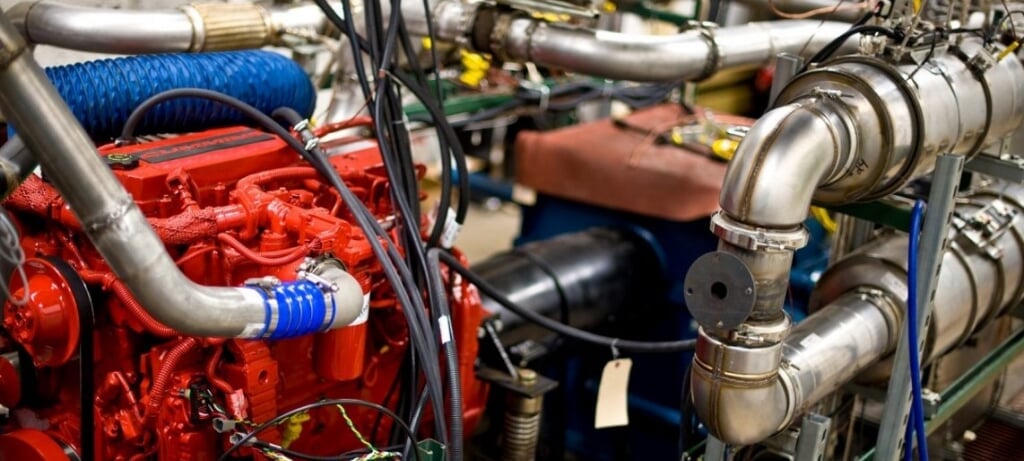
Improve IC Engine Performance and Emissions Control.
From heavy-duty trucks and agricultural machinery to shipping fleets, aviation, and power generation, internal combustion engines STILL remain indispensable to both global infrastructure and mobility. Although electric and hybrid vehicles are on the rise, IC engines continue to dominate industries where durability, energy density, and refueling speed are critical.
The future, then, isn’t about internal combustion engine versus electric vehicle; it’s about integration. Even in hybrid electric vehicles (HEVs), IC Engines remain the backbone of extended range and efficiency, making them central to the transition toward cleaner transportation.

Webinar on MTU's Online IC Engine Systems Certificate.
Michigan Tech's Online Internal Combustion Engine Systems Certificate helps you develop the advanced knowledge of internal combustion engines used in transportation, equipment, and power applications. Examine ways to improve engine operation, efficiency, and emissions performance as propulsion technologies evolve.
Who is This Certificate For?
This certificate is designed for engineers and technically prepared professionals who work with, or want to deepen their knowledge of, internal combustion engine systems. It's particularly relevant to those in transportation, heavy equipment, power generation, and related industries involved in engine design, combustion optimization, fuel delivery, controls and calibration, emissions reduction, testing and diagnostics, modeling and simulation, and systems integration.
It is also ideal for those who want to stack this certificate with others from the MAE department, such as Automotive Systems and Controls, in order to build a customizable master's degree in Mechanical Engineering
What You'll Study
To complete your certificate, you'll enroll in 6 credits of required courses and 3 credits of electives. This compact certificate can fit around the demands of your life, your job, and your other responsibilities.
In your courses, expect a mix of lectures, applied problem-solving, and hands-on analysis activities designed for working professionals. You’ll engage with faculty through structured learning modules and practical assignments that connect theory to industry-relevant engine challenges, technological innovations, and national and global trends.
By the end of the certificate, you’ll be able to
- Analyze engine thermodynamics and cycle performance to identify efficiency gains
- Evaluate trade-offs across power, fuel economy, emissions, durability, and cost
- Apply core concepts in air handling, fueling, combustion, and heat transfer to real systems
- Interpret engine test data to support calibration, diagnostics, and optimization decisions
- Explain how IC Engine tech fits into hybrid powertrains and emerging low-carbon strategies
Required Courses
- Internal Combustion for Engine Systems II (Spring 2026)
- Thermodynamics for Engine Systems (Fall 2026)
Electives
Consult with your advisor to complete your certificate with three credits of electives. Choose from courses in several topics, such as the following:
- Advanced Power Train Instrumentation
- Engine Control Systems (Spark Ignition and Diesel)
- Exhaust Aftertreatment
- Experimental Methods
- Fundamentals of IC Engines
When choosing your courses and electives, though, always remember to check the course registration page for the availability of classes.
Why Michigan Tech?
Work With Esteemed Faculty With a Wealth of Engine Expertise.
Michigan Tech’s IC engine courses are delivered by an expert instructional team who
have decades of development knowledge, research, and innovation in internal combustion
engines, as well as a wealth of diverse industry experience. All are MAE faculty who
have deep connections to APS LABS. Learn from Dr. Jeffrey Naber, Dr. Andrea Strzelec, Dr. Scott A. Miers, and Rick Davis, MSME.
Join One of MTU's Strongest Departments.
By pursuing this online certificate, you will be joining the largest department and
the biggest academic community at Michigan Tech. The Mechanical and Aerospace Engineering Department, which comprises nearly one-fourth of the entire university student population, is
home to innovative, cross-disciplinary research.
Start Learning About Internal Combustion Engine Systems.
Take the next steps on your educational journey at Michigan Tech. We are here to answer your questions and to help you succeed in your online program. Hit the buttons below to tell us more about you. Or begin the FREE online application process right away!