Some kids want to be an astronaut when they grow up. Others want to be an engineer. Dan Green ‘12 is living the best of both worlds, designing space suits that enable safe travel to space and beyond.
Green always knew that he wanted to be an engineer. Following in the footsteps of his dad (Kevin Green ‘84), he chose to pursue mechanical engineering at his top school, Michigan Tech.

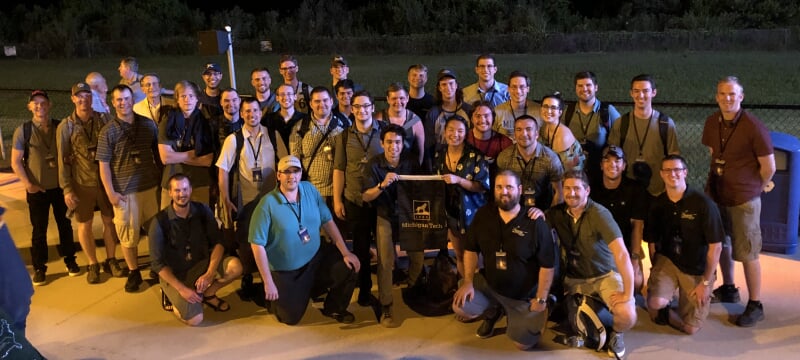
Green’s passion for the space industry began in the Aerospace Enterprise at Michigan Tech. He joined in fall 2010 and was on the team to build Oculus-ASR (a nanosatellite designed to improve the US Department of Defense’s ability to track objects in space more efficiently). Along with fellow students and advisor L. Brad King, Green traveled to Albuquerque, New Mexico, for the University Nanosat 6 competition, where Michigan Tech took first place and earned a contract to prepare the satellite for launch. The satellite was launched on SpaceX Falcon Heavy from Cape Canaveral Pad 39A in June 2019. While Green had already graduated at the time, he was able to travel to Florida to celebrate the launch among current students, fellow alumni, and King.
In addition to his mechanical engineering degree, Green pursued a psychology minor. He took two human factors courses—one through the engineering program and the other through the psychology department—which piqued his interest in human performance and human factors.
“The Aerospace Enterprise began my passion and focus on aerospace, and space specifically,” he said. “I was interested in, not just space, but in human space flight and human exploration.”
After graduating from Tech, Green received his master’s in aerospace engineering from the University of Colorado Boulder in 2014. An internship at Sierra Nevada Corporation turned into a full-time job, until he found his current position as a design engineer at David Clark in spring 2015, where he works among a small team in the aerospace life support systems division to build space suits.

As a design engineer, Green is involved in all steps of the suit-building process from the beginning to the very end. From development to manufacturing to testing, David Clark prides itself on doing the majority of the process in-house. But developing these suits is no quick or easy task. In the 10 years that Green has been at David Clark, he has spent the majority of his time working on two projects: Starliner suits for Boeing and Orion Crew Survival System (OCSS) suits for NASA.
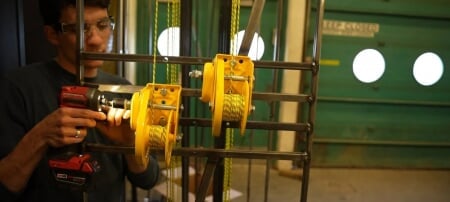
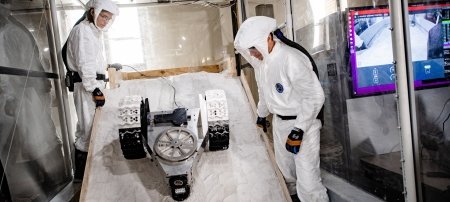
“I focus more on hard goods,” said Green. “So I’ll design some of the hardware, make prototypes and drawings, have the suit made, and then we’ll try it out to see how it works. It helps us to get in the suits to feel what it is like, where things aren’t quite right, and where we need to make adjustments.”
After testing, the team makes iterations based on what they learned and continues to provide support for the suits well into production and even during the launch. After delivering Boeing’s Starliner suits for the Crew Flight Test mission, Green had the opportunity to travel to Florida and suit up Butch Wilmore and Suni Williams—an experience he will always remember.
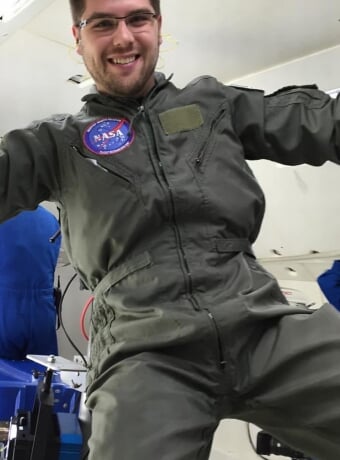
Another unique experience for Green happened during the testing period of the OCSS suits. He got to take a ride on a parabolic flight (otherwise known as the “vomit comet”) in Houston and experience zero gravity.
“It’s really rewarding to have these experiences, like going to Florida to suit up the crew or working with astronauts,” Green said. “We have a direct impact on the space program and human exploration. Being involved with these missions of going to the moon, or potentially going further than that in the future, is really exciting for me.”
The David Clark team will continue to work with NASA to prepare for the Orion flight that will take place early next year. Now, they are focusing on the Artemis II mission, which will send four astronauts around the moon. They are also building the boots for the next walk on the moon.
“This is definitely a dream job,” Green said. “There just aren’t a lot of places where you can do this work, be involved with all aspects of multiple different suits, and be at the forefront of our human exploration program.”
While Green is already living a dream designing the suits that enable human exploration, his impact on the space program is far from over. Perhaps one day, he won’t just send astronauts into orbit… he will be one himself.
April 10, 2026
Michigan Technological University is an R1 public research university founded in 1885 in Houghton, and is home to nearly 7,500 students from more than 60 countries around the world. Consistently ranked among the best universities in the country for return on investment, Michigan's flagship technological university offers more than 185 undergraduate and graduate degree programs in science, technology, engineering, mathematics, computing, forestry, business, health professions, robotics, psychology, social sciences, humanities, and the arts. The rural campus is situated just miles from Lake Superior in Michigan's Upper Peninsula, offering year-round opportunities for outdoor adventure.