Michigan Tech faculty are developing a microbe-fueled power supply system that could keep ocean sensors in the water longer with fewer maintenance stops.
Underwater sensors need battery power. When the batteries die, somebody has to replace them, which can be expensive and difficult. Michigan Technological University researchers are developing a self-refueling power supply for underwater sensors that converts dissolved organic matter and microscopic forms of marine biomass into electrical power. Amy Marcarelli, a distinguished professor of biological sciences at Michigan Tech, is the principal investigator on the project, funded under the Defense Advanced Research Projects Agency (DARPA) BioLogical Undersea Energy (BLUE) program.
"There are increasing deployments of all kinds of sensors in the marine environment for observing ecological conditions, organism migrations, and acoustics relevant to naval defense," said Marcarelli. "Almost all run on batteries, which have to be replaced."
Some sensing units can run on wave energy, but those devices have to be near the ocean's surface. The goal of BLUE power supplies is to enable high-capability, long-endurance ocean-deployed sensor systems that self-refuel while fully submerged, without human maintenance, using organic material already in the ocean's water column. The technology used by the DARPA BLUE team is called a microbial fuel cell, referred to as an MFC.
"The basic idea is that microbes move electrons around during their metabolic processes," said Marcarelli. "In a microbial fuel cell, those processes transfer electrons from an anode to a cathode, creating an electrical current we can harness."
Optimal Biobattery, Suboptimal Environment
Microbial fuel cells are typically used in environments with high nutrient and organic matter concentrations, such as wastewater treatment plants, where microbes have ample material to metabolize. In the ocean's water column, where most aquatic sensors must travel, there is far less organic matter and far more oxygen, creating challenges the DARPA BLUE program is designed to address.
The scope of this DARPA BLUE team encompasses seven co-principal investigators across four different universities — Michigan Tech, Ohio State University, University of Maryland and University of North Texas — and 28 researchers, students and technicians.
"When oxygen is around, that's what microbes use to accept electrons during cellular respiration, because they get the most energy from the process that way. We're trying to build a microbial fuel cell that will work in an environment that isn't very conducive to the operation of microbial fuel cells," said Marcarelli.
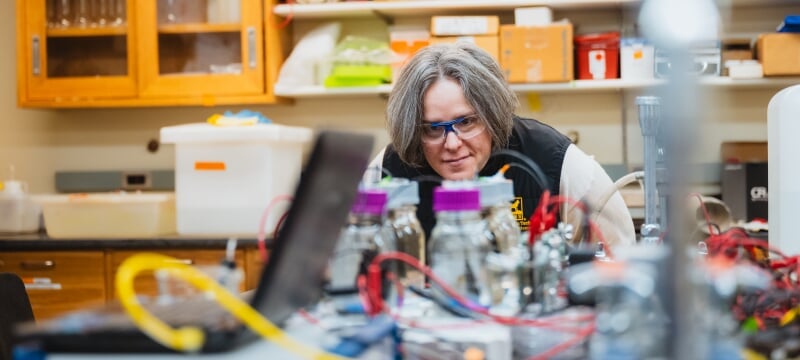
To overcome that, Marcarelli and her team need a way to concentrate organic material from the water column and limit oxygen introduction into the MFC. Jennifer Becker, co-principal investigator on the project and Michigan Tech associate professor with an affiliation in biological sciences, led her team in designing and constructing a robust microbial fuel cell that could be sustained in the marine environment. A key aspect of this design is providing the microbes with what she called "a richer meal."
Becker, who is primarily an associate professor of civil, environmental, and geospatial engineering, said even in a functioning microbial fuel cell, collecting enough energy from the marine water to make the system effective is a challenge.
"There's just only so much energy you can extract out of a microbial fuel cell," said Becker. "The microbes need to take a lot of the energy that is generated, or they won't be able to grow, and the whole thing won't work. So we can only harvest the energy that is left over by the microbes."
The team tackled their goal with a unique innovation on a tried-and-true water treatment method. Their microbial fuel cells use granulated activated carbon (GAC) as a substrate to passively concentrate organic material that passes through the system, while also giving microbes a place to grow.
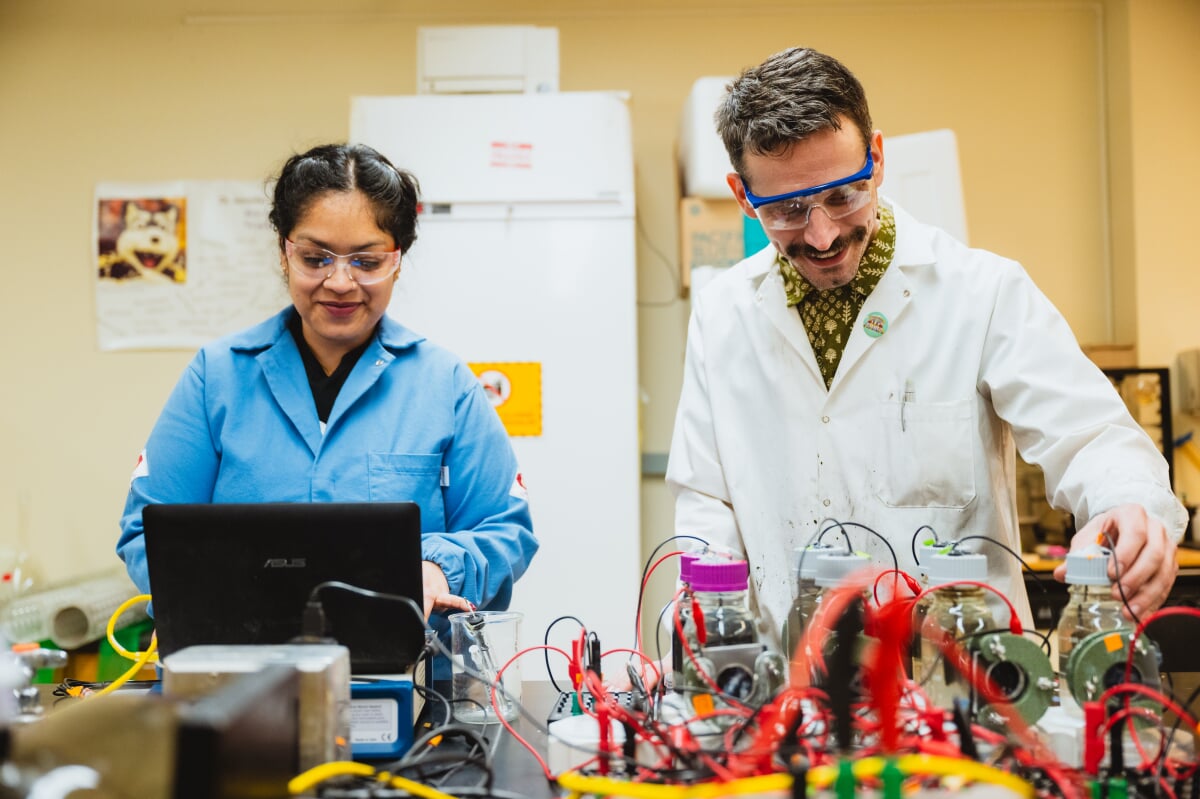
"These microbes like to grow in biofilms. When they form a biofilm on the activated carbon, even if the fuel cell is oxygenated, the microbes will have anoxic conditions where they can carry out the metabolic processes that are related to energy generation," said Marcarelli.
The GAC is placed inside a tubular MFC with an inner anode and an exterior cathode, where bacteria convert the metabolic energy in organic matter into electrical energy, or current. The tube also has check valves at either end to control water flow through the MFC.
In their original concept, the team planned to explore using tidal currents to push water flow through the device. They reached out to Gordon Parker, Michigan Tech's John and Cathi Drake Endowed Chair in Mechanical Engineering, for his expertise in dynamic system modeling and control.
In theory, using tidal currents to flow water through the MFCs would be more efficient than pumps. To test this method, Parker built a machine to simulate tides in the University's wave tank. Ultimately, the team found pumps to be more reliable.
"If we were able to generate the necessary power in that sort of rarefied environment where we have complete control over the flow and when, and how much water we flow through the MFC, then there's a chance we could use the tidal occurrence in the future," said Parker. "But if we couldn't do that in that rarefied environment, there's no way we'd be able to do that in a less controlled environment using less predictable tidal energy."
As the project pivoted away from tides, Parker and the wave tank remained a valuable asset for testing prototypes for leaks before bringing them out into open water. Among his other areas of expertise, working with the wave tank has made Parker an expert in fixing leaks — a skill set he brought to the MFC units' rescue several times.
"The biggest thing that I think I've contributed is a willingness to help and to come up with solutions to odd problems," said Parker. "Progress is made incrementally and with a lot of work. I've worked on tons of projects over the years, both here and elsewhere, and this is one of the best teams I've ever seen."
Controlling the flow with pumps gives the microbes a measured, predictable amount of time to consume organic matter and generate energy before the water is pumped out and replaced. The team found that the oxygen present in marine water causes the MFC power output to drop sharply when the water is pumped in and then climb again as the oxygen is depleted. This "sawtooth pattern" has a negative impact on the average power production from the MFC.
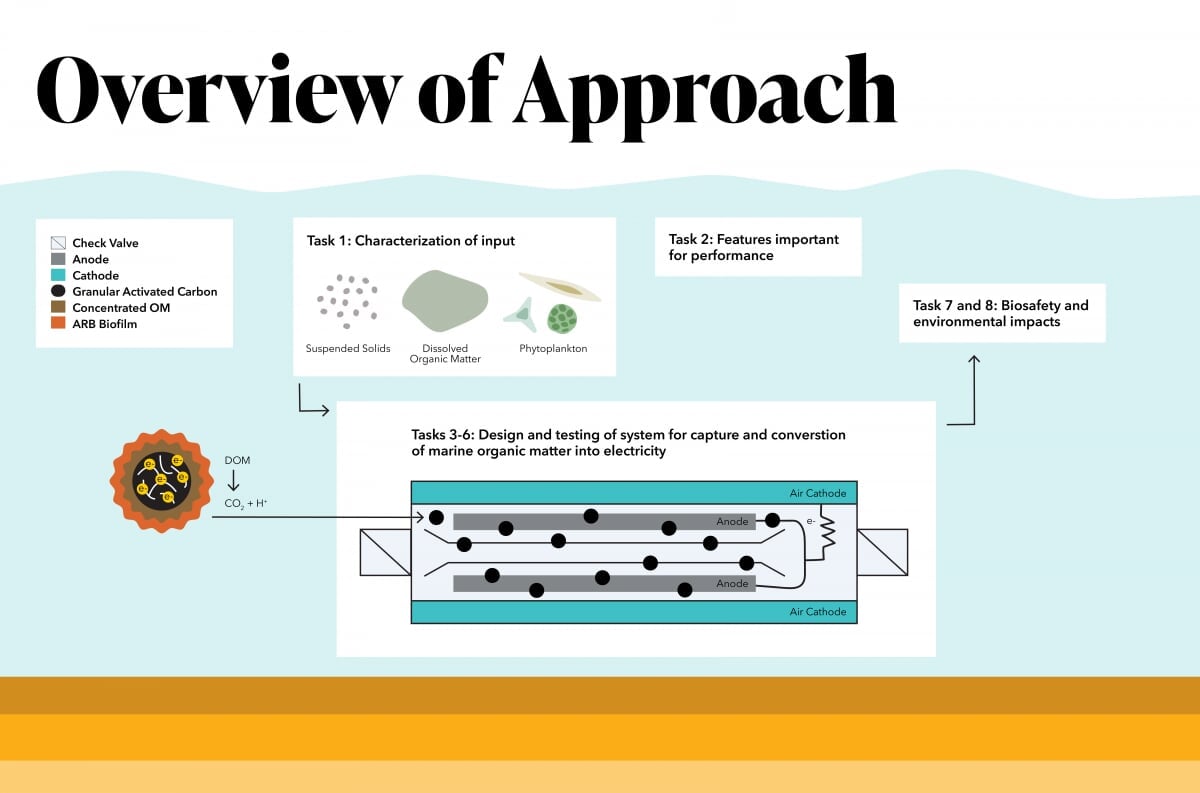
Granulated activated carbon shows itself to be the MVP of MFCs once again with its ability to absorb electrons — or act as a capacitor. The team designed the system to bring the GAC in and out of the circuit, so that as electrons build up in the carbon, they can be discharged into the MFC, creating additional current. If those electrons are successfully discharged during pumping events, the hope is that it will help level off power production, counteracting the sawtooth dips.
"We actually have demonstrated this, and this is one of the reasons why DARPA funded our project," said Becker. "The amount of energy that you can extract from any MFC is pretty small and restricted by the voltage of these systems. So we have to maximize current, which is a key component of power production."
Though the GAC has shown to be an effective method, small adjustments can make a big impact on the cell's output. Too much of a good thing can also hinder the batteries' efficiency.
"We found out through trial and error to some extent, and then through careful modeling and experimentation, that, in some cases, we were adding so much GAC that it was taking up all of the organic matter from the seawater and leaving nothing for the microbes," said Becker.
Keeping the Ocean Out
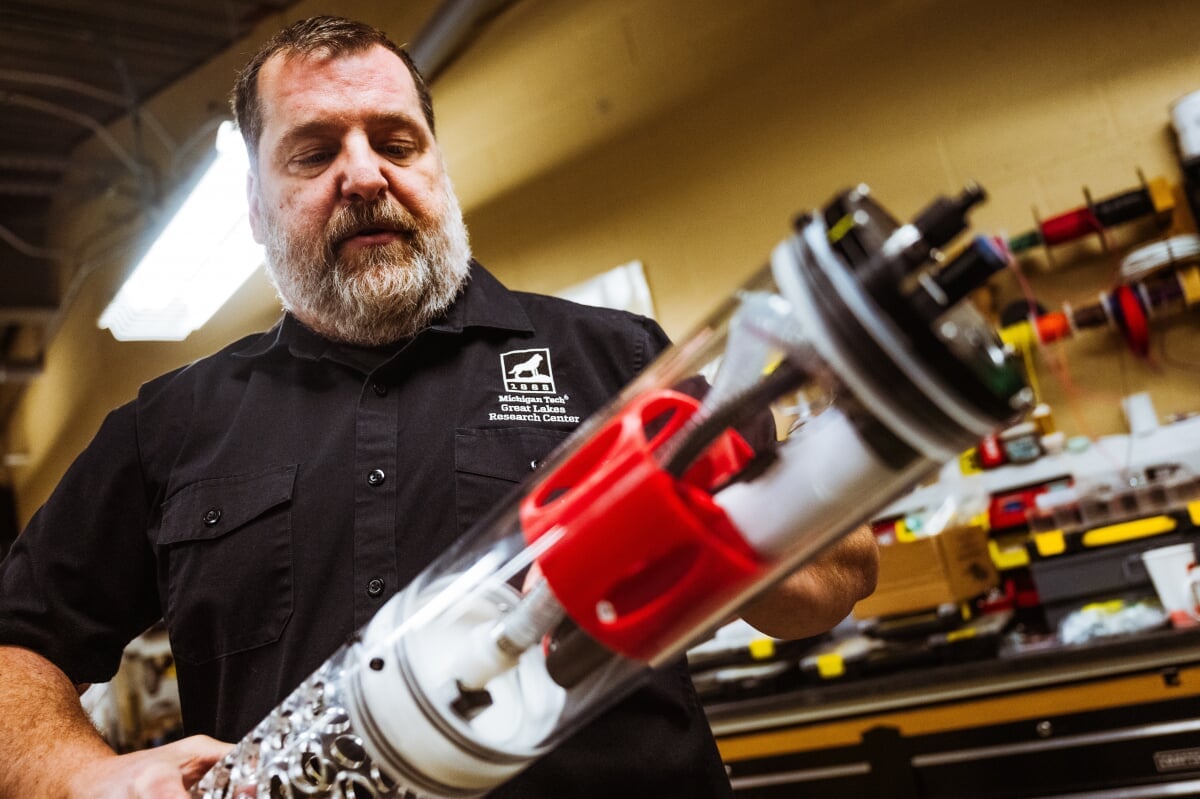
The design has gone through many iterations. The entire system is a delicate balance of pumps, flow meters, waterproof casing, microelectronics, software and biology. Jamey Anderson, assistant director of marine operations at Michigan Tech's Great Lakes Research Center (GLRC), has led the marine engineering team that's designing and assembling components to Becker's specifications. After initial deployment, Anderson's team redesigned the units to increase the microbial fuel cell's power efficiency.
"We're measuring the MFC's power output," said Anderson, "but we're also measuring how much power we're consuming to help it create power in the first place."
Parker assisted with sourcing custom-made parts for the redesign from local business Calumet Machine.
"Finding the local machine tool company that could poke five hundred holes in each one of those tubes was kind of amazing," said Parker. "It required knowing what needed to be done and getting ahold of the right people."
While the environment inside the fuel cell is crucial to its success, so is the environment outside it.
"There's a big part of this that is the survivability of these systems in the ocean," said Anderson. "Our system is a combination of custom-machined and off-the-shelf components. In the end, we need to keep seawater out and keep them happy, dry and functioning."
The MFC must resist water pressure, saltwater corrosion and unwanted invading ocean life — all while achieving maximum efficiency. The team built in preventative measures for these concerns. Some are as simple as using a plastic washer or covering screws with a waterproof PTFE (polytetrafluoroethylene) gel. Others are more strategic, like providing sacrificial anodes that will corrode before the more essential components.
"This is the work that teams on the oceans have always done for a hundred years," said Anderson. "We're doing a lot of early legwork and preparation to make sure that we're stopping or at least really slowing down those issues."
Anderson's team also has to account for a stress point that is a GLRC specialty: getting the unit in and out of the water safely. That means protecting both the equipment and the people deploying and recovering it. The 500-plus-pound units will be put over the side in about 30 feet of water. If any unit is damaged on deployment, the integrity of its functionality could be compromised.
"We want to take all of this technology and get it into a nice, safe package that's easy when we hand it over to the federal government," said Anderson. "We want to make deployment and recovery as simple and straightforward for them as possible."
The robust undersea microorganism-based power plant constructed by the DARPA BLUE team can only be successful if the right microbes — bacteria that can extract energy from organic matter and transfer electrons — are actively growing in the MFC. In an ideal scenario, the device would be placed in an aquatic environment and naturally colonized by bacteria native to the region. However, realistically, that colonization will need a head start.
Cultivating Biosafe Solutions
Choosing which microbes to cultivate in prototype MFCs requires environmental observation, data collection and a keen eye on biosafety. Potential fuel for the device includes anything in the water column less than one millimeter in size, dissolved or particulate, with no discrimination between phytoplankton, zooplankton and other organic matter.
"We know that the device is going to operate differently based on environmental conditions like temperature and the availability of organic material. We're working on environmental observation through quarterly sampling to sample all of the different organic materials in the water column that we think could fuel the device," said Marcarelli.
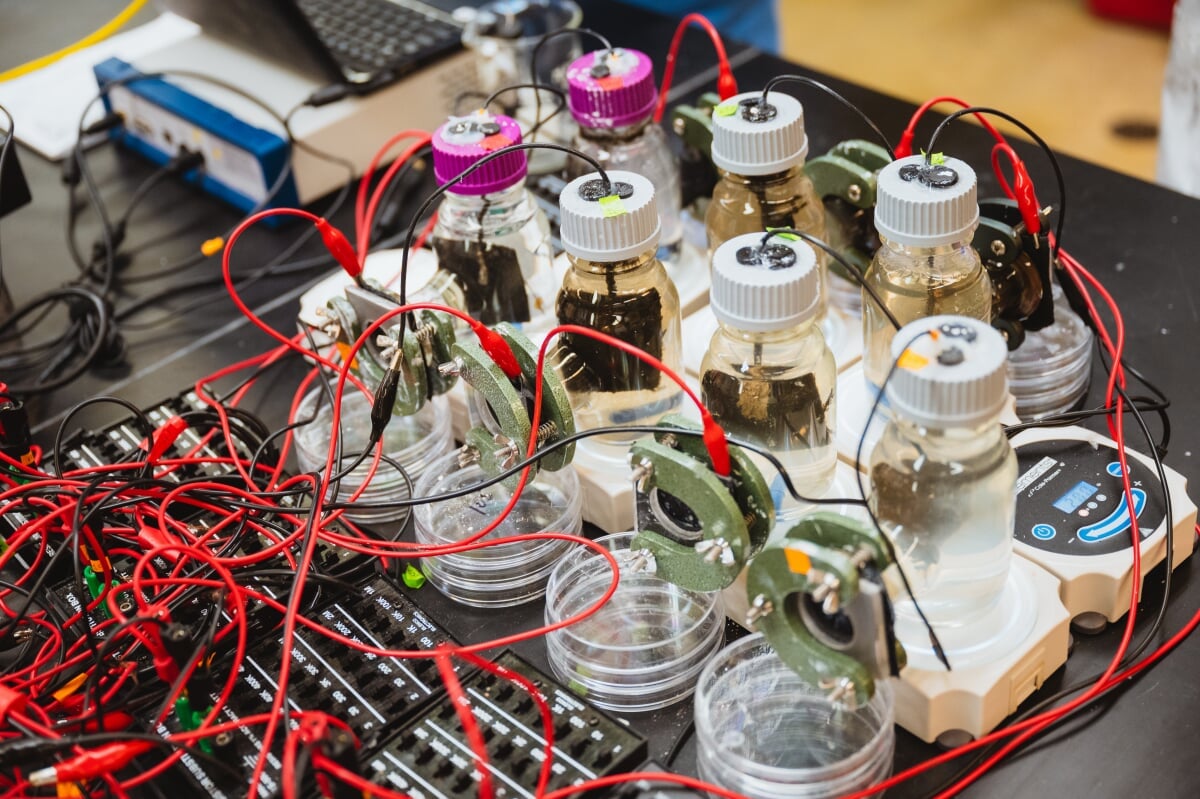
Test sites are in two target locations: the Chesapeake Bay on the east coast of the U.S. and Galveston Bay on the upper Texas coast. The bays were chosen because observational and historical data are readily available for both locations. The team compared that information to the more detailed data from their sampling and tests. Former MTU faculty member Steve Techtmann, now a professor at Ohio State University, is also a co-principal investigator on the project, leading the team in search of the best microbes for their needs.
Having two predetermined deployment sites also helps narrow down microbial candidates and eliminate biosafety concerns. Since the power supply's function requires water flow through its internal systems, the design must avoid spreading microbes that would be invasive in those environments. Techtmann's team is culturing and testing microbes native to each bay. Those best suited to generating electricity in an MFC will be intentionally colonized within the BLUE power system. Since the microbes will only be reintroduced to the same ecosystem they came from, biosafety concerns for the design are minimal.
Early lab testing of cultivated microorganisms in the MFCs and their efficiency in generating power in the cells were largely promising, and the first test deployment took place in November 2025.
From Prototype to Projection
The second portion of the project is building a prototype to demonstrate the MFC's ability to generate power over long periods of time while fully submerged. The team's first prototypes dedicated 30 liters to the MFCs and 15 liters to electronics control systems and monitors. The initial deployment and submersion test was in Chesapeake Bay. For 30 days, the cells successfully produced energy, and the control and deployment systems functioned as the team had hoped.
The latest round of prototype cells is more modular and stackable into units. Each cell in a unit now has its own pump to move water through the fuel cell and an independent control board. The team also scaled back the system to use less power. These changes resulted in a three-foot-long fuel cell with a one-foot-long control tube.
Marcarelli said the team is confident in their current system design and is now making small adjustments to the system's operations to get as much power as possible. Four of the redesigned units were deployed for a short submersion test in Galveston Bay. Three of them have been producing power very well, though one behaved differently, providing an opportunity to learn about how anode and GAC design parameters could alter MFC performance.
Once the four units return, the researchers will make adjustments and set their sights on deploying a 10-microbial-fuel-cell system in Chesapeake Bay for a month, starting in mid-May. Data from environmental observations and both month-long deployments will be used to project performance over a year-long deployment, thanks to data science experts at the Michigan Tech Research Institute (MTRI), led by co-principal investigator Michael Sayers, one of the institute's chief research scientists.
"What we're really doing on our end is combining remote sensing assets, field data, experimental lab data and then actual MFC deployment experiments," said Sayers. "We're using that data to understand where in the world's coastal ocean environment these types of devices could be deployed and successfully generate the power output that the end user would ultimately want."
Fortunately for the MTRI team, there is an abundance of remote sensing records available on where and when the type of organic matter used by the fuel cells will be available. Sayer and his team are building sophisticated statistical models that can forecast where and when fuel will occur.
"We're using historical observations and then putting them into this methodology, so maybe we can look forward six months to a year at a particular location to see if the conditions will be ripe for the MFC to generate the power that the end user needs," said Sayers.
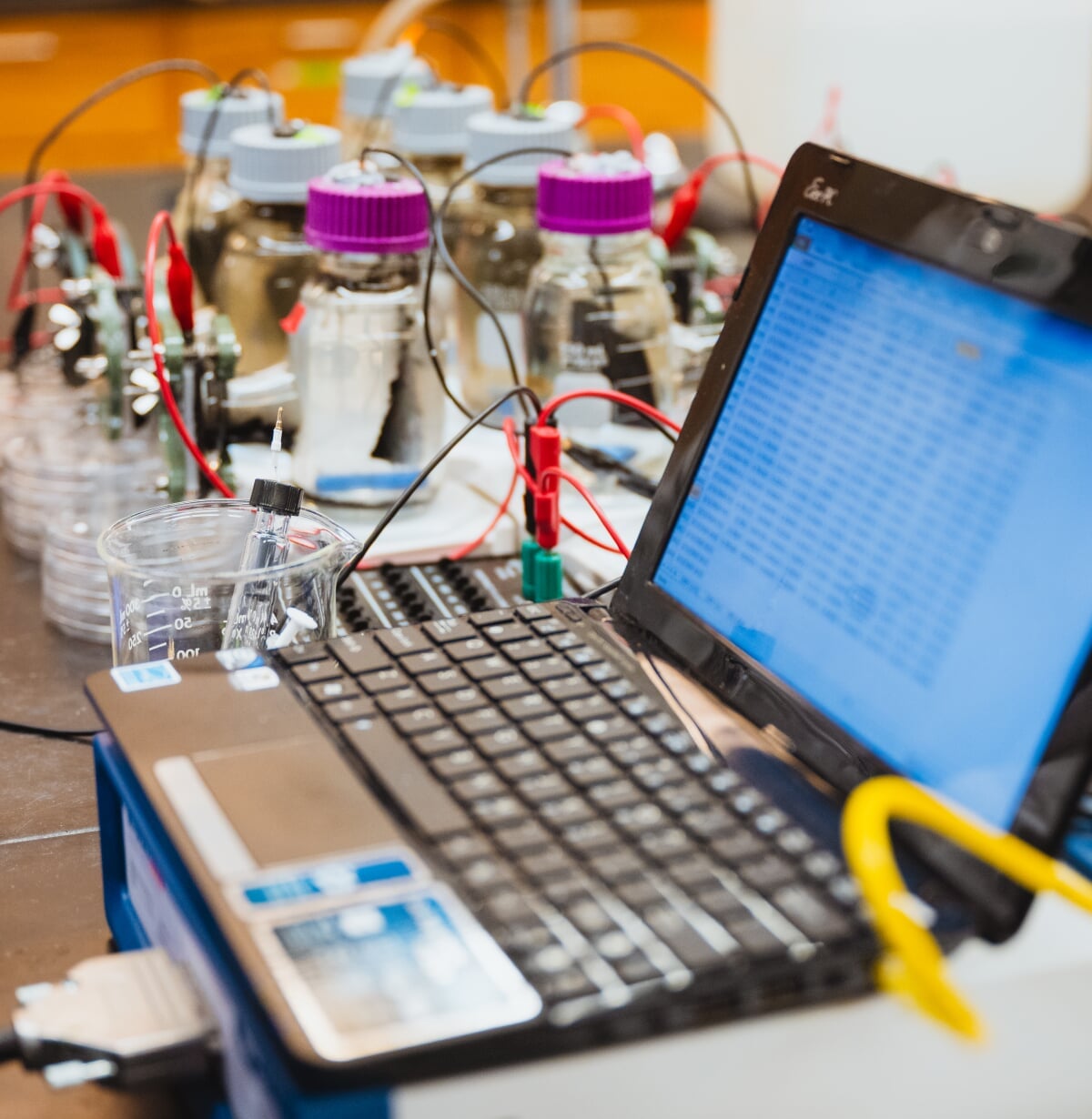
The projection models, part of the team's final product, are a unique asset among the research teams across the nation participating in DARPA BLUE. It's an aspect of the project that has evolved as rapidly and in as many tiny adjustments as the biological, mechanical and electrical components.
"You think in your mind of a giant equation of all these different pieces — at the end of it is 'equals power,'" said Sayers. "We're constantly adjusting to new parameters and thinking about how to input them and which variables are important. As the system changes, the predictive model changes."
Though keeping continuity and synergy across teams to create these predictive models is a challenge, the concerted effort takes the team's contribution to the DARPA BLUE program to the next level.
"The idea of a system we can put on a boat and, with Mike's projections and remote sensing guidance, take 10,000 places in the world, put it over the side and know that power is available is a game-changer," said Anderson.
The scope of the project encompasses seven co-principal investigators across four different universities — Michigan Tech, Ohio State University, University of Maryland and University of North Texas — and 28 researchers, students and technicians. As Marcarelli notes, that's a lot of people and teams in different locations, solving different pieces of a complex problem, all within a two-year timeline. Building a cohesive system with that many moving parts has taken high levels of communication, collaboration and coordination.
"The challenge with so many labs and universities is keeping everyone rowing in the same direction at a rapid pace," said Marcarelli. "It's very different from anything I've ever worked on, but I've learned so much. It's been super cool to work on such a complex project."
The end result is an achievement for the team, the program and the future of microbial fuel cell research.
"Hitting the power metrics DARPA asked for in 22 months is a near-impossible task for all the teams, including ours," said Anderson. "But it's stretching that way that gets us to the advances we have in that time. I have to imagine DARPA is going to be thrilled with the strides in science, engineering and remote sensing."
Michigan Technological University is an R1 public research university founded in 1885 in Houghton, and is home to nearly 7,500 students from more than 60 countries around the world. Consistently ranked among the best universities in the country for return on investment, Michigan's flagship technological university offers more than 185 undergraduate and graduate degree programs in science, technology, engineering, mathematics, computing, forestry, business, health professions, robotics, psychology, social sciences, humanities, and the arts. The rural campus is situated just miles from Lake Superior in Michigan's Upper Peninsula, offering year-round opportunities for outdoor adventure.