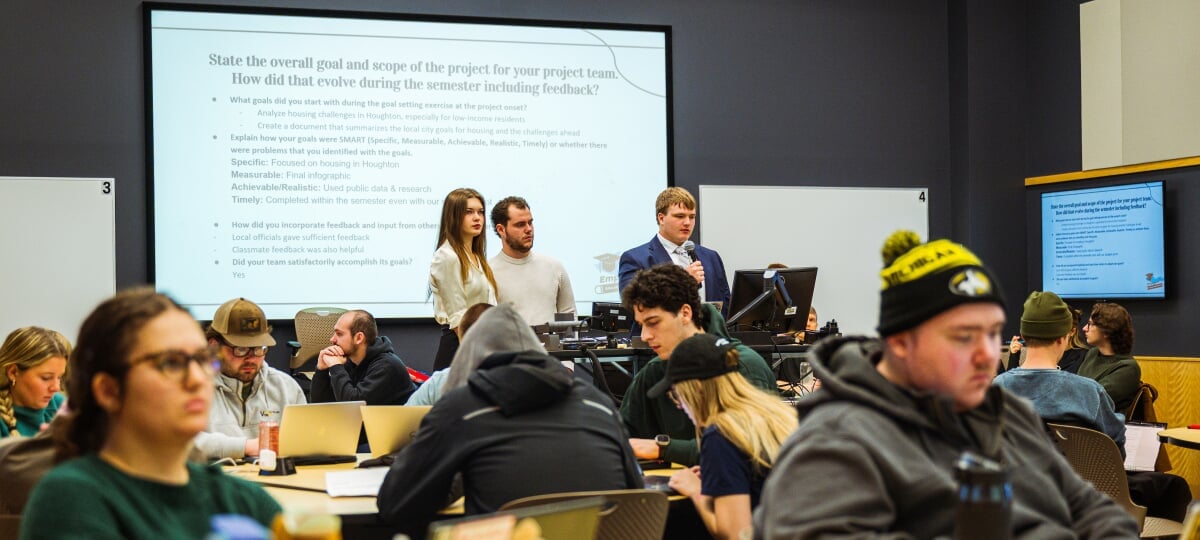
Michigan Tech's EmpowerUP program is only five years old but has involved nearly 700 Huskies in community-engaged research. This year, the program received national recognition for its civic engagement and community service.
What started with two curious, caring and community-focused business students at Michigan Technological University has evolved into a multiyear, multipartner ecosystem. Known as EmpowerUP, the research-in-action program was nationally recognized this spring as a 2026 winner of Insight Into Academia magazine's Civic Engagement and Community Service Award.
All research begins with a question. Undergraduate students Jada Markham and Anderson Lind approached their Michigan Tech College of Business instructor Jonathan Leinonen five years ago with theirs: How could they explore community-engaged research?
They went to the right person. Part of Leinonen's teaching philosophy involves working with entrepreneurial and economic development groups in the region. At the time, the Michigan Tech alumnus, teaching professor in management and assistant dean of the College was collaborating with the Copper Shores Community Health Foundation (CSCHF) on research for what is now known as Copper Shores Bridges, an initiative to help under-resourced people in the western Upper Peninsula.
Leinonen remembers it as a "chocolate and peanut butter" moment.
Nationally Recognized
EmpowerUP received the 2026 Civic Engagement and Community Service Award from Insight Into Academia magazine for its innovative service and deep community collaboration. It was featured in the April 2026 issue of the magazine alongside 51 other nationwide winners.
"The 2026 winners represent institutions whose efforts are making a measurable difference in the lives of the people and communities they serve, and beyond. They understand that their responsibility extends beyond the campus walls, reaching into the neighborhoods, cities, and regions that surround them and into society's broader democratic and social fabric," the magazine noted.
"I saw the Bridges program originators had another piece of the initiative called 'Engaging and Equipping Under-Resourced College Students,'" he said. "I thought, 'We can put this together and make something.' So the students did that first research project, came up with some recommendations for what we could continue to look at and work on, and it's grown from there."
Research, as it so often does, has revealed layers of complexity and new considerations rather than quick solutions to long-standing problems. Markham and Lind's preliminary work established a roadmap of unmet community needs in financial literacy, resource access and institutional communication. They didn't know it, but they were creating the framework for an enduring student research project with a direct effect on both Michigan Tech's campus and the local community.
Over the next five years, the initial study recommendations were woven into Leinonen's Team Dynamics and Decision-Making course. The curriculum he developed for the course, which is open to students in all majors and disciplines, also tapped into his experience with Kern Entrepreneurial Engineering Network's (KEEN) Engineering Unleashed program, where he was named a fellow in 2021.
Leinonen said the success of EmpowerUP demonstrates the "long fuse" of research. As
anyone who understands the scientific method can attest, true progress is most often incremental and gradual. EmpowerUP was an
investment designed to yield dividends over time. The benefits, he said, go both ways.
In industry, communication and teamwork are often described as "soft skills," but
Leinonen — a teaching professor drawing on 20 years of global industry experience
— views these as essential, high-level professional competencies.
He said EmpowerUP projects are designed to be difficult. Students are placed in teams where goals aren't strictly defined, forcing them to navigate the messy reality of stakeholder feedback, teamwork and implementation.
"They're taking a project that I don't define well for them. The projects are intentionally friction-intense so students can work through the dynamics," said Leinonen.

"This isn't about me lecturing, it's about trying to get students engaged in the community."
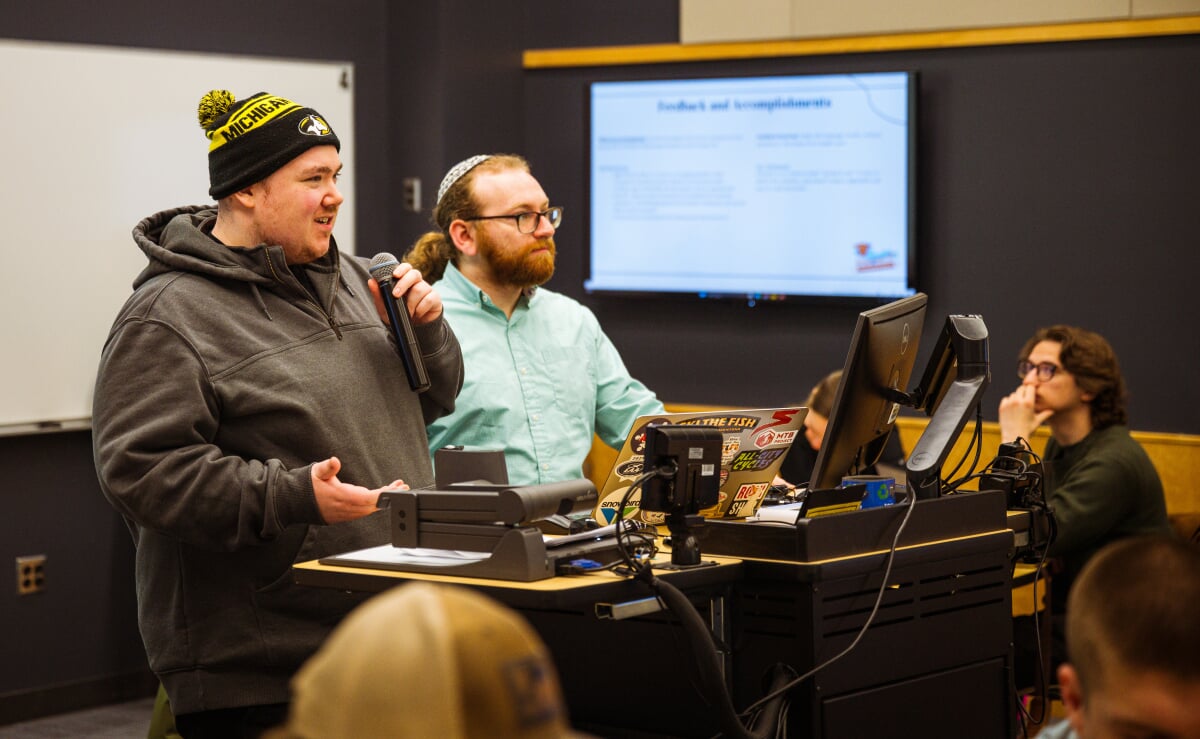
Even the program's final presentations are designed to sharpen Huskies' real-world skills.
"One of the goals that I have for them is to become more comfortable in their public speaking, recognizing that that's one of the greatest fears of people in general," said Leinonen. "And that ties right into civic engagement. I hold them accountable to work on projects that are going to get publicized and promoted."
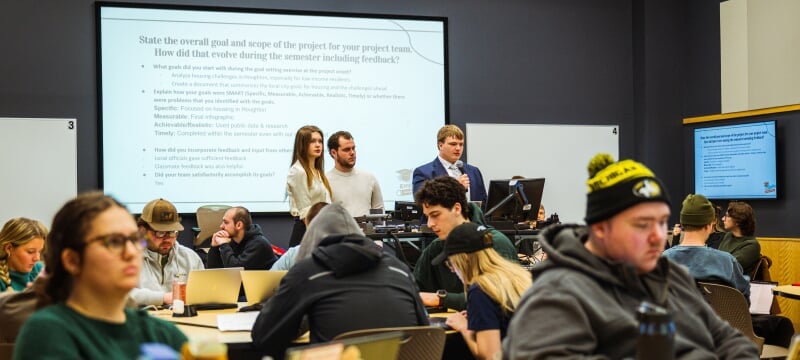
Each semester wraps with students presenting their findings, complete with deliverables, key performance indicators, details on snags they encountered, recommendations for future action and what grade they would give themselves.
From a professional standpoint, Leinonen knows the power of being able to formulate and express concepts clearly. "When I was working in industry, my first job that I had out of Michigan Tech was working for a guy who told me, 'Jon, you have great ideas. You just need to make more recommendations.' That's stuck with me," he said.
Through EmpowerUP, MTU students learn that civic engagement isn't about easy fixes or implementing temporary solutions. While the projects are diverse, all are centered on creating a lasting impact through deliverables that future EmpowerUP members are able to build on.
Tangible Outcomes for the Western UP
The variety of student-led EmpowerUP initiatives in development at Tech showcases the breadth of the program's reach. Current EmpowerUP projects touch on topics including:
Financial Literacy and Accessibility
Students developed an "Insurance Basics" micro-website to distill complex financial topics into accessible guidance. Using action-oriented language, they created a tool for families, veterans and individuals working toward financial stability.
Food Security and Systems Thinking
A team from Michigan Tech's Husky Food Access Network (HuskyFAN) focused on the University's food pantry. Recognizing that many community members are uncertain about how the pantry operates, the team produced streamlined guides and visual instructions to improve clarity and reduce stigma. Students working on the project learned how small changes in communication influence whether someone gets the help they need.
STEM Mentorship and K-12 Outreach
The Saturday Morning Academy team provided programming in conjunction with Tech's Center for Educational Outreach that blended academic support with STEM exploration. Through interactive games and structured learning, EmpowerUP students served as role models for regional youth, helping them imagine future possibilities and building stronger connections between the community and Michigan Tech.
Strengthening the Innovation Pipeline
Entrepreneurship-focused teams are working with Patrick Woock, assistant teaching professor in entrepreneurship, to help revitalize the region's innovation ecosystem. The Collegiate Entrepreneurs Organization (CEO) team rebuilt a previously inactive student organization, establishing the recruitment and communication infrastructure necessary for its long-term survival. Meanwhile, the Husky Innovate team has been working to create repeatable professional development events, such as pitch workshops and networking sessions, to broaden access to entrepreneurial skill-building for all students.
A Signature Pillar of Accreditation
Beyond award-winning community engagement, Michigan Tech's EmpowerUP program tangibly demonstrates that the College of Business meets the Assurance of Learning standard required by its accrediting agency, the Association to Advance Collegiate Schools of Business. This standard requires evidence that a school's programs generate positive societal impact through initiatives aligned with its mission.
By capturing student reflections, project artifacts and community-validated outcomes, the College can document exactly how student learning contributes to regional stability and well-being. The program's model — built on stakeholder collaboration, feedback-driven design and sustainable handoff processes — allows it to adapt to new partners and emerging needs for years to come.
EmpowerUP continues to receive support from the Copper Shores Community Health Foundation, with its most recently awarded grant wrapping up this year. Additionally, Leinonen poured the $10,000 fellowship award he received from the KEEN organization's Engineering Unleashed program back into EmpowerUP. He's also located other micro-grants and is committed to continuing to find more resources to help the program grow in scale and scope.
For Leinonen, it's not just business. It's personal. "I was raised in the mindset of being specifically engaged and socially aware of what's going on in the community and taking some responsibility to use the gifts that I've got to help other people, too. So there's that kind of fundamental underpinning that goes with this," he said.
Leinonen doesn't expect every project to be successful coming out of the gate. He encourages out-of-the-box ideas to address community needs and student-driven initiatives. "I'm happy to work with students who have an idea, but aren't sure how to get it started," he said.
He found two student-initiated projects particularly interesting during the 2025-26 academic year. One sought to create information about hydroponic gardening systems as a resource for local schools. The other was an effort to assist with school funding for children in Zimbabwe.
Like the project that launched EmpowerUP, both projects were created from a Husky's desire to answer a community need.
Natasha Mwanandimayi, who is pursuing her master's degree in accounting and analytics, spearheaded the school funding project for Zimbabwe, her home country, where she completed her undergraduate degree work in accounting and finance in 2024.
"The most rewarding part of the project has been seeing an idea turn into something real. Setting up the social media accounts, building the website — seeing everything come together and become operational was very exciting for me," she said. "It gave me the feeling that I had actually created something that has the potential to make a difference."
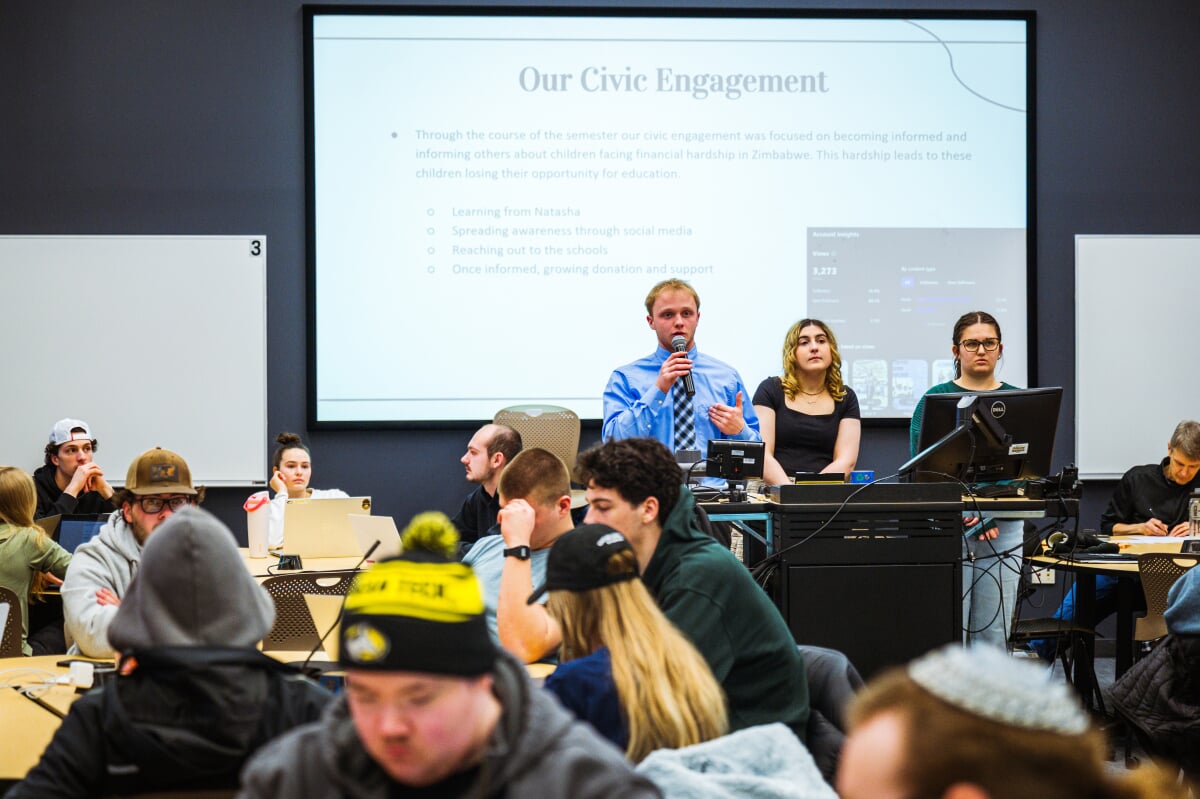
Mwanandimayi said the biggest challenge has been establishing the organization as a formal entity, including securing nonprofit status and setting up an institutional accounting and banking system. "There is still a lot for me to learn about that process, but it has also been a valuable part of the experience," she said. "Going forward, I hope to see the project grow into a sustainable organization that can have a real and lasting impact on children's lives in Zimbabwe."
Leinonen said the project is a first in EmpowerUP's history, broadening the definition of community.
"We're part of a global culture. Whether the project is down the road or around the world, it doesn't matter," said Leinonen. His goal is to get students thinking about how they can contribute to civic engagement and to help them discover both how daunting and how rewarding it can be.
As this spring's year-end projects reports showed, roadblocks are a reality that often can't be navigated in a single semester. But Leinonen said every group that shared insights found teachable moments in the obstacles. For example, students exploring the local housing ecosystem for renters and landlords learned the nuances of establishing relationships with area leaders in government, academia and philanthropic institutions.
Team member Sophie Valima, a forestry major, said one takeaway was understanding the importance of contacting stakeholders early in the process, to make coordinating meetings and information-gathering sessions easier.
Engineering management major Isaac Trockman is part of a two-person team examining how to improve limited access to home computing in the region, a project idea prompted by Timothy Keirnan, assistant teaching professor in humanities. Trockman said the potential unintended consequences that they encountered — such as the potential for increased e-waste that could be caused by asking people to donate computer equipment — helped to lay the groundwork for future Huskies to carry on the effort.
Leinonen sees endless possibilities for helping the program to grow, further bolstering the entrepreneurial ecosystem at Michigan Tech in ways that positively affect both the community and students.
"I have two sections of 30 students, and that's a lot already. But I would love to get more faculty involved and get some other projects coming from other areas that don't necessarily need to be threaded through me," he said. "The program can continue to grow and build more of a life of its own that way. We're investing in the long game."
In the here and now, Mwanandimayi recommends EmpowerUP and Leinonen's course to every student looking for a tangible way to make a difference.
"The course teaches you so much beyond the classroom, including project management, planning, problem-solving, and how to take an idea and actually bring it to life," she said. "For me, the most meaningful part was being able to build something from the ground up and give it life under Professor Jon's guidance. It was a very rewarding experience and I'm excited to see where the project goes from here."
Michigan Technological University is an R1 public research university founded in 1885 in Houghton, and is home to nearly 7,500 students from more than 60 countries around the world. Consistently ranked among the best universities in the country for return on investment, Michigan's flagship technological university offers more than 185 undergraduate and graduate degree programs in science, technology, engineering, mathematics, computing, forestry, business, health professions, robotics, psychology, social sciences, humanities, and the arts. The rural campus is situated just miles from Lake Superior in Michigan's Upper Peninsula, offering year-round opportunities for outdoor adventure.