
Michigan Tech's 2025-26 academic year is bringing long-awaited, impactful changes to the Department of Mechanical and Aerospace Engineering.
As MAE's inaugural class of first-year aerospace engineering majors begin their studies, the department remains committed to the same overall principles that have produced quality Michigan Tech engineering graduates for generations: a hands-on, practical education that produces productive engineers for the aerospace workforce, academia, and beyond.
Long before new and upgraded facilities became a reality this academic year, Michigan Tech was paving the way for the highly desired aerospace engineering program.
In fall 2024, the department—then the Department of Mechanical Engineering- Engineering Mechanics (ME-EM)—announced that the proposed degree program had finally cleared all the hurdles to make it official. Now, this fall, for the first time, Tech offers a Bachelor of Science in Aerospace Engineering.
Alongside the new major, and a minor in aerospace engineering started in 2014, the department's new name felt natural. Our transformation from ME-EM to MAE answered a persistent call from eager Michigan Tech faculty, students, and alumni, as well as prospective and current students.
For those working, teaching, studying, and researching in the department, a formally sanctioned concentration on aerospace came as no surprise. MAE has helped to develop and support faculty from the aerospace industry for decades, including researchers from NASA, SpaceX, and the US Air Force. Today, robust, award-winning research continues here at Tech through the Michigan Tech Aerospace Engineering Research Center (MARC), Planetary Surface Technology Development Lab (PSTDL), and Ion Space Propulsion (ISP) Lab.
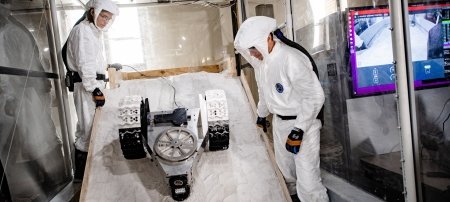
Mechanical engineering students have long pursued opportunities in aerospace engineering through Michigan Tech's Enterprise Program and Senior Design. Students in the Aerospace Enterprise developed a working satellite launched into orbit in 2019. Members of the Multiplanetary INnovation Enterprise (MINE) build, test, and compete with working lunar rovers in NASA's Lunabotics Challenge. And Enterprise's most recent addition, the AEronautics and Rocketry Enterprise (AERE), competed in the International Rocket Engineering Competition in the team's first year.
"Roughly 50 percent of all engineers working in the aerospace industry are mechanical engineers," said Associate Professor Paul van Susante, who holds the department's Lou and Herbert Wacker Professorship of Mechanical Engineering and serves as PSTDL director and MINE advisor. "Our department has always had the interest."
Gregory M. Odegard, University Professor and John O. Hallquist Endowed Chair in Computational Mechanics, has been at Michigan Tech for over 20 years. He joined Tech after working as a researcher at the NASA Langley Research Center, and much of his work today is supported by the federal agency.
"Since I joined Tech, our department has maintained a presence in aerospace through the Enterprise Program, the aerospace engineering minor, and related research," said Odegard.
Over the years, Tech's aerospace interest gained momentum while aerospace employment opportunities continued to grow at an above-average rate. MAE was primed to offer a premier aerospace program. The voices of prospective and current students clamoring for an aerospace engineering undergraduate degree specifically from Tech tipped the scale.
"For a while, aerospace engineering was the most requested program that we didn't have at Tech," said van Susante. "Now, we do."
"With the popularity of the aerospace engineering minor, countless questions and requests from prospective undergraduate students in recent years, and the University president's vision for increased undergraduate enrollment, we knew the time was perfect to develop the major," said Odegard.
The History of MAE
1927
Mechanical engineering (ME) program added.
1958
Department of Engineering Mechanics (EM) formed.
1970
ME and EM departments combine into the Department of Mechanical Engineering-Engineering Mechanics (ME-EM).
1971
Two Nike Apache sounding rockets launched from Keweenaw Missile Range, coordinated with other NASA North American facilities, to mark the International Geophysical Year. The Nike Apaches are by far the largest sounding rockets fired so far from the range. MTU and University of Michigan researchers collaborate on the project.
1971
R. L. Smith Building cornerstone set. ME-EM moves into "The MEEM" in 1972.
1999
MTU's Enterprise Program launches. Teams collaborate with clients from industry, communities, and government organizations, and work closely with a faculty advisor.
2002
Aerospace Enterprise formed by ME-EM faculty L. Brad King at students' request.
2013
Aerospace engineering minor approved by University Senate; first students enroll in 2014.
2014
Multiplanetary INnovation Enterprise (MINE) launched by ME-EM faculty Paul van Susante.
2017
Institute for Ultra-Strong Composites by Computational Design (US-COMP) awarded $15 million by NASA, with ME-EM faculty Greg Odegard as principal investigator. Its goal: Develop and deploy carbon nanotube-based ultrahigh-strength lightweight aerospace structural material within five years.
2018
Michigan Tech Aerospace Engineering Research Center (MARC) established.
2019
Michigan Tech's student-built Oculus-ASR nanosatellite rides the SpaceX Falcon Heavy from Cape Canaveral Pad 39A into orbit.
2021
A custom-built rectangular Dusty Thermal Vacuum Chamber (DTVAC) is added to faculty Paul van Susante's Planetary Surface Technology Development Lab. The facility is one of eight listed on NASA's ARES Dust Testing Facilities webpage.
2022
American Institute of Aeronautics and Astronautics (AIAA) student branch chartered at MTU.
2024
BS in Aerospace Engineering approved by University Senate. ME-EM officially becomes the Department of Mechanical and Aerospace Engineering (MAE).
2025
Michigan Tech welcomes inaugural class of first-year students majoring in aerospace engineering.
New Faces, New Spaces
As the department welcomes our first class of aerospace engineering students, key aspects of MAE's home base are getting an upgrade.
Built in 1972, the R. L. Smith Building is named after Michigan Tech's sixth president, Raymond L. Smith. It is the second-tallest building in Michigan's Upper Peninsula with 12 floors, more than 55,000 square feet of lab space, and multiple student learning centers.
While the Smith Building's longtime nickname of "The MEEM" no longer fits after the department's name change, the new aerospace engineering degree program is bringing major renovations to the venerable campus landmark. Work began on the building's 11th floor this year to create a new, welcoming environment for both mechanical engineering and aerospace engineering students alike.
Complete with glass-walled labs with state-of-the-art equipment, there are also classroom spaces for the department's signature practicum courses, including the new Spacecraft Engineering Practice course. The addition of a student collaboration center on the 11th floor highlights the department's continued focus on preparing students for their work in team-based industries.
The 11th floor also includes a brand-new laboratory aligned with a new course in electric propulsion. The Electric Propulsion Lab will support ground, air, and marine vehicle development in a first-of-its-kind facility on campus. Beyond coursework, renovations will support the department's healthy array of Enterprise offerings, with a new lab space dedicated to the MINE team.
Renovations, well underway, are continuing throughout the R. L. Smith Building. Spaces in the building's sub-basement that previously held engine test cells have been revamped for aerospace instruction and research. A working wind tunnel, jet engine testing laboratory, and rocket engine testing facility ensure a practical and comprehensive approach to aerospace engineering education.
The project doesn't neglect lecture spaces. Halls and classrooms that haven't been updated since the building's initial construction are getting a facelift. Two lecture halls on the first floor and two classrooms on the third floor will be renovated for instructional use.
The new spaces join the current state-of-the-art classrooms, centers, and laboratories in the MAE department, including wave tanks, robotics labs, machine shops, and more. Michigan Tech's longtime commitment to hands-on, practical education, as well as the University's recent classification as an R1 institution, highlight the need to regularly maintain and upgrade facilities to meet the needs of industry and academia.
Support for the renovations comes from both Michigan Tech and private donors in anticipation of the department's increased enrollment. That increase is now on the horizon.
"University administration has been very supportive of the department's renovations," said Jason R. Blough, distinguished professor and MAE chair. "The 30 percent increase in freshman deposits for the 2025-2026 academic year has justified that we have developed a highly sought-after and exciting new aerospace engineering program that is benefiting from the support it requires to be successful."
Support for the new program also comes in the form of accomplished, diverse, and talented faculty. With the advent of Michigan Tech's aerospace engineering program and the anticipated department enrollment increase, MAE expanded our faculty, with six tenure-track and two instructional-track faculty joining the department in fall 2025.
"This is very unusual to hire this many faculty in one year in any department nationwide!" said Blough. "It again shows the commitment from the dean of the College of Engineering, the provost, and the University administration."
Readying Curriculum for Takeoff
Building a program from the ground up takes time, even with dedicated, enthusiastic faculty and students. In addition to upgraded facilities, curricula needed to be built, with courses developed strategically to create a program that met rigorous guidelines and cleared all necessary administrative approvals.
Under the guidance of Jeffrey S. Allen, MAE associate chair and director of undergraduate studies, the faculty committee for curriculum development constructed a course of study that meets the current and anticipated needs of the aerospace industry as well as the caliber of a Michigan Tech engineering education.
The curriculum for Tech's bachelor's degree in aerospace engineering includes both new and established departmental courses. To develop the program's first new course, Principles of Aerospace Engineering, Assistant Professor Shawn Brueshaber—perhaps unsurprisingly—applied reverse engineering.
"We have this chain of classes, a sequence that we want the curriculum to follow," said Brueshaber. "We asked faculty, 'What skill sets and what knowledge do you want students to have before they enter your courses?' That informed what I needed to prepare students for."
With specified learning objectives in mind, Brueshaber was able to scaffold a course built from modules that will prepare aerospace engineering students for their future coursework. The course, designed to be taken by second-year students after they've taken the necessary prerequisite courses in mathematics and engineering principles, will introduce them to key aspects of the study of aeronautics and astronautics.
"With this particular course, it's a broad survey," said Brueshaber. "We are only going skin-deep on these subjects. Most of the modules for this course are themselves entire courses. We'll do a module on aerodynamics; that itself could be an entire course or courses."
Brueshaber's research focuses on atmospheric science on Earth and other planets as a member of NASA's Juno Science Team. However, his MS and PhD work in mechanical engineering at Western Michigan University was focused primarily on aerospace engineering. Designing the Principles of Aerospace Engineering course was a return to form.
"It's been a load of fun for me," he said. "I feel like I'm getting back to my roots."
Brueshaber will be the first instructor of the course, which he believes will set students up for long-term success at Tech.
"There'll be a lot of things that these students will walk out of this course knowing how to do, but they will also walk out with a lot of questions," said Brueshaber. "Those will be answered in future courses. That's part of the overall course of study for the aerospace engineering program."
His excitement for this field of study is as strong as our Huskies' excitement to pursue the new major.
"I'm really passionate about it," he said. "I can't wait to see how this program will expand."
Preparing the Productive Engineer
Hands-on experience is a Michigan Tech hallmark for every program, and MAE's aerospace engineering degree will be no exception.
Building off the success of our mechanical engineering undergraduate program, aerospace engineering students will engage in the same level of practice courses as their mechanical engineering counterparts. A suite of courses will weave together design, theory, and practical approaches across four semesters, along with two additional semesters of senior capstone courses.
These practice courses, custom-designed and taught by renowned MAE faculty, are unique to Michigan Tech. The value of that level of practical education can't be understated, said van Susante.
"We spend a lot of effort and resources to ensure that our students receive a strong, hands-on experience," said van Susante. "We do this because we are interested in the field, but we also want to provide good value to our students. We work with industry to understand what they are looking for in graduates. We have to make sure our students are ready for that."
In conjunction with programs like Enterprise and Senior Design, practice courses are integrated throughout the curriculum so that students have the opportunity to build and develop real skills on real projects over the years, rather than just in a single capstone course.
"By the time our students graduate, they already have experience in real engineering, so that once they are hired in industry, they can immediately participate and be productive," said van Susante.
Since joining the faculty in 2012, he's seen how eager MTU students are for practical applications in aerospace engineering. While teaching aerospace engineering courses for the minor, his courses have typically been over-enrolled.
"We only technically have 40 spots available, but I always accept everyone on the waitlist," van Susante said. "The last time I taught that class, we had over 80 students."
MAE faculty developed the coursework so students can hit the ground running as they begin their careers. Students want the same thing.
"That's a real value to our students," said van Susante. "Employers are really happy with the skills our students have and what they are capable of, which was how the curriculum was designed."
As the 2025-26 academic year began, enrollment was up for both aerospace and mechanical engineering students. Launching the new aerospace engineering program with renovated facilities, revitalized curriculum, and an expanded faculty, MAE is living up to the standard of excellence we are known for: industry-tested, practical education that prepares Husky engineers to shoot for the stars.
Michigan Technological University is an R1 public research university founded in 1885 in Houghton, and is home to nearly 7,500 students from more than 60 countries around the world. Consistently ranked among the best universities in the country for return on investment, Michigan's flagship technological university offers more than 185 undergraduate and graduate degree programs in science and technology, engineering, computing, forestry, business, health professions, humanities, mathematics, social sciences, and the arts. The rural campus is situated just miles from Lake Superior in Michigan's Upper Peninsula, offering year-round opportunities for outdoor adventure.